View agreement
Check how the same face, hairstyle and silhouette read from the requested angles. Do not accept contradictory views simply because each image looks attractive.


Decide which views, expressions, outfit details and colors belong on your reference sheet. Start by creating one approved base character, then request and inspect the references your project needs before carrying that design into a comic or webtoon.
Example reference-sheet brief
Workflow preview
Illustrative sheet layout
Requested views
inspect each reference
Approved identity
reuse across scenes
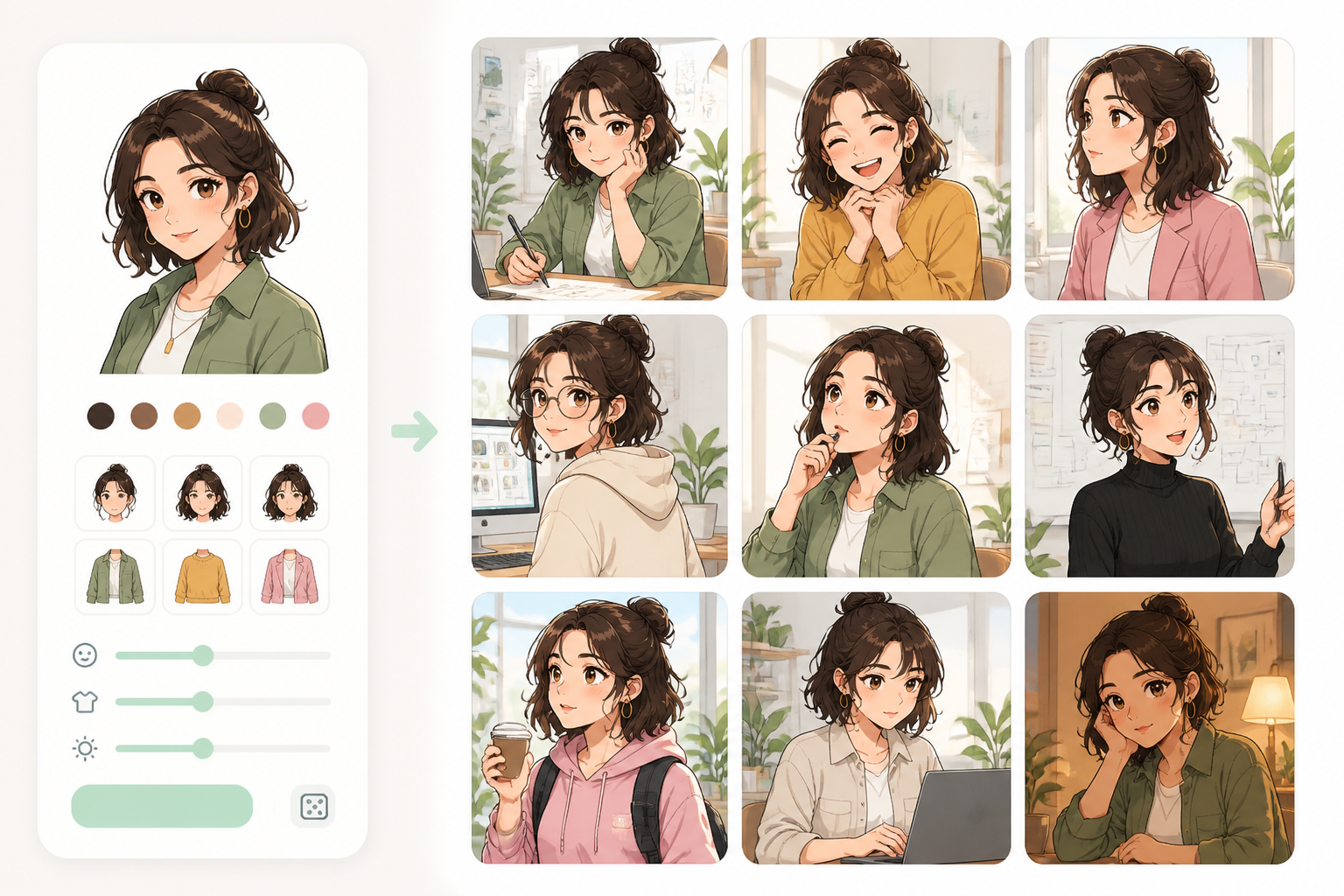
Choose the character’s face, hair, body, signature outfit, palette and asymmetric details. The creation button opens the guided studio to build that base character; it does not guarantee a finished multi-view sheet in one click.
Specify front, side or back views, important expressions and visible accessories. Keep the clothing and identity brief stable while changing the requested view; label intentional alternate outfits separately.
Compare face shape, hair silhouette, relative proportions, costume colors and left/right markings across views. Reject a mirrored satchel, changed fastening, extra limb or newly invented accessory before accepting the sheet.
Keep the approved references available for scene generation. Compare an establishing shot and close-up against the sheet; inspect the next page before treating the design as consistent across a sequence.
These labels describe a sheet brief and review criteria. The button opens the character studio; available views and final layout depend on the selected workflow and generated result.
Record the identity anchors, requested views, expressions and any deliberate outfit alternatives.
Approve only views that agree on identity. A reference sheet is not proof that future panels will remain identical.
A useful sheet removes specific doubts before the character appears in many scenes.
Check how the same face, hairstyle and silhouette read from the requested angles. Do not accept contradictory views simply because each image looks attractive.
Write LEFT or RIGHT for a scar, mechanical limb, sleeve patch or bag strap. Compare the actual images; text labels alone do not prove the side was preserved.
Keep a base outfit separate from a deliberate costume change. Record which details may change and which identity anchors must remain recognizable.
Reference
A rear view can clarify a coat or backpack; a profile can clarify the hair silhouette; expression studies can test the face at a different emotional angle. Request what the scene needs, then inspect the result rather than assuming a standardized turnaround.
Consistency
The separate consistency page publishes an original 8-character, 40-panel case, its first-pass failures and targeted repairs. That evidence concerns recurring panel identities; it is not a benchmark of automatic sheet layout or a promise that all views will match.
Workflow guide
Use this guide to plan and review the reference set. Start from a base character when you want guided sheet generation; use the consistency workflow to check how that design holds up in later panels.
Choose the character’s face, hair, body, signature outfit, palette and asymmetric details. The creation button opens the guided studio to build that base character; it does not guarantee a finished multi-view sheet in one click.
Specify front, side or back views, important expressions and visible accessories. Keep the clothing and identity brief stable while changing the requested view; label intentional alternate outfits separately.
Compare face shape, hair silhouette, relative proportions, costume colors and left/right markings across views. Reject a mirrored satchel, changed fastening, extra limb or newly invented accessory before accepting the sheet.
Keep the approved references available for scene generation. Compare an establishing shot and close-up against the sheet; inspect the next page before treating the design as consistent across a sequence.
Suggested prompts to adapt to your own references. These are planning examples, not recorded generation results.
It helps create visual references for a character’s views, expressions, clothing and identity details. This page focuses on planning and reviewing that reference set. The studio starts from a base character; the chosen model and prompt determine the generated views and layout.
This guide helps you decide which references to request and how to accept or reject them. The AI Character Sheet Generator provides the guided base-character creation workflow. Use this checklist while planning, or open the generator when you are ready to create the sheet.
Do not assume it will. Define the approved base character, request the views your selected workflow supports and inspect the results. A finished, contradictory-free turnaround is not guaranteed by the entry button.
Compare the face, hair, proportions, signature outfit, palette and asymmetric details in every view. Mark hidden features as unverified. Then test the approved references in actual scenes; a good sheet alone does not establish cross-page consistency.
Yes. You can read the reference checklist and public consistency case for free. Creating or regenerating character images requires an account and depends on available credits, the selected model and plan limits; check those conditions before generating.
Approve a base character, request the views you need and inspect the sheet before reusing it across pages.