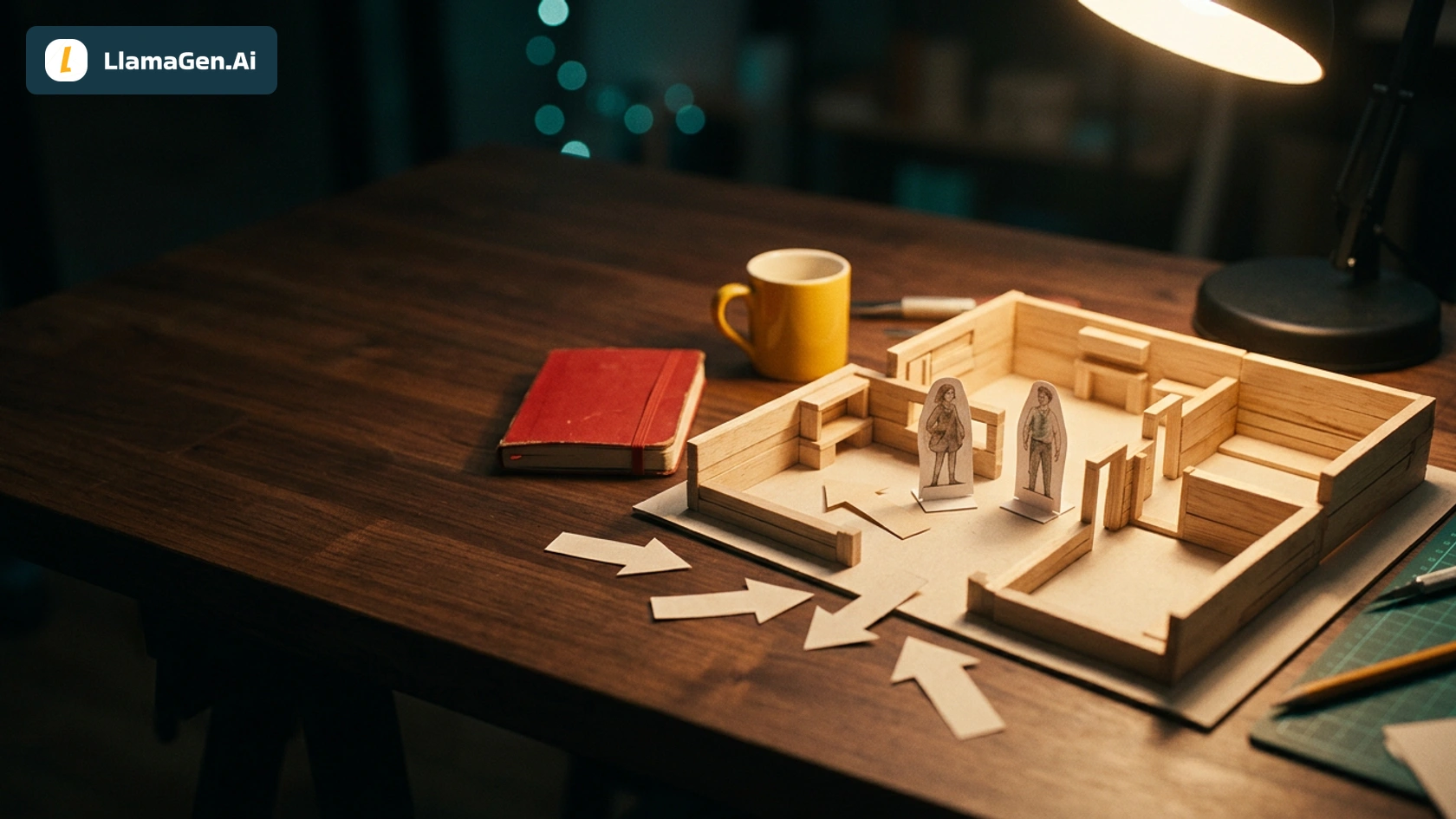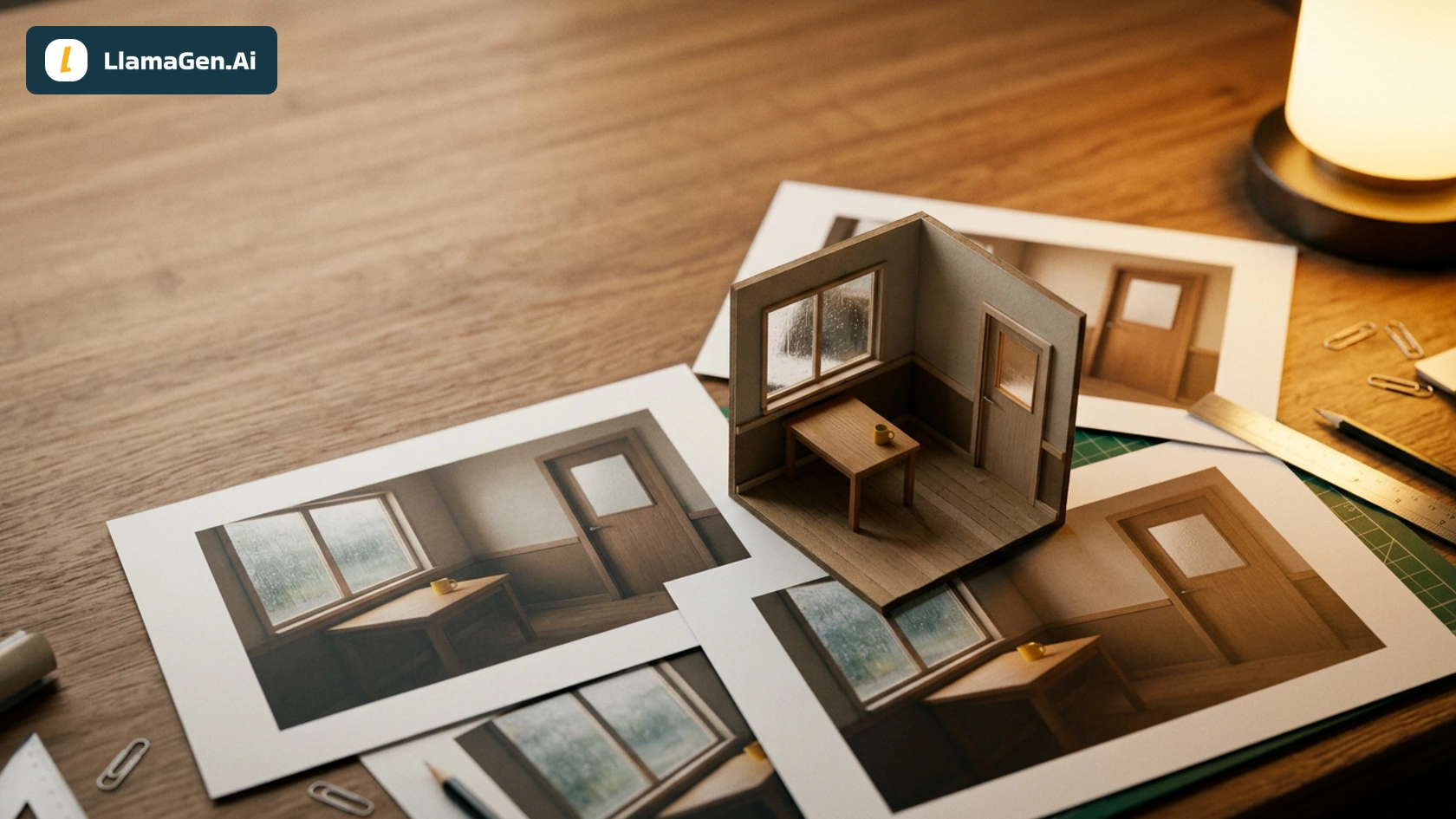
A recurring location needs an identity just as much as a recurring character does. If the station window changes shape, the door jumps to another wall, or the notebook reappears after somebody carried it away, the next panel can contradict the story even when the face is correct.
Build a comic location bible before a place becomes a regular set: one approved master image, a short description of its geography, the views you actually need, and a separate record of movable props. You can start a character or scene in LlamaGen.AI, then keep the approved references and state notes with your project.
This guide responds to a Reddit discussion about revisiting locations across an AI-generated episode. The useful production question is specific: when the story returns, are the landmarks and props still where the previous scene left them?
Example scope — November 28, 2026: the station below is our original generated teaching set. We made an exterior departure image and two new indoor returns through direct Google Vertex image calls. These are still-image examples assembled locally for review; they are not a native LlamaGen.AI location-memory feature, a ComfyUI workflow, or a video test. The calls supplied references explicitly. Nothing here establishes persistent model memory.
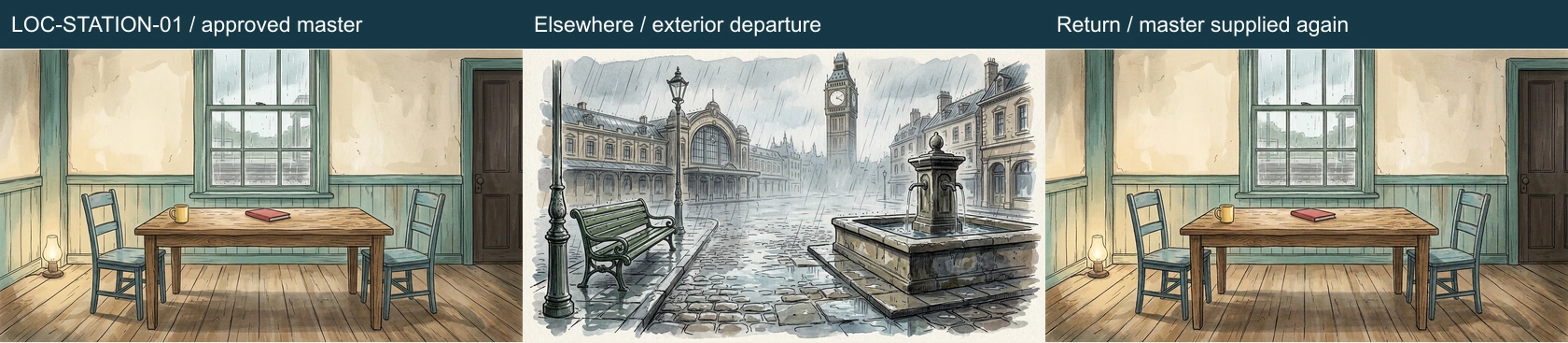
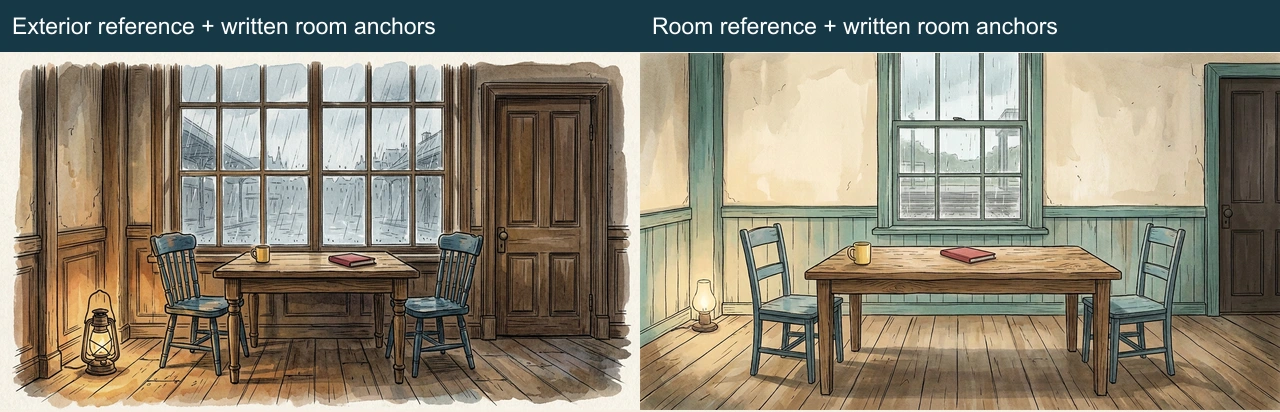
The middle image is another place. For the third image, we supplied the original interior again instead of expecting the outdoor frame to preserve indoor construction details.
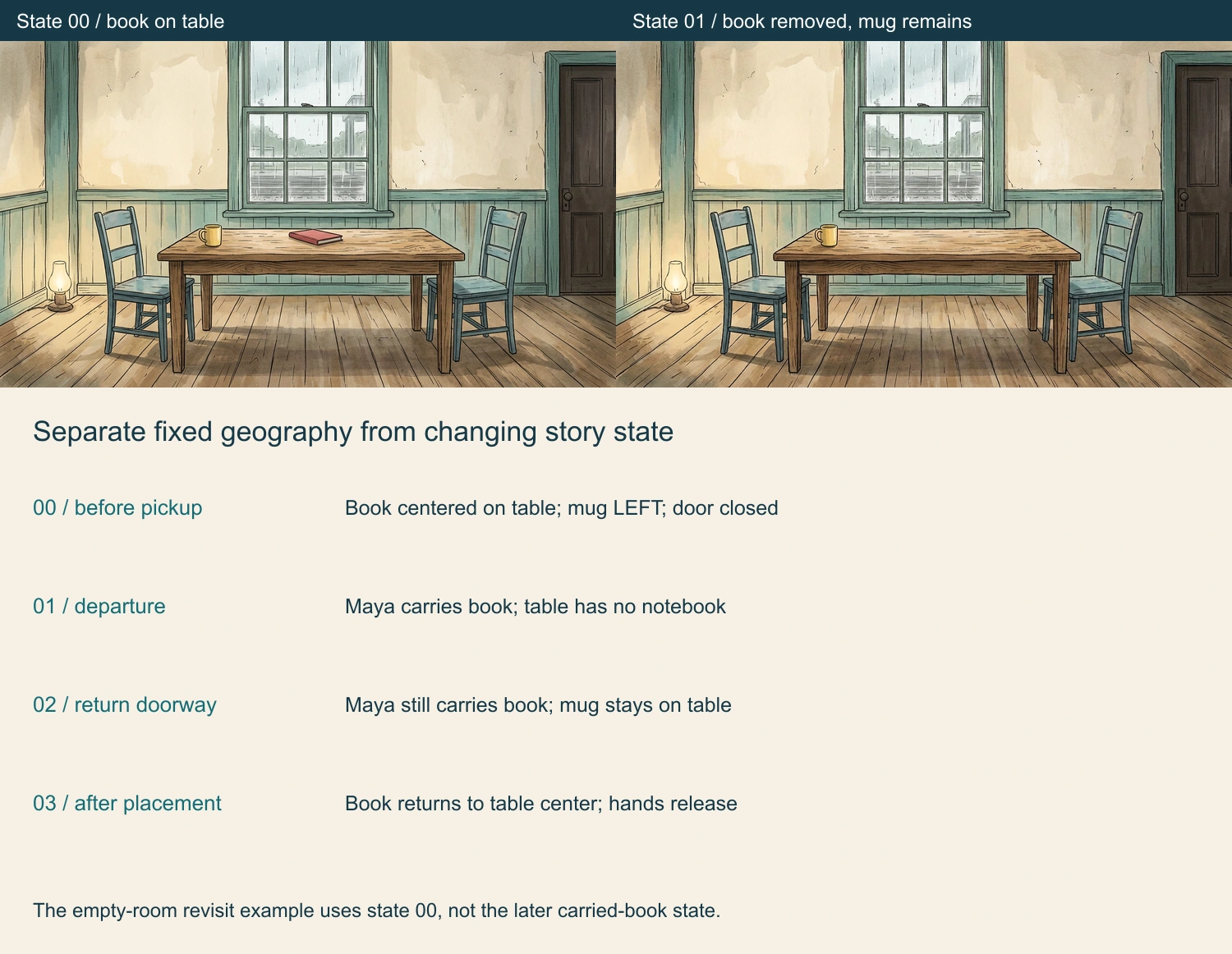
Our room is LOC-STATION-01, version 01. Its approved master shows a wooden table under a rainy window, a wooden door on the right, two blue chairs, green wainscoting, and an oil lamp on the left floor. A yellow mug sits on the left side of the tabletop; a closed red notebook sits near the center.
Use the master as the authority for this version. A later attractive image does not automatically become the new room. If you approve an architectural change, issue a new version and identify which future panels should use it.
Save the original at a readable resolution. A small contact sheet is useful for orientation, but the next artist or reference-aware generator may need the actual window, chair, and door details.
A practical folder might contain:
Ferramentas populares para criadores
Crie quadrinhos, storyboards e fotos estilosas com LlamaGen.
Transforme uma ideia em tirinhas polidas em minutos.
Criar quadrinhos02Crie arte mangá expressiva e histórias com vários painéis.
Crie mangá com IA03Visualize cada cena antes de começar a produção.
Crie storyboards com IA04Transforme qualquer foto em uma ilustração estilo quadrinho.
Crie quadrinhos a partir de fotos05Monte tirinhas compartilháveis com personagens consistentes.
Crie tirinhas com IAUm resumo dos lançamentos mais recentes de recursos do LlamaGen, melhorias no produto, atualizações de design e correções importantes de bugs.

LOC-STATION-01/v01/
station-master.png
location-bible.json
location-map.svg
approved-views/
scene-state/
candidates-not-approved/
Those names are an editorial organization example, not a required product folder structure. The downloadable source pack contains the master and the actual candidates used here.
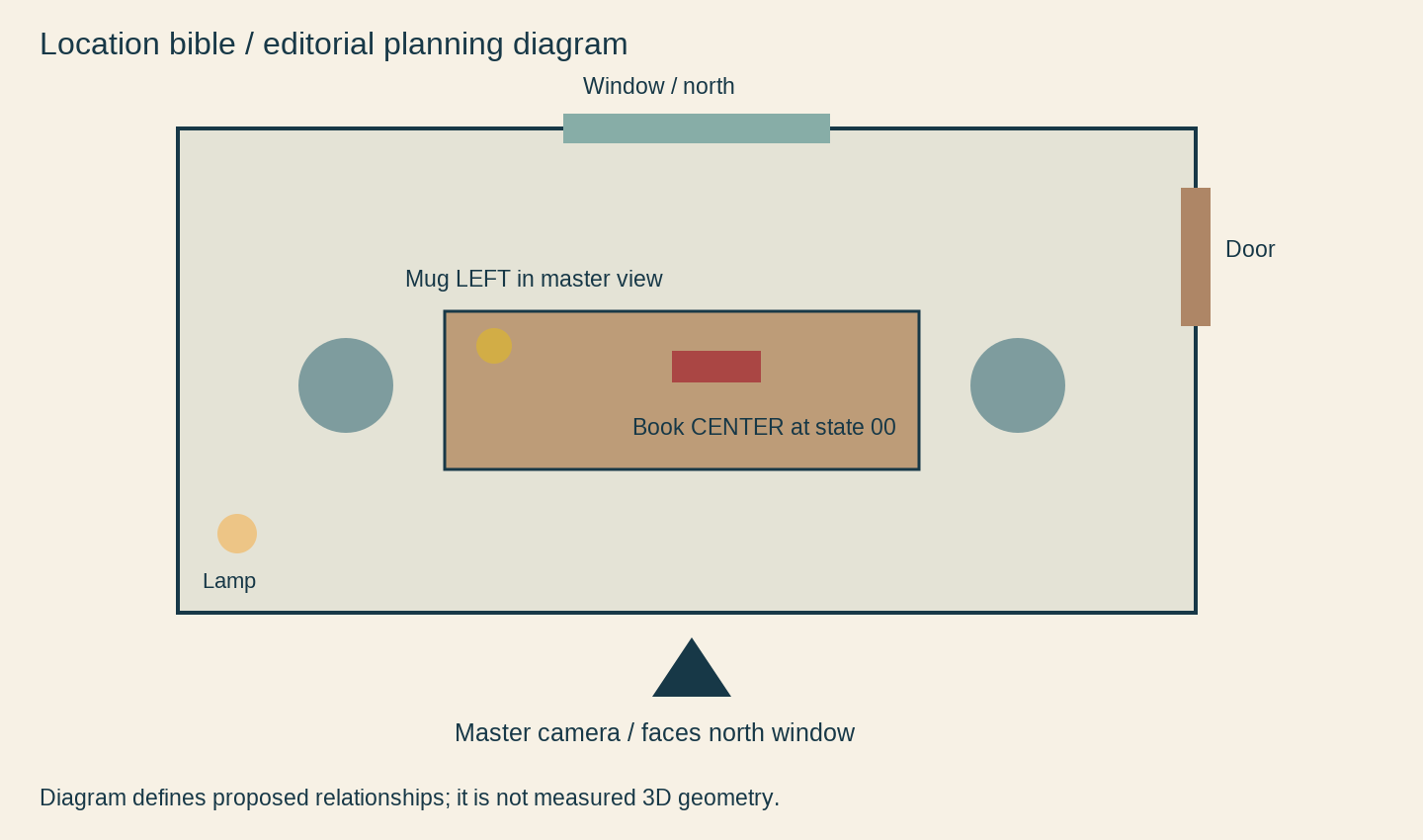
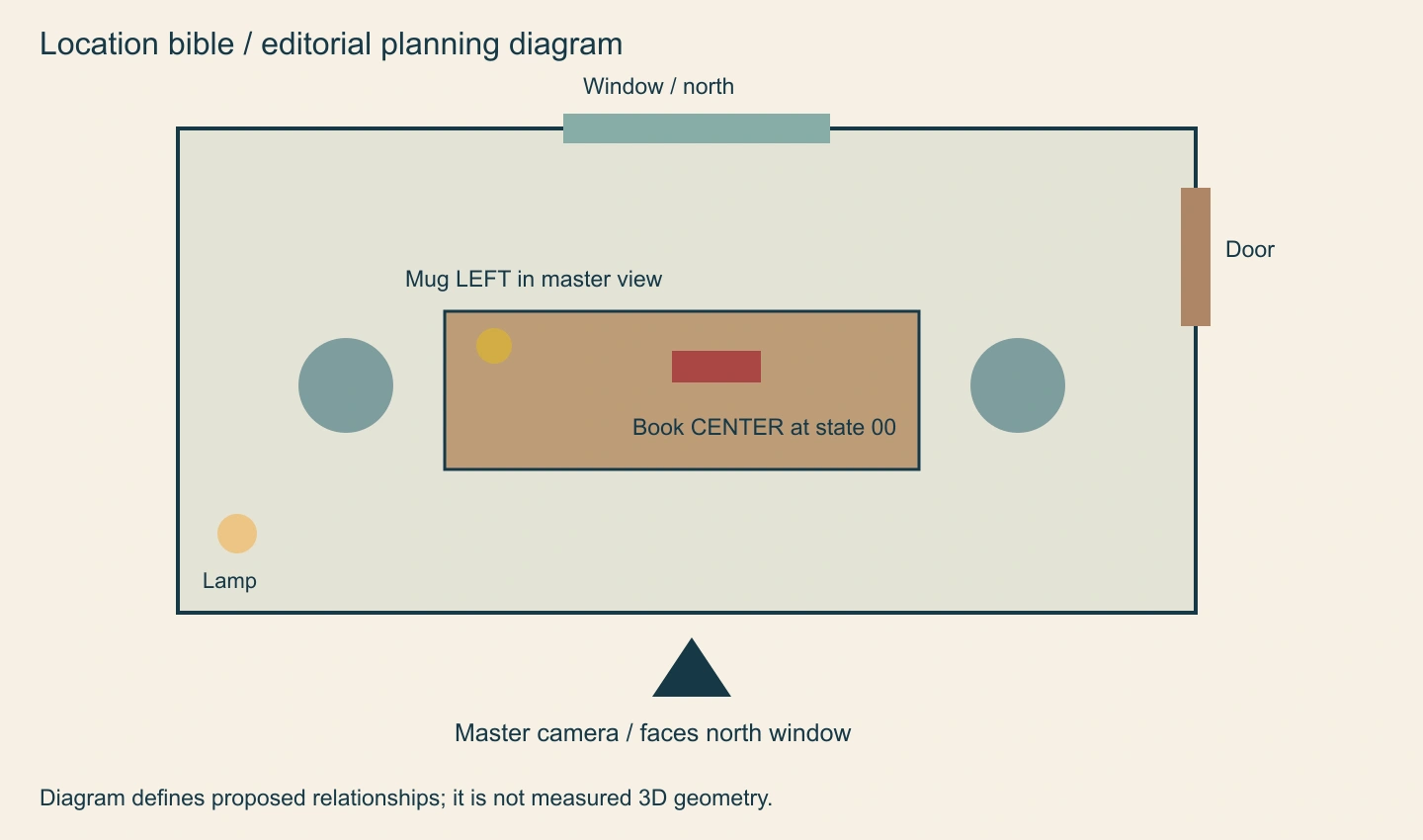
Write relationships that survive a camera change. “The door is on the room's east wall” is more durable than “the door is always on the right.” In our master view the camera faces the north window, so the east door appears on screen right. A reverse view could legitimately put it on screen left.

This is a proposed planning diagram drawn locally from the approved illustration. It is not a measured reconstruction, a depth map, or a guarantee that generated perspectives share consistent 3D geometry.
| Location anchor | Fixed relationship | What to check in another view |
|---|---|---|
| Window | North wall behind the table | Same frame design and relation to table |
| Door | East wall | Correct wall and plausible direction from the camera |
| Table | Between the two chairs | Shape, scale and clearance from the wall |
| Chairs | Opposite ends of table | Count, blue finish and readable placement |
| Oil lamp | West side on floor | No unrequested wall lamp or extra duplicate |
| Wall and floor | Cream wall, green paneling, wood planks | Recognizable materials and proportions |
Do not force every anchor into every close-up. If the window is outside the frame, it cannot be checked visually. Record it as not visible rather than declaring it correct.
The notebook's starting position is not a permanent part of the architecture. If Maya takes it outside, a return panel must not reset it onto the table unless the story shows her putting it back.

The empty-room return experiment in this article uses starting state 00. The later character-and-book sequence in the cost example uses changing states. Do not treat these as one uninterrupted filmed take.
| State | Notebook | Mug | Door |
|---|---|---|---|
| 00: before pickup | Closed, table center | Table left | Closed |
| 01: departure | Carried by Maya | Unchanged | Opens for departure |
| 02: return | Still carried | Unchanged | Opens for entry |
| 03: after placement | Closed, table center | Unchanged | Specify in the next shot brief |
A good state entry names an owner and a transition: who moved the object, in which panel, from where to where? “Same room” cannot answer that question.
For an action sequence, add the chair pulled out, the broken glass, or the wet footprints. These details can be temporary while still being essential to continuity.
We generated two indoor candidates after making the outdoor image:
The prompts share the room description but differ in their return instruction. There is one output per condition. Reference content, prompt wording, and available visual information differ; this is an illustrative comparison, not an isolated causal benchmark.

Both candidates retain the basic requested arrangement: window behind table, door right, two blue chairs, mug left, red notebook near center, and lamp left. The exterior-referenced image nevertheless reinvents the window divisions, chair construction, wall finish, and table proportions. The interior-referenced image is closer to the approved green paneling, window frame, and blue chair design, with smaller proportion changes still visible.
That observation supports a modest workflow decision: supply the approved set again when its construction matters. It does not prove that this model always needs a particular number of images or that another reference system will behave the same way.
A readable prompt template is:
Location: LOC-STATION-01, version 01.
Use the attached approved interior as the visual authority.
Camera: master view facing the north window.
Keep the window frame, green wainscoting, oak table and two blue chairs.
The east-wall wooden door appears screen right in this view.
State: 00. Yellow mug at table left; closed red notebook at center.
One oil lamp on the west-side floor. No additional lamps or objects.
Empty room, no captions, no inset views.
This is an improved reusable template, not a claim that the exact formatted text above produced the pictured outputs. The raw prompts and reference hashes are in the source archive.
Start with the shots on your panel list: master, doorway approach, table insert, and any needed reverse. Generate or draw each view, compare it with the location bible, and approve it separately.
Do not infer an unseen corridor from a single interior and then treat every generated corridor as established canon. If the next chapter needs the corridor, design it deliberately and link it to the station room.
A rough 3D blockout can be a useful option when camera geometry is central. Our example did not build or test one. The map here describes intended relationships; it does not replace the validation a 3D pipeline would require.
For each approved view, record the camera description, visible anchors, story state, reference version, and unresolved differences. An image can be useful for a mood board while still being unsuitable as a continuity authority.
Run this short check before accepting a recurring location:
That last step matters. In our small-batch comic cost example, a repair fixed Maya's gaze but added an unwanted second lamp. A locally correct action can still produce an unusable continuity result.
Pair the location record with a shot-ready OC reference pack. Character identity, room geography, and current prop state are separate inputs, even when they meet in one panel.
Use the location bible JSON, editable SVG map and original location source pack. The archive includes the approved set, departure image, both return outputs, and sanitized generation receipts. It contains no 3D scene or native Studio project.
No. It gives you a visual and written standard for finding drift. Our interior-referenced return is closer to the master, but table and room proportions still vary.
Use the reference that best describes the intended view and state. A master may be insufficient for an unseen reverse angle; approve that view before relying on it.
Record the change as a state transition or a new set version. A notebook moved by a character is scene state; a rebuilt wall is a location revision.
If you start the scene in LlamaGen.AI, keep the approved location pack beside your cast references before you generate the return panel.