The story behind the study
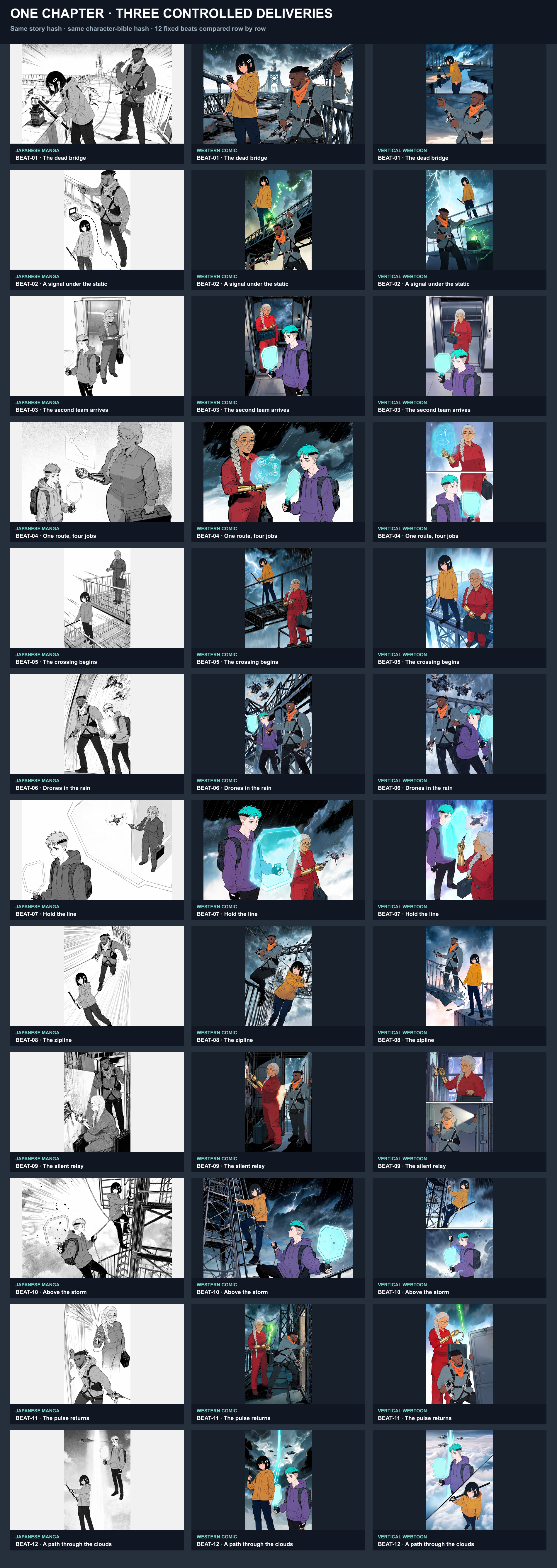
Can a story stay recognizable when its reading direction, page layout, and visual language change?
We held the 993-word source chapter, 12 story moments, and four recurring characters constant, then composed each reading format in a separate run. The purpose was to test continuity and delivery. Each format was independently generated and reviewed; this was not an automatic format conversion.
What the run delivered
These are the results of this documented production run.
| Production measure | Result |
|---|---|
| Separate format runs | 3 |
| Recurring characters | 4 |
| Final story panels | 36 |
| Total generated outputs | 44 |
| Total model-generation time | 33.07 min |
The 44 outputs include four replacement character references and four additional generated assets around the 36 final story panels. The time above is total model-generation time. Human review time was not tracked, and these results are not a promise for every input.
Open each format and read it yourself
Explore the finished deliveries below. Each PDF and CBZ contains the complete version of its format.

01 / Right to left
Japanese manga
Black-and-white pages use ink, screentone, close-ups, and right-to-left composition. The plot and cast match the other two deliveries, but the layout was generated and reviewed specifically as manga.
4 pages · 1800 × 2400 PNG · PDF · CBZ
02 / Left to right
Western comic
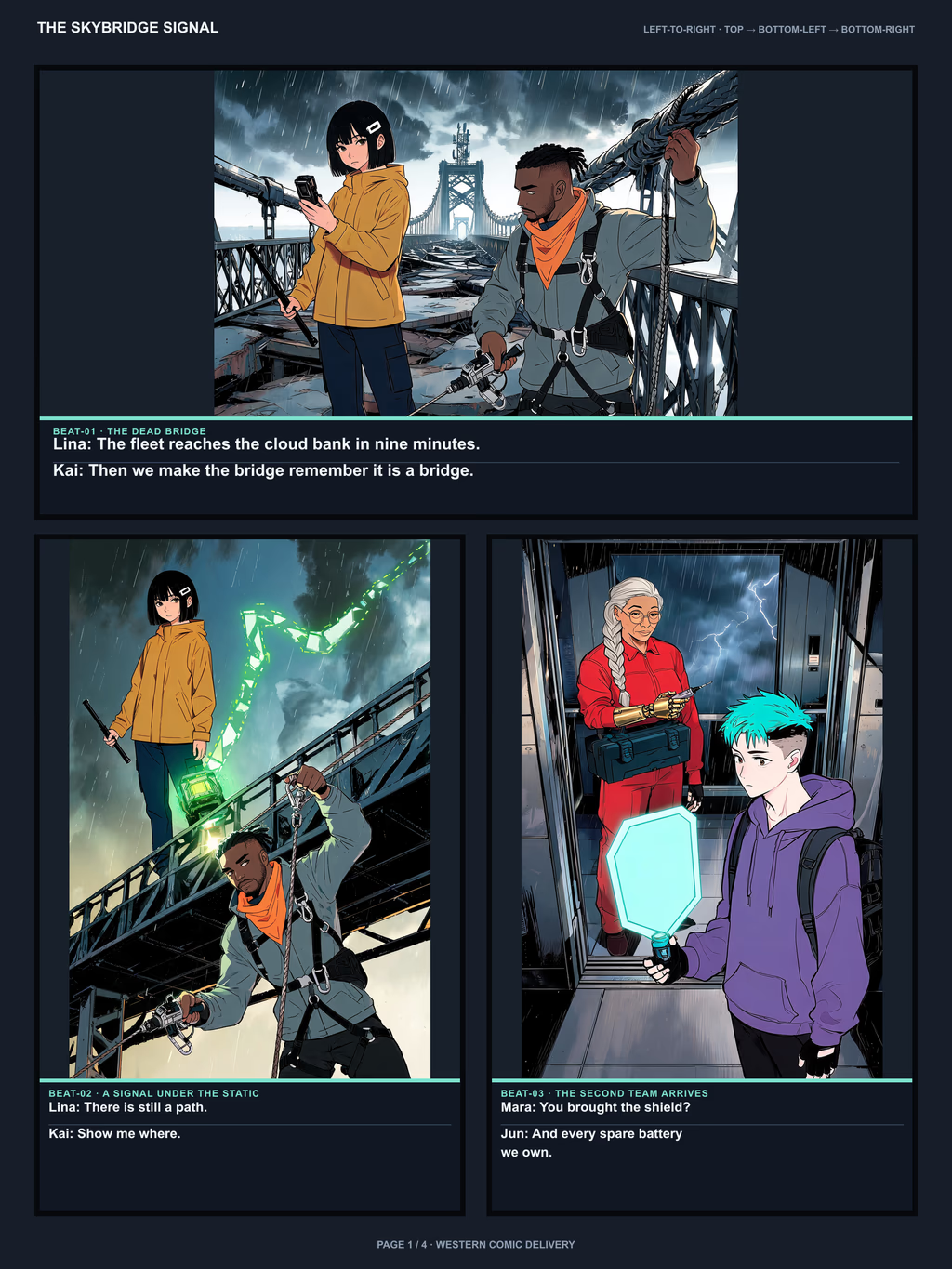
Full-color pages use graphic-novel lighting and a familiar left-to-right flow. This was a separate composition run, not an automatic recolor or one-click conversion of the manga pages.
4 pages · 1800 × 2400 PNG · PDF · CBZ

03 / Top to bottom
Vertical Webtoon
A continuous mobile-first strip adds breathing room between story moments. It preserves the same narrative order while changing pacing and panel shape for scrolling rather than page turns.
1 strip · 1200 × 22150 PNG · PDF · CBZ
How it was made and checked
Start with a fixed source
One 993-word chapter was reduced to the same 12 ordered story moments for every format.
Approve a consistent cast
Four early character references were replaced because their styles did not match; the approved four were then reused.
Compose three separate runs
Manga, Western comic, and Webtoon were independently composed for their own reading direction and layout.
Review the finished work
Every full-resolution panel was reviewed for story order, character recognition, and delivery readiness; automated checks verified file sizes, page order, archives, and links.
What did not work perfectly
The review also surfaced details worth understanding before repeating this workflow.
- The first references mixed realistic and anime styles, so all four were redrawn before story-panel generation.
- Some Webtoon moments combine more than one action inside a single image instead of using one clean composition.
- The final manga panel simplifies the antenna-release action, although the story outcome remains readable.
- Dialogue in this controlled delivery is presented as reliable caption cards below the art rather than generated inside speech balloons.
Audit the source package
Read the exact source chapter, character bible, format plan, and asset manifest to inspect what went into this run and verify the approved evidence set.
- Generation model
- bytedance/seedream-5-lite · seed 20260831
- Approved evidence SHA-256
- 8b0e234e65cfc359ba29e1a060ee5fffeb82463a41a01e3a7da2d5f1cb461f55
Compare all 12 story moments