

Dialogue webtoon template for a four-beat conversation
Example preview
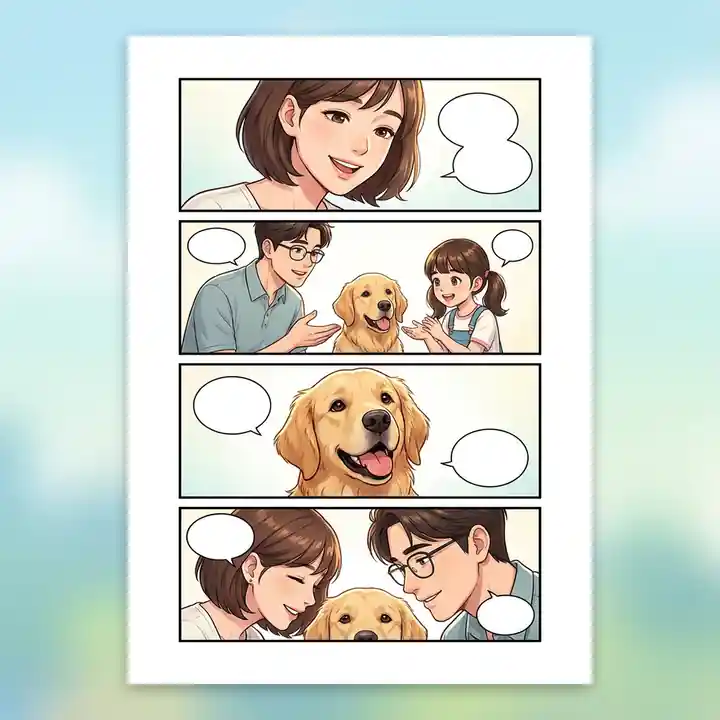
Stage a conversation in four stacked portrait panels, alternating shared views and close-ups. Plan who speaks, who reacts, and where a pause belongs before adding the final words.
Make a short conversation readable through camera changes, expressions, and clear turn-taking.
When to use this template
- A misunderstanding resolved through one clear exchange.
- A confession or difficult question with a visible listener reaction.
- A quiet character scene where a pause changes the meaning of the conversation.
Build your first draft
Outline the conversation without lettering
Write four beats: shared context, first speaker, listener reaction, and response or silence. Decide which beat needs the closest framing.
Establish positions and eyelines
Keep each character on a consistent side and describe where they look. The source layout uses four stacked portrait panels with empty speech bubbles.
Review bubble space and turn order
Check who appears to speak, whether the expressions match, and whether the empty bubbles leave enough room for your final dialogue.
Try a complete example
The extra train ticket
Dialogue-driven vertical webtoon, four stacked 5:8 portrait panels on pure white, clean black borders and generous gutters, expressive faces, empty speech bubbles only, no readable text. Two adult siblings wait at a small train station, older sibling in a brown coat on the left, younger sibling in a blue jacket on the right. Panel 1: two-shot establishing their positions beside a bench. Panel 2: close-up of the older sibling holding out an extra ticket, tentative expression. Panel 3: close-up of the younger sibling looking from the ticket to the older sibling, surprised. Panel 4: two-shot as the younger sibling accepts the ticket and both smile softly. Warm morning light.
The shared shots anchor the positions while close-ups show the offer and reaction. The ticket carries the topic of the conversation even before dialogue is added.
Before you publish
- Keep one speaker or one reaction as the focus of each portrait panel.
- Empty bubbles can still be misplaced or change shape; check their tails and room for translated dialogue before lettering.
Questions about this template
- Will the template write my dialogue?
- The source prompt requests empty speech bubbles and no readable text. Plan the exchange first and add or revise the final words separately for spelling and pacing.
- How many characters should I include?
- Two speakers are the clearest starting point for four portrait panels. A larger group needs extra staging so readers can tell who speaks and who listens.
- Why alternate close-ups and two-shots?
- A two-shot establishes where the speakers are. Close-ups then give expressions enough space, and a final shared view can show how the relationship changed.