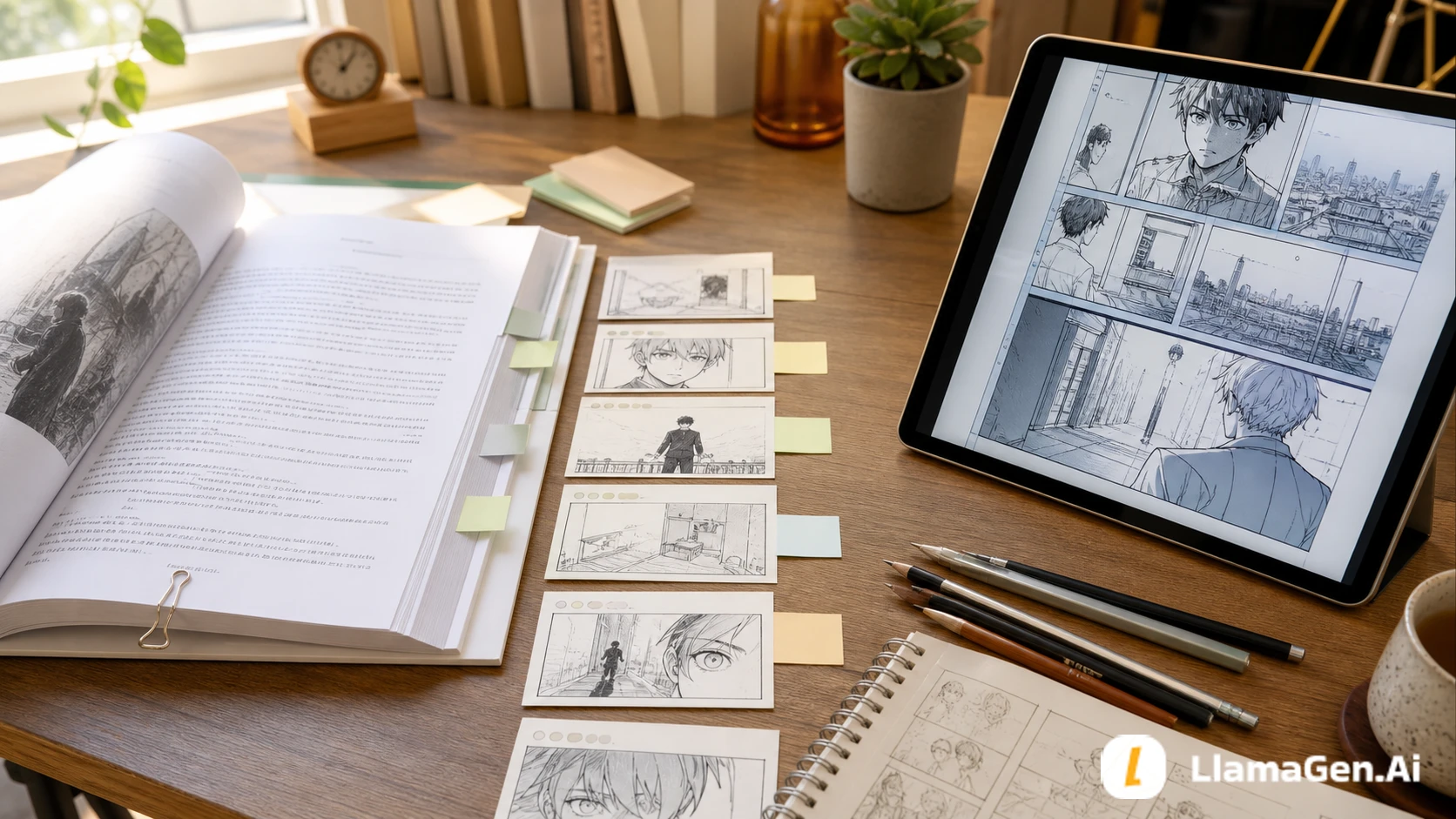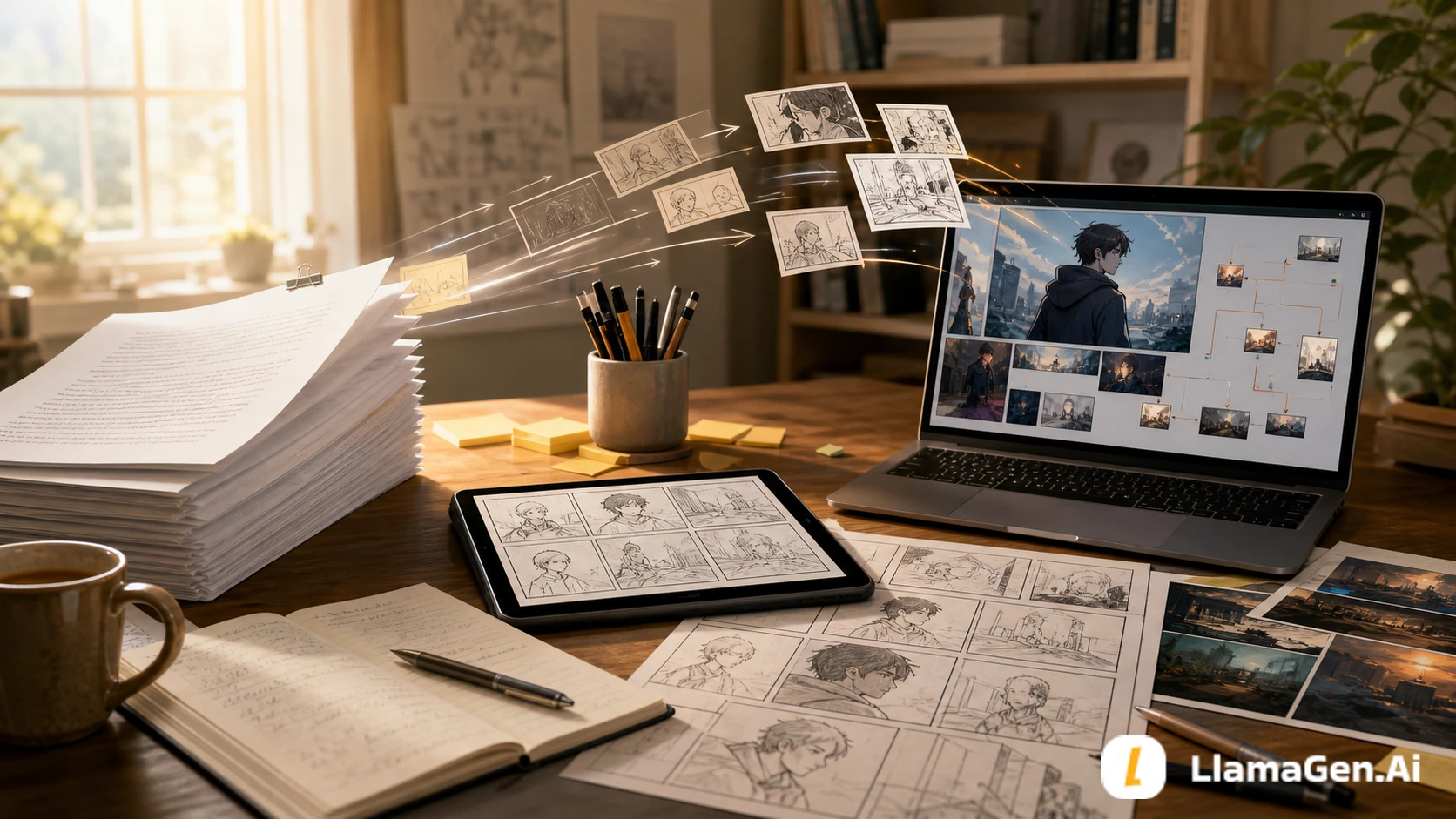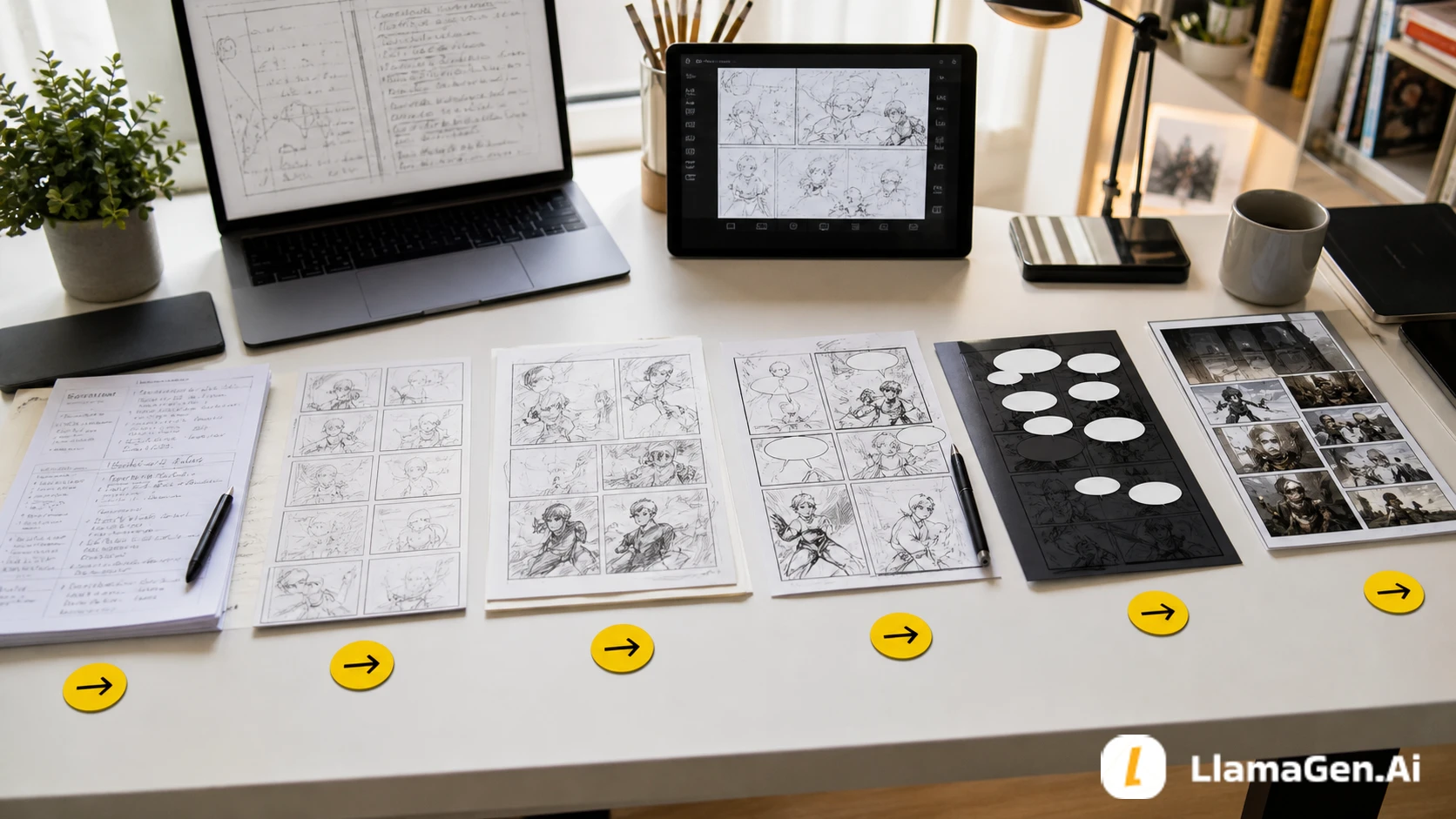

A comic background is not just scenery. It should help the reader understand where the scene happens, what the character wants, what has changed, and what kind of pressure the location creates.
Use this rule:
location detail -> story information -> reader expectation -> panel choice
If a background only looks nice, it is decoration. If it reveals mood, scale, social context, clues, movement, or danger, it becomes part of the story.
Use LlamaGen.AI Storyboard or the AI Storyboard Generator to test backgrounds as story beats before you generate final comic panels.

Beginners often treat the establishing shot as a polite opening panel:
Here is the city.
Here is the school.
Here is the bedroom.
Here is the forest path.
That is useful, but it is not enough.
A stronger establishing shot gives the reader story information before anyone speaks. It can show:
| Background job | What it tells the reader |
|---|---|
| Scale | The character is small, trapped, watched, or out of place |
| Mood | This scene is warm, tense, quiet, strange, or unstable |
| Status | The place is expensive, neglected, temporary, private, or public |
| Movement | The reader knows where the character can enter, hide, or leave |
| Clue | A prop or light source hints at what happened before the panel |
| Change | The same location feels different because the story moved forward |
The goal is not to draw more detail. The goal is to choose details that do work.
This tutorial uses a short original comic scene and tests whether a location can carry story information without adding extra dialogue.
| Test item | Setup |
|---|---|
| Date tested | August 19, 2026 |
| Project | Rain Line Delivery |
| Source input | One scene summary plus rough location notes |
| Target tool | LlamaGen.AI Storyboard |
| Target output | Establishing shot, location story kit, storyboard prompt, repair checklist |
| Creator stage | Before final panel generation |
| Active editing time | About 19 minutes |
| Total elapsed time | About 38 minutes including one failed background pass |
| Editorial note | This is a workflow test, not a pricing benchmark. Output speed and credits can vary by workspace settings. |
The test question was:
Can a comic background make the reader understand the story problem before a character explains it?
Here is the scene:
Mara delivers a sealed package to an old train station after the last evening service.

The station should be empty. Instead, one platform light is still on. A row of wet footprints leads from the locked ticket gate to a door marked only by a torn paper shape. Mara notices that the clock above the gate has stopped, but the puddles on the floor are still moving as if a train just passed.
A rundown of the latest LlamaGen feature releases, product enhancements, design updates, and important bug fixes.
This scene has enough information for a strong establishing shot. The background needs to do more than show a train station.
Before generating or drawing the background, write one sentence:
This station should feel closed, but one fresh clue proves someone or something passed through after hours.
That sentence gives the background a job.
Now choose the location signals:
| Signal | Background detail |
|---|---|
| Closed place | Dark ticket gate, empty benches, locked shutters |
| Fresh clue | Wet footprints, moving puddles, one active light |
| Time pressure | Stopped clock, last-service feeling |
| Reader path | Footprints lead from foreground to the side door |
| Character scale | Mara is small inside a wide station interior |
Notice that each detail supports the same story question:
Who crossed the station after it closed?
A weak establishing shot is accurate but passive.
A strong establishing shot is selective. It gives the reader a place, a mood, and a reason to look closer.
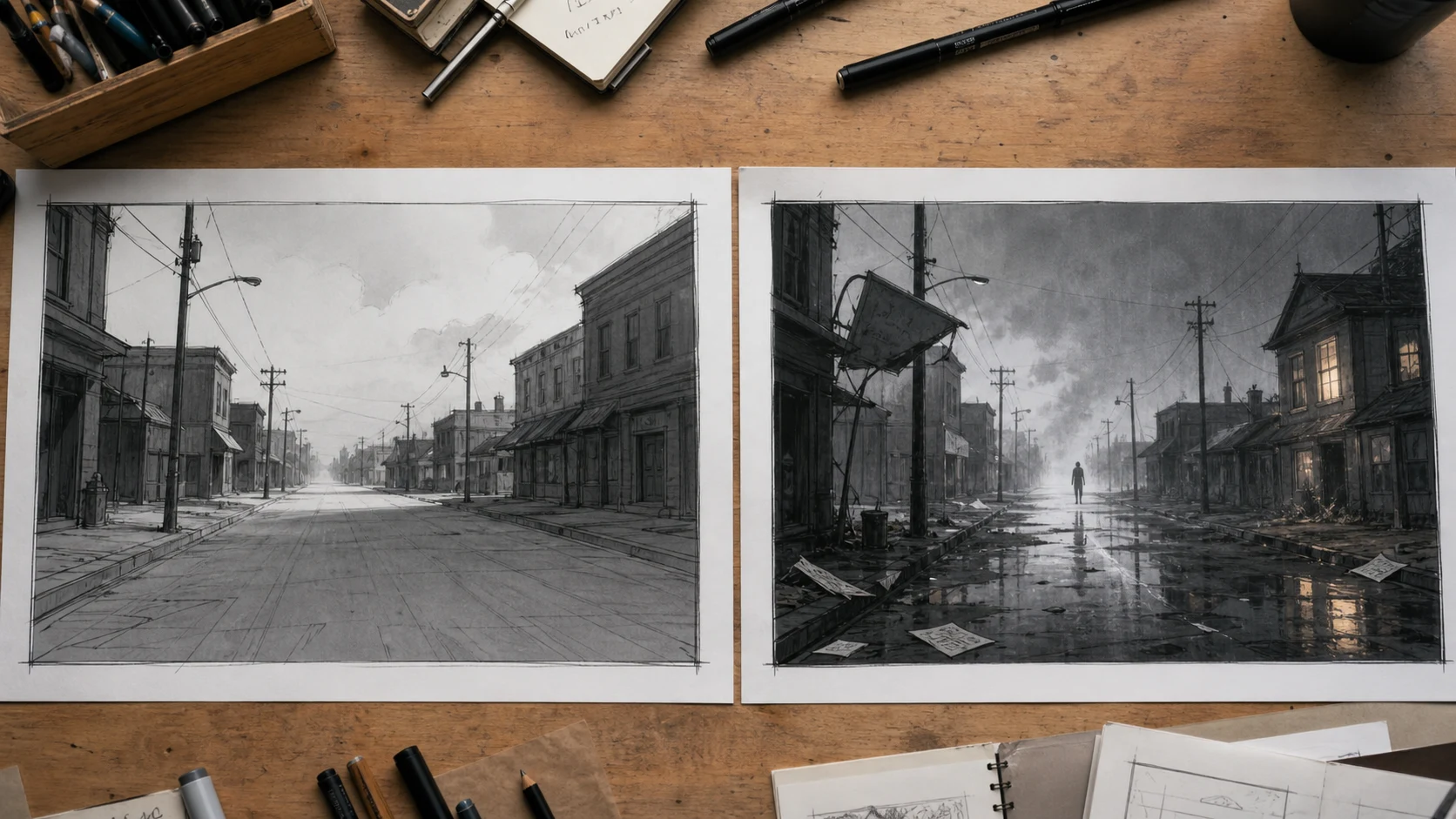
| Weak version | Stronger version |
|---|---|
| Empty street, no story clue | Wet street with one distant figure and a lit window |
| Generic buildings | Specific damage, props, and shadows |
| No reader path | Reflections and road lines guide the eye |
| Could belong to any scene | Implies a recent event |
| Pretty but neutral | Mood and question appear immediately |
The repair is usually not "add more stuff." It is "make every visible thing point toward the scene's problem."
Before final art, build a compact location kit. This can be one card, one document, or one Storyboard project note.
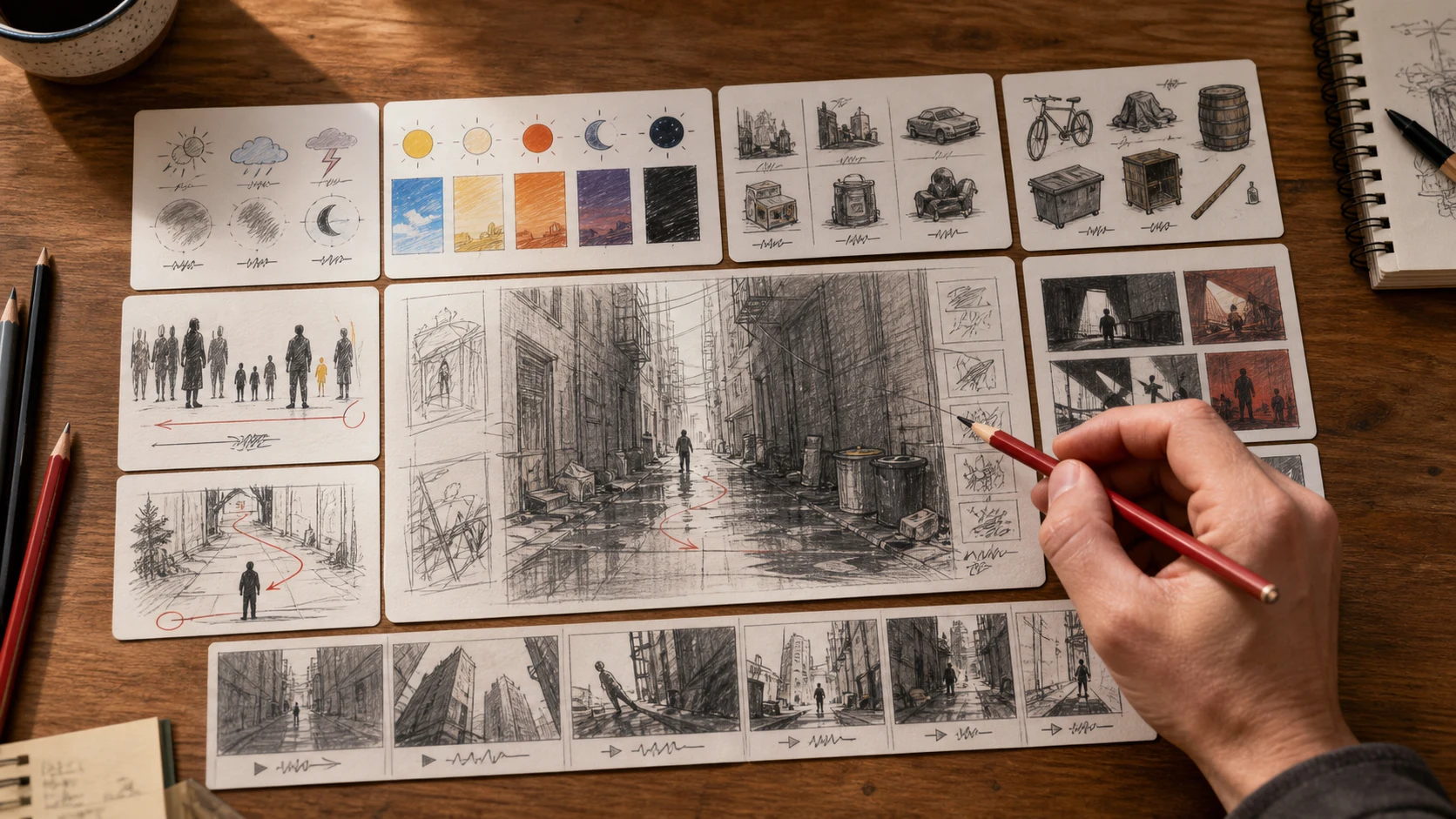
Use this structure:
| Kit item | Example for Rain Line Delivery | Why it matters |
|---|---|---|
| Location role | Closed station after last service | Sets expectation |
| Mood | Quiet, wet, recently disturbed | Creates tension |
| Time | Late evening, lights mostly off | Explains emptiness |
| Story clue | Moving puddles and footprints | Pulls reader forward |
| Character path | Gate to side door | Guides the eye |
| Scale | Wide interior, small character | Shows vulnerability |
| Repeatable prop | Torn paper shape on the door | Creates continuity |
This kit keeps the background specific without forcing you to write a long lore note.
Establishing shots do not always need to be huge.
| Scene need | Best shot choice |
|---|---|
| Reader must understand geography | Wide shot |
| Reader must notice a clue | Medium wide with clear foreground |
| Reader must feel trapped | Low or high angle |
| Reader must compare two spaces | Split or doorway composition |
| Reader must feel intimacy | Small room shot with character close to frame |
| Reader must wait before a reveal | Long empty frame with one point of interest |
For Rain Line Delivery, the best first shot is:
Wide interior shot from behind Mara, looking through the locked gate toward the dim platform. The footprints start near the gate and lead toward a side door. One light is on. The clock is visible but not central.
That gives geography and mystery at the same time.
Use this prompt in LlamaGen.AI:
Create a storyboard establishing shot for this comic scene.

Scene:
Mara enters an old train station after the last evening service. The station should be empty, but a single platform light is still on. Wet footprints lead from the locked ticket gate toward a side door. The clock above the gate has stopped. Puddles on the floor still ripple as if something just passed.

Goal:
The background must carry story information without exposition.

Return:
1. The location job in one sentence.
2. The camera distance and angle.
3. The foreground, middle ground, and background details.
4. The reader eye path.
5. Which details are clues and which are mood.
6. A simpler fallback version for a small panel.
7. A repair note if the scene becomes too cluttered.

Visual constraints:
- No readable text in signs or papers.
- Keep the side door and footprints visible.
- Leave room for one small caption or speech bubble.
- Keep the shot readable at thumbnail size.
The most important line is:
The background must carry story information without exposition.
That tells the model and the creator what success looks like.
One strong establishing shot is useful. A short sequence is better.
| Panel | Background job | Visual choice |
|---|---|---|
| 1 | Establish place and mood | Wide shot of empty station and locked gate |
| 2 | Point to the clue | Medium shot of wet footprints near gate |
| 3 | Make the clue strange | Insert of puddle rippling without movement |
| 4 | Show Mara's choice | Mara turns toward the side door |
| 5 | Confirm risk | Light flickers over the stopped clock |
| 6 | End on next action | Mara reaches for the door with the torn mark |
This sequence uses location details as pacing. The station is not a backdrop; it becomes the scene engine.
The first generated background may look impressive but fail as storytelling.
Run this repair check:
| Problem | Repair |
|---|---|
| Too much detail everywhere | Remove decorative details that do not support the clue |
| Reader cannot find the path | Use floor lines, light, footprints, or perspective to guide the eye |
| Location feels generic | Add one specific prop, rule, or sign shape that belongs to this story |
| Character disappears | Increase contrast around the character silhouette |
| Background steals from dialogue | Leave clean bubble space in a quiet area |
| Panel only shows a place | Add a change, clue, obstacle, or route |
Repair prompt:
Review this establishing shot for comic readability.

Keep:
- the location mood
- the character path
- the main clue
- clear bubble space

Fix:
- remove decorative clutter
- make the eye path clearer
- make the story clue visible at thumbnail size
- keep all signs and paper marks unreadable
The useful workflow is:
scene summary
-> location job
-> location story kit
-> establishing shot
-> storyboard sequence
-> final panel background
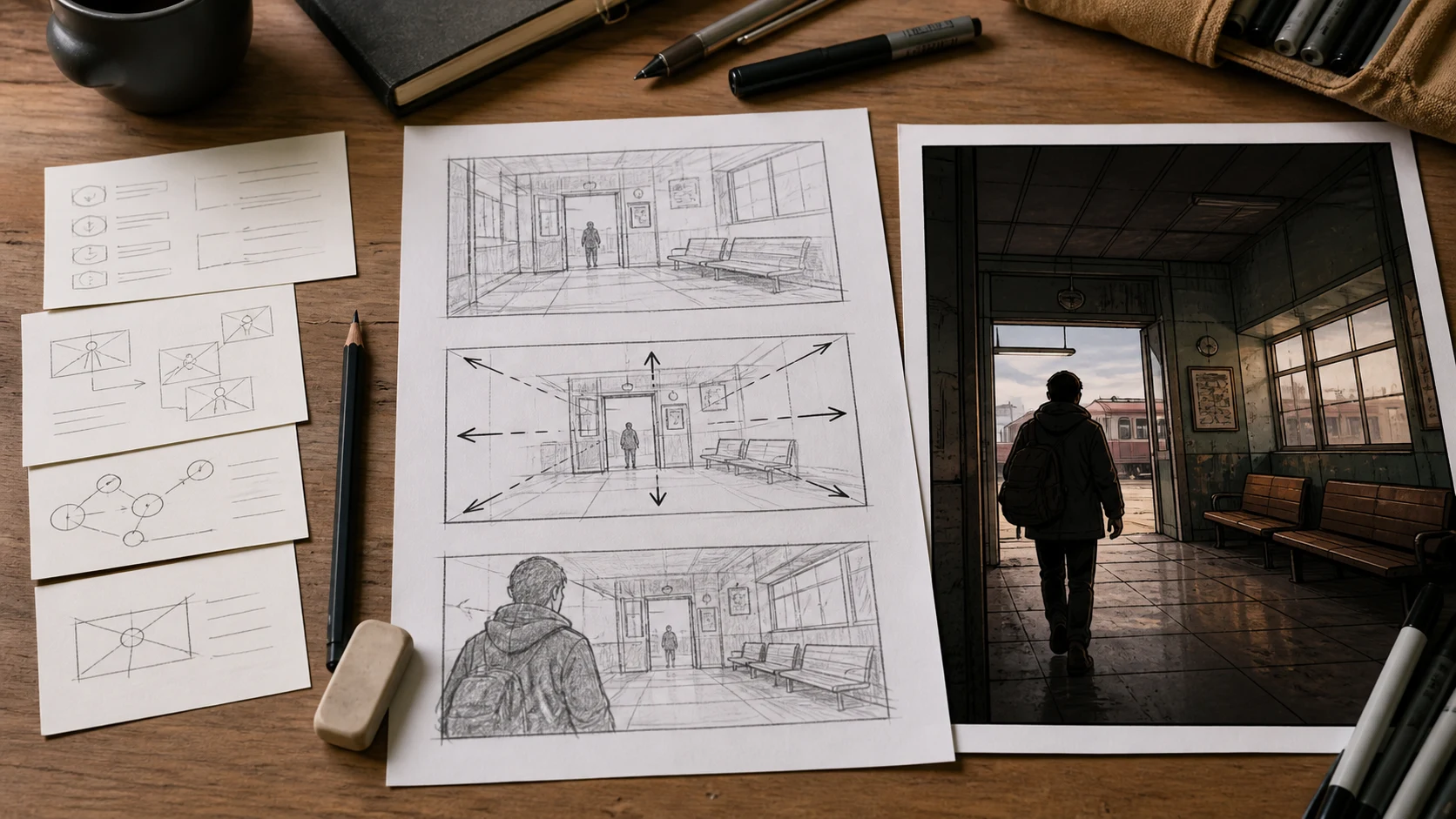
Use Storyboard for the planning stage because it lets you test camera distance, panel order, and location clues before final panel art.
| Mistake | Why it hurts the page | Better move |
|---|---|---|
| Starting every scene with a skyline | It becomes repetitive | Pick the detail that matters now |
| Filling the panel with props | The reader cannot find the story | Choose three active details |
| Hiding the character | The scene loses emotional focus | Place the character in the reader path |
| Relying on signs | Text can be hard to render and translate | Use shape, light, object, or action |
| Showing the same room the same way | The location stops changing | Change angle as the character learns more |
Before approving an establishing shot, ask:
| Question | Pass condition |
|---|---|
| Does the shot tell us where we are? | Yes, without a caption |
| Does it tell us why this place matters now? | Yes, through a clue, obstacle, route, or contrast |
| Can the reader follow the eye path? | Yes, from character to story detail |
| Is there clean space for text? | Yes, without covering faces or clues |
| Is the background specific to this story? | Yes, it has at least one unique detail |
| Would the scene lose meaning if the background changed? | No. The current location is doing story work |
Usually one strong establishing shot plus two or three smaller angle variations is enough. Reuse the location, but change the camera based on the beat.
For planning, yes. Test the location first, then place the character inside it. For final panels, keep the character, camera, and background in the same prompt or reference workflow so the panel reads as one image.
It can, but keep dialogue light. The image should do most of the orientation work.
Use backgrounds as story tools, not as decorative chores. A few specific clues, clear perspective, and a readable path can be more valuable than a fully detailed city.
A good comic background tells the reader how to feel, where to look, and what might happen next.
Start with the location job. Build a small story kit. Test the shot in storyboard form. Then generate or draw the final panel only after the background is doing real narrative work.
Popular creator tools
Go from comics and storyboards to stylized photos with LlamaGen.
Visualize every scene before production starts.
Just refer your friends, followers, and customers to earn up to 30% in recurring commissions for a lifetime!