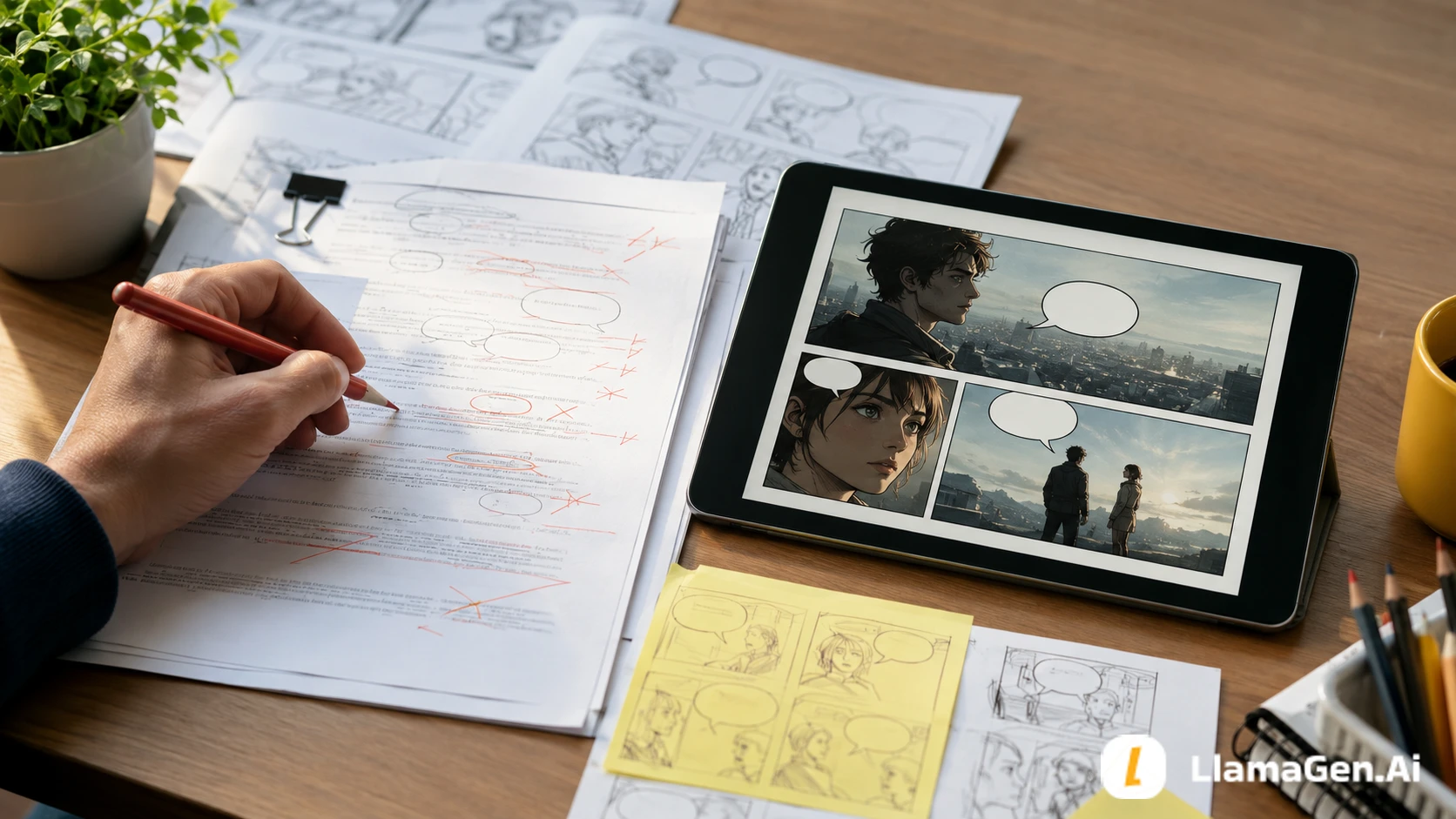

One novel chapter does not become one comic page automatically.
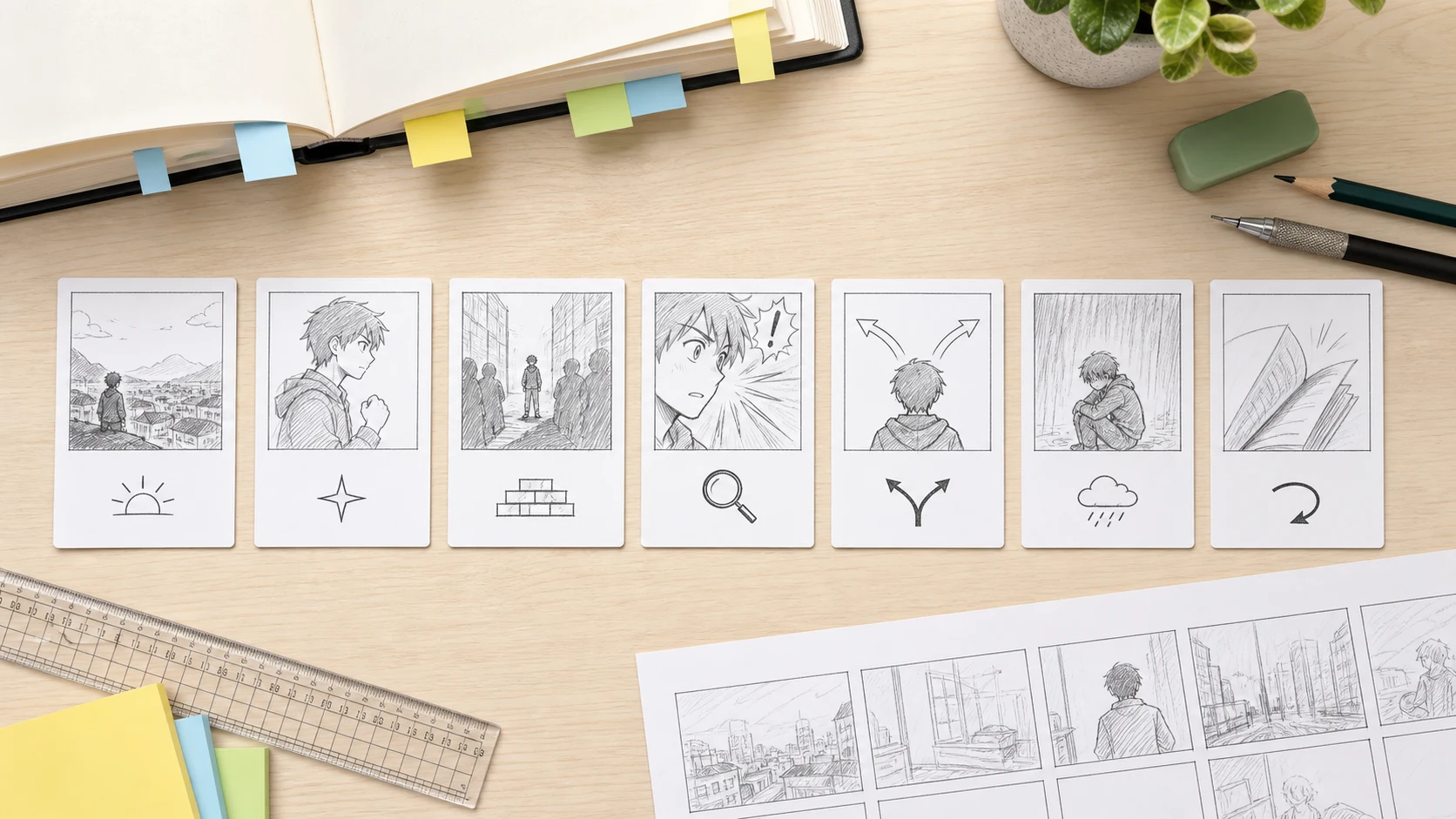
First, turn the chapter into visual beats:
chapter promise -> pressure -> reveal -> choice -> consequence -> hook
Then decide which beats deserve panels, which beats can become captions, and which beats should become reusable visual assets.
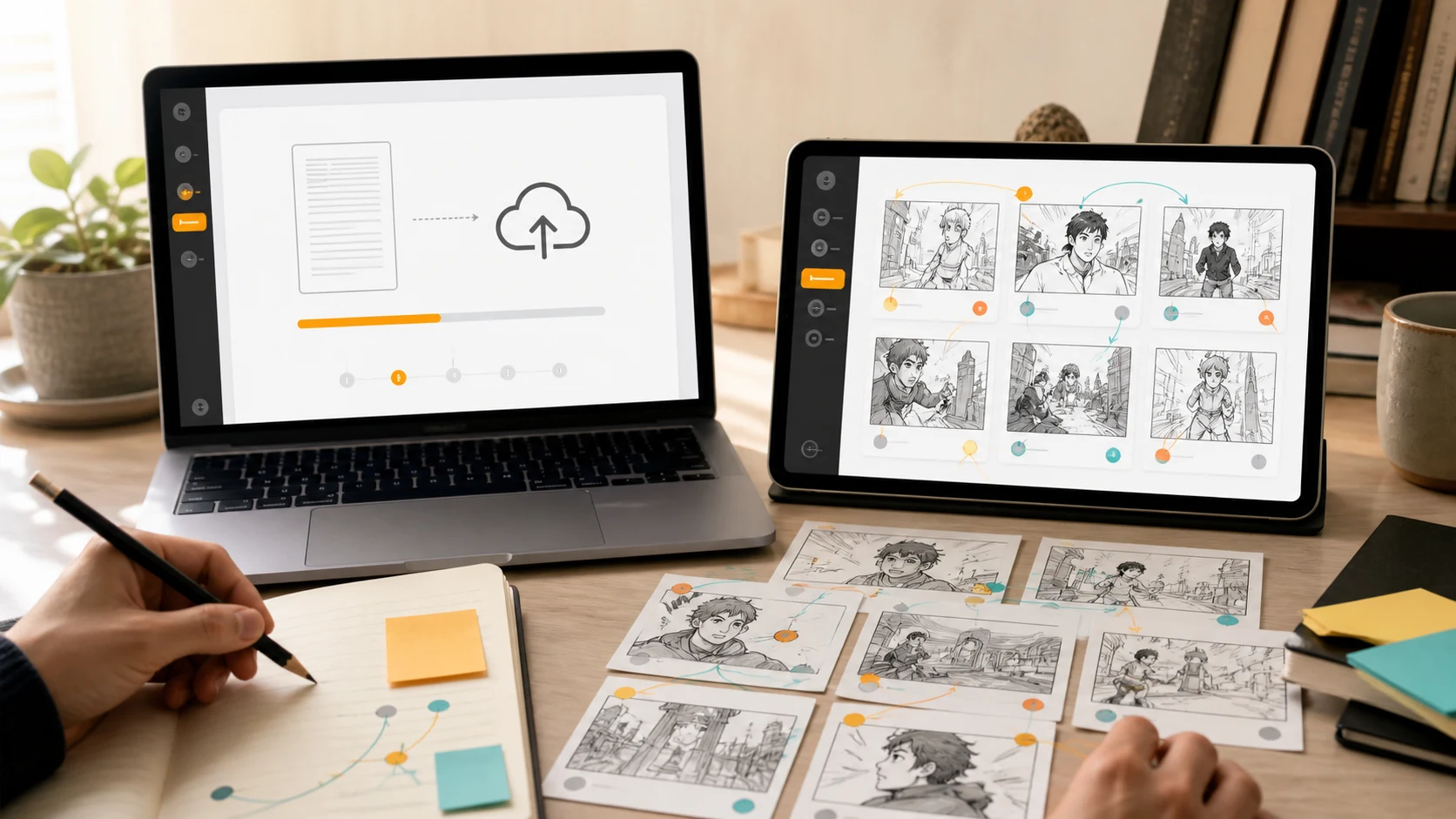
The fastest starting point is to upload the chapter to LlamaGen.AI Upload and ask for a beat map before generating panels.
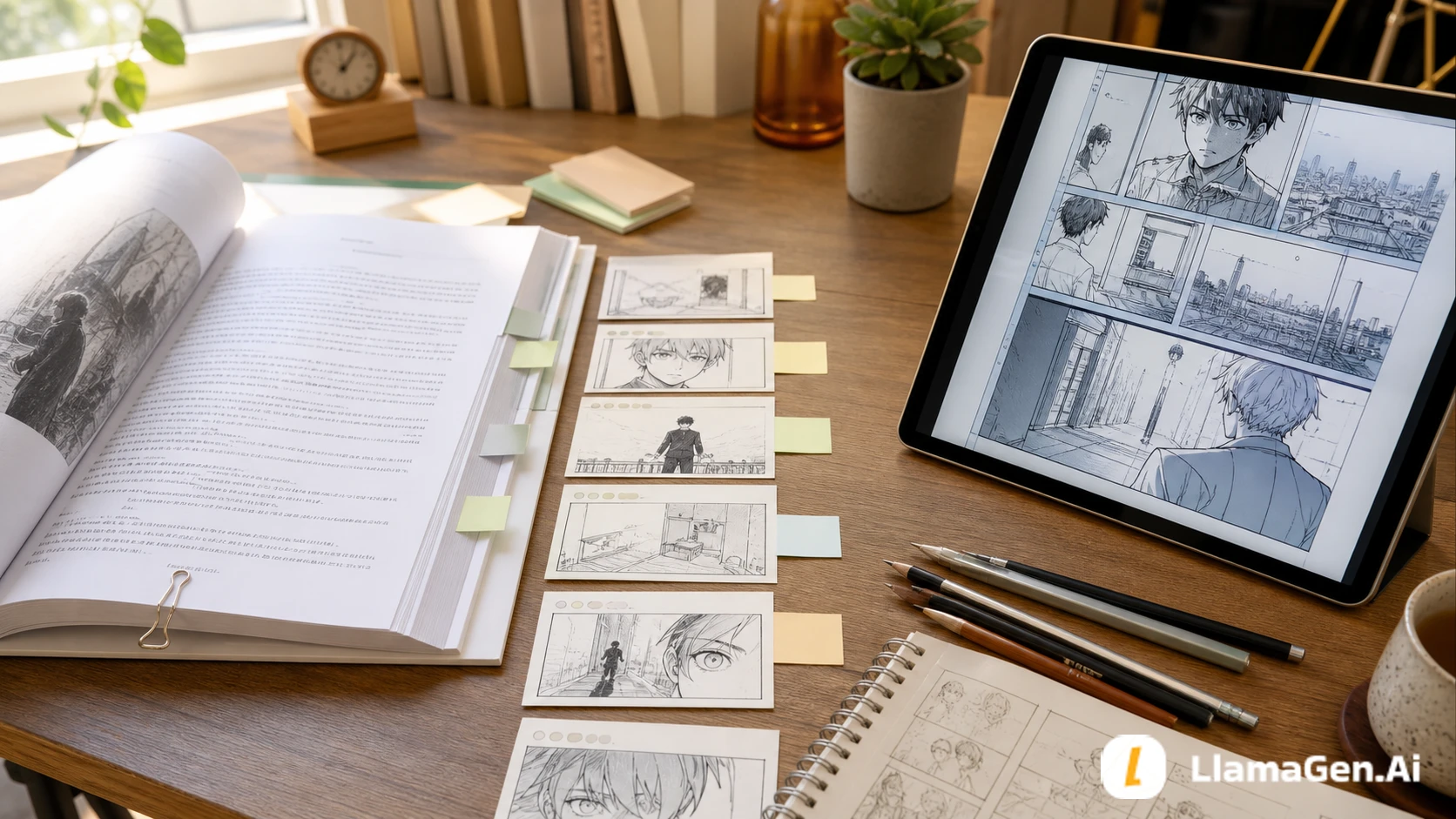
Novel chapters often mix several kinds of material:
| Chapter material | What it becomes visually |
|---|---|
| Scene opening | Establishing image |
| Character desire | Clear action or blocked goal |
| Description | Location signal or mood reference |
| Dialogue | Speech bubbles, captions, or visual silence |
| Internal thought | Expression, posture, object, or camera distance |
| Turn | Panel reveal or scroll beat |
| Ending hook | Page turn, vertical cliffhanger, or visual novel choice |
If you skip the beat pass, the comic usually becomes either too text-heavy or too random.
This tutorial uses one original chapter summary and converts it into a comic beat plan.
A rundown of the latest LlamaGen feature releases, product enhancements, design updates, and important bug fixes.
| Test item | Setup |
|---|---|
| Date tested | August 24, 2026 |
| Source | One chapter from a fictional long-form story |
| Main tool entry | LlamaGen.AI Upload |
| Target output | Beat map, 6-panel plan, revision checklist, visual novel variant |
| Creator stage | Before final comic generation |
| Active editing time | About 24 minutes |
| Total elapsed time | About 49 minutes including one repair pass |
| Editorial note | This is a workflow test for writers, not a speed or pricing benchmark. |
The test question was:
Can one prose chapter become a visual beat map without losing the chapter's emotional turn?
Here is the chapter summary:
Eli works the night shift in a closed coastal library. He is waiting for the storm to pass so he can go home, but the oldest reading room keeps unlocking itself.

Inside, the atlas table is open to a page that did not exist yesterday. The map shows the town as it will look tomorrow after the tide rises.

Eli wants to leave, but his sister's name is written beside the flooded pier.

The chapter ends when he finds a ferry token under the atlas. It is warm, as if someone has just used it.
The chapter has a clean structure:
ordinary night -> impossible room -> future map -> personal stake -> warm token hook
That structure is the adaptation spine.
Start by identifying the chapter promise. In this example:
The library knows tomorrow before Eli does.
Now break the chapter into visual beats.
| Beat | Visual question | Panel purpose |
|---|---|---|
| Opening image | Where are we? | Closed coastal library at night |
| Character want | What does Eli want? | He wants to finish shift and leave |
| Pressure | What stops him? | Reading room unlocks itself |
| Reveal | What is impossible? | Atlas shows tomorrow's flood |
| Personal stake | Why does it matter? | Sister's name appears beside the pier |
| Choice | What must Eli do? | Leave or investigate |
| Hook | What image ends the chapter? | Warm ferry token in his hand |
This map is enough to begin comic planning.
A chapter may have 2,000 words, but the comic page may need only six to ten visual decisions.
Use this filter:
| Prose passage | Beat decision |
|---|---|
| Library description | One establishing panel |
| Storm atmosphere | Background and lighting, not separate panels |
| Eli's boredom | One posture or action |
| Door unlocking | One clear sound or motion beat |
| Future map | One large reveal panel |
| Sister's name | Close-up insert |
| Ferry token | Final hook panel |
You are not shrinking the chapter. You are choosing what the reader must see.
For a first sample, six panels are enough.
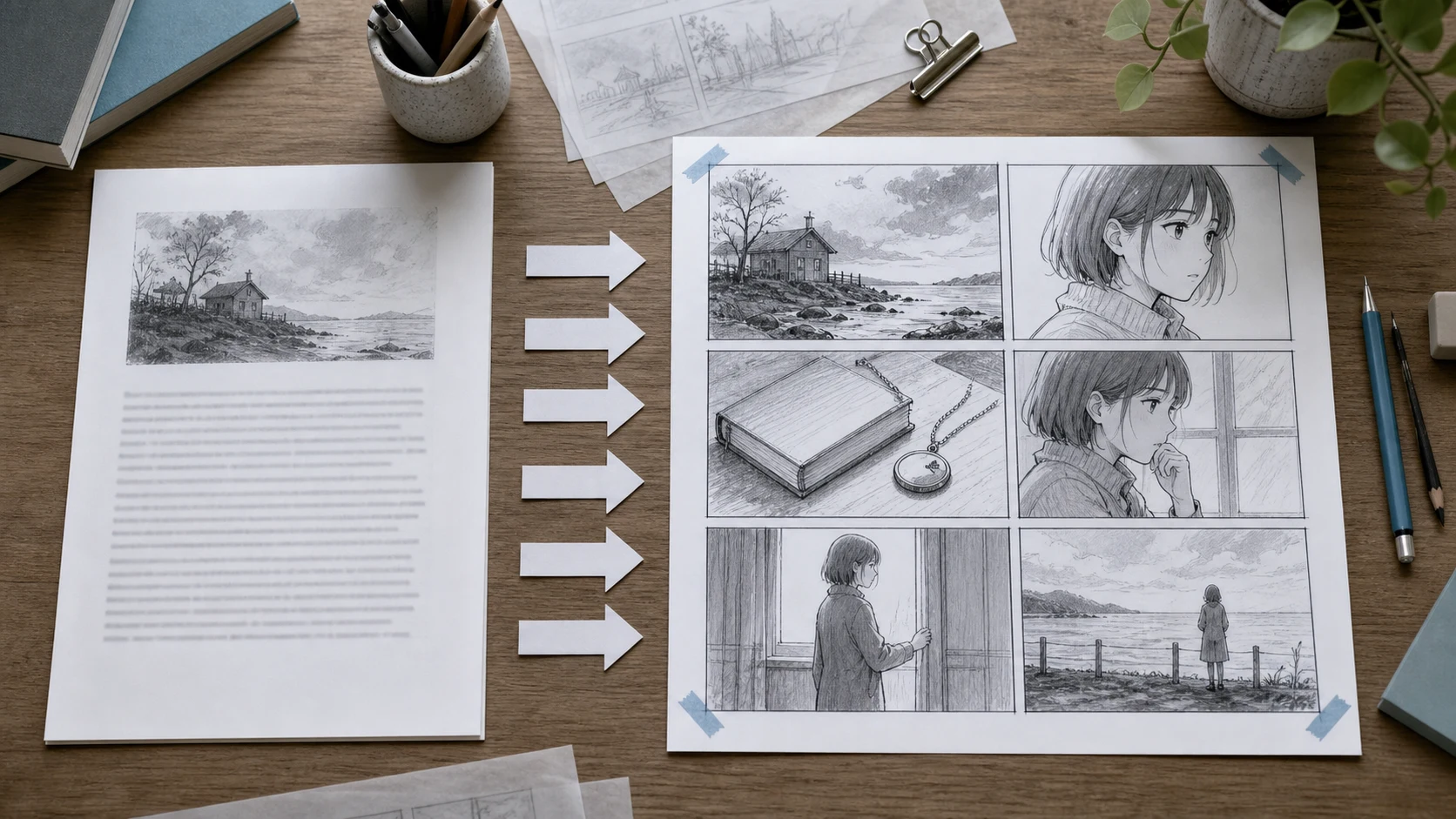
Here is a compact panel plan:
| Panel | Camera | Image | Story job |
|---|---|---|---|
| 1 | Wide | Closed library, storm outside | Establish isolation |
| 2 | Medium | Eli checks the locked reading room | Show ordinary routine |
| 3 | Close | Door latch turns by itself | Introduce pressure |
| 4 | Wide | Atlas table open under one lamp | Reveal impossible space |
| 5 | Insert | Sister's name beside the pier | Make the danger personal |
| 6 | Close | Warm ferry token in Eli's hand | End with hook |
This page plan works because every panel changes the reader's information.
Use LlamaGen.AI Upload when you have a real chapter, draft, outline, or scene file.
Use this instruction:
I am adapting this novel chapter into comic beats.

Please return:
1. The chapter promise in one sentence.
2. The emotional turn.
3. The 6-10 visual beats.
4. What to cut, keep, and visualize.
5. A panel plan for a sample comic page.
6. A webtoon scroll version.
7. A visual novel scene version.
8. Character, location, and prop continuity notes.
9. A repair checklist for weak panels.

Do not rewrite the whole chapter. Turn it into visual production decisions.
Then upload the chapter and review the result as a plan, not a final script.
One chapter can become multiple visual outputs.
| Output | Beat count | Best structure |
|---|---|---|
| Comic sample page | 6-8 beats | One clear page turn |
| Manga scene | 8-12 beats | More reaction and silence |
| Webtoon episode | 10-18 beats | Vertical rhythm and cliffhanger |
| Visual novel scene | 5-9 beats | Background, dialogue, choice, result |
| Pitch deck sample | 4-6 beats | Fast proof of tone and character |
If the goal is to test adaptation quality, begin with one sample page. If the goal is a reader-facing webtoon, expand the same beats into scroll rhythm.
Before final generation, write a small continuity packet.
| Asset | Notes to lock |
|---|---|
| Eli | Age range, silhouette, hair, clothing, recurring expression |
| Library | Coastal town, old reading room, lamp, atlas table, storm windows |
| Atlas | Large book, map page, worn paper, central reveal object |
| Ferry token | Small round object, warm light, final hook |
| Mood | Quiet, tense, investigative, not action-heavy |
This gives every panel the same story universe.
For visual novels, the same beat map becomes scene logic:
| Beat | Visual novel asset |
|---|---|
| Library night | Background |
| Eli notices door | Sprite expression change |
| Atlas reveal | CG scene or close-up |
| Sister's name | Insert image |
| Leave or investigate | Choice |
| Warm token | Scene ending image |
The key is choice placement. Do not branch before the reader understands the stakes.
The failed version used this prompt:
Convert each paragraph of this chapter into a comic panel.
It created too many panels and weak pacing.
| Problem | Cause | Fix |
|---|---|---|
| Too many quiet panels | Paragraphs were treated as panels | Use beats, not paragraphs |
| The hook felt small | No final image priority | Reserve the last panel for the token |
| Character motivation was unclear | Eli's want was not named | Define the chapter promise first |
| The visual novel choice felt random | Stakes arrived too late | Put sister's name before the choice |
| Backgrounds drifted | No location packet | Lock library and atlas references |
The repair was to rebuild the beat map.
Before generating panels, confirm:
| Question | Pass condition |
|---|---|
| What does the chapter promise? | One visual sentence |
| What does the character want? | Visible action or blocked goal |
| Where is the turn? | One beat changes the reader's understanding |
| What image ends the sample? | Strong hook panel |
| What can be cut? | Any prose repeated by image |
| What must stay consistent? | Character, location, prop, mood |
For a first test, use one page or one short scroll section. You are testing whether the story becomes visual, not adapting the whole book.
No. Use panels for changes in information, emotion, action, or suspense. Summary and atmosphere can often become one strong image.
Yes. Convert beats into background states, sprite expressions, CG moments, and choice timing.
Start with LlamaGen.AI Upload. Upload one chapter, ask for a beat map, then turn the strongest beats into storyboard panels.
The best chapter adaptation is not a direct conversion. It is a beat map.
Upload one chapter to LlamaGen.AI Upload, identify the chapter promise, choose six to ten visual beats, and build the comic or visual novel scene from those decisions.
Popular creator tools
Go from comics and storyboards to stylized photos with LlamaGen.
Visualize every scene before production starts.
© 2026 LlamaGen.Ai All rights reserved
Leading the Future of AI Comic Generation