Internal monologue should not be copied into comic captions by default.
First, ask what the thought does:
thought -> story job -> visible evidence -> panel choice
Then choose whether the thought becomes an expression, a body action, a prop, a setting detail, a caption, a speech bubble, or silence.
For a faster first pass, upload your prose scene or chapter to LlamaGen.AI Upload and ask for a visual panel brief before generating the final page.

Novelists can spend a full paragraph inside a character's head. Comics and manga can do that too, but the page pays for every word with space, pacing, and reader attention.
The common mistake is treating every thought as caption text:
| Prose habit | Comic problem | Better move |
|---|---|---|
| Explaining emotion | The panel repeats what the face already shows | Let expression carry the first layer |
| Long reflective paragraphs | The page becomes crowded | Keep one sharp caption, then show behavior |
| Abstract guilt or fear | The image has nothing concrete to draw | Attach the thought to an object or action |
| Repeated hesitation | Multiple panels feel static | Show one strong pause, then force a choice |
| Memory summary | Backstory stops the current scene | Use one flash image, prop, or location echo |
The goal is not to remove interiority. The goal is to make interiority visible.
This tutorial uses an original prose scene and turns it into a comic panel plan.
| Test item | Setup |
|---|---|
| Date tested | August 25, 2026 |
| Source | One fictional prose scene with heavy internal monologue |
| Target output | Comic page, manga page, webtoon section, visual novel scene |
| Main tool entry | LlamaGen.AI Upload |
| Output needed | Thought map, panel brief, caption plan, revision checklist |
| Active editing time | About 22 minutes |
| Total elapsed time | About 46 minutes including one failed pass |
| Editorial note | This is a workflow test for writers, not a pricing benchmark. |
The test question was:
Can a writer preserve a character's private thoughts while making the comic page readable?
Here is the prose scene:
Nadia stood outside the rehearsal room with her hand on the doorknob.

She told herself she was only late because the subway stalled, not because she had spent ten minutes staring at the message from her brother.

He had written: "Dad asked if you are still coming Sunday."

Nadia had typed five replies and deleted all of them.

Inside the room, the piano started without her. The first note was wrong. It was the same wrong note she used to play when she was twelve, before her father stopped coming to recitals.

She wanted to laugh at the coincidence, but her throat closed.

The doorknob clicked under her hand before she turned it.
This scene has almost no physical action. That is why it is a useful test. The emotion is mostly in delay, memory, family pressure, and one impossible sound.
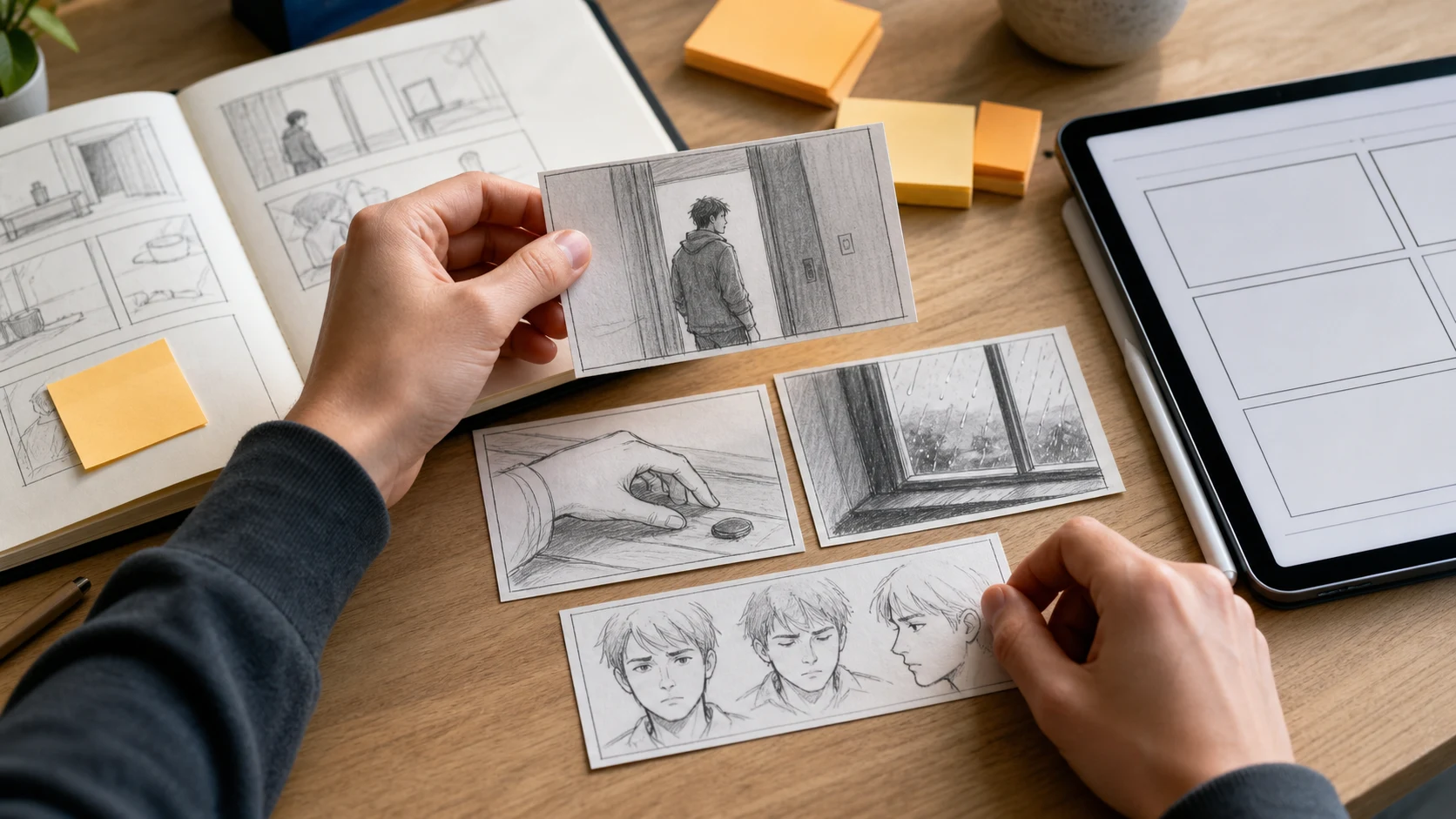
Do not begin with panels. Begin with the job of each thought.
| Internal material | Story job | Visual evidence |
|---|---|---|
| Nadia blames the subway | Denial | She checks the time, but keeps looking at the phone |
| She deleted five replies | Avoidance | Draft bubbles on the phone can stay unreadable, or use repeated thumb movement |
| Father's Sunday question | Pressure | Her grip tightens around the phone |
| The wrong piano note | Memory trigger | Her face changes before she opens the door |
| Throat closes | Body reaction | Hand pauses on doorknob, breath held |
| Doorknob clicks first | Hook | The door becomes active before she chooses |
This converts prose into production decisions. The panel does not need to explain everything. It needs to show enough evidence for the reader to infer the thought.
A thought can enter a comic page through several containers.
| Container | Best for | Example from the scene |
|---|---|---|
| Expression | Immediate emotion | Nadia hears the wrong note and freezes |
| Body action | Resistance or desire | Her hand stays on the knob but does not turn |
| Prop | Concrete pressure | Phone message, rehearsal bag, old music sheet |
| Setting | Mood and subtext | Empty hallway outside a warm rehearsal room |
| Caption | Precise voice | "I can still miss Sunday if I never answer." |
| Dialogue | External conflict | Someone inside calls her name |
| Silence | Weight | One panel with only the door and her hand |
Captions are not the enemy. Bad captions are the problem.
Use captions when the exact sentence matters. Use panels when the reader can understand the thought by seeing its consequence.
Before generating panels, set a strict caption budget.
| Page type | Caption budget | Why |
|---|---|---|
| 6-panel comic page | 1-3 short captions | Enough for voice without crowding |
| Manga mood page | 0-2 captions | Let silence and close-ups carry the scene |
| Webtoon section | 1 short caption every 3-5 scroll beats | Keeps vertical rhythm clean |
| Visual novel scene | More internal text allowed | The format expects prose and choice logic |
For this scene, the best caption plan is:
Panel 1: no caption.
Panel 2: "I was only late because of the train."
Panel 3: no caption.
Panel 4: "Five replies. None sent."
Panel 5: no caption.
Panel 6: no caption.
Panel 7: "The first note was wrong."
Panel 8: no caption.
That keeps Nadia's voice while leaving room for images.
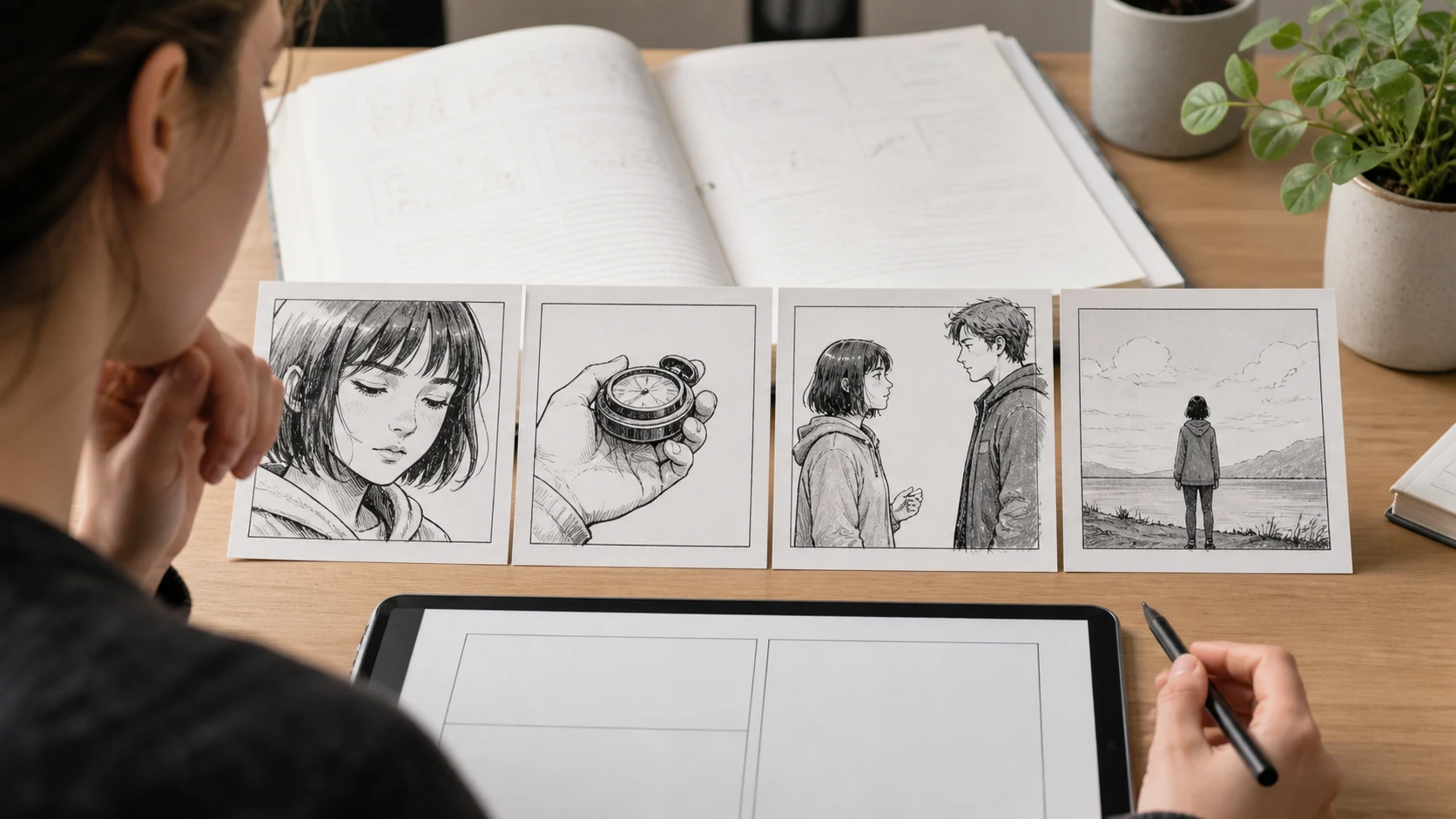
Now write the panel plan.
| Panel | Camera | Image | Thought represented |
|---|---|---|---|
| 1 | Wide | Empty hallway, rehearsal room door, Nadia arriving late | Avoidance |
| 2 | Insert | Phone in her hand, message visible only as unreadable blocks | Family pressure |
| 3 | Close | Her thumb hovering above reply field | Deleted replies |
| 4 | Medium | Her hand touches doorknob but stops | She does not want to enter |
| 5 | Interior cutaway | Piano keys, one finger striking a note | Memory trigger |
| 6 | Close | Nadia's face hears it before the reader knows why | Recognition |
| 7 | Flash image |
The internal monologue is still present. It has simply moved from explanation into visible pressure.
Use LlamaGen.AI Upload when you have a real chapter, scene, outline, or script file.

Use this instruction:
I am adapting this prose scene into comic panels.

Please return:
1. The internal monologue inventory.
2. The story job of each thought.
3. Which thoughts should become visible actions.
4. Which thoughts should remain captions.
5. Which thoughts should become props, setting, expression, or silence.
6. A 6-8 panel plan.
7. A caption budget.
8. Character continuity notes.
9. A revision checklist for text-heavy panels.

Do not copy the prose sentence by sentence. Preserve the character's private emotional logic and make it readable visually.
Then upload the manuscript or chapter to LlamaGen.AI Upload. Treat the result as a planning document first, not as the final page.
If a page feels slow, find the repeated information.
| Problem | Likely cause | Repair |
|---|---|---|
| Every panel has a caption | The prose voice was copied directly | Keep only the sharpest inner line |
| The character looks passive | All conflict stayed in narration | Give the body a visible decision |
| The reader misses the emotion | The visual evidence is too subtle | Add a prop, close-up, or reaction beat |
| The page feels melodramatic | Captions over-explain the feeling | Replace explanation with silence |
| The hook is weak | The final thought is abstract | End on an object, action, or reveal |
For Nadia's scene, the weak version used four captions in the first two panels. The stronger version made the phone, doorknob, and wrong note do more work.
Use this when revising a prose scene.
| If the prose says... | Try showing... |
|---|---|
| "She regretted it." | A hand stopping before touching the object tied to the mistake |
| "He felt watched." | A reflective surface, an open doorway, or a figure-shaped shadow |
| "They did not trust each other." | Two characters framed apart, with an object between them |
| "She remembered childhood." | One specific recurring prop, costume detail, or location echo |
| "He was ashamed." | A face turned away from light, not a caption saying shame |
| "She decided to leave." | Shoes turning, bag lifted, last look at the room |
| "He could not say it." | Speech bubble withheld, mouth closed, hands doing the talking |
Good comic adaptation is often less about inventing more plot and more about choosing the one visible detail that carries the thought.
| Stage | Writer action | Output |
|---|---|---|
| 1. Upload | Send the scene to LlamaGen.AI Upload | Thought inventory |
| 2. Map | Assign each thought a story job | Adaptation table |
| 3. Choose | Pick expression, action, prop, setting, caption, dialogue, or silence | Panel strategy |
| 4. Brief | Create a 6-8 panel page plan | Generation-ready prompt brief |
| 5. Generate | Produce a first comic or storyboard pass | Visual draft |
| 6. Repair | Remove repeated captions and strengthen visual evidence | Cleaner page |
This workflow is especially useful for novelists, memoir writers, screenwriters, and visual novel creators who already have strong prose but need a readable visual sequence.
Before final panel generation, confirm:
| Question | Pass condition |
|---|---|
| Does every panel change the reader's information? | Yes |
| Is the main emotion visible without reading every caption? | Yes |
| Are captions short enough to leave breathing room? | Yes |
| Is at least one internal thought carried by a prop or action? | Yes |
| Does the final panel end on a visual hook? | Yes |
| Are character, setting, and prop details consistent? | Yes |
If the answer is no, revise the panel brief before generating final art.
Yes. Comics can use internal monologue, but it works best when captions are selective and the image carries part of the thought.
If the caption says exactly what the character's face, pose, or setting already says, remove or shorten it.
Yes, but do it in passes. Upload the chapter to LlamaGen.AI Upload, ask for an internal thought inventory, then adapt the most important thoughts into visible beats.
Use objects, pauses, posture, distance, light, and interruptions. A scene does not need action spectacle to become visual.
Start with a panel brief or storyboard. Generate polished panels after the thought-to-visual map is clear.
Internal monologue is not a problem to delete. It is a signal to translate.
When you turn thought into evidence, the reader gets both sides of the scene: what the character hides inside and what the page lets us see.
Upload your scene to LlamaGen.AI Upload, ask for a thought-to-panel brief, and build the comic from visible emotional logic instead of copied prose.
Popular creator tools
Create comics, storyboards and stylized photos with LlamaGen.
Turn an idea into polished comic strips in minutes.
Create comics with AI02Create expressive manga art and multi-panel stories.
Create manga with AI03Visualize every scene before production starts.
Create storyboards with AI04Transform any photo into a comic-style illustration.
Create comics from pictures with AI05Build shareable strips with characters that stay consistent.
Create comic strips with AIA rundown of the latest LlamaGen feature releases, product enhancements, design updates, and important bug fixes.







| Younger Nadia at a recital bench, empty chair in audience |
| Past wound |
| 8 | Insert | Doorknob clicks under her hand | Hook |
© 2026 LlamaGen.Ai All rights reserved
Leading the Future of AI Comic Generation