A weekly target of 240 comic panels is not the same as 240 image requests. A six-panel page can come from one request, and a paid request can still leave you with panels you cannot publish. Budget around approved story panels, and record generation actions and repair work separately.
The target here comes from a Reddit creator describing four ten-page, six-panel comics per week. That equals 4 × 10 × 6 = 240 intended panels. Their comments about subscription allowances reflect the poster's experience and expectations, not verified provider policy or a pricing source for this article.
If you are building the workflow in LlamaGen.AI, start with a small sample before committing a full weekly story. This article shows how to count that sample and where the unknown costs still belong.
Measured scope — November 28, 2026: we generated three six-panel pages, then made two individual-panel repair requests through direct Google Vertex image calls. We retained all raw outputs and usage receipts. We did not make 240 panels, measure a full production week, run these calls through LlamaGen.AI billing, or obtain a settled currency invoice. Monetary AI comic cost per panel is therefore unknown, not zero.
Define the unit you actually need to deliver
For the Reddit production target, the delivery unit is a comic panel that completes an intended story beat in a finished page. A page image, a depicted panel, a generation action, and an approved beat are different counts.
Unit
What it means in this sample
Page generation action
One image request asking for six panels
Candidate panel
One depicted cell in a generated page, or one individual repair
Approved beat
One target beat accepted after visual review
Repair action
Related hot tags
Truyện tranh AI
Trình tạo OC
Hướng dẫn
Comic Production
Công cụ tạo nổi bật
Biến cảm hứng thành câu chuyện tiếp theo của bạn
Tạo truyện tranh, storyboard và ảnh phong cách với LlamaGen.
Khơi dậy ước mơ cho thế hệ trẻ Nơi hàng triệu câu chuyện trở nên sống động
Tổng hợp các tính năng mới nhất của LlamaGen, cải tiến sản phẩm, cập nhật thiết kế và các bản sửa lỗi quan trọng.
✦
✧
✦
✧
Một phương tiện mới cho Kể chuyện
Thỏa sức tạo ra không giới hạn câu chuyện, truyện tranh, hoạt hình, trò chơi và hơn thế nữa—chỉ trong vài giây, phù hợp với khán giả hiện đại
One additional request aimed at a failed target beat
Finished panel
A panel that also meets your lettering, layout, resolution, and delivery requirements
Our acceptance threshold here is storyboard candidate. We checked for a recognizable Maya design, readable intended action, the current red-notebook state, and major location or prop relationships where visible. We did not require lettering, print detail, anatomical perfection, or final publication polish. Occluded details were not assumed correct.
This threshold matters. A team with stricter standards for hands, costume consistency, or backgrounds could reject more of the same images.
Run a small sequence with a real continuity dependency
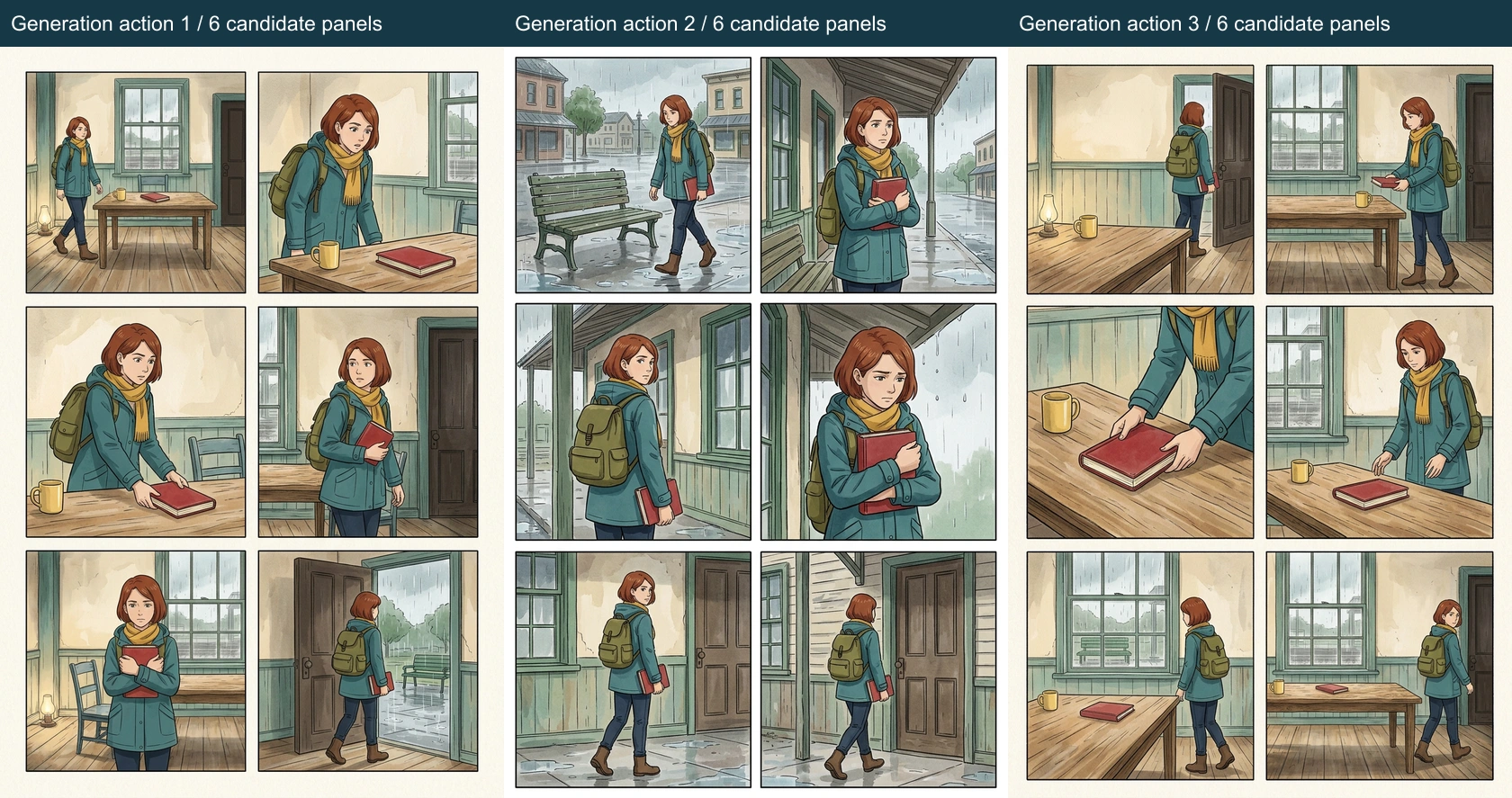
We reused Maya's approved design and the station-room reference, and generated a separate red-notebook reference. The story is simple enough to audit but still includes continuity dependencies:
Page 1: Maya enters, notices and picks up the notebook, looks toward the door, holds it, and leaves carrying it.
Page 2: she pauses outside near a green bench, looks back, and returns toward the station.
Page 3: she comes back inside, puts the notebook on the table, releases it, checks the window, and leaves it behind.
Each page request asked for two columns by three rows, read left to right and then down. Each request supplied the same character, indoor location, and notebook references. The exterior geography was less constrained than the interior, which is a limitation of this sample.
These are the actual initial page outputs. They document a small test, not a finished three-page comic: some beats remain unapproved.
A shot-ready character pack and a location bible can make the review standard more explicit. They do not remove the need to inspect action clarity and prop state in the results.
Count failed beats before repairing them
At the stated storyboard threshold, we accepted 15 of the initial 18 candidate panels and withheld approval from three:
Target
Reason for withholding approval
Page 1, panel 4
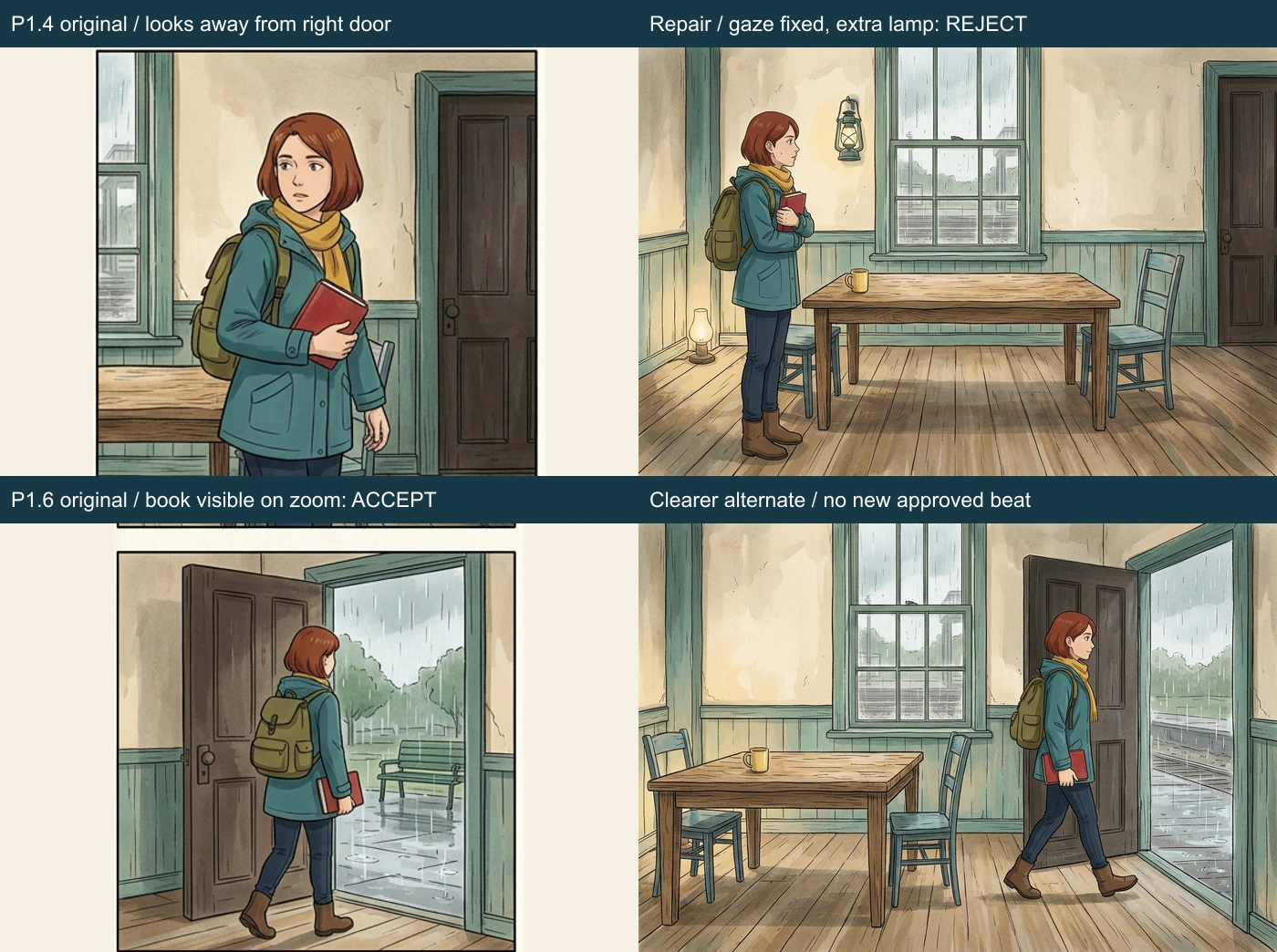
Maya looks left, away from the wooden door shown at right
Page 3, panel 1
Maya faces toward the doorway; returning into the room is not clearly shown
Page 3, panel 2
The yellow mug shifts toward the right side of the table in the room view
A full-resolution zoom corrected our first review of the exit image: the red notebook edge and cream pages are visible beside Maya's hand. That original panel passes at the stated threshold. Inspect the source at useful resolution before spending on a replacement.
The accepted candidates still vary in drawing detail, room scale, and framing. This review table reflects an editorial decision under the declared threshold, not an objective quality grade.
Treat repairs as new candidates, not guaranteed fixes
We made two additional individual-panel requests for page 1 panels 4 and 6, using the approved references and clearer action instructions. The exit request was made before the zoom correction and is retained as actual extra work.
The gaze repair puts Maya facing the right-hand door, but adds a second hanging lamp while the original floor lamp remains. We rejected it under the same location rule. The exit alternate shows the notebook more prominently as she moves through the door at right. We accepted it as a clearer alternate of an already approved beat; it adds no new unique approved panel.
These are separate candidate images for the target beats. We have not composited them back into a finished page or verified final page layout. That editing work belongs in the production budget too.
The two additional requests produced one accepted alternate and one rejected candidate. Three of the original eighteen target beats remain unresolved at this stopping point. Stopping is part of the record; this article does not present the sequence as complete.
Use the right denominator
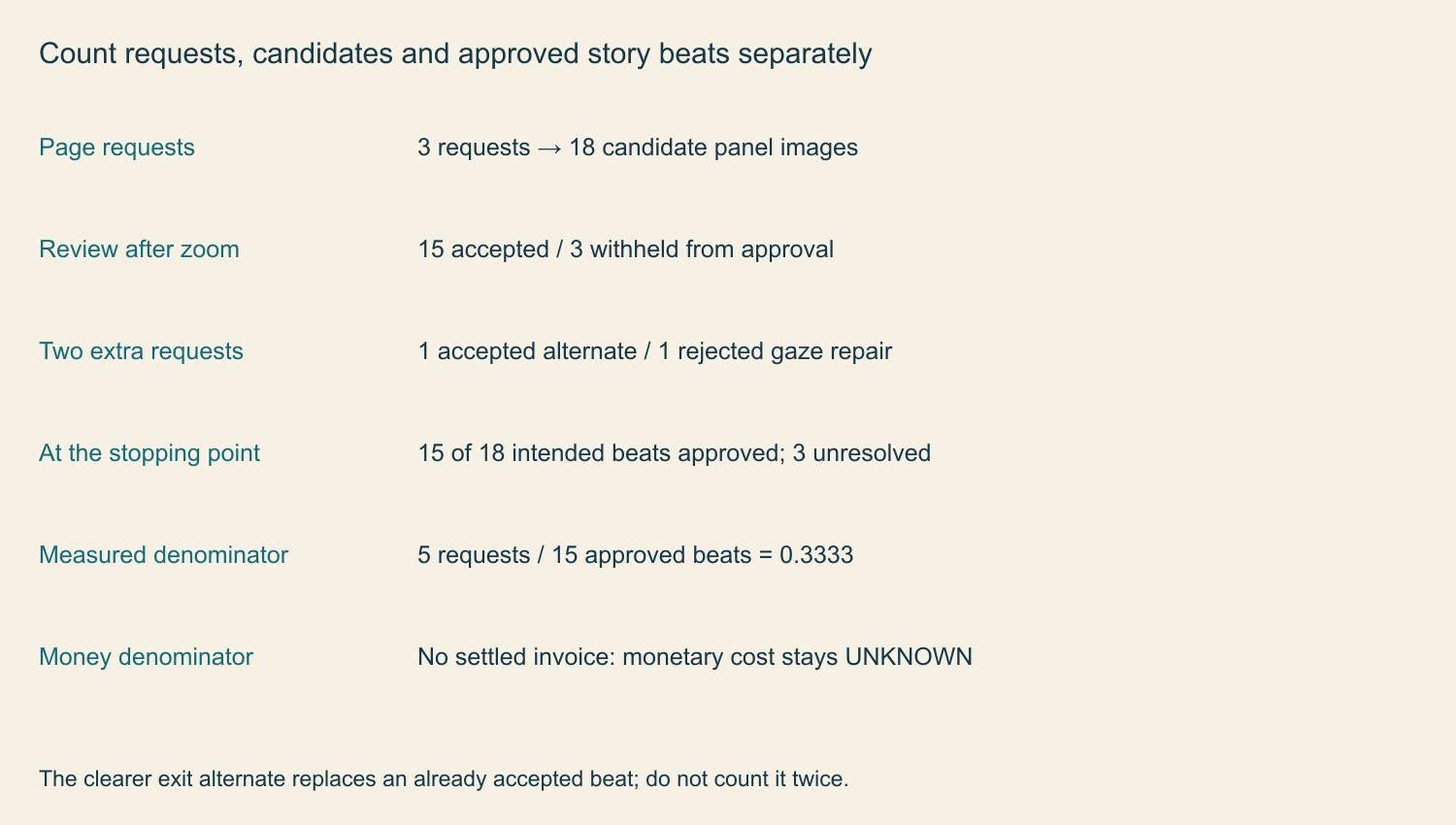
The measured counts are:
Metric
Observed value
Initial page requests
3
Initial candidate panels
18
Initially accepted panels after zoom review
15
Repair requests
2
Accepted additional candidates
1 alternate, no new unique approved beat
Total generation requests in this production sample
5
Total candidates, including repairs
20
Unique target beats approved at stopping point
15
Intended beats still unresolved
3
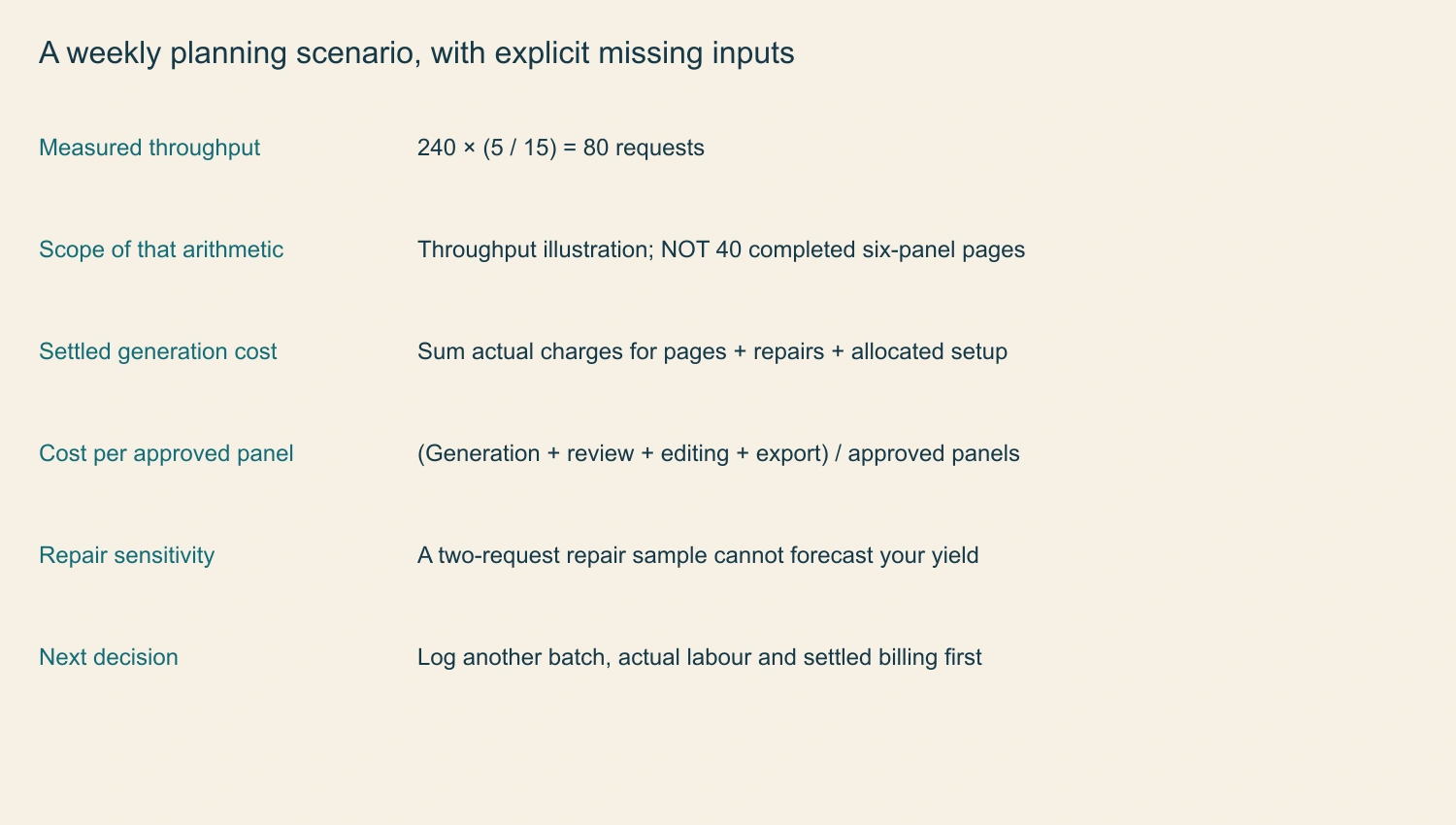
So the sample used 5 / 15 = 0.3333 generation requests per approved beat. That ratio combines six-panel page generation with single-panel repairs; it is not a provider billing unit.
If the settled generation cost for those five requests were G, then generation cost per approved beat would be G / 15. Since G is unavailable, we cannot publish a measured dollar figure. Do not divide an assumed subscription price by 18 and call that the cost of an approved panel.
Keep usage receipts separate from currency costs
The downloadable request log contains the actual model identifier, per-request elapsed duration, and returned usage metadata, including the token fields the service reported. It does not contain credentials or any claimed conversion into Studio credits.
Token totals are not the same as a settled invoice. Different token modalities or billing categories may require different treatment, and account discounts, regional rules, or later adjustments can matter. Obtain the actual charge associated with your request batch, or reconcile it against the correct billing record, before filling in the currency fields.
The five-call sample also excludes editorial cover generation and the separate twelve-output character-reference comparison. It excludes setup allocation as well: Maya and the station were reused from earlier work, and the notebook reference was generated separately. This production sample is therefore a marginal generation record, not an all-in project cost claim.
For an all-in comparison, use an explicit formula:
Cost per approved panel =
  (settled page-generation charges
   + settled repair-generation charges
   + allocated character/location/prop setup
   + measured review labour
   + editing, lettering and export costs)
  / unique approved panels
Count a replaced beat once in the denominator. Include rejected attempts in the numerator. If setup will support several episodes, record how you allocate it instead of letting it disappear.
We did not time human review or editing work and have not assigned an hourly wage. Client request duration is not human labour and cannot fill that gap.
Plan the 240-panel week as a scenario, not a promise
A straight-line illustration is 240 × (5 / 15) = 80 requests. This scales the sample's observed throughput mix. It does not promise forty complete six-panel pages: some sampled beats remain unresolved, and selecting enough acceptable beats from more pages is not the same as completing a fixed script.
For a fixed forty-page story, start with forty six-panel page requests only if that generation shape actually fits your workflow. Then budget additional requests, review, and editing to resolve the failed beats that matter for delivery. The initial sample accepted 15 of 18, but three pages are too few to forecast a stable page yield. Two repairs are also far too few to estimate a long-run repair success rate.
Use your next sample to answer practical questions:
Does a different scene increase failures, especially with two-character staging or hand-object actions?
Can you repair one panel without regenerating approved neighboring panels?
How much actual review, lettering, and page assembly time is required?
What are the settled charges for each request type?
Which rejected beats block delivery of an otherwise usable page?
Keep a budget limit and a delivery rule separate. “Stop after two repairs” controls spending; it does not mean the page is complete. If the limit is reached, choose an editorial rewrite, a manual correction, or a later production slot, and record that decision.
The worksheet is an editable accounting template, not an automatic quote or subscription recommendation. Use one consistent currency and avoid double-counting costs already included in another line.
Is the cheapest image model the cheapest comic workflow?
Not necessarily. Compare the cost of approved, delivered panels under the same review standard, including repairs and labour. This sample does not rank providers or prove that one is cheaper.
Does one six-panel page count as six paid image calls?
In this test, it was one image request with six depicted cells. Other tools may price requests, pages, panels, tokens, or credits differently. Check the actual billing unit rather than inferring it from the layout.
Can this sample establish a weekly production budget?
It establishes a logging method and a small observed request-to-approval ratio. You still need the monetary inputs, full-page finishing work, and a representative weekly sample.
If you are using LlamaGen.AI for your next comic, run a bounded sample first and make the approval ledger part of your production plan before scaling to a weekly target.