

Three-Panel Comic Strip Template: A Short Story in Three Beats
Example preview
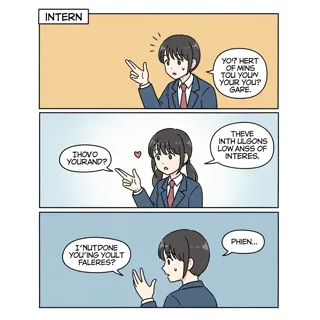
Build a quick three-scene comic using a top, center, and bottom sequence. Make the middle panel change the situation and let the last panel deliver the result.
For creators who need a compact beginning, middle, and end. The stored template prompt specifies TOP, CENTER, BOTTOM, making a vertically read strip the starting point.
When to use this template
- A visual joke built around expectation and reversal
- A three-stage classroom observation
- A short character introduction for a social post
Build your first draft
Choose one expectation
Write a first beat that tells readers what the character wants. Keep that goal small enough to resolve in two more images.
Use the center for change
Show the obstacle or discovery in the middle. Reuse a prop or pose from the first beat so readers can follow the change quickly.
Make the bottom the answer
Give the final panel enough space for the result. Preview the strip at phone width to see whether its faces and props remain readable.
Try a complete example
The plant sitter
Three vertically stacked comic panels, top center bottom. Top: a student in a yellow sweater waters a drooping houseplant. Center: the student measures sunlight with a worried expression. Bottom: the healthy plant now shades a sleeping cat. Same windowsill, soft daylight, simple cartoon linework, no text.
The repeated windowsill fixes the setting while the plant changes. The final cat reveals the outcome without requiring a separate explanatory caption.
Before you publish
- Avoid introducing a new location in every panel when the strip is meant to read in seconds.
- Check that the middle image is a new event rather than a duplicate of the setup.
Questions about this template
- Is this a horizontal strip?
- The starting prompt asks for top, center, and bottom panels. You can request a horizontal arrangement, but inspect the generated image rather than assuming the layout changed correctly.
- How is it different from four panels?
- Three beats leave little room for a second complication. Use four panels when the reaction needs its own moment after the main event.
- Can a lesson fit into three panels?
- Yes, if it is one observation or procedure: prediction, action, result. A process with several decisions needs more panels or a separate explanatory note.