
A bus company does not only move people from one stop to another. It teaches a city how to share space.
Every rider sees the same small public messages: give up priority seats, board from the right door, move inside the bus, hold the handrail, keep bags out of the aisle, wait behind the curb, and help older passengers or riders with special needs. Those rules are simple, but a wall of text is easy to ignore.
Comics solve a very practical communication problem. They show a situation, a choice, and the better action in a few seconds. A passenger can understand the message even while standing in a queue, looking at a phone, or riding past a sign.
That is why AI comics are useful for bus operators, city agencies, schools, and public-service teams. With LlamaGen.AI's AI comic creator, a transit team can turn a safety rule into a friendly rider tutorial without waiting for a full illustration production cycle.
Bus comics are not only marketing assets. They can support city-building in small but visible ways.
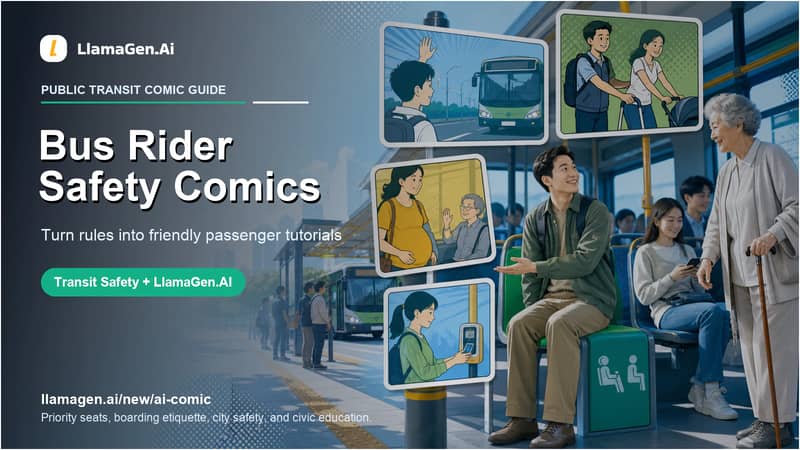
They can make shared rules feel less like warnings and more like social norms. A short comic can show a student offering a seat to an older rider, a commuter folding a stroller before boarding, or a group waiting behind the curb until the bus stops.
They can also reduce language barriers. Many transit systems serve tourists, children, older adults, immigrant communities, and riders who are not fluent in the dominant local language. A well-designed comic can make the core action clear before the caption is translated.
And they can make safety feel concrete. "Be careful near buses" is abstract. A four-panel comic showing a child stepping back from the curb, making eye contact with the driver, boarding calmly, and holding the rail is easier to remember.
A bus operator can start with topics that are already part of passenger education:
| Topic | Comic angle | Where to use it |
|---|---|---|
| Priority seating | A rider notices someone who needs the seat more and offers it kindly. | In-vehicle posters, social posts, school outreach. |
| Safe boarding | Riders queue, wait for the bus to stop, and board without pushing. | Bus stops, app messages, youth education. |
| Hold the handrail | A rider puts away a phone before the bus moves and holds the rail. | In-vehicle screens, short comics, onboarding. |
| Keep aisles clear | A passenger moves a bag and makes room for wheelchair access. | Posters, accessibility pages, rider guides. |
| Respect the driver | A passenger asks a question politely and avoids distracting the driver. | Internal campaigns, station signage. |
| Traffic safety | Children wait away from the curb and cross after the bus leaves. | Schools, city safety programs, community events. |
The best topics have one clear behavior. Do not try to explain ten rules in one strip. A comic is strongest when it shows one moment people recognize.
Open llamagen.ai/new/ai-comic and treat the comic like a small public-service lesson.
Start with the behavior, not the art style.
Example:
Topic: Priority seating on a city bus
Audience: everyday bus riders, including students and commuters
Goal: encourage riders to offer priority seats to older passengers, pregnant riders, disabled passengers, and people with temporary injuries
Tone: warm, respectful, not shame-based
Format: 4-panel public-service comic
This gives the AI a clear communication job.
Use a prompt that describes the sequence:
Create a 4-panel public transit safety comic for a city bus company.

Panel 1: A busy but calm city bus interior during daytime. A young commuter sits near the priority seating area and notices an older passenger with a cane boarding the bus.
Panel 2: The commuter smiles, stands up, and gestures toward the seat. Other riders make space in a friendly way.
Panel 3: The older passenger sits safely, holding the rail. The commuter stands nearby and holds a handrail.
Panel 4: A warm closing moment showing the bus moving through the city, with riders sharing space respectfully.

Style: clean modern educational comic, inclusive passengers, bright civic colors, easy-to-read expressions, no aggressive warning tone.
Avoid: shaming, crowded chaos, readable brand logos, real transit agency names, unsafe behavior.
The panel plan matters because transit tutorials must be unambiguous. A rider should instantly know what action the comic recommends.
After the first generation, review it like a transit communications team:
If one panel is weak, revise the panel instead of restarting the whole concept. For example, change "older passenger" into "older passenger with a cane" or change "gives up seat" into "stands and gestures toward the seat."
Public transit messages often need multiple languages. Keep captions short and action-based:
A rundown of the latest LlamaGen feature releases, product enhancements, design updates, and important bug fixes.
Notice who needs the seat.
Offer it kindly.
Hold the rail.
Share the ride.
Short captions translate better and leave more room for the visual.
Copy this prompt into LlamaGen.AI:
Create a 4-panel educational comic for a bus company public-service campaign.

Theme: passenger courtesy and safer rides.
Audience: city bus riders, students, commuters, older passengers, families, and tourists.
Message: small acts make public transit safer and easier for everyone.

Panel 1: Riders wait behind the curb at a clean city bus stop while the bus approaches.
Panel 2: Riders board calmly. One passenger lets an older rider and a parent with a stroller board first.
Panel 3: Inside the bus, a seated rider offers a priority seat to someone who needs it. Another rider moves a backpack out of the aisle.
Panel 4: The bus travels through a bright city street. The riders look calm, safe, and respectful.

Style: modern friendly public-service comic, clean line art, warm civic color palette, inclusive passengers, clear body language, readable panel order.
Do not include real agency logos, readable signage, trademarked brands, or heavy warning text.
This prompt can be reused for posters, blog posts, public transit websites, school worksheets, or social media.
The same comic can become multiple assets:
| Asset | Best format |
|---|---|
| Bus-stop poster | One 4-panel strip with a simple headline. |
| In-bus digital screen | One panel per slide, looped calmly. |
| Social post | Square crop or carousel with one rule per slide. |
| School safety handout | Comic plus two discussion questions. |
| Website guide | Comic near the rule explanation. |
| Driver training support | Comic used as a scenario opener. |
This is where AI helps a small transit communications team. The team can test many scenarios quickly, choose the most respectful visual direction, and then refine the best version for final review.
Before publishing a rider-safety comic, check:
AI speeds up the first draft, but transit teams should still review the message with operations, accessibility, safety, and communications stakeholders.
LlamaGen.AI is useful here because a bus safety campaign is not a single image request. It is a story workflow.
The team needs characters, situations, panels, captions, and variants. One version may target priority seating. Another may target school commute safety. Another may target luggage, bikes, or boarding etiquette. LlamaGen.AI helps turn each rule into a visual sequence that can be refined and reused.
Start with a simple topic, make one 4-panel comic, and test whether riders understand it in five seconds. If they do, you have a template for the next safety lesson.
Create your first rider education comic at llamagen.ai/new/ai-comic.
Popular creator tools
Go from comics and storyboards to stylized photos with LlamaGen.
Visualize every scene before production starts.
© 2026 LlamaGen.Ai All rights reserved
Leading the Future of AI Comic Generation