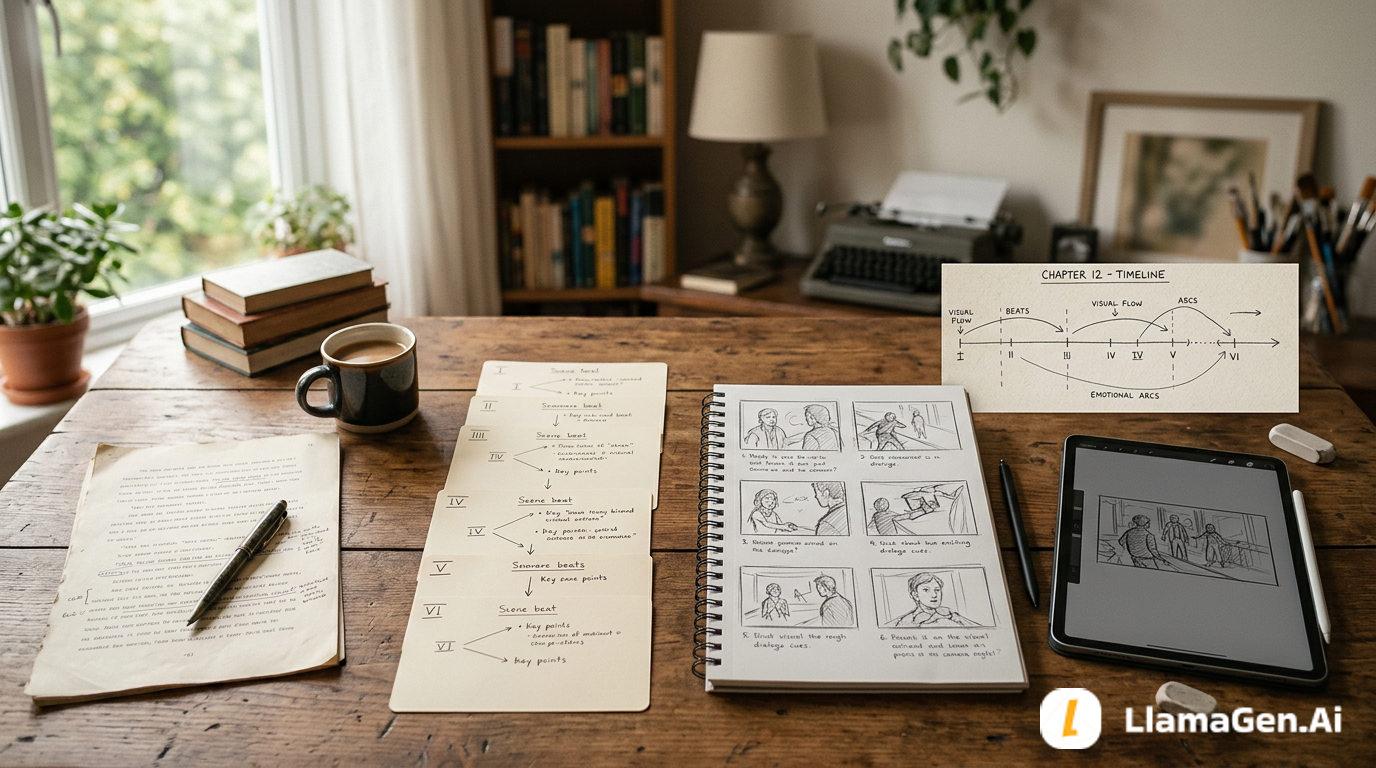
A novel chapter does not become a storyboard by turning every sentence into an image.
That usually creates too many frames, weak pacing, and visual repetition.
A better workflow is:
chapter -> scene purpose -> beats -> shot list -> storyboard frames -> continuity repair
For writers, the goal is not to replace prose. The goal is to test whether the chapter works visually: where the emotion turns, which object matters, whether the character reads clearly, and what the scene needs before it can become a comic, pitch deck, animatic, or book trailer.
A practical next step is to open the LlamaGen.AI AI storyboard generator, paste one scene from the chapter, and ask for storyboard frames only after the beats are clean.
Novel prose can move through thought, memory, smell, subtext, and time in the same paragraph.
A storyboard cannot do all of that at once.
A storyboard needs visible decisions:
If you skip that translation step, the storyboard often becomes a set of attractive but disconnected illustrations.
The fix is to make the chapter visual before you make it beautiful.
I used the same original fiction project from this August writer series and treated one short chapter scene as if it needed to become a visual pitch.
| Test item | Setup |
|---|---|
| Date tested | August 6, 2026 |
| Project | The Glass Orchard |
| Source input | 641-word chapter scene excerpt |
| Writer stage | After story bible, before comic, animatic, or trailer production |
| Target output | Scene purpose, 6 story beats, 8 storyboard frames, continuity checklist, repair prompt |
| Active editing time | About 16 minutes |
| Total elapsed time | About 34 minutes including one failed pass and repair |
| AI/editorial model note | CMS editorial review used GPT-5.4; product model and credit cost can vary by workspace settings and output type |
| Credits / cost note | Treat this as a workflow test, not a pricing benchmark |
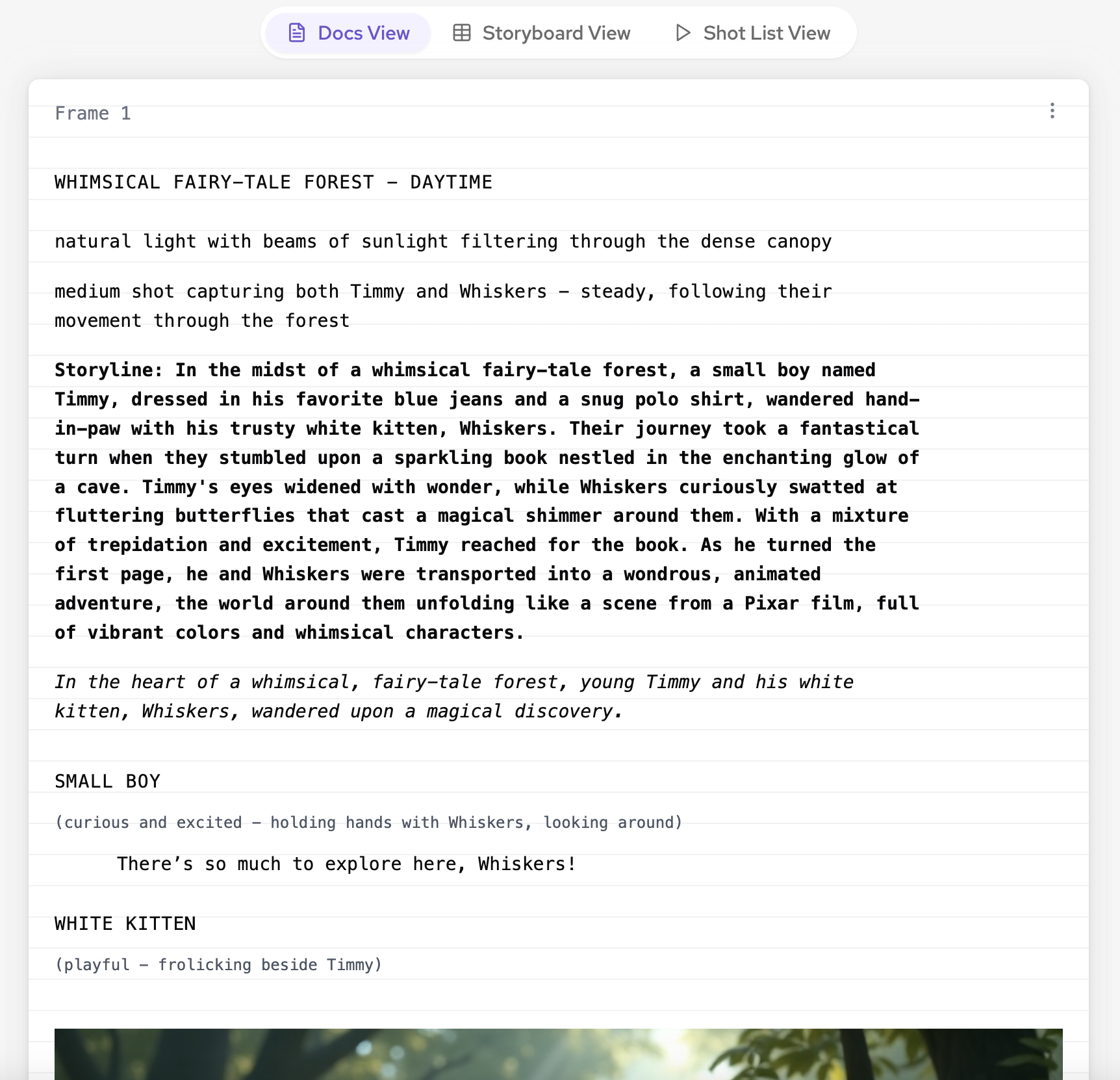
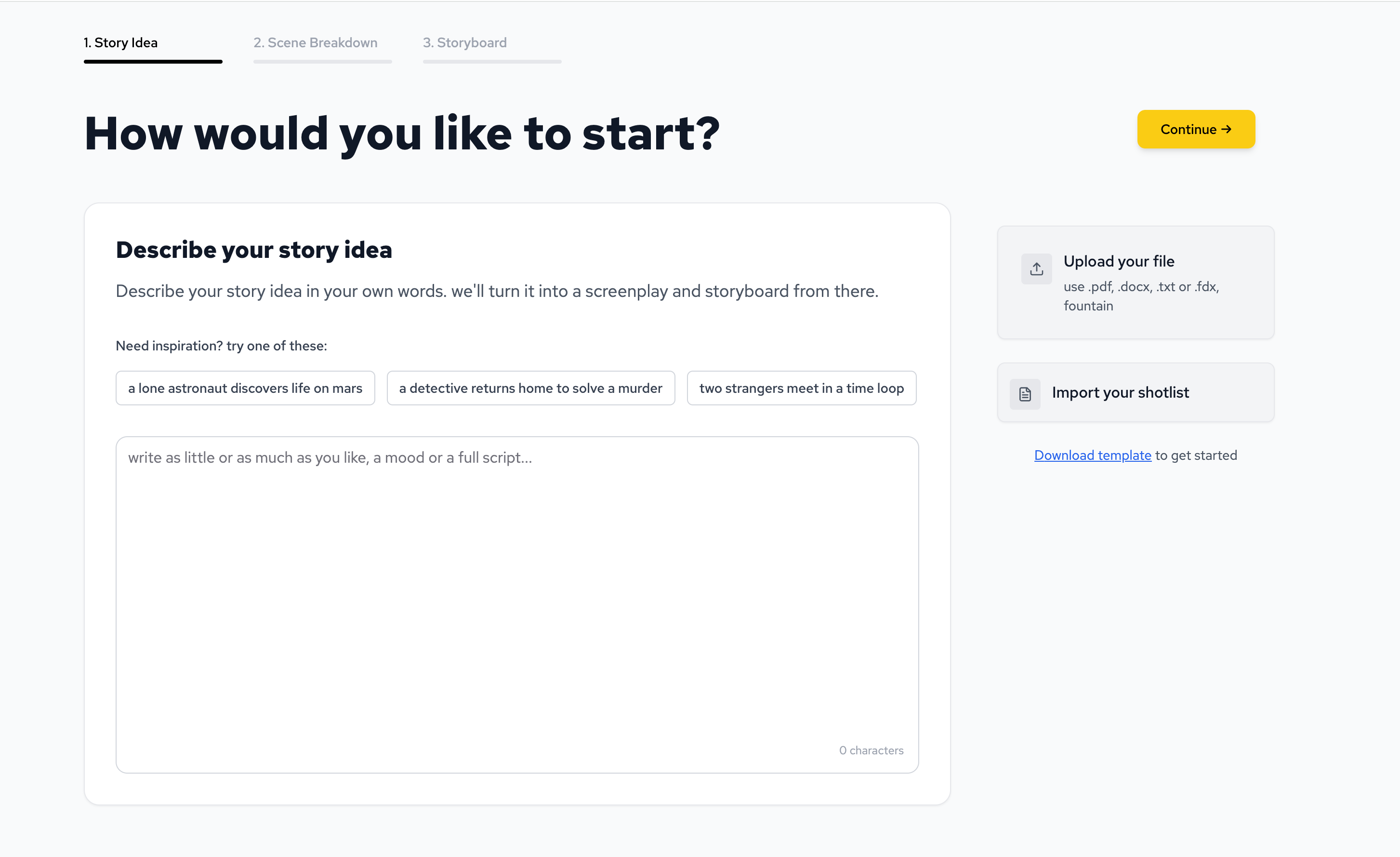
These were the LlamaGen.AI product surfaces used as workflow references.
The test question was:
Can a writer turn one prose scene into storyboard frames without losing character intention, object continuity, and pacing?
This is the original test scene.
A rundown of the latest LlamaGen feature releases, product enhancements, design updates, and important bug fixes.
Mira climbed through the greenhouse service hatch just before midnight.

Rain clicked against the glass roof in a thousand small warnings. The air smelled of wet metal, bruised leaves, and the mineral sweetness of memory-fruit. Her mother had once said the orchard remembered better than any court archive, but archives at least admitted when they were incomplete.

Mira touched the brass catalog key inside her coat pocket. It was warm, though the room was cold.

The first row of silver branches woke as she passed. Each fruit held a dim scene under its skin: a candle guttering, a hand closing a door, a child laughing with no sound. None of them were the memory she had come for.

Behind her, the salvage drone unfolded from the ceiling.

She did not run. Running made machines confident.

Instead she stopped beside the old irrigation desk and opened the drawer her mother had always kept locked. Inside was a paper tag, dry despite the damp room. One line had been written in her mother's careful archive hand:

Catalog the absence first.

Mira read it twice. Then the music box began playing from somewhere below the roots.
This is good prose. It is not yet a storyboard.
The scene contains atmosphere, interior thought, implied backstory, a prop, a threat, a clue, and a sound cue. A storyboard needs to separate those into visible beats.
Before making frames, ask what the scene is doing.
Analyze this chapter excerpt for storyboarding.

Return:
1. The scene purpose.
2. The emotional turn.
3. The visible conflict.
4. The continuity anchors.
5. The details that should stay off-screen or unclear.
Output example:
| Field | Working answer |
|---|---|
| Scene purpose | Mira enters the forbidden greenhouse and finds the first clue from her mother. |
| Emotional turn | Controlled investigation becomes personal unease. |
| Visible conflict | Mira is alone in a dangerous space while a salvage drone wakes behind her. |
| Continuity anchors | Blue raincoat, brass catalog key, silver branches, glowing memory-fruit, locked drawer, paper tag, music box. |
| Keep unclear | The mother's face, the meaning of the note, the source of the music box, the final memory. |
This step prevents the storyboard from over-explaining the chapter.
Do not split by paragraph. Split by visual change.
Convert this chapter excerpt into 6 storyboard beats.

For each beat include:
- visible action
- character intention
- key prop or location detail
- emotional temperature
- what changes from the previous beat
Output example:
| Beat | Visible action | What changes |
|---|---|---|
| 1 | Mira climbs through the greenhouse service hatch at night. | The story moves from outside danger to inside mystery. |
| 2 | Rain strikes the glass roof as rows of silver branches fade into view. | The location becomes a living archive. |
| 3 | Mira touches the brass key in her coat pocket. | The scene narrows from world to personal mission. |
| 4 | Memory-fruit glows with silent fragments as she passes. | The orchard shows history without giving the answer. |
| 5 | A salvage drone unfolds behind her while she stays still. | Threat enters, and Mira's discipline becomes visible. |
| 6 | Mira opens the locked drawer and finds the note as music begins below the roots. | The chapter lands on clue plus unease. |
Six beats are enough for the first pass. Add more only if the scene truly needs slower pacing for comics, webtoon, or animatic use.
The right frame count depends on the use case.
| Use case | Suggested frames | Why |
|---|---|---|
| Novel pitch deck | 4 to 6 | Show premise, tone, and protagonist quickly. |
| Comic or manga test | 6 to 10 | Enough room for pacing, reaction, prop inserts, and reveal. |
| Webtoon vertical scroll | 8 to 14 | More breathing room for atmosphere and scroll rhythm. |
| Book trailer planning | 8 to 12 | Works well as a shot list before video generation. |
| Film or animation previsualization | 10 to 18 | Needs clearer camera and motion continuity. |
For this test, I used 8 frames. That gives the scene one frame for arrival, one for world, one for prop, one for memory-fruit, one for threat, one for decision, one for clue, and one for the ending hook.
The shot list is where prose becomes production language.
Create an 8-frame storyboard shot list from these beats.

For each frame include:
- frame number
- camera framing
- visible action
- required continuity
- mood and lighting
- story purpose
- no readable text unless the note is intentionally represented as abstract marks
Output example:
| Frame | Framing | Visible action | Story purpose |
|---|---|---|---|
| 1 | Wide exterior-to-interior angle | Mira climbs through a broken service hatch into the greenhouse. | Establish risk and arrival. |
| 2 | Wide interior | Rain patterns the glass roof above rows of silver branches. | Make the location feel alive. |
| 3 | Medium close-up | Mira's hand touches the brass catalog key inside her blue raincoat. | Anchor the mission and prop continuity. |
| 4 | Over-the-shoulder | Memory-fruit glows with tiny silent scenes under translucent skins. | Show the orchard as archive. |
| 5 | Low rear angle | The salvage drone unfolds from the ceiling behind her. | Introduce threat without chase. |
| 6 | Medium still frame | Mira stops beside the old irrigation desk instead of running. | Reveal character discipline. |
Notice that the note is not rendered as readable text in the frame prompt. In-image text often creates errors. Put exact words in captions, subtitles, alt text, or article copy unless the workflow specifically supports clean text placement.
Now you can generate storyboard frames.
Create storyboard image prompts for the 8-frame shot list.

Rules:
- Keep Mira consistent: young former archivist, weathered blue raincoat, observant posture, restrained expression.
- Keep the brass catalog key visible when relevant.
- Keep the greenhouse old, wet, luminous, and mechanical.
- Keep memory-fruit translucent and subtle, not magical explosions.
- Keep the salvage drone practical and industrial.
- Do not show the mother's face.
- Do not render readable text, logos, UI, watermarks, or title cards.
- Each prompt describes one frame only.
Example prompts:
| Frame | Storyboard prompt |
|---|---|
| 1 | Wide cinematic storyboard frame of a young former archivist in a weathered blue raincoat climbing through a broken service hatch into an old glass greenhouse at midnight, rain outside, restrained mystery tone, no text. |
| 2 | Wide interior frame of a wet glass roof with rain trails and rows of silver branches waking softly in the dark, old greenhouse machinery in shadow, subtle luminous atmosphere, no text. |
| 3 | Medium close-up of Mira's hand touching a brass catalog key inside the pocket of her blue raincoat, cold greenhouse light, tactile fabric and metal detail, no readable marks. |
| 4 | Over-the-shoulder frame from behind Mira looking at translucent memory-fruit glowing with tiny abstract scenes under the skin, silver branches around her, no faces revealed in fruit, no text. |
| 5 | Low rear angle of an industrial salvage drone unfolding from the ceiling behind Mira, drone lens dimly lighting, she remains still in the foreground, tense but quiet, no branding. |
| 6 | Medium frame of Mira standing beside an old irrigation desk instead of running, posture controlled, wet metal drawers and roots nearby, blue raincoat and brass key continuity, no labels. |
| 7 | Close-up insert of a damp wooden drawer opening to a dry paper tag with abstract unreadable archive marks, warm clue light, brass key edge visible, no readable text. |
| 8 | Wide final frame of Mira listening in the greenhouse as warm light rises from below tangled roots and silver branches, unresolved mystery, no title overlay, no text. |
This is the point where the LlamaGen.AI storyboard workflow becomes useful. The prompts are specific enough to preserve scene logic, but not so overloaded that every frame becomes noisy.
After the first frame set, review the storyboard as a sequence.
| Check | What to look for |
|---|---|
| Character continuity | Does Mira look like the same person in every frame? |
| Wardrobe continuity | Does the blue raincoat stay consistent? |
| Prop continuity | Does the brass key appear only when needed and keep the same design language? |
| Location continuity | Does the greenhouse feel like one connected place? |
| Threat continuity | Does the drone feel practical, not cute or decorative? |
| Story clarity | Can a viewer understand arrival, discovery, threat, clue, and hook without reading the chapter? |
| Reveal control | Does the storyboard avoid showing the mother's face or the final truth too early? |
This review step matters more than any single beautiful frame. A storyboard succeeds as a sequence.
My first pass failed because the prompt asked for "every important moment in the chapter."
That produced three common problems:
| Problem | What happened | Repair |
|---|---|---|
| Too many images | The model treated each descriptive phrase as a separate visual event. | Limit the scene to 6 beats and 8 frames. |
| Weak continuity | Mira's coat, age, and posture shifted between frames. | Add a short character continuity rule before every frame batch. |
| Bad in-image text | The note became fake words on paper. | Make the note visually abstract and place the exact sentence in article copy or captions. |
| Over-revealed mystery | One frame implied a ghostly mother figure. | Add "do not show the mother's face" and "do not reveal the final memory." |
The repair prompt was simple:
Repair this storyboard plan.

Keep only 8 frames.
Make every frame visible and storyboard-friendly.
Preserve Mira's blue raincoat, brass catalog key, old wet greenhouse, silver branches, memory-fruit, industrial drone, and restrained mystery tone.
Do not render readable text.
Do not show the mother's face.
End on the music-box clue rather than a full explanation.
The repaired version was calmer, clearer, and much easier to use as a pitch asset.
Use this template for your own chapter.
I am turning a novel chapter into a storyboard.

Here is the chapter excerpt:
[paste chapter excerpt]

Return:
1. Scene purpose
2. Emotional turn
3. Visible conflict
4. Continuity anchors
5. Details to keep hidden
6. Six storyboard beats
7. Recommended frame count for my use case
8. An 8-frame shot list
9. One visual prompt per frame
10. A continuity checklist

Rules:
- Do not adapt every sentence.
- Split by visual change, not paragraph.
- Preserve character appearance, wardrobe, props, and location logic.
- Avoid readable text in image prompts.
- Keep the storyboard useful for writers, comic artists, and video planning.

My use case is:
[novel pitch deck / comic test / webtoon / book trailer / film previsualization]
If the chapter is still messy, start in Story AI before going to storyboard.
Use Story AI when you need:
Use the storyboard generator when the scene already has enough narrative shape and you want to test it visually.
Here is the practical workflow I would use for a real chapter:
| Stage | Action | LlamaGen.AI surface |
|---|---|---|
| 1 | Paste the chapter and ask for scene purpose. | Story AI |
| 2 | Convert the chapter into beats and continuity anchors. | Story AI |
| 3 | Turn beats into an 8-frame shot list. | AI storyboard generator |
| 4 | Generate storyboard frames and review sequence clarity. | Storyboard |
| 5 | Repair continuity, character, and reveal-control issues. | Storyboard editing workflow |
| 6 | Export or reuse the frames for comic, pitch, animatic, or video planning. | Storyboard export and sharing |
The key is to avoid treating storyboarding as decoration. Storyboarding is a diagnostic tool. It tells you whether the scene can be understood visually.
You can, but it is usually better to paste one scene or one excerpt at a time. A full chapter often contains several visual sequences. Splitting it first gives better pacing and continuity.
Most prose scenes work well with 6 to 12 frames for a first pass. Use fewer frames for pitch decks and more frames for webtoon, comic, or animation planning.
Not in the image prompts. Keep exact dialogue in captions, script fields, or panel text after image generation. This avoids fake or broken in-image text.
Treat that as feedback, not failure. If the storyboard cannot show the scene clearly, the prose may need a stronger action line, cleaner object continuity, or a more visible emotional turn.
No. The same method works for romance, thriller, memoir-style fiction, children's books, historical fiction, and literary scenes. Any prose scene can be translated into visual beats.
Do not start with "make a storyboard from my chapter."
Start with:
What is this scene doing, and what must a viewer understand without reading the prose?
Once that answer is clear, turn the chapter into beats, turn beats into a shot list, and only then generate frames.
That is how a novel chapter becomes a useful storyboard instead of a folder of pretty images.
Start with the LlamaGen.AI AI storyboard generator when your scene is ready to be tested visually.
| 7 | Insert | Drawer opens to a dry paper tag with marks too small to read. | Land the clue without relying on text rendering. |
| 8 | Wide final frame | Mira listens as warm light rises from below the roots. | End on mystery and sound cue. |
Just refer your friends, followers, and customers to earn up to 30% in recurring commissions for a lifetime!