

Three-Scene Family Pet Comic: Beginning, Change, and Warm Ending
Example preview
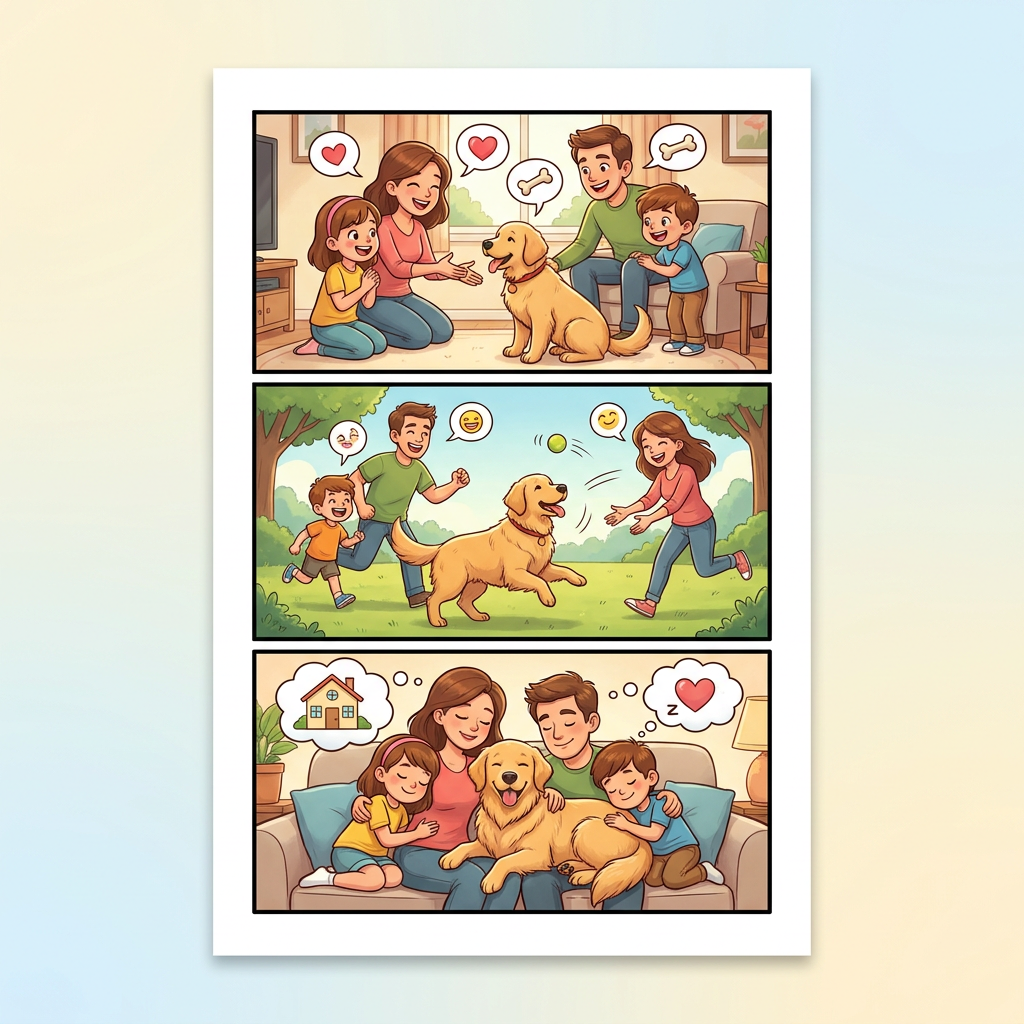
Create a family-and-dog story in three stacked scenes with room for expressive interaction. Keep the beginning, middle, and end simple enough to read without captions.
For a warm everyday pet vignette that needs fewer, larger moments. The stored prompt asks for three stacked panels and a clear beginning-middle-end rhythm rather than a dense sequence.
When to use this template
- A dog welcoming a family member home
- A simple pet memory turned into a short keepsake
- A gentle story about finding a misplaced toy
Build your first draft
Pick one change
Write the starting situation and the warm ending first. Use the middle scene for the action that connects them.
Use the extra scene space
Show the family and dog interacting rather than filling the wider panels with unrelated background details.
Check the emotional arc
Read the three images in order and inspect the dog’s markings and expressions. Add a brief caption only if it contributes a personal detail.
Try a complete example
The rainy welcome
Three stacked family comic panels: a child comes home from a rainy walk looking tired; a golden dog brings a favorite soft toy to the doorway; child and dog sit together under a dry blanket. Cozy indoor light, same red toy and green raincoat, broad readable gestures, no text.
The toy connects the dog’s action to the comforting ending. Three scenes leave room to show the interaction without adding unnecessary intermediate steps.
Before you publish
- Do not overload the middle panel with several actions just because the layout uses fewer scenes.
- If adapting a real memory, review invented details before presenting the comic as a literal record.
Questions about this template
- When should I use three panels instead of four?
- Use three when the event has one clear change and a direct result. Use the four-strip version when a separate pause, search, or reaction matters.
- Does it require a dog?
- The source centers a friendly dog and family. You can adapt it to another pet, but state the species and recognizable details clearly.
- Does the name specify a print format?
- The ID is an internal label. Check the generated file and your printing requirements rather than assuming the output has a particular physical size.