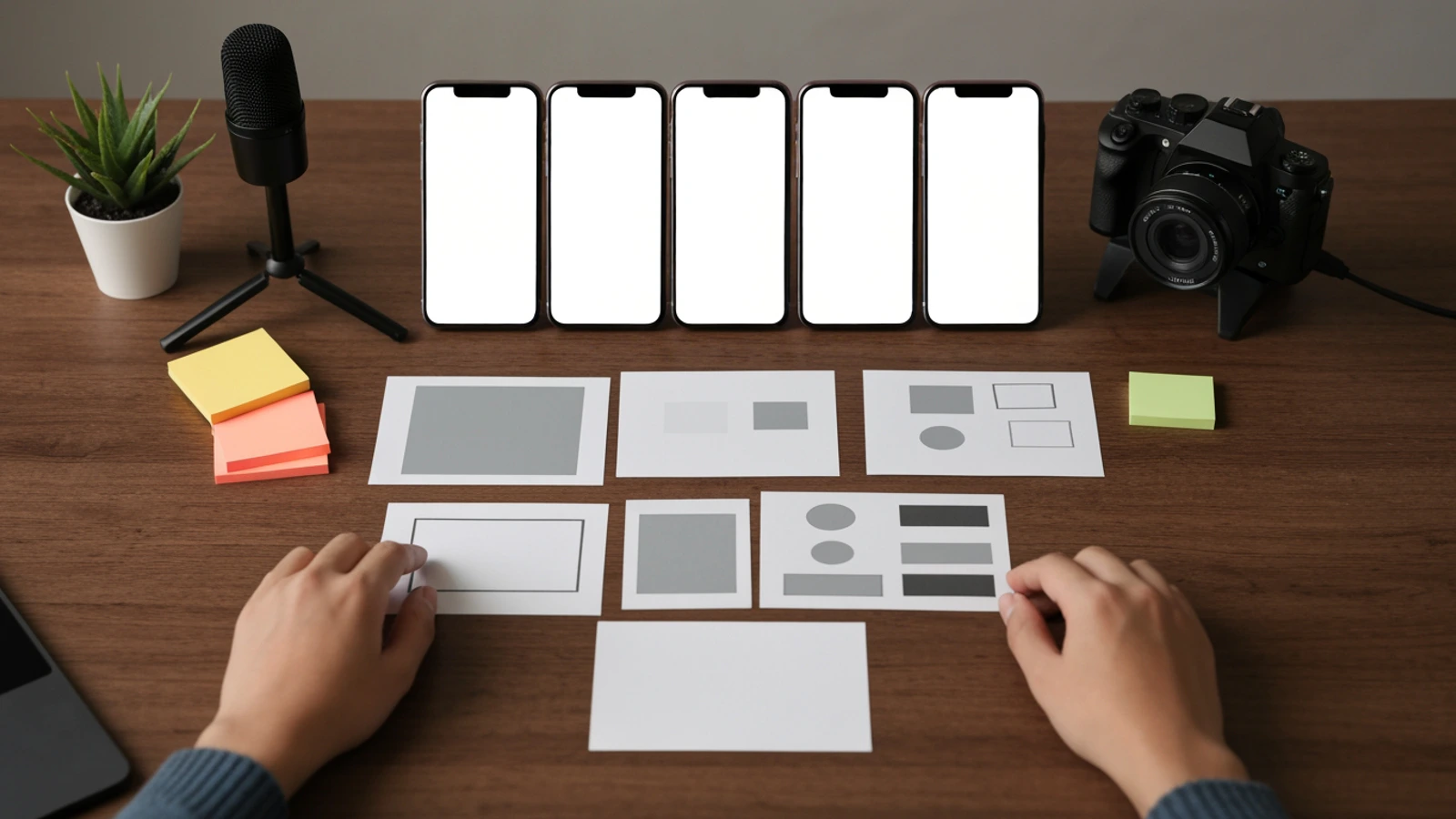

A UGC ad should feel spontaneous.
It should not feel unplanned.
That is the trap.
Many creator-led ads try so hard to look casual that the story becomes loose, the product appears too late, the proof feels vague, and the CTA arrives after the viewer has already scrolled away. The ad may look authentic, but it does not sell.
This is Day 6 of our advertising storyboard series.
Day 1 covered how to plan an ad storyboard before production. Day 2 shared a commercial storyboard template for video ads. Day 3 focused on billboard storyboards and outdoor readability. Day 4 explained digital billboard storyboards and DOOH loops. Day 5 showed how to plan a social media ad storyboard for short-form platforms.
Day 6 focuses on UGC ads:
Turn a creator-led ad idea into a believable storyboard that feels human while still proving the product fast.
The goal is not to over-script the creator.
The goal is to protect the sequence:
hook -> human context -> product action -> proof -> objection answer -> CTA
That sequence gives the creator room to feel real without letting the ad drift.
A UGC ad storyboard is a frame-by-frame plan for a creator-led advertisement.
It maps:
UGC means user-generated content, but in paid advertising it often refers to a creator-style ad, such as:
The storyboard should not make the creator sound robotic.
It should keep the ad clear.
UGC ads work because they borrow trust from ordinary creator behavior.
But paid social does not reward randomness.
A weak UGC ad usually fails in predictable ways:
A storyboard fixes those problems before the shoot, generation pass, or edit.
It gives each moment a job:
| Moment | Job |
|---|---|
| Hook | Stop the right viewer |
| Context | Make the problem feel familiar |
| Product action | Show what changes |
| Proof | Make the claim believable |
| Objection answer | Reduce friction |
| CTA | Make the next step obvious |
The ad can still look casual.
The structure should not be.
Most good UGC ads follow a trust arc.
Use this structure:
I had this problem.
I tried this thing.
Here is what happened.
Here is why I would use it again.
Here is what you should do next.
That is not a script to memorize.
It is the emotional order of the ad.
A rundown of the latest LlamaGen feature releases, product enhancements, design updates, and important bug fixes.
For a creator-led ad, the viewer is asking:
Your storyboard should answer those questions visually.
Use this template for TikTok, Reels, Shorts, Instagram, Facebook, YouTube Shorts, or paid creator ads.
| Frame | Time | Visual Action | Creator Beat | Product Cue | Proof / Trust Cue | Review Check |
|---|---|---|---|---|---|---|
| 1 | 0-2s | Creator opens with a familiar pain or surprising result | Hook | Product category hinted or visible | The viewer recognizes the situation | Would the right viewer stop? |
| 2 | 2-5s | Creator shows the old way or frustration | Context | Product not hidden too long | Pain is specific, not generic | Is the problem clear without a long setup? |
| 3 | 5-8s | Product enters through a real action | Product action | Product appears clearly | The creator uses it, not just holds it | Does the product show up early enough? |
| 4 |
For a 12-second UGC ad, compress it:
| Frame | Time | Purpose |
|---|---|---|
| 1 | 0-2s | Hook |
| 2 | 2-5s | Problem |
| 3 | 5-8s | Product action |
| 4 | 8-10s | Proof |
| 5 | 10-12s | CTA |
For a 30-second UGC ad, add one objection beat:
| Frame | Time | Purpose |
|---|---|---|
| 1 | 0-2s | Hook |
| 2 | 2-5s | Personal context |
| 3 | 5-9s | Old way |
| 4 | 9-14s | Product action |
| 5 | 14-19s | Visible result |
| 6 | 19-24s | Objection answer |
| 7 | 24-27s | Repeat benefit |
| 8 | 27-30s | CTA |
Keep the storyboard short enough to test.
UGC ads often improve through variants, not one perfect master script.
Before writing the hook, decide who is speaking.
The same product can feel completely different depending on the creator.
| Creator Type | Best For | Storyboard Tone |
|---|---|---|
| Beginner | Tools, education, creative workflows | "I finally found a simpler way" |
| Expert | B2B, technical, professional tools | "Here is why this workflow saves time" |
| Founder | SaaS, launches, niche products | "We built this because this problem kept happening" |
| Customer | Proof, ecommerce, creator products | "I tried it and this changed" |
| Teacher | Education, tutorials, classroom products | "Here is how I explain this faster" |
| Creator | Visual tools, editing apps, content products | "This is how I made the final asset" |
Do not write every UGC ad in the same voice.
A beginner creator can admit confusion.
An expert creator should sound precise.
A founder should explain the pain with conviction.
A customer should focus on the before-and-after.
Define this before production:
Creator persona:
Audience relationship:
Tone:
Level of polish:
Primary proof:
Objection to answer:
CTA:
UGC hooks should sound like something a person might actually say.
But they still need a visual job.
Use these hook types:
| Hook Type | Example Pattern | Visual Requirement |
|---|---|---|
| Pain hook | "I kept running into this problem..." | Show the problem instantly |
| Result hook | "This is what changed after I tried..." | Show the result early |
| Mistake hook | "I was doing this the hard way..." | Show the old workflow |
| Comparison hook | "I tested the old way against this..." | Show two paths |
| Confession hook | "I thought this would be gimmicky, but..." | Show honest hesitation |
| Time hook | "This saved me from rebuilding..." | Show the time-consuming task |
| Creator hook | "If you make ads, you know this moment..." | Show a relatable creative problem |
Weak hook:
Today I want to talk about an AI storyboard tool.
Stronger hook:
I had an ad script approved, but no one could picture the actual shots.
Even stronger visual hook:
Creator holds a messy ad script beside an empty storyboard wall, then points to the first blank frame.
The hook should make the viewer think:
That is my problem.
UGC ads often over-rely on the creator's face.
A face can build trust, but the product still needs proof.
Use one of these proof types:
| Proof Type | What It Shows | Example |
|---|---|---|
| Workflow proof | The product changes the process | Brief becomes storyboard frames |
| Result proof | The output looks better | Before/after visual plan |
| Speed proof | A task becomes faster | Creator prepares a pitch before a meeting |
| Decision proof | The team can approve faster | Stakeholders point to the same frames |
| Clarity proof | Confusion becomes visible order | Messy notes become sequence |
| Reuse proof | The output works in more formats | Vertical, square, and horizontal variants |
Do not say:
This makes ad planning easier.
Storyboard the proof:
Frame 3: The creator drops a rough campaign idea into the workflow.
Frame 4: A six-frame storyboard appears with hook, problem, product, proof, CTA, and variant notes.
Frame 5: The creator uses the storyboard to explain the ad to a teammate.
The viewer should see the value, not only hear it.
Here is a 20-second creator-led ad for an AI storyboard workflow.
Offer:
Turn a rough ad idea into a visual storyboard before production.
Audience:
Marketers, founders, creators, agencies, and video teams who need to pitch ads before spending production time.
Creator persona:
Practical marketer who has been burned by unclear briefs.
Storyboard:
| Frame | Time | Visual | Creator Beat | Production Note |
|---|---|---|---|---|
| 1 | 0-2s | Creator holds a messy ad brief beside a blank storyboard board | "This is the moment most ad ideas get stuck." | Start with the problem in frame |
| 2 | 2-5s | Close view of the creator arranging blank frames | "The script sounds fine, but nobody can see the shots yet." | Keep paper and screen text unreadable |
| 3 | 5-8s | Creator turns the offer into a simple storyboard sequence | "So I plan the ad visually first." | Show hook, product, proof, CTA as visual-only cards |
| 4 | 8-12s | The rough idea becomes six clear frames | "Now the team can review the story before production." | Make transformation obvious |
| 5 | 12-16s | Creator shows vertical, square, and horizontal variants |
This ad feels creator-led, but the structure is commercial.
It has:
Founder-led ads work when the founder can explain the pain sharply.
Structure:
Problem insight -> why the old way breaks -> product reason -> proof -> invitation
Storyboard:
| Frame | Time | Visual | Founder Beat | Storyboard Job |
|---|---|---|---|---|
| 1 | 0-2s | Founder looks at a wall of disconnected campaign notes | "Most ad briefs fail before production starts." | Strong opinion hook |
| 2 | 2-6s | Founder points to the missing visual sequence | "The team approves words, but not the actual story." | Define the problem |
| 3 | 6-10s | Founder turns one offer into storyboard frames | "We built a way to make the ad visible first." | Product reason |
| 4 | 10-15s | Frames show hook, product action, proof, CTA | "Now every frame has a job." | Workflow proof |
| 5 | 15-20s | Team reviews the storyboard before production | "You can fix the weak shot before you shoot it." |
Founder-led ads should avoid vague inspiration.
The founder needs to name the problem better than the viewer can.
Testimonial UGC should not sound like a press quote.
It should show a small story.
Use this structure:
Before -> trigger -> product action -> result -> why it matters -> CTA
Storyboard:
| Frame | Time | Visual | Customer Beat | Trust Cue |
|---|---|---|---|---|
| 1 | 0-2s | Customer shows an old messy workflow | "I used to pitch ads with text docs." | Relatable before |
| 2 | 2-5s | Customer shows the first storyboard attempt | "Clients kept asking what the final video would look like." | Specific pain |
| 3 | 5-9s | Customer turns the idea into frames | "Now I show the sequence before production." | Product action |
| 4 | 9-13s | Customer compares old brief and new storyboard | "The review call got much easier." | Clear result |
| 5 | 13-17s | Customer points to the approved frame sequence | "Everyone talks about the same shots." |
Make the testimonial specific.
Specific is more believable than enthusiastic.
UGC ads should not look too polished.
But they should be intentionally imperfect.
In the storyboard, decide what can feel casual:
Also decide what cannot be messy:
This is the balance:
Casual surface, disciplined sequence.
That is why storyboarding matters.
Most UGC ads are vertical.
Plan for 9:16 first unless the campaign is built for another format.
Keep important details away from:
Use this simple rule:
Face, product, and proof stay in the center-safe area.
Captions stay in a planned readable zone.
CTA gets a clean final frame.
If the creator holds a product, do not let it drift to the edge of the frame.
If the proof is on a screen, make it large enough to understand as a visual change without reading tiny UI.
LlamaGen.AI is useful because UGC ads are not only scripts.
They are sequences.
You can use LlamaGen Storyboard to turn a creator ad idea into visual frames, test the first 3 seconds, compare hook variants, and prepare a cleaner production handoff. The AI Storyboard Generator is useful when you already have a script, product pitch, customer quote, or creator brief and need a frame-by-frame plan.
A practical UGC ad workflow:
The important habit is to storyboard what the viewer sees, not only what the creator says.
Use this prompt to create a creator-led ad plan.
Create a UGC ad storyboard for a paid social campaign.

Product or offer:
[Describe the product, service, or campaign]

Audience:
[Who should stop scrolling?]

Creator persona:
[Beginner / expert / founder / customer / teacher / creator]

Platform:
[TikTok / Reels / Shorts / Instagram / Facebook / YouTube Shorts / paid social]

Length:
[12 seconds / 20 seconds / 30 seconds]

Goal:
[Sign up / try product / shop / book demo / learn more / remember brand]

Proof type:
[workflow proof / result proof / speed proof / decision proof / clarity proof / reuse proof]

Requirements:
1. Give 5 hook options that sound human.
2. Build a frame-by-frame storyboard with timing.
3. Include visual action, creator beat, product cue, proof cue, and CTA.
4. Keep the product visible in the first half of the ad.
5. Make the ad understandable without sound.
6. Include 9:16 safe-zone notes.
7. Suggest 3 variants for paid social testing.
8. Avoid generic hype and avoid tiny unreadable UI details.
Use this after the storyboard is approved.
Generate a vertical UGC ad storyboard sequence.

Scene:
A creator explains how a rough ad idea becomes a clear storyboard before production.

Frames:
1. Hook: creator holds a messy ad brief beside an empty storyboard wall.
2. Problem: creator shows that the script sounds fine but the shots are unclear.
3. Product action: creator turns the offer into storyboard frames.
4. Proof: the frames show hook, problem, product, proof, and CTA as a clear sequence.
5. Variant value: the storyboard appears in vertical, square, and horizontal layouts.
6. CTA: creator presents the approved storyboard for production.

Style:
Natural creator-led paid social look, realistic workspace, handheld but composed feel, believable human gestures, consistent creator across frames, visual-only screens and cards.

Restrictions:
No readable text inside images, no fake logos, no watermarks, no title overlay, no UI screenshot text, no speech bubble text, no barcode.
Use this before production.
Review this UGC ad storyboard as a paid social creative director.

Check:
1. Does the hook sound human and stop the right viewer?
2. Is the creator persona clear?
3. Is the problem specific by second 3?
4. Does the product appear early enough?
5. Is the proof visible, not only spoken?
6. Can the ad work muted?
7. Are face, product, captions, and CTA safe for 9:16 platform UI?
8. Does the CTA match the viewer's next step?

Return:
- Top 5 storyboard problems
- Stronger hook options
- Revised frame order
- Proof improvements
- Safe-zone notes
- 3 A/B test variants
Avoid these:
The best UGC ads usually feel simple because the storyboard made hard decisions early.
Before approving a UGC storyboard, run this checklist.
If the storyboard passes this checklist, production can stay casual without becoming unclear.
Package the UGC storyboard like this:
ugc-ad-storyboard-package/
  01-offer-and-audience.md
  02-creator-persona.md
  03-hook-variants.md
  04-storyboard-table.md
  05-script-notes.md
  06-visual-frames/
  07-safe-zone-notes.md
  08-test-variants.md
  09-production-handoff.md
For each frame, include:
This keeps the creator, editor, creative strategist, and media buyer aligned.
It also makes testing easier. If hook 1 fails, hook 2 can reuse the same proof sequence. If the CTA is weak, the final frame can change without reshooting the whole ad.
A UGC ad should feel real.
But real does not mean random.
The storyboard gives the ad a spine: a human hook, a relatable problem, an early product moment, visible proof, one objection answer, and a simple CTA.
Use the template above to plan your next creator-led ad. Then bring the idea into LlamaGen Storyboard, generate the visual sequence, test hook variants, protect the vertical safe zones, and hand off a UGC ad that feels natural while still doing its commercial job.
Popular creator tools
Go from comics and storyboards to stylized photos with LlamaGen.
| 8-12s |
| Creator shows the change |
| Proof |
| Product creates a visible result |
| Before/after, screen change, saved time, better output |
| Can the viewer see the benefit muted? |
| 5 | 12-16s | Creator answers one objection | Trust | Product remains nearby | Specific reassurance, not hype | Does this reduce a reason not to click? |
| 6 | 16-20s | Creator gives a simple CTA | Action | Brand, product, or URL area | Clear next step | Is the CTA easy to follow? |
| "And I can test hooks without rebuilding everything." |
| Show format variation |
| 6 | 16-20s | Creator presents the approved storyboard | "Start with the storyboard, then make the ad." | Leave clean CTA space |
| Production value |
| 6 | 20-24s | Founder closes with a simple invite | "Try planning the storyboard first." | CTA |
| Practical proof |
| 6 | 17-20s | Customer closes with recommendation | "If your ads start as scripts, storyboard them first." | CTA |
Visualize every scene before production starts.
© 2026 LlamaGen.Ai All rights reserved
Leading the Future of AI Comic Generation