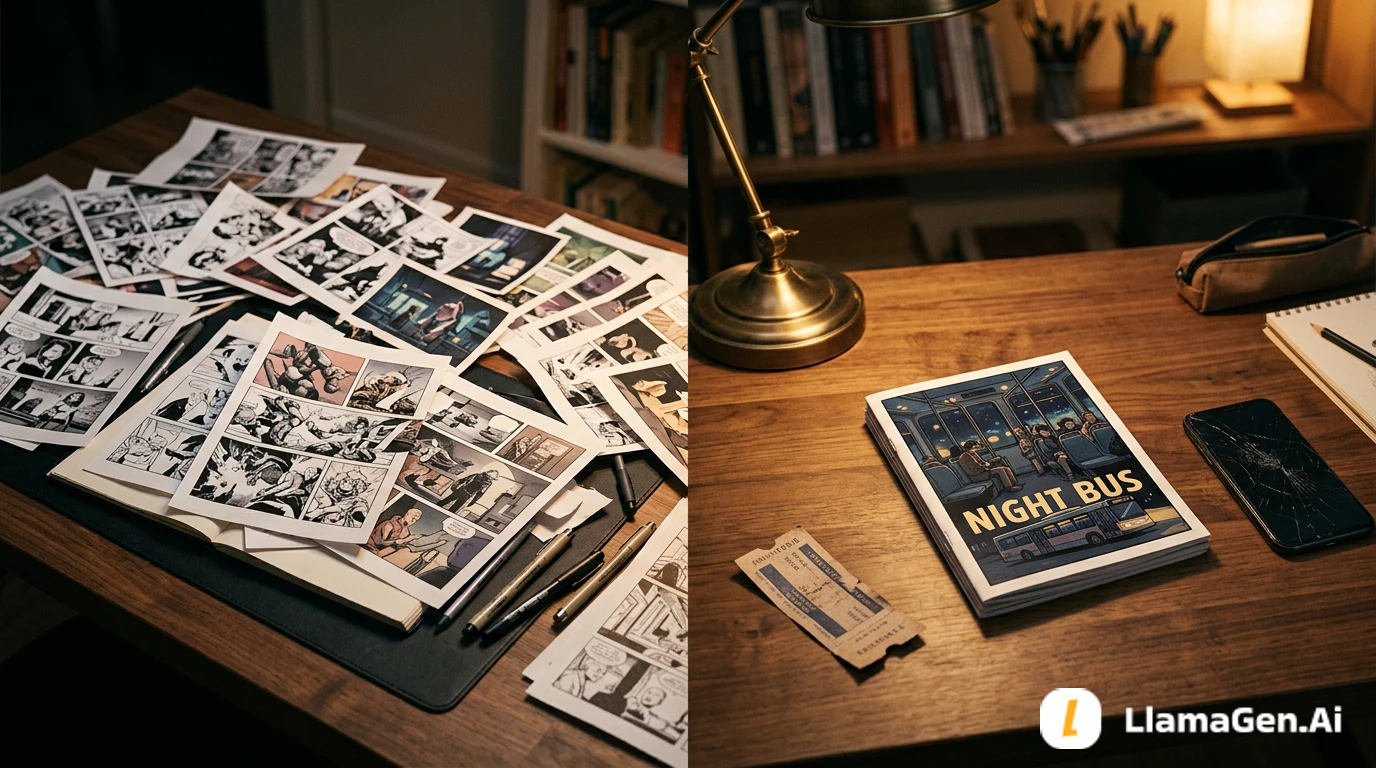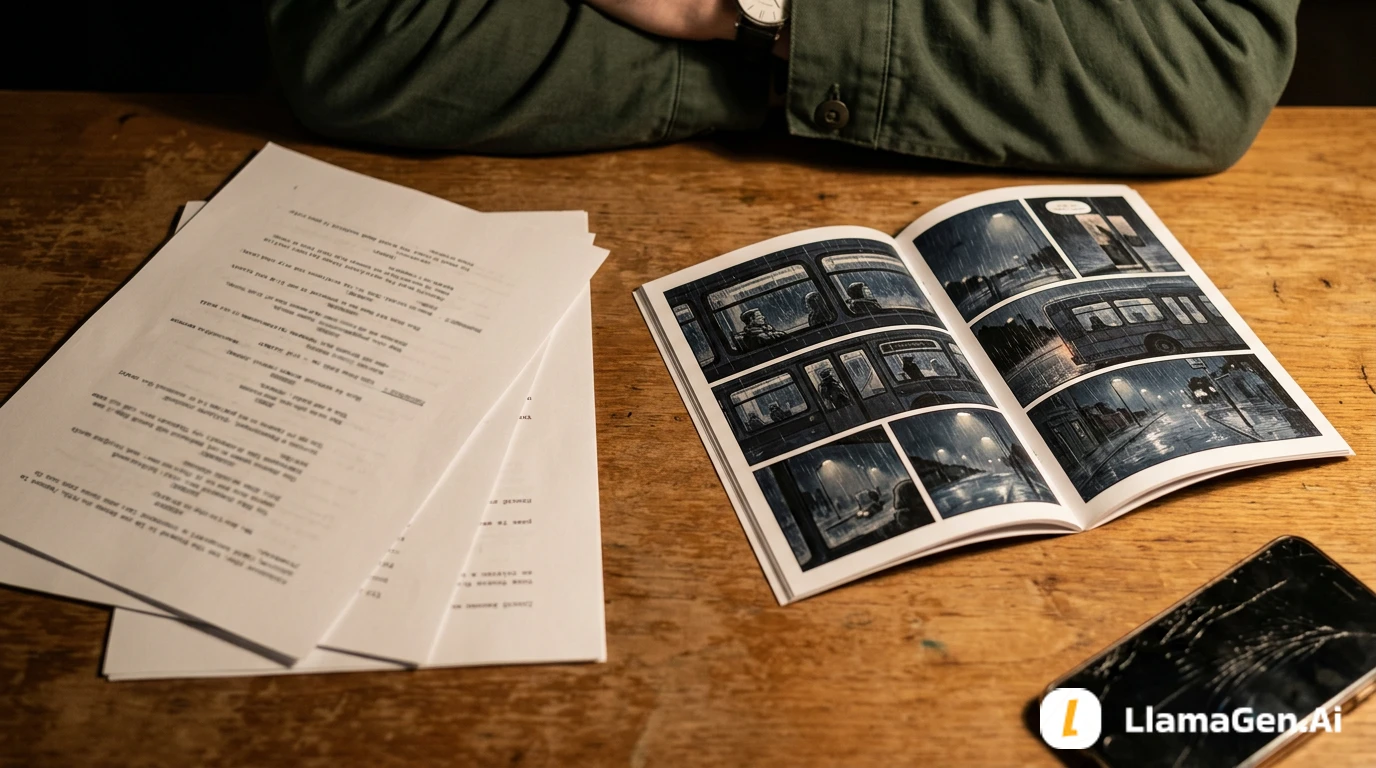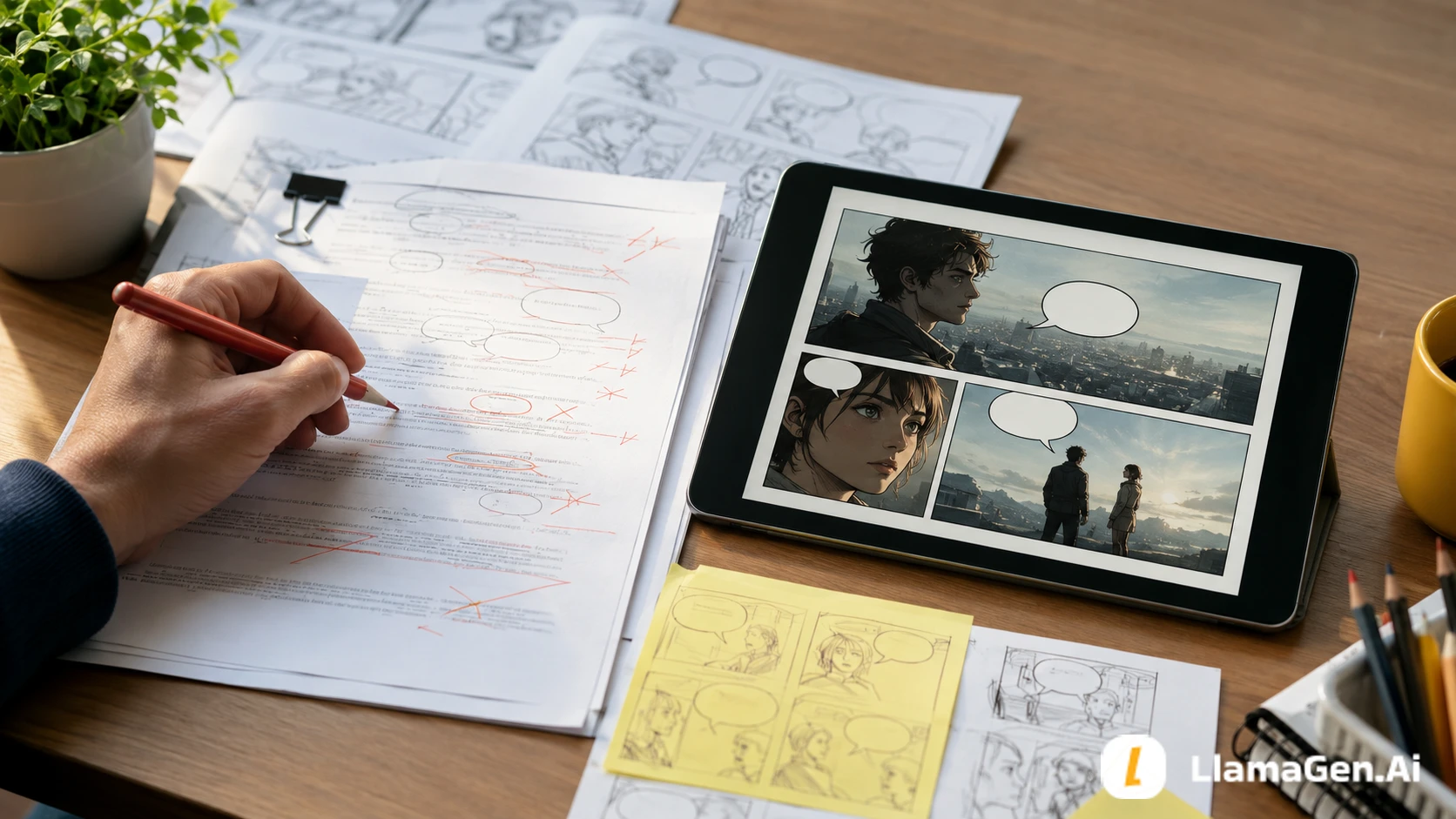
When one comic panel is wrong, do not regenerate the whole page by default.
First classify the failure:
wrong scene or pose -> redraw the panel
small local visual defect -> partial modification
wrong speech or caption -> edit the text object
exact external artwork needed -> replace the panel image
several adjacent panels are structurally wrong -> return to the storyboard
Open the affected panel in LlamaGen.AI Comic Studio, preserve everything that already works, and make the narrowest repair that can solve the actual problem.
A finished comic page contains many approved decisions:
Regenerating the full page can reopen all of them when only one decision failed.
LlamaGen.AI's help guidance recommends using panel-level redraw for focused corrections and comparing the replacement with neighboring panels. The single-panel redraw guide also notes that a redraw is a new generation, so details beyond the requested edit can still change.
The practical rule is simple: protect accepted work.
This tutorial uses an original six-panel scene:
1. Nora enters a rainy night market.
2. She spots a red paper crane on a stall.
3. She reaches for the crane.
4. A gust blows it into the street.
5. Nora catches it beside a bicycle.
6. The vendor reveals a matching crane in his pocket.
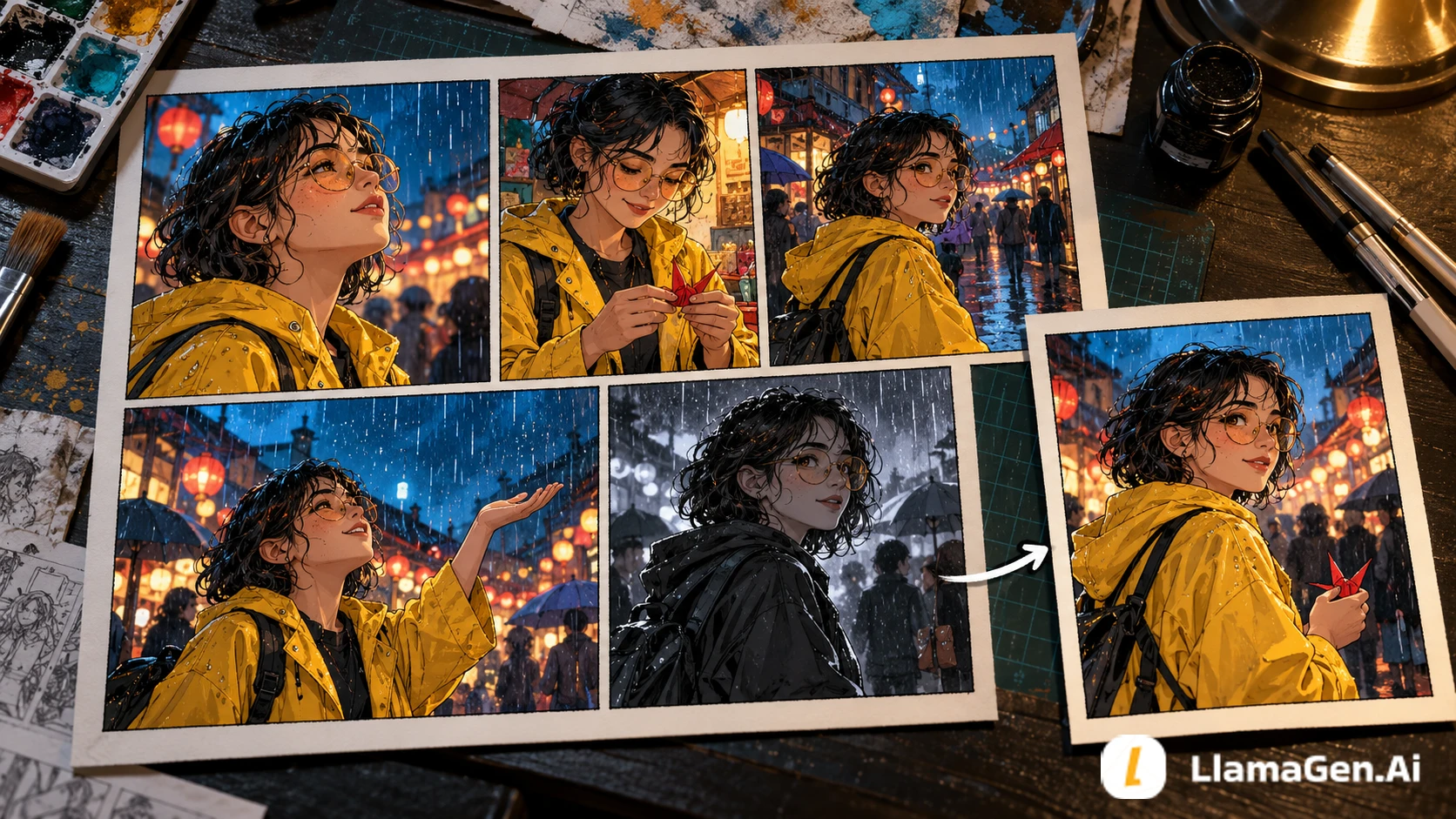
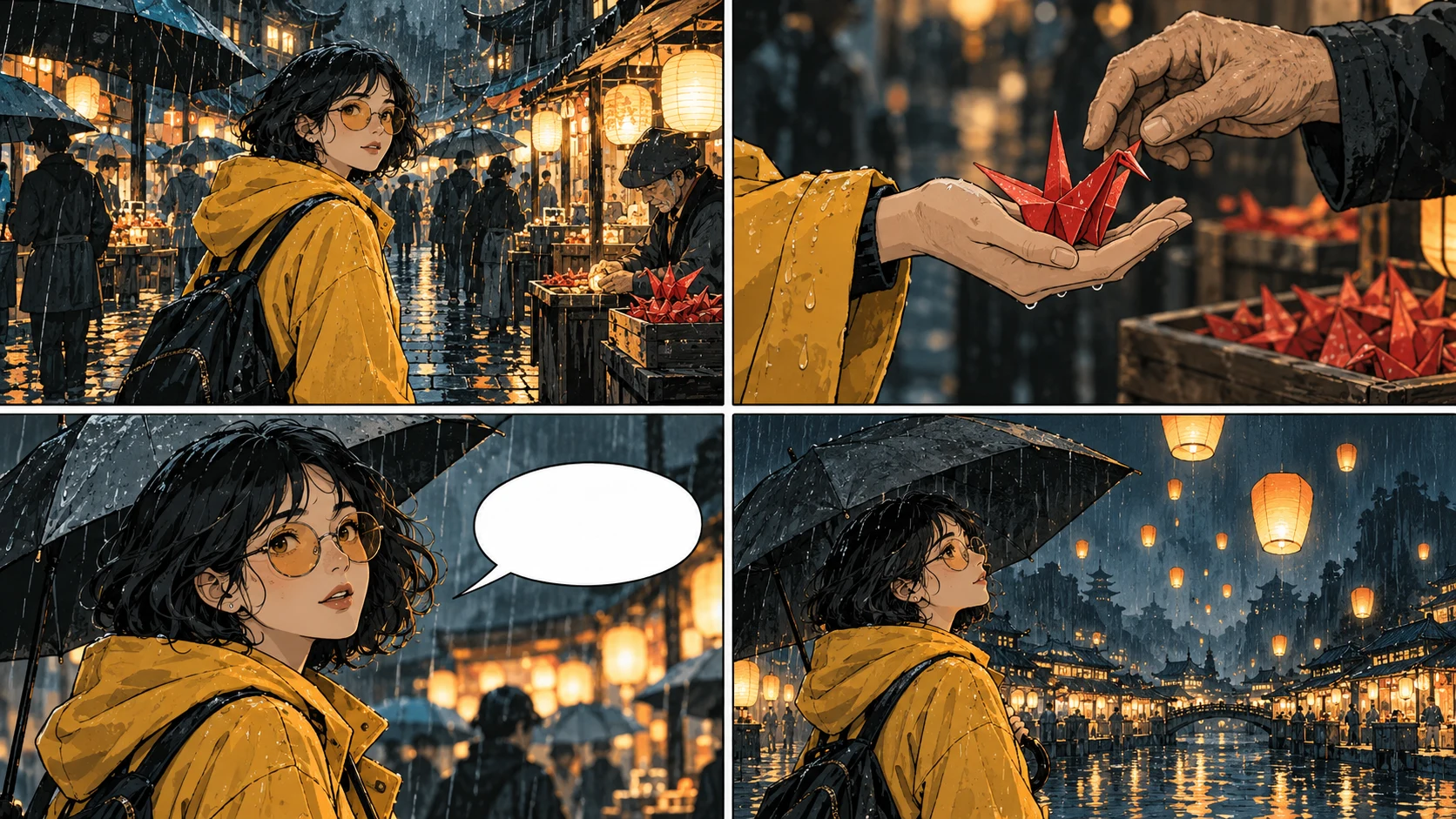
Panel 5 fails. Nora's yellow raincoat becomes a black jacket, her face changes, and the red crane disappears. The bicycle, wet street, camera angle, and action are otherwise useful.
The goal is to repair panel 5 without disturbing panels 1-4 or 6.
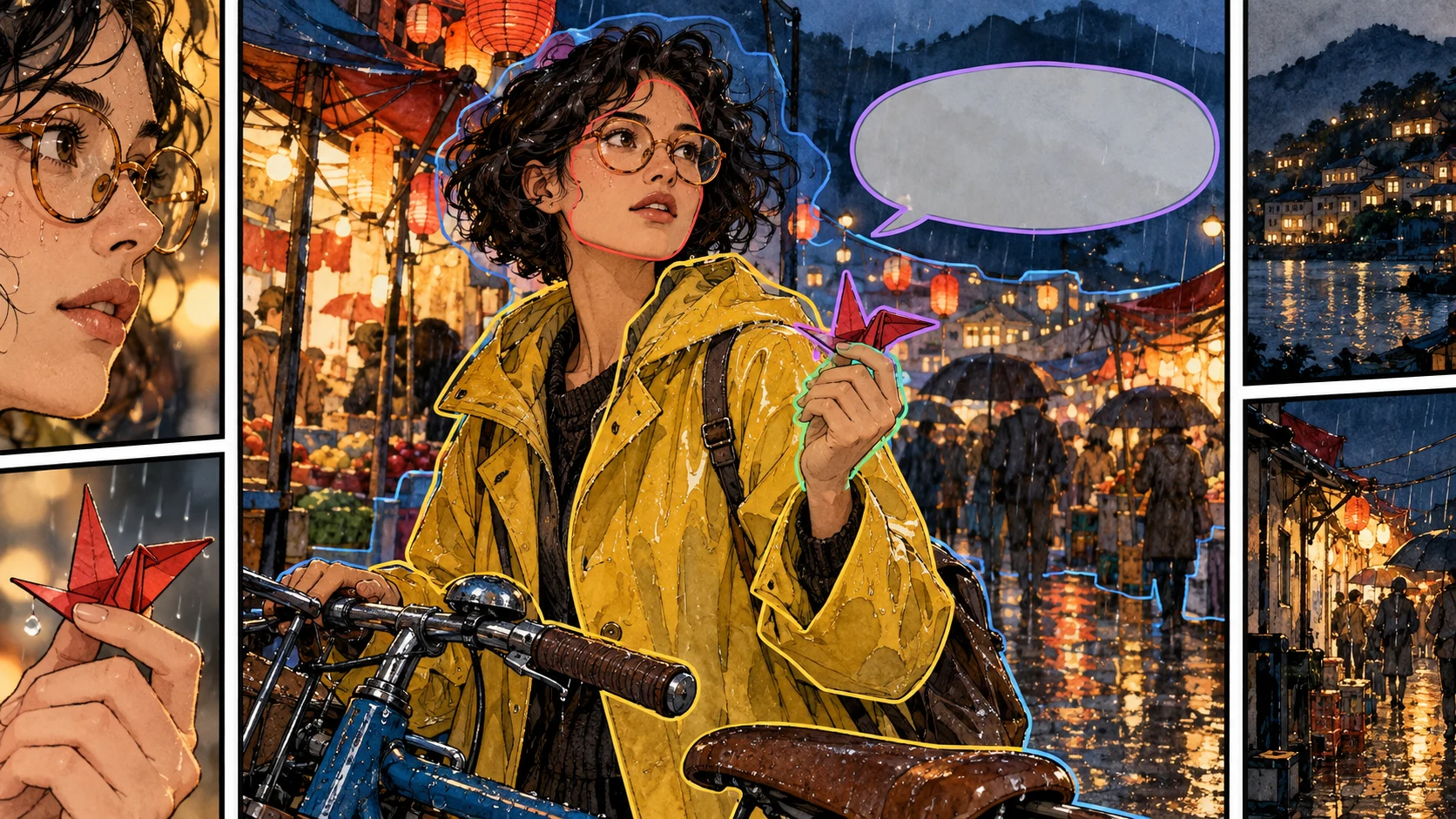
Use this five-part diagnosis:
| Layer | Question | Panel 5 result |
|---|---|---|
| Story | Does the panel show the correct beat? | Yes: Nora catches something |
| Identity | Is it clearly the same character? | No: face and coat drifted |
| Prop | Is the story object present and correct? | No: red crane missing |
| Composition | Are camera, pose, and background useful? | Yes |
| Text | Is the speech or caption wrong? | No text in this panel |
This diagnosis rules out full-page regeneration and text editing. It leaves two plausible tools: redraw the whole panel or partially modify the failed regions.
Um resumo dos lançamentos mais recentes de recursos do LlamaGen, melhorias no produto, atualizações de design e correções importantes de bugs.
| Repair method | Best for | Do not use when |
|---|---|---|
| Panel redraw | Wrong action, shot, pose, or several connected visual details | Most of the panel is already exact and only one small area failed |
| Partial modification | Missing prop, hand, face detail, clothing patch, unwanted object | The underlying composition is wrong |
| Text or bubble editing | Typo, translation, wording, tail direction, bubble position | The artwork itself is wrong |
| Replace image | You already have the exact approved asset | You expect generation to reproduce an image pixel-for-pixel |
| Storyboard revision | Beat order or page readability is wrong | The problem is only local rendering |
Feature availability, model support, and credit rules can vary by plan. Review the controls and cost shown in the product before confirming a repair.
Weak prompt:
Fix panel 5 and make it better.
This does not define what "better" means or which decisions must survive.
Use this pattern instead:
Preserve:
[CHARACTER IDENTITY]
[LOCATION]
[ART STYLE]
[CAMERA ANGLE]
[APPROVED OBJECTS]

Change only:
[FAILED ACTION OR DETAIL]

Do not change:
[NEIGHBORING CONTINUITY ANCHORS]
For the test scene:
Redraw panel 5 only.

Preserve Nora's established identity: short dark curls, round glasses,
yellow raincoat, green scarf, and brown ankle boots. Keep the rainy night
market, wet street reflections, blue bicycle, low three-quarter camera angle,
and ink-and-watercolor style.

Change only the failed story details: Nora is catching one red paper crane
with her right hand beside the bicycle. Her expression is surprised and relieved.

Do not add other people, umbrellas, extra cranes, text, logos, or a different outfit.
The LlamaGen.AI character workflow guide recommends confirming that the correct saved character or reference is attached before regenerating a panel. A perfect prompt cannot compensate for selecting the wrong character reference.
Suppose panel 5 already has the correct Nora, coat, pose, street, and bicycle. Only the crane is missing.
Then a full redraw is unnecessarily broad. Select the hand area and use a local instruction:
One folded red paper crane held gently between the existing thumb and index finger.
Match the panel's ink-and-watercolor style, night lighting, scale, and perspective.
Keep the hand pose, sleeve, face, bicycle, and background unchanged.
The Partial Modification guide describes this tool as a way to target a selected region rather than regenerate the entire image.
Keep the selection tight but include enough surrounding context for lighting and anatomy. A selection around only two fingers may not provide enough information to place the object naturally.
If the only problem is a typo, translation, or bubble position, do not redraw the art.
Use editable text and bubbles for:
This matters because generated lettering can be difficult to correct consistently. Keep words separate from the art whenever the editor allows it. The Speech Bubble Placement Checklist covers reading order and safe placement in more detail.
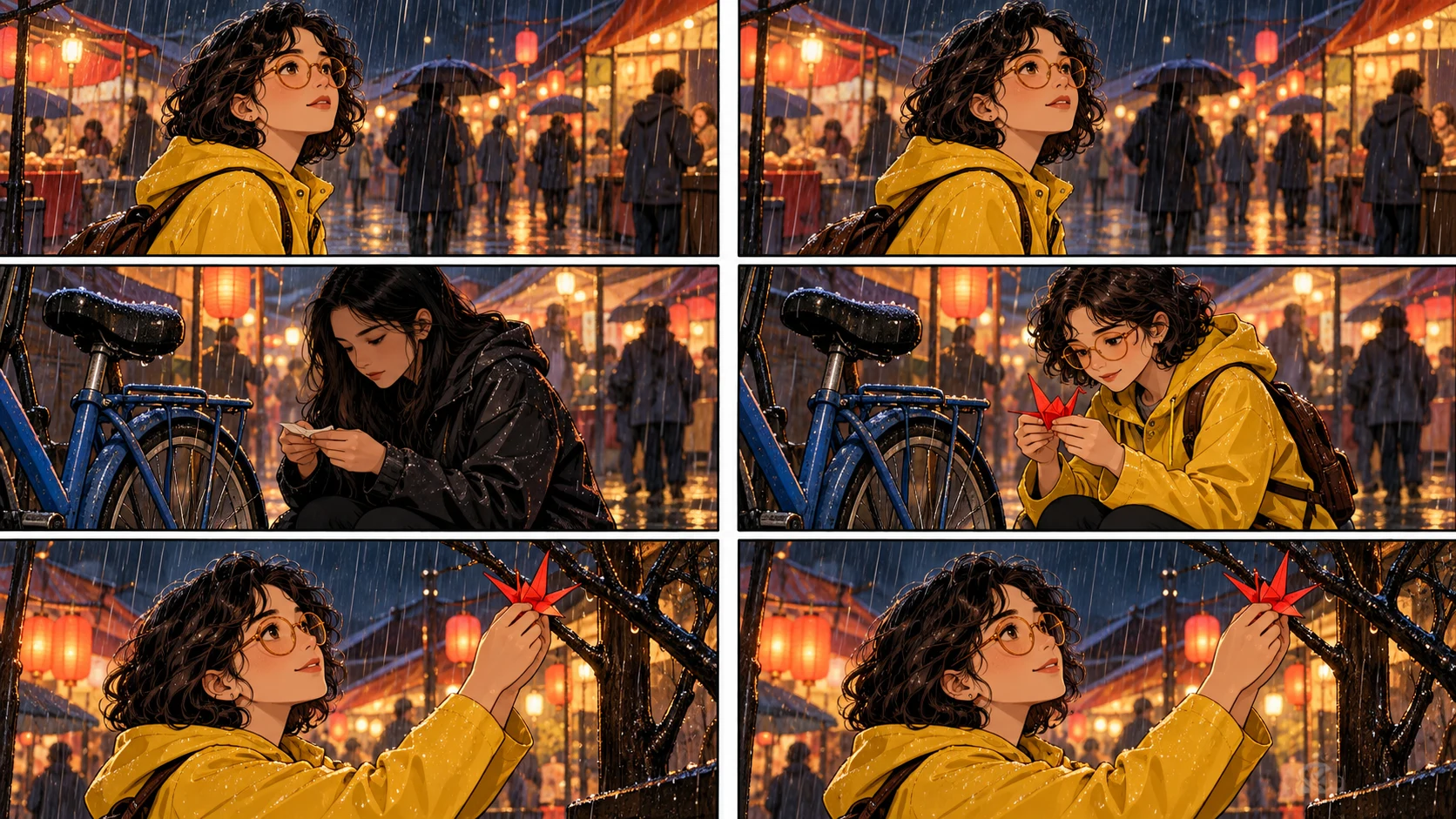
Do not judge a replacement panel in isolation. Compare it with the panel before and after it.
| Continuity check | Question |
|---|---|
| Identity | Does Nora look like the same person as panels 4 and 6? |
| Outfit | Are raincoat, scarf, glasses, and boots unchanged? |
| Prop | Is there exactly one red crane, at the correct size? |
| Screen direction | Does movement still carry from panel 4 into panel 5? |
| Weather | Do rain direction and street reflections match? |
| Style | Are line weight, color, and contrast compatible? |
| Story | Does panel 5 now prepare the reveal in panel 6? |
The repaired panel passes only when it strengthens the sequence, not merely when it looks attractive on its own.
Use this order from least disruptive to most disruptive:
Stop as soon as the page passes review. More generation is not the same as more quality.
Modify the face only. Restore Nora's short dark curls, round glasses,
soft jawline, and same apparent age as the neighboring panels.
Keep the head angle, expression, raincoat, hands, crane, bicycle,
lighting, background, and panel framing unchanged.
Add one folded red paper crane to Nora's right hand.
Match the existing perspective, wet reflected light, and watercolor texture.
Do not change the hand pose, sleeve, face, bicycle, or background.
Redraw this panel only. Use the same Nora character and rainy market scene.
Show a low three-quarter medium shot as she catches the red paper crane
beside the blue bicycle. Preserve the established ink-and-watercolor style.
No text, no extra people, no outfit changes, no additional cranes.
Notice that the third prompt changes enough connected elements to justify a full panel redraw.
| Failed attempt | Result | Better approach |
|---|---|---|
| "Make it consistent" | Model chose its own interpretation | Name the exact identity anchors |
| Changed face, outfit, hand, camera, and lighting together | New panel drifted further | Split local and structural fixes |
| Used partial modification on the entire panel | Behaved like a broad redraw | Select only the failed region |
| Asked generation to recreate an exact imported image | Similar, not identical | Replace the image asset directly |
| Approved the panel without neighbor comparison | Screen direction broke | Review panels 4-6 as a sequence |
Yes, use the available panel-level redraw action on the affected panel. Controls, plan eligibility, and credit rules may differ by model and account.
Use it when the composition works and the failure is local, such as a missing object, clothing detail, hand region, unwanted artifact, or small identity drift.
No. It is a new generation and can change details beyond your requested edit. State what must remain stable and compare the entire result against neighboring panels.
Edit the text or bubble layer when possible. Do not spend an art regeneration on a spelling or placement problem.
Check whether they share one cause. If the shot order, beat, or page layout is wrong, return to the storyboard. If they are independent rendering failures, repair them one at a time and keep the strongest existing versions.
The best comic repair is the smallest change that restores the story.
Diagnose the failed layer, preserve accepted decisions, attach the correct character reference, make one focused correction, and compare the result with its neighbors. That workflow protects your time and the visual continuity readers already trust.
Open LlamaGen.AI Comic Studio and repair the failed panel without throwing away the page that already works.
Editorial note: This tutorial was prepared on October 13, 2026 with an original fictional test scene and purpose-built workflow illustrations. It documents a repair method, not a guarantee that every redraw will preserve all unselected details. Product controls, plan access, model behavior, and credit rules can change; review the current information shown in the product.
Popular creator tools
Go from comics and storyboards to stylized photos with LlamaGen.
Visualize every scene before production starts.
© 2026 LlamaGen.Ai Todos os direitos reservados
Liderando o futuro da geração de quadrinhos por IA