

Character continuity tutorial · Independent creator guide
Gemini Comic Character Consistency: Fix Faces, Outfits & Colors
A character-reference workflow for consistent Gemini comics across four, eight or more panels, with prompts and a concrete review checklist.
Independent educational content. GPT-6 and Astra are OpenAI products; Claude is an Anthropic product; Gemini and Nano Banana are Google products. LlamaGen is not endorsed by those companies. Updated October 15, 2026
This page is partially translated. Detailed examples, prompts, and FAQs are still in English.
Quick answer
Use one original character sheet, a stable verbal identity, panel-by-panel prompts and a side-by-side inspection grid. Fix single-panel errors immediately before the appearance drifts across a whole chapter.
Getting one attractive character image is easier than keeping the same face and outfit over a complete comic. Gemini's image documentation supports reference-image workflows, but consistent output still needs controlled prompts and visual QA.
What the evidence supports Gemini reference-image guidance describes a mechanism, not a multi-panel perfect-consistency guarantee. Verify the source ↗
用角色设定表开启统一角色工作流
Nano Banana 2.1 角色设定表可以让原创设计在复用前更容易检查。请把它当作候选参考,再把每个新场景与已确认的设计进行对比。
- 检查整张设定表中的标识性脸部、发型、服装和关键道具。
- 在把设定表作为后续图片来源前,先排除相互冲突的视图。
- 后续姿势和场景也要复核;参考输入并不能保证身份完全一致。
Nano Banana 2.1 需要付费的 LlamaGen 方案。生成前请先查看当前积分消耗和导出选项。直接使用 Google Cloud API 的计费是分开的。 方案与积分
内容已审核:
Worked example · editable production brief
Eight-panel continuity review sheet
Use these example checks against C01's original character reference. Mark passes only after inspecting actual generated panels.
| Checkpoint | Locked reference detail | What to compare |
|---|---|---|
| 01–02 · Introduction | Bronze round glasses, asymmetric black fringe | Same eye and hair silhouette |
| 03–04 · Action | Orange patch on LEFT sleeve | Avoid mirrored or missing patch |
| 05–06 · Night scene | Dark-green jacket remains green | Lighting does not change fabric identity |
| 07–08 · Close-up | Small mole below RIGHT eye | Facial anchors still visible |
This is an acceptance rubric, not a claim that a Gemini run passed eight panels.
Practical walkthrough
Follow the sequence using an original or authorized project. The workshop above is an editorial plan, not output falsely attributed to a model.
步骤 1
Create a locked character sheet
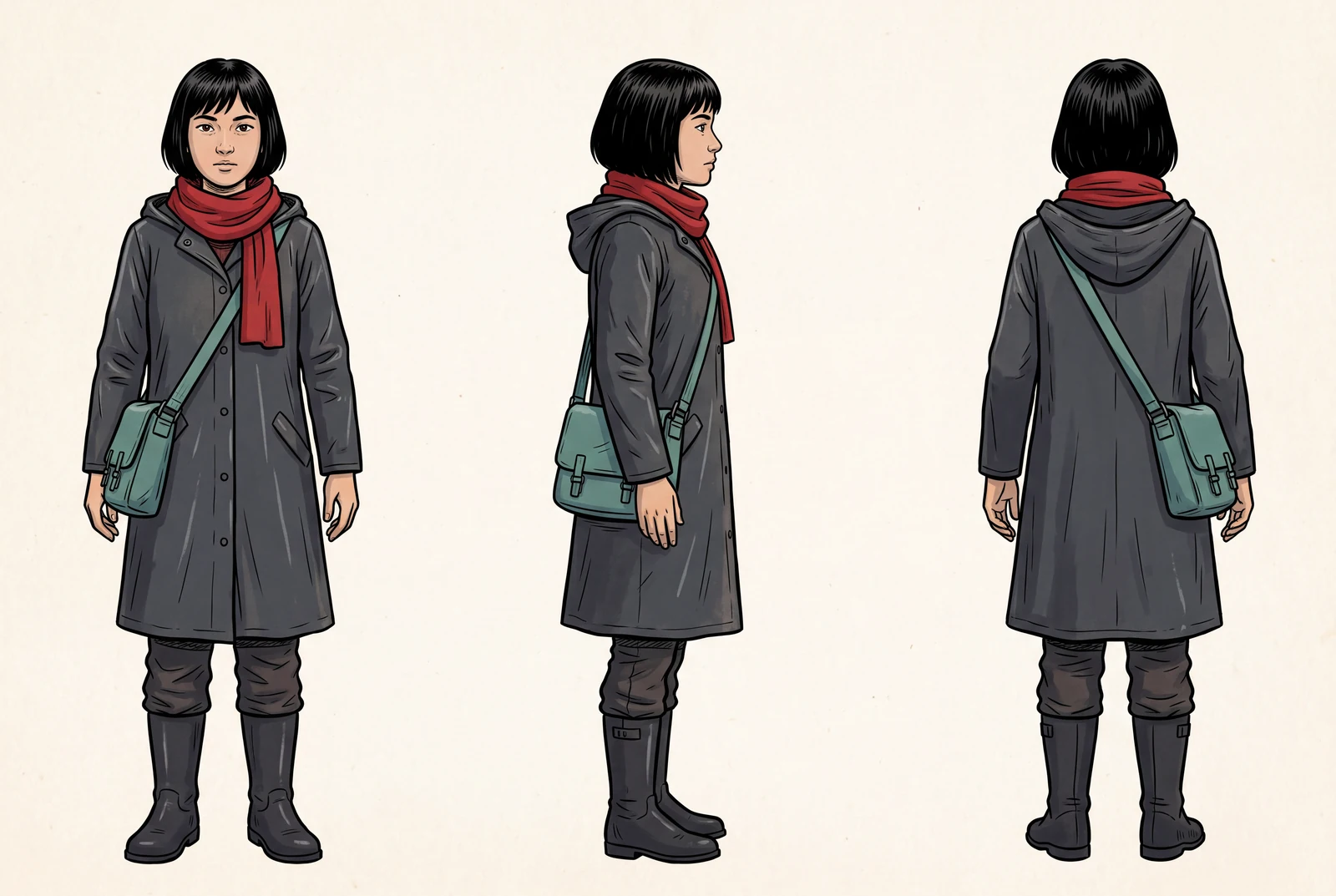
Draw front, side and three-quarter views. Include exact clothing colors, silhouette, freckles, eyewear and a palette. Use artwork you own.
步骤 2
Assign immutable IDs
Name characters C01, C02 and so on. Reuse the same reference images instead of replacing them with later AI outputs after every panel.
步骤 3
Control variables between frames
Keep visual identity constant while changing only location, expression, pose and camera angle. Hold art style and lighting vocabulary steady.
步骤 4
Review a grid of eight panels
Compare eyes, face width, hairstyle, jacket markings, accessory placement and palette across all eight outputs.
步骤 5
Repair just the broken panel
Use the correct original reference and a constrained regeneration/edit. Avoid rewriting the entire issue when one frame diverges.
Copy-ready prompts
Replace placeholder details with your own original story and reference assets. Paste into a compatible model or workflow; available tools and results differ.
1. Reference-locked comic panel
Character C01 is based on my attached original reference sheet. Preserve their asymmetrical short black hair, round bronze glasses, dark-green jacket with one orange patch on left sleeve, and small mole under right eye. Draw C01 reading a map in a train station. Change only pose, expression and background; no costume redesign or new accessories.
2. Continuity audit prompt
Compare these eight comic panels of character C01 to the reference. For each panel mark face, hair, outfit, palette and props as pass / needs correction. Quote the concrete mismatch; do not claim pixel-perfect identity.
Failure → Cause → Fix
When your comic workflow goes wrong
Specific failure patterns matter more than a generic 'try again'. These fixes target the output you can inspect.
1. The jacket becomes nearly black at night
Likely cause Lighting overrode the garment palette.
What to do Specify neutral base color and dark-scene lighting separately.
2. Accessories flip sides
Likely cause Mirror/inversion is common when pose changes.
What to do Call out left/right from the character's perspective and use marked references.
3. After eight panels, the character looks different
Likely cause Generated intermediate art replaced the original ground truth.
What to do Keep one canonical reference, repair each divergence before continuation.
What to check before publishing
Review progress: 0 of 4 checks complete
A personal QA worksheet, not an automated pass/fail evaluation of your image.
常见问题
Why do colors drift between panels?
Lighting and broad prompts can change interpretation; fix named palette colors and ask to preserve costume colors independent of scene lighting.
Does Gemini guarantee a consistent character?
No. Google documents reference workflows and improvements, not an unconditional multi-panel guarantee.
What if one image is wrong?
Repair the offending panel against the original reference instead of using a drifted output as the new standard.
Sources and further reading
Primary documentation and public creator discussions; not a substitute for hands-on results.