



Worldbuilding becomes a comic scene when it stops explaining the world and starts changing what a character can do.
Use this rule:
worldbuilding detail -> pressure on a character -> visible choice -> panel beat
If a detail does not create a choice, obstacle, visual clue, relationship problem, or consequence, it probably belongs in your private story bible instead of the page.
Use LlamaGen.AI Story AI to store the world rules, turn them into scene beats, and move only the panel-ready parts into your comic script.
Lore dumps are tempting because they feel productive. You can write 900 words about a city, a magic system, a family feud, or a government collapse and feel like the story is getting deeper.
On a comic page, that same lore can slow everything down.
Readers do not have a narrator's voice carrying the momentum. They have panels, faces, body language, props, space, timing, and page turns. If the page spends too much energy explaining the setting, the reader may understand the world but stop caring about the scene.
The fix is not to remove worldbuilding. The fix is to make worldbuilding do story work.
Good comic worldbuilding should answer questions like:
What can the character not do because of this world rule?
What object proves the rule without a paragraph?
What social cost appears in the scene?
What does the setting force the character to hide, choose, or risk?
What can be shown in one strong image?
This workflow uses a small fantasy comic project and the same editorial standard we use for LlamaGen.AI blog tutorials: real input, visible process, output examples, and a failure case.
| Test item | Setup |
|---|---|
| Date tested | August 17, 2026 |
| Project | The Salt Gate |
| Source input | 820 words of worldbuilding notes |
| Target tool | LlamaGen.AI Story AI |
| Target output | One 8-panel comic scene plan |
| Creator stage | After story bible, before storyboard or final comic art |
| Active editing time | About 18 minutes |
| Total elapsed time | About 36 minutes including one failed pass |
| Editorial note | This is a workflow test, not a pricing benchmark. Product models, credits, and output speed can vary by workspace settings. |
The test question was:
Can a writer turn dense worldbuilding into a comic scene without making the character deliver a lecture?
Here is the kind of raw note that often becomes a lore dump:
The city of Erynd keeps the ocean outside its walls with a salt gate. Every morning the gate priests ring copper bells to harden the sea into a white glass road for three hours. Only families who pay the salt tithe may cross. Anyone who steps onto the road after the third bell becomes part of the tide until the next winter moon.

The salt tithe was originally meant to fund repairs after the flood war, but the council now uses it to control travel, food, and marriage contracts. Smugglers cut secret marks into old doorframes to show which alleys lead to untithed crossings.

The main character, Mara, grew up outside the tithe registry. Her brother has a legal crossing mark, but she does not.
This has useful material, but it is not a scene yet. It is a rulebook.
Before writing panels, write the job of the scene in one sentence.
This scene shows Mara trying to cross the salt gate illegally, failing because the world rule is real, and discovering that her brother's legal mark can save her at a cost.
That sentence converts the lore into action.
Now the worldbuilding has four jobs:
| Lore detail | Scene job |
|---|---|
| Salt gate | Physical obstacle |
| Copper bells | Time pressure |
| Salt tithe | Social exclusion |
| Brother's legal mark | Relationship cost |
If a lore detail has no scene job, keep it out of the page.
The simplest repair is to replace explanation with consequence.
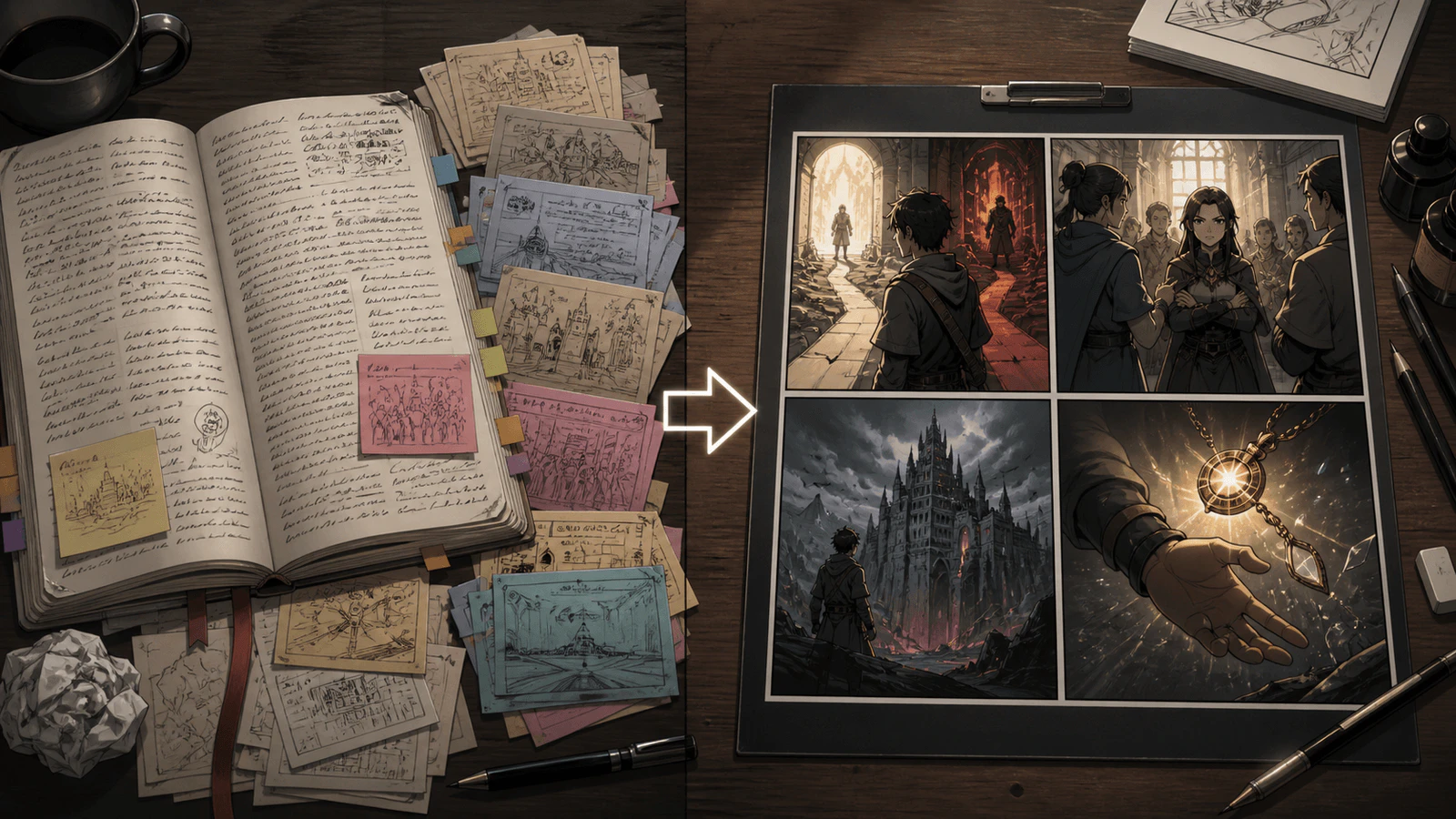
Use this conversion table:
| Instead of explaining | Show this in the scene |
|---|---|
| The salt gate controls travel | Mara reaches the gate and guards block her wrist mark |
| The copper bells limit time | A bell rings and the road begins cracking |
| The tithe creates class pressure | A rich family walks through while Mara is pushed aside |
| Smugglers use door marks | Mara follows a carved mark behind a fish stall |
| Her brother has legal status | His mark glows when he grabs her hand |
The reader learns the world by watching it hurt or help someone.
When you are stuck, choose one of four triggers:
| Trigger | Question | Comic result |
|---|---|---|
| Place | What does this location force the character to do? | Establishing panel plus obstacle |
| Rule | What happens if the character breaks the rule? | Consequence panel |
| Object | What prop proves the world rule? | Insert panel |
| Relationship | Who benefits or suffers because of the rule? | Emotional turn |
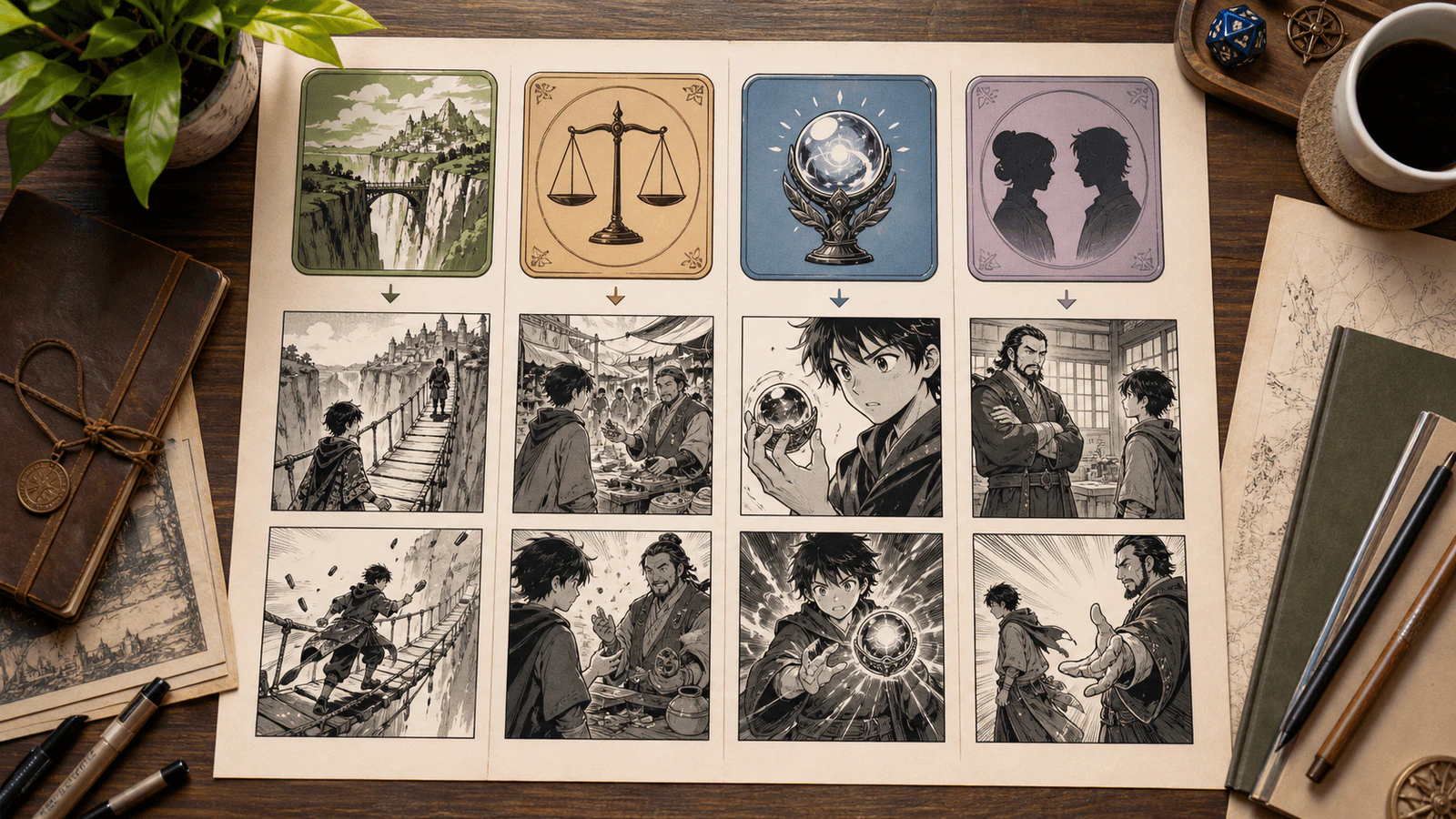
For The Salt Gate, the trigger mix looks like this:
| Trigger | Detail | Scene beat |
|---|---|---|
| Place | Gate mouth at low tide | Mara waits in a crowd as the white road forms |
| Rule | Three bells only | The second bell rings before she reaches the checkpoint |
| Object | Wrist crossing mark | Guard checks marks with a copper ring |
| Relationship | Brother's legal mark | Her brother can save her, but it exposes him |
This gives the scene structure without a single exposition paragraph.
Do not ask for "a scene about my worldbuilding." That often produces a polished paragraph that still sounds like prose.
Ask for visible beats.
I am writing a comic scene from this worldbuilding note.

Goal:
Turn the world rules into visible action. Do not explain the lore in narration.

Return:
1. One-sentence scene job.
2. The key world rule the reader must understand.
3. 8 comic panel beats.
4. For each panel, include what changes visually.
5. Identify any line of dialogue that can be removed because the image already explains it.
6. Give one failed version that feels like a lore dump.
7. Give one repair prompt.

Worldbuilding:
[paste worldbuilding note]

Main character:
Mara wants to cross the salt gate without a legal tithe mark. Her brother has a legal mark, but helping her puts him at risk.
The important instruction is "what changes visually." A scene is not eight illustrations of the same idea. Each panel should change the reader's knowledge, emotion, or expectation.
Here is a usable output structure:
| Panel | Visual beat | What the reader learns |
|---|---|---|
| 1 | Wide shot of the salt gate opening at dawn as a white glass road forms across the sea | This city has a strange rule around travel |
| 2 | Mara hides her bare wrist under her sleeve in the crowd | She does not belong in the legal crossing system |
| 3 | A guard checks a rich traveler's glowing wrist mark with a copper ring | The mark controls passage |
| 4 | Mara follows a carved smuggler sign behind a fish stall | There is an illegal route |
| 5 | The second copper bell rings and cracks spread through the road | Time pressure is real |
| 6 | A child drops a toy onto the road and a parent pulls them back in panic | The rule has danger |
| 7 | Mara slips, her sleeve tears, and the guard sees no mark | Her secret is exposed |
| 8 | Her brother grabs her hand and his legal mark flares across both wrists |
Notice what is missing: a panel where someone explains the council, flood war, history of the tithe, and winter moon curse.
Those details can appear later if they create choices.
A strong comic page uses images to carry facts.
| Fact | Image job |
|---|---|
| This road is temporary | Show cracks spreading after the bell |
| This society is unequal | Show a wealthy family crossing while workers wait |
| This mark has power | Show the copper ring reacting to the wrist |
| Mara is excluded | Show her bare wrist, hidden sleeve, and anxious posture |
| Her brother's help has cost | Show guards turning toward him after the mark flares |
You can still use captions and dialogue, but they should add conflict, irony, or character voice. They should not simply repeat what the panel already shows.
Weak caption:
Only those with the legal salt tithe mark were allowed to cross the road, and Mara did not have one.
Stronger panel note:
Close on Mara's sleeve as she pulls it over her bare wrist. In the background, a guard's copper ring lights up against another traveler's legal mark.
After drafting, scan the scene for these warning signs:
| Warning sign | Repair |
|---|---|
| A character explains history while nothing changes | Turn the history into a current obstacle |
| The page has captions but no choices | Add a decision with a cost |
| Every panel is a setting detail | Put a character goal inside the setting |
| The world rule is named but not tested | Make someone break or nearly break the rule |
| The scene could happen in any city | Add one prop, ritual, law, or consequence only this world has |
Use this repair prompt:
Review this comic scene for lore dumps.

For each panel:
1. Mark whether the panel shows a choice, obstacle, consequence, clue, or relationship pressure.
2. Remove narration that repeats the image.
3. Convert abstract worldbuilding into visible action.
4. Keep the scene readable for a first-time reader.
5. Preserve the emotional goal of the scene.

Scene:
[paste panel plan]
Once Story AI gives you clean scene beats, move into thumbnails or storyboard frames.
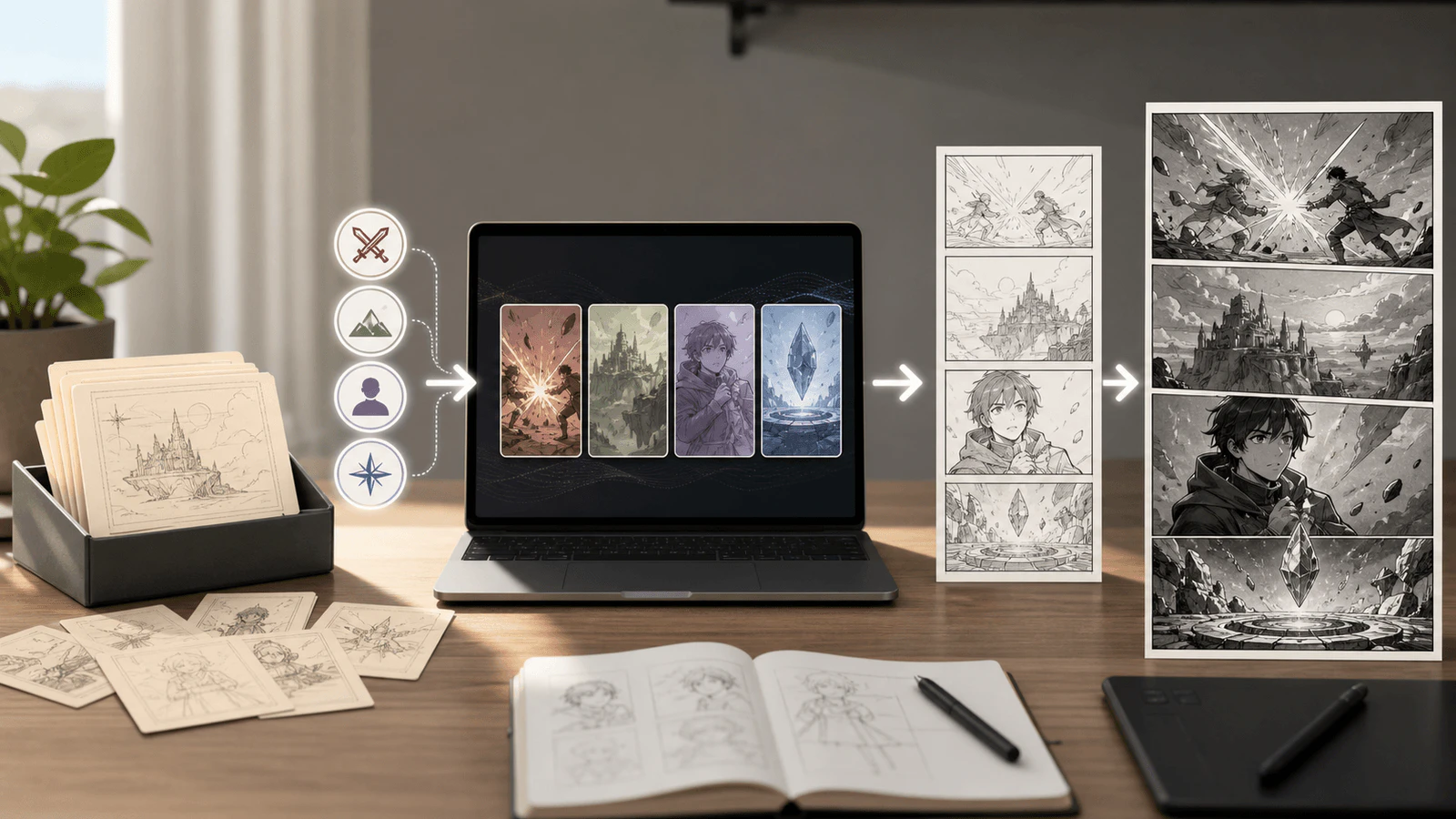
The practical workflow is:
world bible
-> scene job
-> visible pressure beats
-> thumbnail page
-> character consistency check
-> final comic panels
Use Story AI for the story logic, then use a storyboard or comic workflow when the scene is ready to become visual production.
Mara approached the Salt Gate, the great invention created after the flood war. The city used it to control trade and travel through a tithe system that had become corrupt over the past century. The priests rang bells to control the road, and anyone without permission could be punished.
The first bell rings.

A white road hardens over the tide.

Mara covers her bare wrist and steps into the line.

Ahead, a copper ring flashes green over a merchant's glowing mark.

The second bell rings before Mara reaches the gate.

The road cracks.
The second version teaches the same world faster because the reader is watching the rule operate.
Before you move a worldbuilding-heavy scene into final art, check:
| Question | Pass condition |
|---|---|
| Does the scene have a visible goal? | The character wants something on the page |
| Does the world rule create pressure? | It blocks, costs, reveals, or tempts |
| Can the rule be understood without a paragraph? | A prop, action, or consequence shows it |
| Does every panel change something? | New information, emotion, risk, or position |
| Is the lore tied to character choice? | The world forces a decision |
| Did you cut private history? | Backstory stays out unless it affects the moment |
Include only the worldbuilding the reader needs to understand the current choice, danger, joke, reveal, or emotional turn. Keep the rest in your story bible.
Yes, but sparingly. A short caption can orient the reader. The rule should still be tested visually as soon as possible.
Then make the worldbuilding active. Let readers discover it through rituals, objects, architecture, conflict, and consequences instead of a static explanation.
Yes. Use LlamaGen.AI Story AI to store the rules, characters, settings, and scene constraints before turning the scene into storyboard or comic panels.
Worldbuilding is not the problem. Passive worldbuilding is the problem.
When a setting rule changes a character's options, it becomes drama. When a prop proves a rule, it becomes visual storytelling. When a place forces a choice, it becomes a comic scene.
Start with the world bible, but publish the moment where the world pushes back.
Popular creator tools
Go from comics and storyboards to stylized photos with LlamaGen.
Una panoramica delle ultime funzionalità rilasciate di LlamaGen, dei miglioramenti del prodotto, degli aggiornamenti di design e delle correzioni di bug più importanti.


| The solution creates a relationship cost |
Visualize every scene before production starts.
Consiglia semplicemente ai tuoi amici, follower e clienti per guadagnare fino a 30% in commissioni ricorrenti per tutta la vita!