

Customer Service Comic: Practice a Specific Support Conversation
Example preview
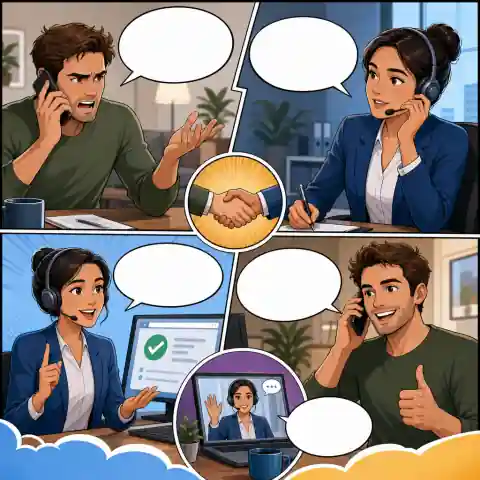
Turn a customer-support scenario into a clear training comic. Show listening, a checked next step, and follow-up using blank dialogue areas you can fill with your actual policy.
For support-team roleplay and discussion, rather than a universal script. The source includes phone, chat, and counter service, friendly conflict resolution, and empty speech bubbles.
When to use this template
- A counter-service roleplay about a delayed order
- A support handoff showing what information to collect
- A coaching example comparing acknowledgment and next steps
Build your first draft
Choose a real scenario
Write the customer’s issue and the agent’s authority. Use your organization’s actual process to decide what can be promised.
Show the support actions
Separate listening, checking information, and offering a next step. Use expressions and props to make the interaction understandable.
Add approved dialogue
Fill the empty bubbles with checked wording. Review privacy, escalation, and follow-up details with the team before using the comic in training.
Try a complete example
A delayed pickup
Four clean business cartoon panels: a customer shows a blank order receipt at a pickup counter; an agent listens and checks a screen; the agent offers a clearly indicated next step while pointing to a pickup shelf; both confirm a follow-up note on a blank card. Friendly professional acting, empty speech bubbles, no logos or readable text.
The blank receipt and card create places for a team’s actual process. The example avoids inventing refund promises or deadlines.
Before you publish
- Do not let generated dialogue create promises outside the agent’s real authority.
- Use fictional customer details and review the scenario with the team that owns the process.
Questions about this template
- Does the comic provide a ready-to-use support policy?
- No. It illustrates a scenario. Add your organization’s current policy, limits, escalation path, and approved wording before using it for training.
- Why are speech bubbles empty?
- The source asks for no readable generated text. Empty bubbles allow trainers to add accurate language, localize the lesson, or ask learners to propose a response.
- Can I compare two responses?
- Yes. Build one version showing an unhelpful response and another showing a better action, then discuss the concrete differences without using real customer data.