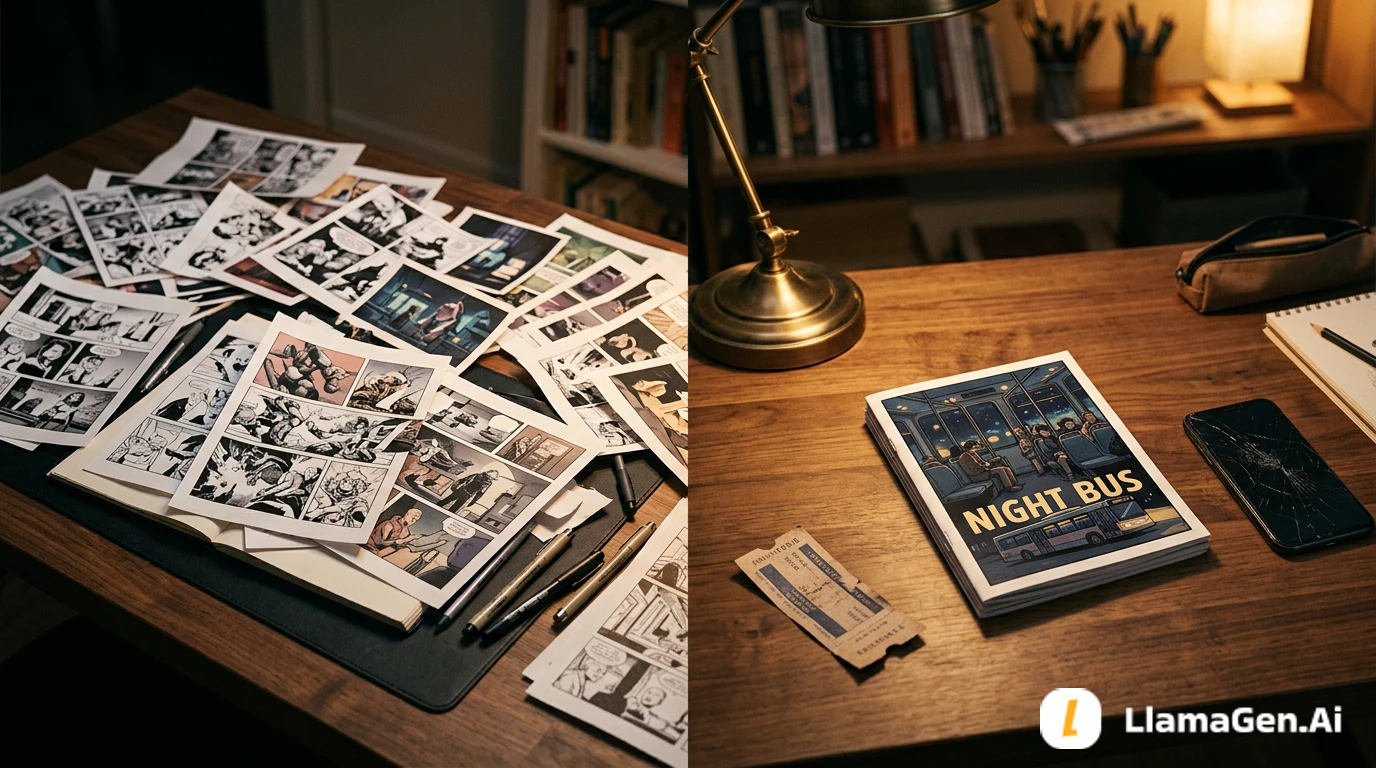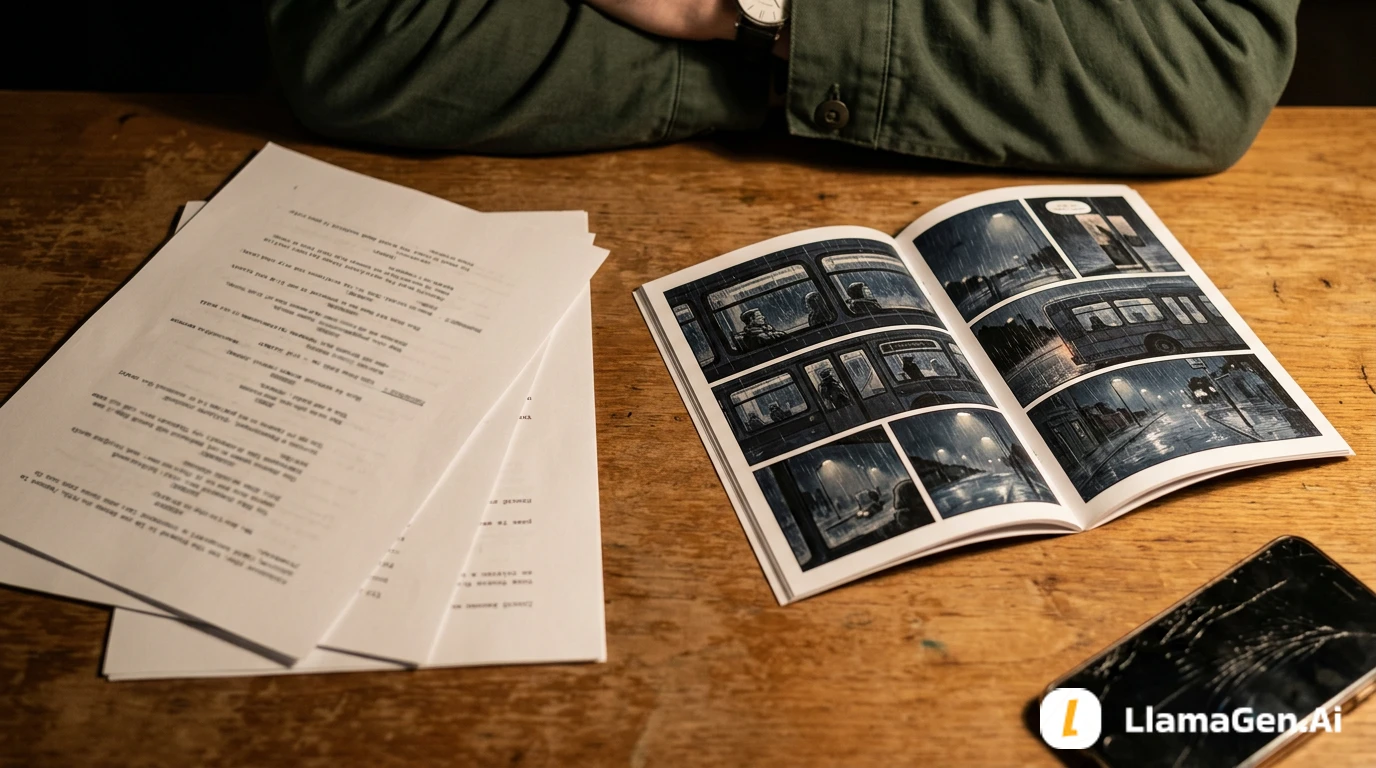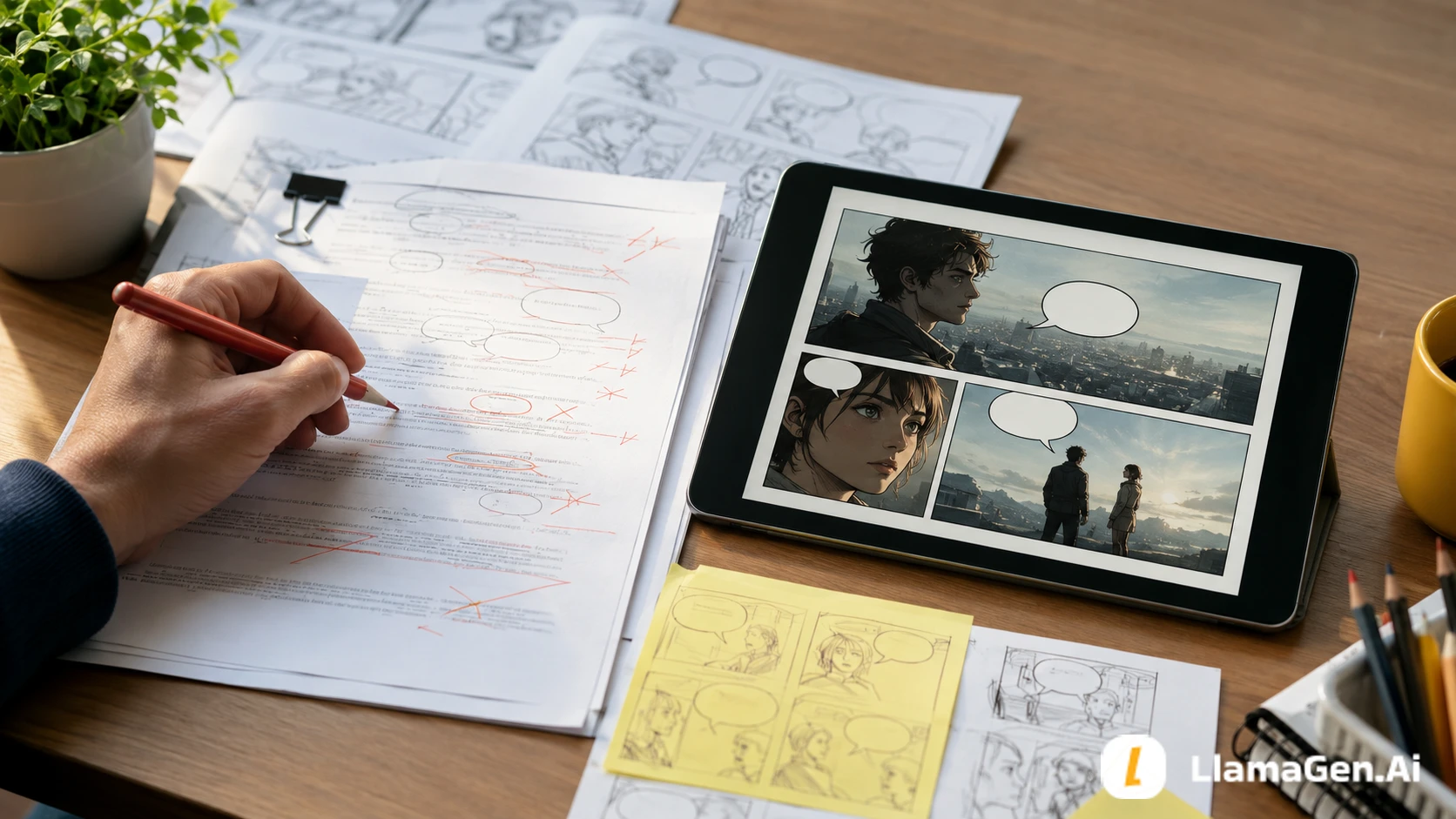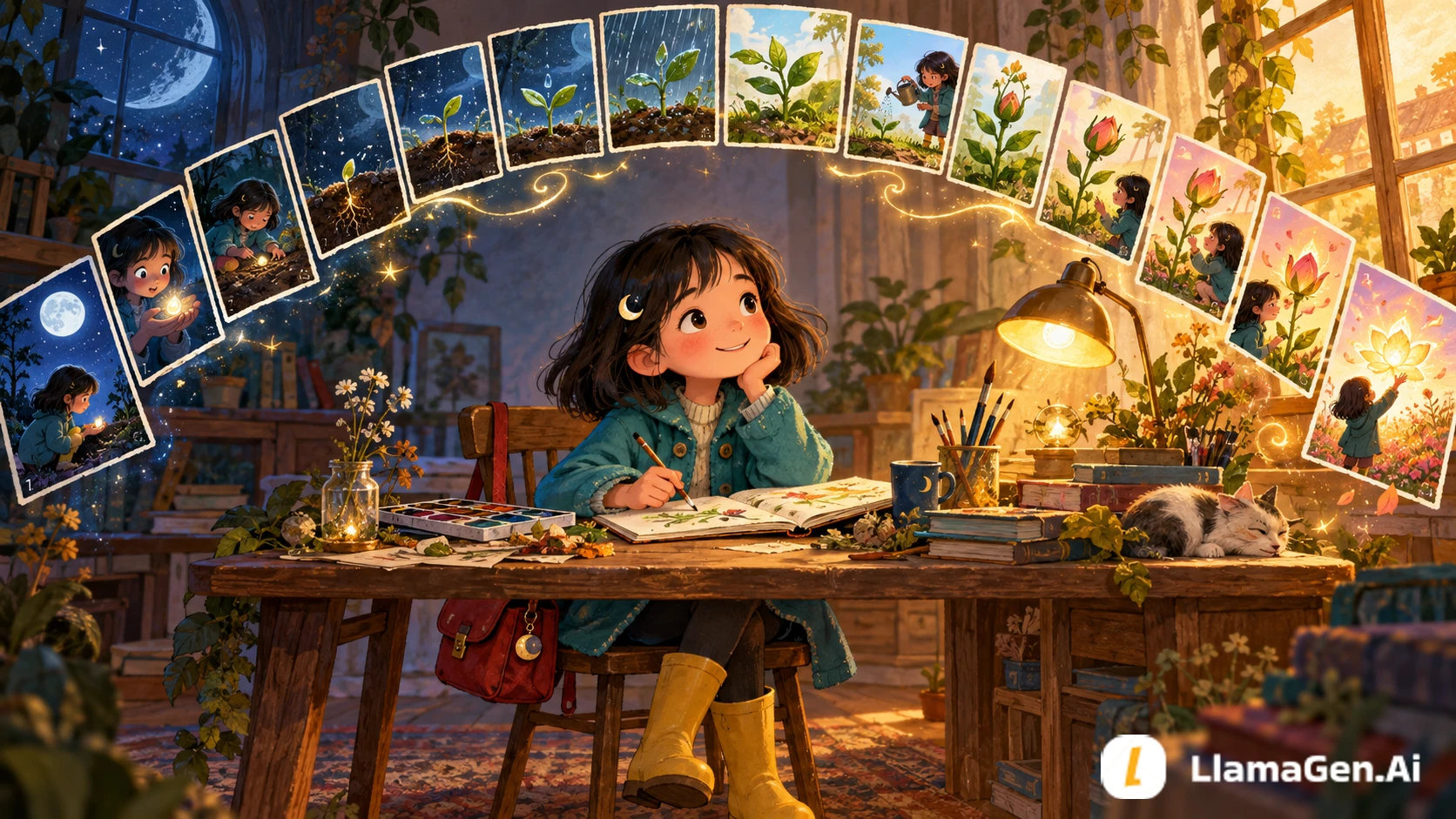

A strong 16-page children's storybook comic is not sixteen unrelated illustrations. It is one small story divided into sixteen visual promises.
Use this production order:
one-sentence story -> 16-page beat map -> character lock -> page thumbnails
-> final panels -> text pass -> continuity review -> export
Keep each page focused on one emotional change, use one to three panels per page, and create the cover separately. You can build the pages in LlamaGen.AI Comic Studio, then review all sixteen pages as a sequence before exporting.
This workflow covers 16 interior story pages. The front cover, back cover, title page, copyright page, and any printer-required blank pages are separate production decisions.
That distinction matters. A digital storybook prototype can be sixteen story pages, while a print service may require a different total page count, trim size, bleed, or binding setup. Check the current specifications of your chosen printer before promising a physical edition.
Our example is an original story called Mina and the Moonlight Seed:
Mina finds a seed that only grows when someone performs a quiet act of courage.
She tries to force it to bloom, fails, then helps a frightened moth find its way home.
The seed opens into a glowing flower that lights the village path.
The target reader is approximately ages 6-9. The language is short, the emotional problem is clear, and the visual action carries more of the story than the narration.
Do not start by asking for sixteen finished images. First assign one job to every page.
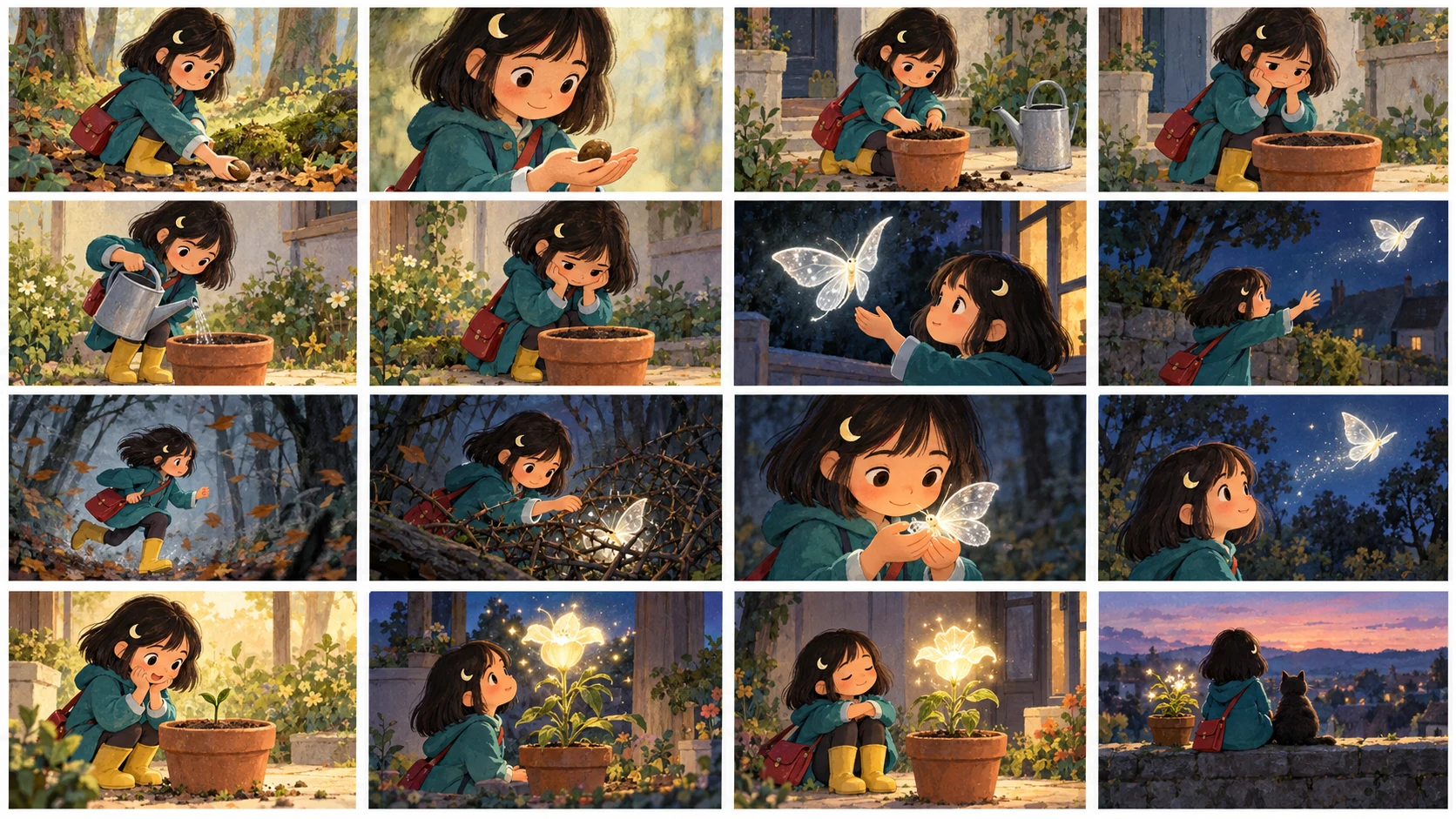
| Page | Story job | Visual focus | Suggested text load |
|---|
| 1 | Introduce Mina and the village | Wide establishing image | 1-2 sentences |
| 2 | Show Mina's ordinary problem | Medium character moment | 1-2 sentences |
| 3 | Discover the moonlight seed | Object close-up | 1 short sentence |
| 4 | Learn the seed's rule | Mina and an elder | 2-3 short sentences |
| 5 | Try an easy solution | One playful action | 1-2 sentences |
| 6 | The seed does not react | Quiet reaction close-up | 1 sentence |
| 7 | Try a louder solution | Two small comic panels | 2 short lines |
| 8 | Fail again | Large humorous panel | 1 sentence |
Pages 1-4 establish the promise. Pages 5-8 show failed attempts. Pages 9-12 require a real choice. Pages 13-16 deliver the emotional and visual payoff.
Um resumo dos lançamentos mais recentes de recursos do LlamaGen, melhorias no produto, atualizações de design e correções importantes de bugs.
This is more useful than a generic instruction such as "make a children's book about courage" because every page has a specific narrative responsibility.
Before generating art, write five rules:
Reader: ages 6-9
Theme: courage can be quiet
Main character: Mina, curious but impatient
Visual promise: a dim seed gradually becomes a warm light
Ending feeling: safe, proud, and ready for sleep
This contract prevents the middle of the book from becoming louder, scarier, or more complicated than the intended reading experience.
Create Mina before creating pages. Use one clear reference image or an original character design in LlamaGen.AI Characters.
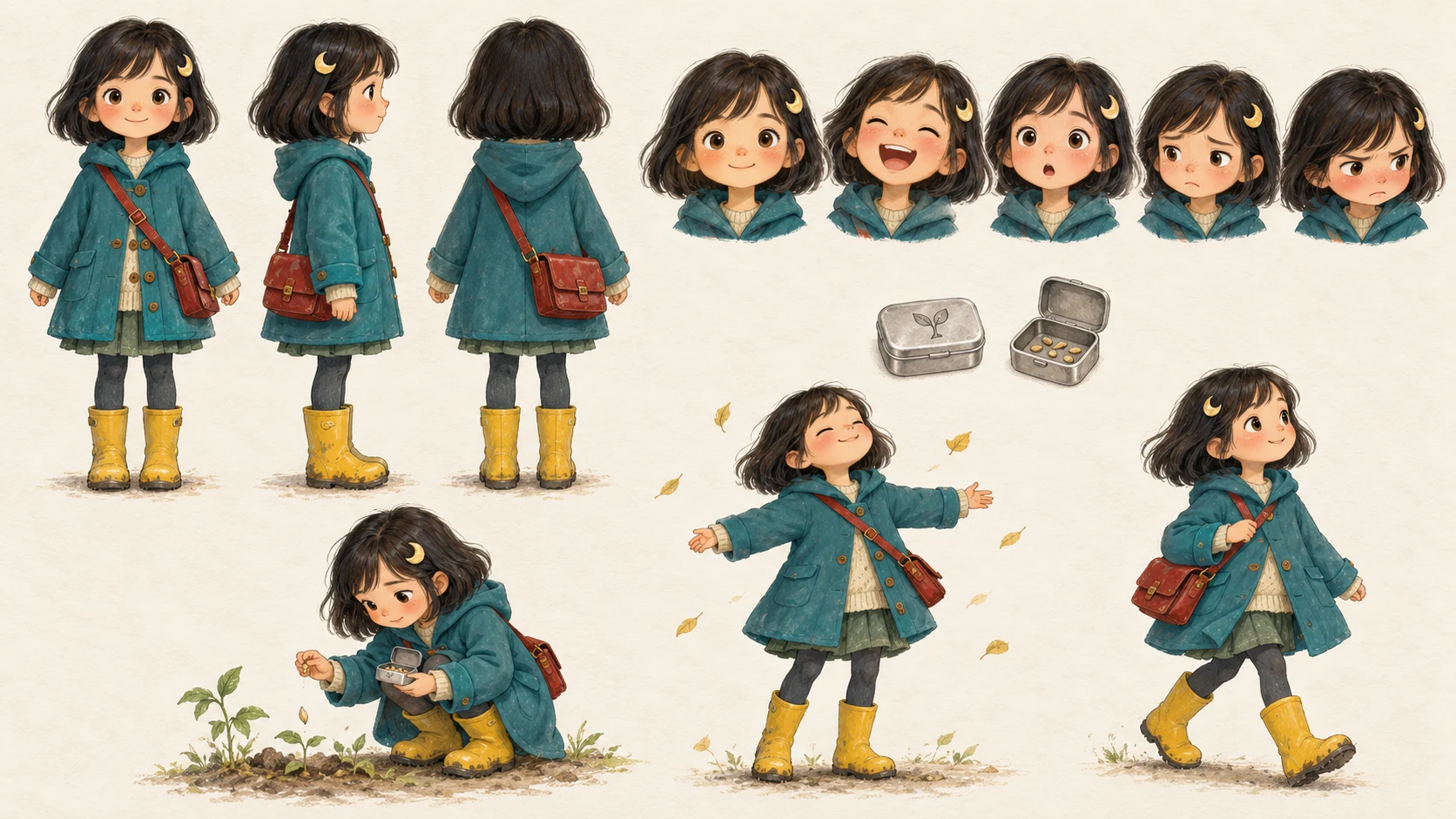
Use a compact lock file:
| Element | Mina's fixed rule | Allowed variation |
|---|---|---|
| Age and build | 8-year-old child, small frame | Natural pose changes |
| Hair | Dark bob, one moon-shaped clip | Wind or rain movement |
| Outfit | Teal coat, yellow boots, red satchel | Coat open or closed |
| Face | Round cheeks, dark eyes | Full emotion range |
| Prop | Small silver seed box | Open, closed, carried |
| Acting | Curious lean, hands move before feet | Calm posture at the end |
The moon clip, teal coat, yellow boots, and red satchel are recognition anchors. Repeat them in the page prompts that include Mina.
If you use a photo as a character reference, upload only an image you own or have permission to use. For a real child, obtain guardian consent and avoid exposing names, school uniforms, home addresses, or other private details. A fictional child design is usually the cleaner choice for a public project.
Make rough page thumbnails before finished art. The thumbnails only need to answer:
The value of a thumbnail is that it is cheap to change. Sequential work reveals problems that isolated illustrations hide. A ComicBookCollabs discussion about finishing a 16-page issue makes a similar point: many storytelling problems only become obvious after the full sequence is visible.
A sixteen-page book becomes tiring if every page has the same layout.
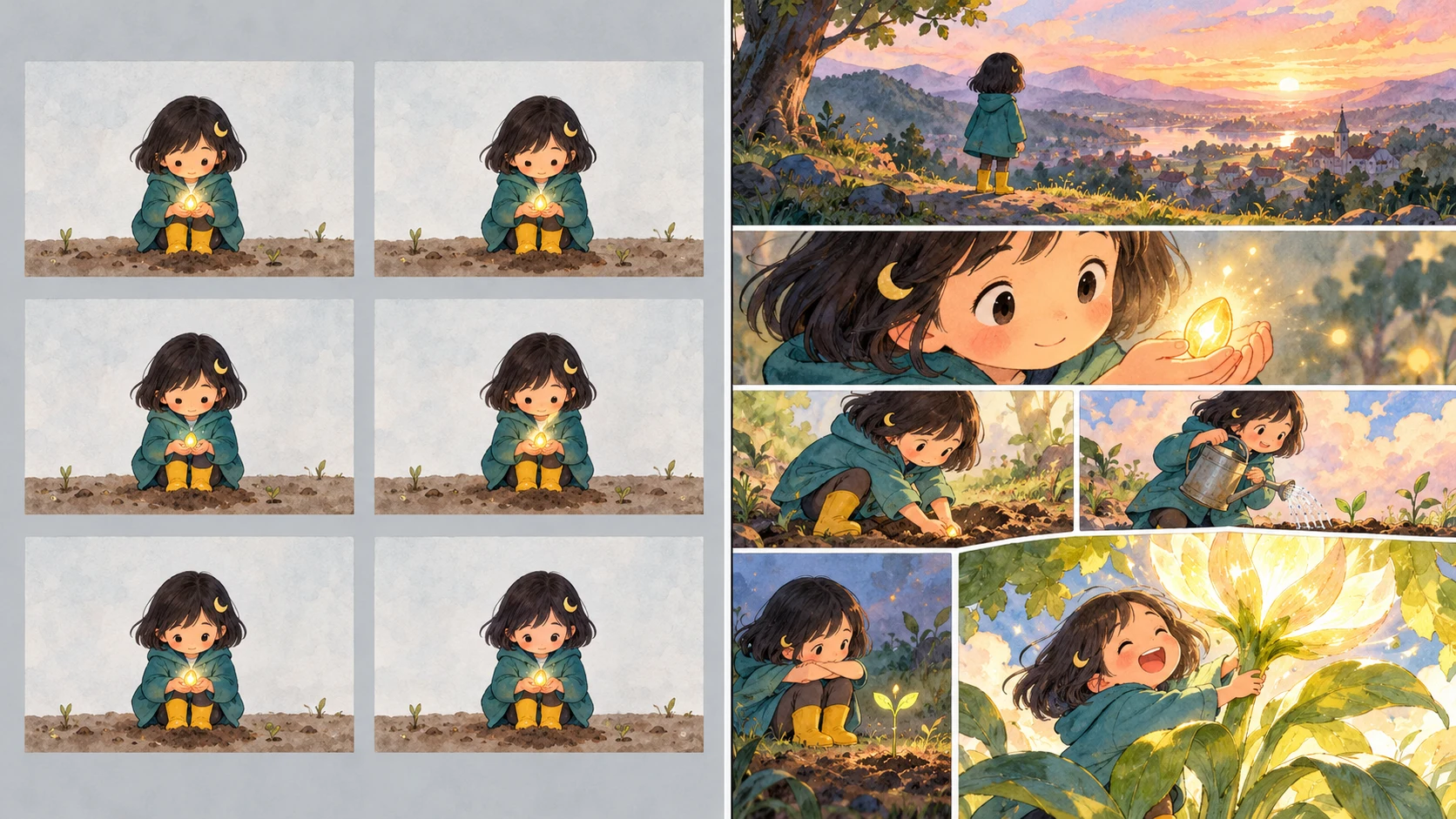
Use this rhythm:
wide scene -> medium action -> close detail -> quiet reaction
-> playful two-panel beat -> large failure -> location change
-> obstacle sequence -> full-page payoff -> calm closing echo
One to three panels per page is a useful constraint for this hybrid format. It gives young readers enough visual sequence to feel like a comic while preserving the breathing room of a picture book.
Do not treat that as a universal publishing rule. It is an editorial choice for this example.
Start with the approved beat, the locked character, and only the details needed for that page.
Use this prompt structure:
Create page [NUMBER] of a warm children's storybook comic.

Story moment:
[ONE ACTION OR EMOTIONAL CHANGE]

Character lock:
Mina is an 8-year-old child with a dark bob, moon-shaped hair clip,
teal coat, yellow boots, and red satchel.

Composition:
[ONE LARGE PANEL / TWO PANELS / THREE PANELS]
[CAMERA DISTANCE AND READING ORDER]

Important object:
[SEED BOX / MOTH / GLOWING FLOWER]

Art direction:
soft gouache storybook texture, expressive faces, clear silhouettes,
gentle night colors, warm pools of light, age-appropriate mood.

Leave clean negative space for narration. Do not render readable text,
logos, signatures, page numbers, or watermarks into the artwork.
For page 12, the filled prompt becomes:
Create page 12 of a warm children's storybook comic.

Story moment:
Mina shields a frightened silver moth from a sudden gust using her teal coat.

Character lock:
Mina is an 8-year-old child with a dark bob, moon-shaped hair clip,
teal coat, yellow boots, and red satchel.

Composition:
Two panels, read left to right. First panel: wind bends the grass as Mina
spots the moth. Second panel: close protective action, Mina crouches and
holds the coat around the moth without touching its wings.

Art direction:
soft gouache storybook texture, clear silhouettes, gentle suspense,
cool moonlight outside the coat and warm reflected light inside.

Leave clean space above the first panel for one narration sentence.
No readable text, logos, signatures, page numbers, or watermarks.
If you are using LlamaGen.AI Comic Studio, treat each page as a separate production unit. That makes it easier to revise a weak page without disturbing the rest of the sequence.
Do not ask the image model to paint paragraphs into the illustration. Add narration and speech as editable text so you can correct spelling, placement, language, and reading order.
Use these limits for the first edit:
Example:
too explanatory: Mina finally understood that courage meant helping someone
even when she was scared and did not know what would happen next.

cleaner: Mina was afraid. She held the coat steady anyway.
The image already shows the moth and the wind. The sentence only needs to name the emotional choice.
Read only the sixteen page summaries. Can you understand the cause-and-effect chain?
Hide the text. Can you recognize Mina, follow the seed, and understand the major actions?
Read the final copy at a natural pace. Remove words that delay the page turn without adding emotion, clarity, or humor.
Use this final checklist:
| Check | Pass condition |
|---|---|
| Character identity | Mina remains recognizable on all pages |
| Prop continuity | Seed box and seed do not change without reason |
| Location logic | Village, woods, and path remain spatially clear |
| Emotional arc | Impatience becomes care, then quiet pride |
| Page turns | Pages 4, 8, 12, and 15 create forward pull |
| Text | Editable, readable, and not baked into the art |
| Safety | No private child information or unlicensed references |
| Export | Correct dimensions for the intended digital or print destination |
The weak first prompt was:
Make a 16-page children's comic about a girl who finds a magic seed.
It left too many decisions unresolved.
| Failure | Why it happened | Repair |
|---|---|---|
| Mina's outfit changed | No character lock | Repeat four recognition anchors |
| The seed bloomed too early | No page beat map | Reserve bloom for pages 14-15 |
| Middle pages felt repetitive | Every page used one centered image | Alternate shot size and panel count |
| Text competed with faces | No negative space instruction | Reserve text area in composition |
| Ending felt abrupt | Page 16 had no echo | Return to the page 1 village view |
The fix was not a longer single prompt. It was a clearer production sequence.
Not in this workflow. The sixteen pages are story pages. Create the cover separately and confirm the total page requirements of your export or print service.
Yes, but more panels are not automatically better. Young-reader pages need clear actions, readable faces, and room for text. Use additional panels only when the sequence benefits from them.
Start with the complete beat map, then generate and review pages in small batches. Page-level control makes continuity failures easier to diagnose and repair.
Create a character reference first, repeat stable visual anchors, and compare every page against the same lock file. The Comic Character Consistency Checklist provides a deeper review method.
You can prepare art for print, but trim size, bleed, color mode, page count, binding, fonts, and rights requirements depend on the printer and marketplace. Validate those specifications before final export.
Sixteen pages are enough for a complete children's story when every page performs one clear job.
Plan the emotional arc first. Lock the character second. Thumbnail the entire sequence third. Generate finished pages only after the page turns, text space, and visual rhythm work together.
Open LlamaGen.AI Comic Studio and turn your 16-page beat map into a storybook comic one controlled page at a time.
Editorial note: This tutorial was prepared on October 13, 2026 with an original fictional story and purpose-built workflow illustrations. It documents an editorial process, not guaranteed generation time, pricing, print acceptance, or exact visual output. Product controls, model behavior, plan access, and credit rules can change; review the information shown in the product before generating.
Popular creator tools
Go from comics and storyboards to stylized photos with LlamaGen.
| 9 | Hear the lost moth | Darker location shift | 1-2 sentences |
| 10 | Decide whether to help | Face and body language | 1 sentence |
| 11 | Enter the windy woods | Wide obstacle shot | 1-2 sentences |
| 12 | Protect the moth | Action close-up | Minimal text |
| 13 | Find the moth's family | Warm reveal | 1 sentence |
| 14 | The seed begins to glow | Seed and Mina together | 1 short line |
| 15 | The flower lights the path | Largest payoff image | 1-2 sentences |
| 16 | Echo the opening image | Calm closing scene | 1 final sentence |
Visualize every scene before production starts.
© 2026 LlamaGen.Ai Todos os direitos reservados
Liderando o futuro da geração de quadrinhos por IA