LlamaGen-logotypLlamaGen-varumärket
Kom igångPrenumerera nu20 % rabatt
  1. Hem
Build a Location Bible for AI Comics: Return to the Same Place Without Reinventing It
Alla inlägg

Build a Location Bible for AI Comics: Return to the Same Place Without Reinventing It

Jay
Jay
28 november 2026
Kopiera länk
  • 1. Give the place an ID and one visual authority
  • 2. Separate geography from screen direction
  • 3. Keep movable props in a different record
  • 4. Reattach the right location reference when you return
  • 5. Approve useful views, not an imaginary complete room
  • 6. Review the return against the story, not just the picture
  • Download the example location bible
  • Does a location bible stop all background drift?
  • Should every panel use the master image?
  • What if the place changes during the story?
elevate-your-comics.png
Elevate your Comics with LlamaGen

A recurring location needs an identity just as much as a recurring character does. If the station window changes shape, the door jumps to another wall, or the notebook reappears after somebody carried it away, the next panel can contradict the story even when the face is correct.

Build a comic location bible before a place becomes a regular set: one approved master image, a short description of its geography, the views you actually need, and a separate record of movable props. You can start a character or scene in LlamaGen.AI, then keep the approved references and state notes with your project.

This guide responds to a Reddit discussion about revisiting locations across an AI-generated episode. The useful production question is specific: when the story returns, are the landmarks and props still where the previous scene left them?

Example scope — November 28, 2026: the station below is our original generated teaching set. We made an exterior departure image and two new indoor returns through direct Google Vertex image calls. These are still-image examples assembled locally for review; they are not a native LlamaGen.AI location-memory feature, a ComfyUI workflow, or a video test. The calls supplied references explicitly. Nothing here establishes persistent model memory.
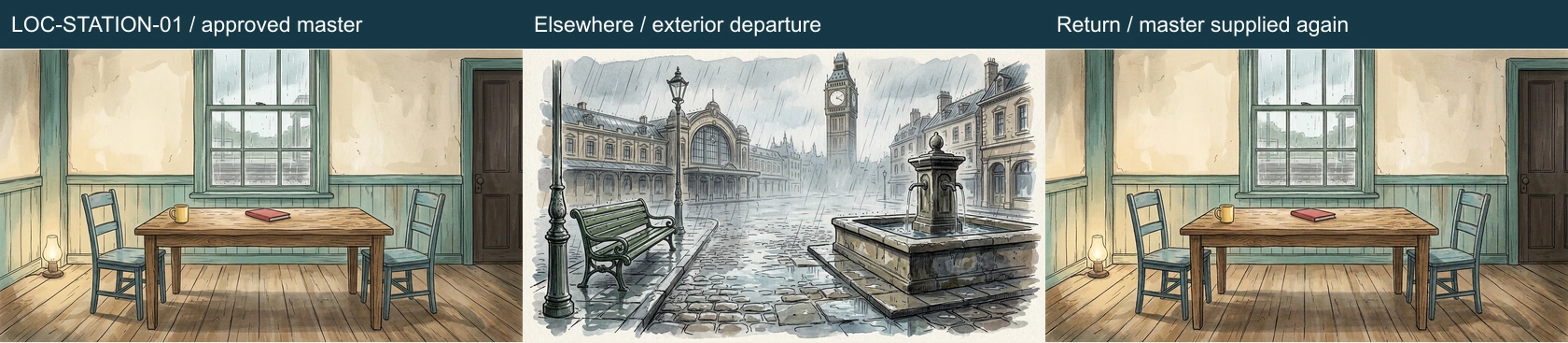
Approved station interior, exterior departure and a return generated with the interior master supplied again

The middle image is another place. For the third image, we supplied the original interior again instead of expecting the outdoor frame to preserve indoor construction details.

1. Give the place an ID and one visual authority

Our room is LOC-STATION-01, version 01. Its approved master shows a wooden table under a rainy window, a wooden door on the right, two blue chairs, green wainscoting, and an oil lamp on the left floor. A yellow mug sits on the left side of the tabletop; a closed red notebook sits near the center.

Use the master as the authority for this version. A later attractive image does not automatically become the new room. If you approve an architectural change, issue a new version and identify which future panels should use it.

Save the original at a readable resolution. A small contact sheet is useful for orientation, but the next artist or reference-aware generator may need the actual window, chair, and door details.

A practical folder might contain:

Related hot tags

AI-serier

OC Maker

Guide

Comic Production

Populära kreatörsverktyg

Förvandla inspiration till din nästa berättelse

Skapa serier, storyboardar och stiliserade foton med LlamaGen.

01

AI-seriegenerator

Förvandla en idé till välgjorda seriestrippar på några minuter.

Skapa serier
02

AI-mangagenerator

Skapa uttrycksfull manga och berättelser i flera paneler.

Skapa manga
03

AI-storyboardgenerator

Visualisera varje scen innan produktionen drar igång.

Skapa storyboardar
04

Gör bild till serie

Förvandla valfritt foto till en serielik illustration.

Skapa serier från bilder
05

AI-serierutskaper

Skapa delningsbara seriestrippar med konsekventa karaktärer.

Skapa seriestrippar

LlamaGen community

checkmark

Get hands-on help with your comics

checkmark

Showcase your comics to fellow LlamaGen creators

checkmark

Participate in special events to win gifts

Ändringslogg

Tänd drömmar hos de unga
Där miljontals berättelser blir levande

En översikt över de senaste funktionssläppen i LlamaGen, produktförbättringar, designuppdateringar och viktiga buggfixar.
✦
✧
✦
✧

Ett nytt medium för Berättande

Skapa obegränsat med berättelser, serier, animationer, spel och mer på några sekunder som tilltalar moderna målgrupper

LOC-STATION-01/v01/ station-master.png location-bible.json location-map.svg approved-views/ scene-state/ candidates-not-approved/

Those names are an editorial organization example, not a required product folder structure. The downloadable source pack contains the master and the actual candidates used here.

2. Separate geography from screen direction

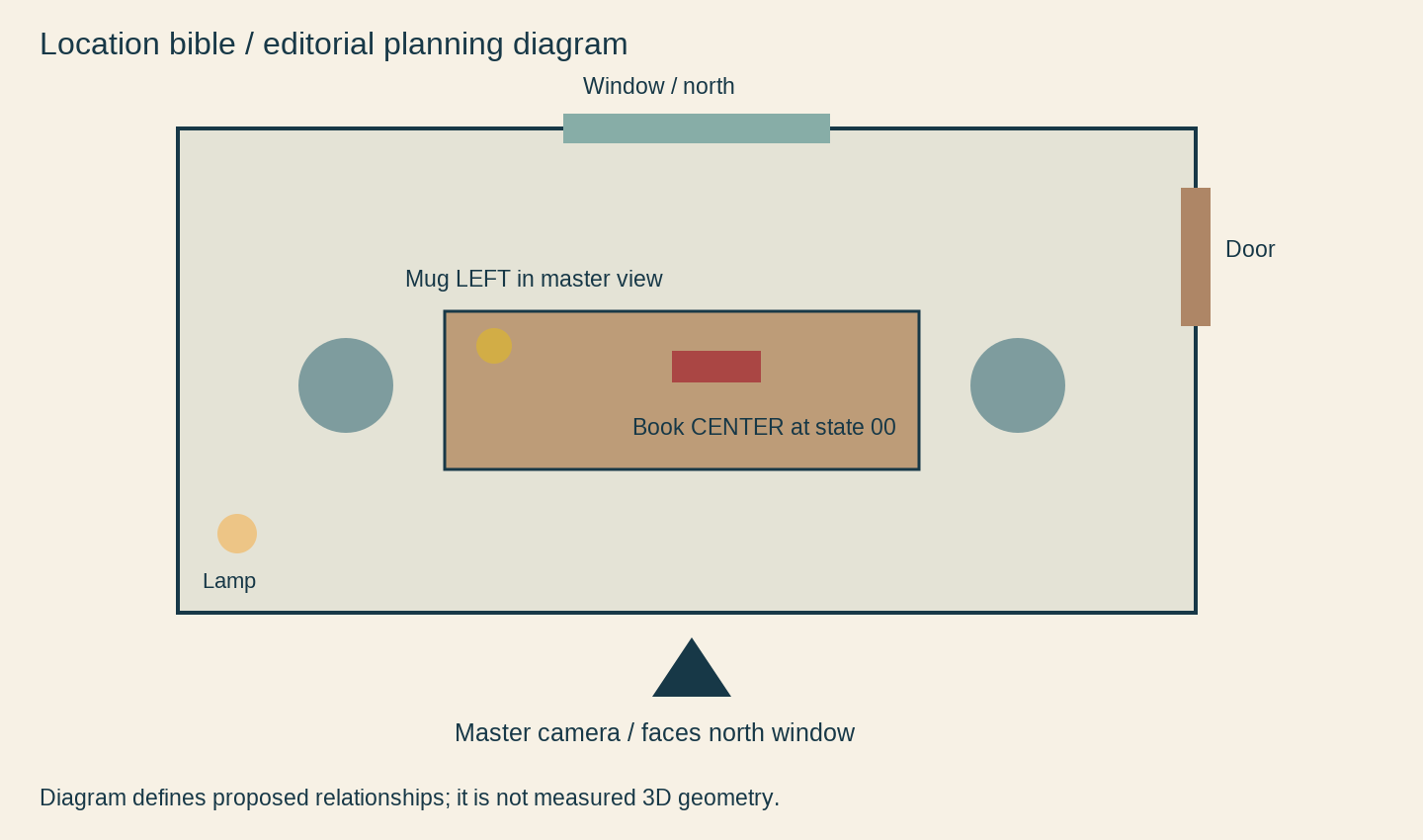
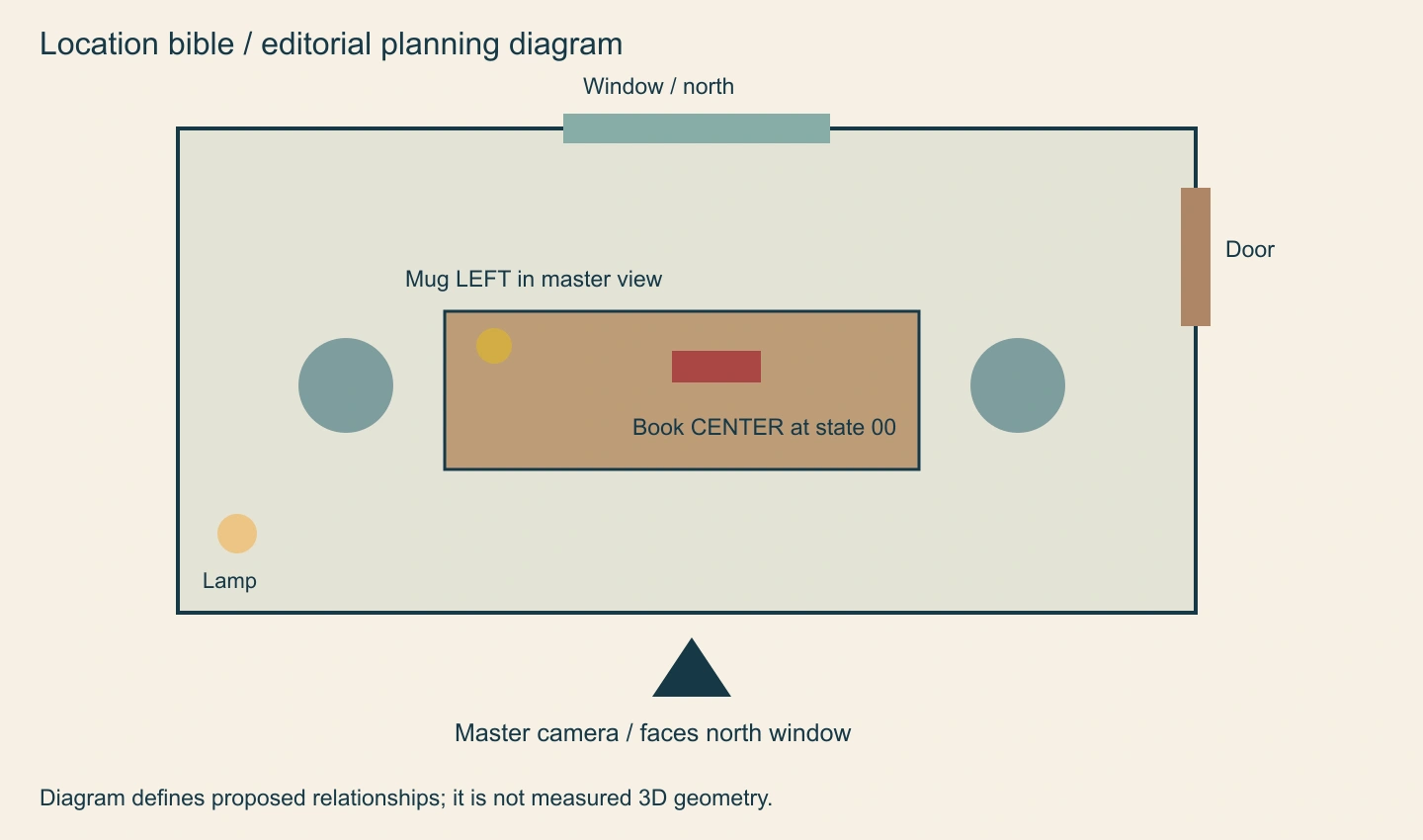
Write relationships that survive a camera change. “The door is on the room's east wall” is more durable than “the door is always on the right.” In our master view the camera faces the north window, so the east door appears on screen right. A reverse view could legitimately put it on screen left.

Editorial top-down location diagram with the north window, east door, table, chairs and master camera

This is a proposed planning diagram drawn locally from the approved illustration. It is not a measured reconstruction, a depth map, or a guarantee that generated perspectives share consistent 3D geometry.

Location anchorFixed relationshipWhat to check in another view
WindowNorth wall behind the tableSame frame design and relation to table
DoorEast wallCorrect wall and plausible direction from the camera
TableBetween the two chairsShape, scale and clearance from the wall
ChairsOpposite ends of tableCount, blue finish and readable placement
Oil lampWest side on floorNo unrequested wall lamp or extra duplicate
Wall and floorCream wall, green paneling, wood planksRecognizable materials and proportions

Do not force every anchor into every close-up. If the window is outside the frame, it cannot be checked visually. Record it as not visible rather than declaring it correct.

3. Keep movable props in a different record

The notebook's starting position is not a permanent part of the architecture. If Maya takes it outside, a return panel must not reset it onto the table unless the story shows her putting it back.

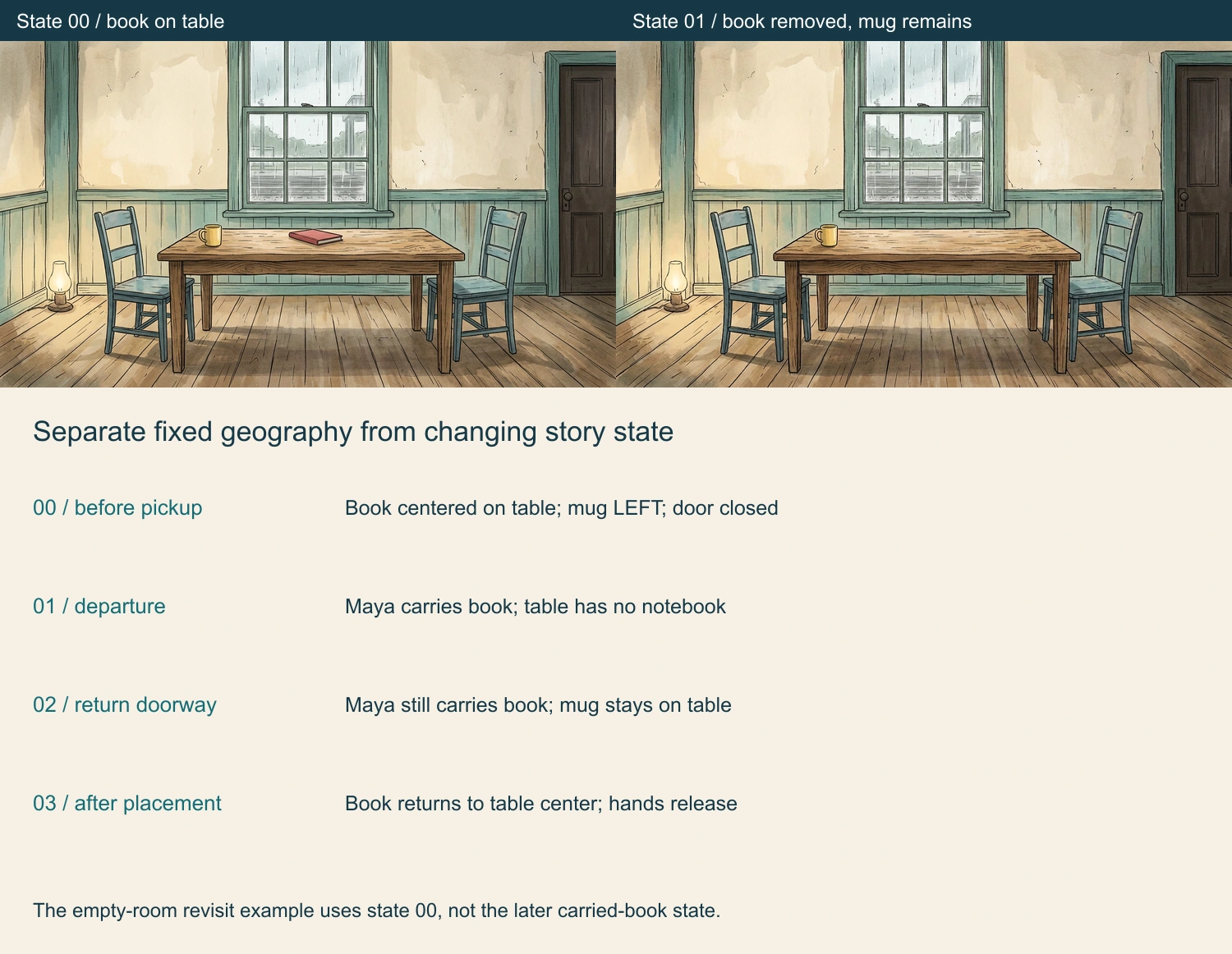
Four scene-state entries distinguish notebook on the table, carried outside, carried back and replaced on the table

The empty-room return experiment in this article uses starting state 00. The later character-and-book sequence in the cost example uses changing states. Do not treat these as one uninterrupted filmed take.

StateNotebookMugDoor
00: before pickupClosed, table centerTable leftClosed
01: departureCarried by MayaUnchangedOpens for departure
02: returnStill carriedUnchangedOpens for entry
03: after placementClosed, table centerUnchangedSpecify in the next shot brief

A good state entry names an owner and a transition: who moved the object, in which panel, from where to where? “Same room” cannot answer that question.

For an action sequence, add the chair pulled out, the broken glass, or the wet footprints. These details can be temporary while still being essential to continuity.

4. Reattach the right location reference when you return

We generated two indoor candidates after making the outdoor image:

  • Exterior-reference condition: supplied the exterior departure image and a written description of the indoor anchors.
  • Interior-reference condition: supplied the approved room master and the written indoor anchors, with an instruction to return to that room.

The prompts share the room description but differ in their return instruction. There is one output per condition. Reference content, prompt wording, and available visual information differ; this is an illustrative comparison, not an isolated causal benchmark.

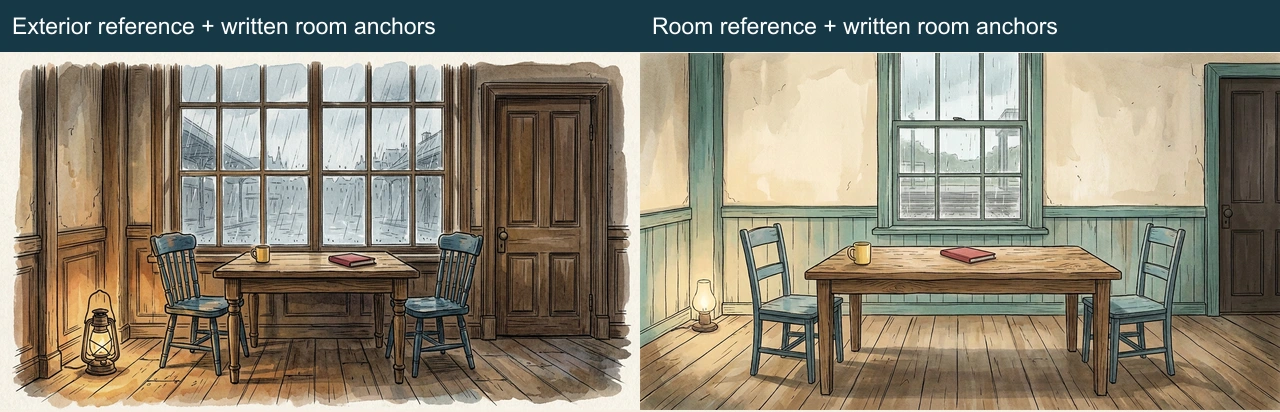
Two return candidates: an exterior-referenced room with changed construction and an interior-referenced room closer to the master

Both candidates retain the basic requested arrangement: window behind table, door right, two blue chairs, mug left, red notebook near center, and lamp left. The exterior-referenced image nevertheless reinvents the window divisions, chair construction, wall finish, and table proportions. The interior-referenced image is closer to the approved green paneling, window frame, and blue chair design, with smaller proportion changes still visible.

That observation supports a modest workflow decision: supply the approved set again when its construction matters. It does not prove that this model always needs a particular number of images or that another reference system will behave the same way.

A readable prompt template is:

Location: LOC-STATION-01, version 01.
Use the attached approved interior as the visual authority.
Camera: master view facing the north window.
Keep the window frame, green wainscoting, oak table and two blue chairs.
The east-wall wooden door appears screen right in this view.
State: 00. Yellow mug at table left; closed red notebook at center.
One oil lamp on the west-side floor. No additional lamps or objects.
Empty room, no captions, no inset views.

This is an improved reusable template, not a claim that the exact formatted text above produced the pictured outputs. The raw prompts and reference hashes are in the source archive.

5. Approve useful views, not an imaginary complete room

Start with the shots on your panel list: master, doorway approach, table insert, and any needed reverse. Generate or draw each view, compare it with the location bible, and approve it separately.

Do not infer an unseen corridor from a single interior and then treat every generated corridor as established canon. If the next chapter needs the corridor, design it deliberately and link it to the station room.

A rough 3D blockout can be a useful option when camera geometry is central. Our example did not build or test one. The map here describes intended relationships; it does not replace the validation a 3D pipeline would require.

For each approved view, record the camera description, visible anchors, story state, reference version, and unresolved differences. An image can be useful for a mood board while still being unsuitable as a continuity authority.

6. Review the return against the story, not just the picture

Run this short check before accepting a recurring location:

  1. Match the location ID and approved version.
  2. Compare the major visible architecture and furniture.
  3. Interpret left and right from the actual camera direction.
  4. Compare props with the latest story-state entry.
  5. Check for duplicates, missing objects, and unexplained changes.
  6. Keep the candidate or request one specific repair; inspect the whole repair again.

That last step matters. In our small-batch comic cost example, a repair fixed Maya's gaze but added an unwanted second lamp. A locally correct action can still produce an unusable continuity result.

Pair the location record with a shot-ready OC reference pack. Character identity, room geography, and current prop state are separate inputs, even when they meet in one panel.

Download the example location bible

Use the location bible JSON, editable SVG map and original location source pack. The archive includes the approved set, departure image, both return outputs, and sanitized generation receipts. It contains no 3D scene or native Studio project.

Does a location bible stop all background drift?

No. It gives you a visual and written standard for finding drift. Our interior-referenced return is closer to the master, but table and room proportions still vary.

Should every panel use the master image?

Use the reference that best describes the intended view and state. A master may be insufficient for an unseen reverse angle; approve that view before relying on it.

What if the place changes during the story?

Record the change as a state transition or a new set version. A notebook moved by a character is scene state; a rebuilt wall is a location revision.

If you start the scene in LlamaGen.AI, keep the approved location pack beside your cast references before you generate the return panel.

LlamaGen.Ai
  • United States
  • Español
  • Français (France)
  • 日本語
  • 한국어
  • Deutsch
  • 繁體中文 (台灣)
  • 繁體中文 (香港)
  • 简体中文
  • Português
  • Italiano
  • Español (México)
  • العربية
  • Русский
  • Português (Brasil)
  • Tiếng Việt
  • Svenska

Ledande inom AI-generering av serier

  • 24/7-support
  • Veckovisa uppdateringar
  • Säker och följer regler
  • 99,9 % drifttid

Ladda ner LlamaGen gratis

AndroidiOSSkrivbord

Produkt

  • Senaste lanseringarna
  • Funktioner
  • Skapa seriestrippar
  • Comic StoresNy
  • Studio för mangaNy
  • Förvandla bild till serie
  • Serie till video
  • AI-seriefabrik
  • Serieagent
  • iOS & Android
  • Mac & Windows
  • Ladda ner
  • Comic ZapNy
  • AI-seriegenerator
  • AI-tecknad generator
  • AI-webtoon-generator
  • Serieremsmakare
  • Förvandla bild till serie
  • AI-mangagenerator
  • Mangaöversättare
  • Foto till anime
  • Bild till prompt
  • Anime till verklighet
  • Manga-färgläggare
  • Anime-figurgenerator
  • Verktyg för pixelspelsresurser
  • AI-sprite sheet-generator
  • Bästa pixelspelsverktygen 2026
  • Foto-serie-skapare
  • Alternativ till Comic Life

Systerprodukter

  • LlamaGen-familjen
  • CineoBoardNy
  • Comics API

Planer

  • Prissättning
  • Start
  • Pro

Gemenskap

  • Skapare
  • Partners
  • Partner

AI-modeller

  • GPT Image 2.6 Flare
  • GPT Image 2.6 Sunburst
  • Grok Imagine Image 2.0
  • Wan 3.0
LinkedInX (Twitter)
  • Hem
  • Artiklar
  • Blogg
  • Skapa
  • Prissättning
  • API
  • Affiliate ProgramNEW

Fråga AI om LlamaGen

  • Comic Zap
  • Velika
  • För företag
  • Utbildning
  • Serie-API
  • Kontakta försäljning
  • Utbildningsplaner
  • Lärare
  • Studenter
  • Lärare och elever
  • Nystartade företag
  • Student-/lärrabatter
  • Företag

    • Prata med vår grundare
    • Om
    • Produktfärdplan

    Hjälp

    • Hjälpcenter
    • Förtroende
    • Säker AI
    Omdömen
  • Kärleksvägg
  • LlamaGen MCPNy
  • LlamaGen för utvecklare
  • Resurser

    • Ändringslogg
    • Blogg
    • Guider

    Verktyg

    • AI-logotypgenerator
    • Karaktärsgenerator i Grokbot-stil
    • PNG till serie
  • Wan 3.0 Prime
  • Seedance 2.5
  • MiniMax H3
  • Nano Banana 2.1
  • Nano Banana 2 Lite
  • Seedream 5.0 Flash
  • Seedream 5.0 Pro
  • Seedance 2.0 Mini
  • Kling 3.0 Turbo
  • Nano Banana 2
  • GPT Image 2
  • Gemini Omni Flash
  • All AI Models
  • AI-verktyg

    • AI-outfitsutdragare
    • AI-frisyrändrare
    • AI-frisyrändrare för manga
    Instagram
    YouTube
    Facebook-grupp
    Reddit
    Discord
    Support via e-post
    IntegritetVillkorSidkarta
    Ladda ner varumärkesmaterial
    © 2026 LlamaGen.Ai Alla rättigheter förbehållsAlla tjänster är online

    Tidigare bloggar

    Planning 240 Comic Panels a Week: Measure Cost per Approved Panel

    Planning 240 Comic Panels a Week: Measure Cost per Approved Panel

    Audit an 18-panel comic sample and two repair calls. Track approved panels, rejected candidates, usa

    Jay
    Jay
    28 november 2026
    Build a Location Bible for AI Comics: Return to the Same Place Without Reinventing It

    Build a Location Bible for AI Comics: Return to the Same Place Without Reinventing It

    Create a comic location bible with a master image, map, and prop-state ledger so recurring AI-genera

    Jay
    Jay
    28 november 2026
    Human-Led AI Game Cutscenes: Keep the Script, Storyboards, and Timing Under Your Control

    Human-Led AI Game Cutscenes: Keep the Script, Storyboards, and Timing Under Your Control

    A practical, creator-led AI game cutscene workflow for selecting storyboard candidates, rejecting we

    Jay
    Jay
    23 november 2026
    Make an AI Film Feel Real: Blocking, Reactions, and Continuity in a Quiet Scene

    Make an AI Film Feel Real: Blocking, Reactions, and Continuity in a Quiet Scene

    A worked quiet-scene repair case: room geography, prop behavior, reactions, and edit choices that im

    Jay
    Jay
    23 november 2026
    Karriär
  • Maila oss
  • Vår maskotvärld
  • Mediakit
  • KOL-partnerskap
  • Innehåll
  • Professionella tjänster
  • Vanliga frågor
  • Säkerhet
  • Tillgänglighet
  • Videoguide
  • Kontakta oss
  • Sidkarta
  • Personliga serier
  • Funktioner
  • Alternativ
  • Bästa AI-appar
  • Guide för att färglägga manga med GPT-6
  • Claude-serieboksskicklighet
  • Guide till Gemini AI för serier
  • Den serien
  • Student-/lärrabatter
  • Studentrabatt
  • Text till serie
  • PDF till serie
  • Manus till serie
  • Bok till serie
  • Förvandla bild till serie
  • AI Pixelkonst-generator
  • Pedagogiska serier
  • AI-videogenerator
  • Gemini AI-videogenerator
  • Gratis AI-videogenerator utan ansikten
  • Serie till video
  • Storyboard-programvara
  • AI-storyboardgenerator
  • Manusprogramvara
  • Manusredigerare
  • Berättelse-AI
  • AI-berättelsegenerator
  • Generator för bilderbok
  • AI-bildgenerator
  • AI-lagersplitter
  • AI-styrning av kameravinkel
  • AI Pixelkonst-generator
  • Verktyg för pixelspelsresurser
  • AI-sprite sheet-generator
  • Sprite sheet-skärare
  • Bästa pixelspelsverktygen 2026
  • Animations-API
  • ChatGPT/Codex-plugin
  • Installationsguide för ChatGPT
  • Claude Code-plugin
  • Installationsguide för Claude Code
  • AI-generator för vindeffekt
  • AI-djupkarteringsgenerator
  • AI-vit bakgrund
  • AI-objektborttagare
  • AI-virtuell provning
  • AI-skärp bilder
  • AI-brusreducering
  • AI-fotorestaurering
  • AI-produktskuggor
  • AI-generator för bakgrunder
  • AI-porträttgenerator
  • AI-emoji-skapare
  • AI-bakgrundsändrare
  • AI-öppna ögon
  • AI-skönhetsförbättring
  • AI-produktfotografering
  • Visa alla bloggar
    Build a Location Bible for AI Comics: Return to the Same Place Without Reinventing It - LlamaGen.AI Blog