How to Make an AI Drama: A Six-Shot Pilot and Series Continuity Plan - LlamaGen.AI Blog
How to Make an AI Drama: A Six-Shot Pilot and Series Continuity Plan
All posts

How to Make an AI Drama: A Six-Shot Pilot and Series Continuity Plan

Jay
Jay
November 23rd, 2026
Copy link
  • Watch the actual six-shot pilot
  • Define the dramatic change before requesting shots
  • Approve a small reference kit
  • Write start, action, and end states
  • Keep the actual failures in the production record
  • Carry story state into the next episode
  • Package the scene before scaling
elevate-your-comics.png
Elevate your Comics with LlamaGen

Learning how to make an AI drama is easier when you start with a scene small enough to finish and inspect. This example limits the scope to two original adult characters, one station room, one notebook, and a small emotional change. The result is a playable 30-second illustrated pilot plus a continuity package for a possible second episode.

Use LlamaGen.AI Storyboard to organize your own sequence; the explains the planning workflow. In this case, the images, video requests, and final edit were prepared outside a signed-in Studio session, with the production boundary stated below.

public storyboard overview

Watch the actual six-shot pilot

Download the MP4 if your browser cannot play it.

Download the 30-second pilot. It is 1280×720, 24 fps, and 720 frames, with no audio stream. The on-screen words are local editorial captions; there are no recorded actors, generated voices, or verified lip-sync performances.

Production scope, November 23, 2026: still images were generated directly with local Vertex configuration. Station motion was generated with Veo 3.1 Fast through Replicate. The final six-shot edit uses five generated-motion sources and one static reveal hold, plus local captions. One motion source is reversed locally. This is an illustrated dramatic scene, not a photorealistic production, a complete AI drama series, or a native Studio export.

A filmmaker asking about AI drama production described difficulty getting consistent, usable clips for a first episode. That discussion motivates this small, reviewable production unit. It does not establish which provider is best or how quickly another creator can finish an episode.

Define the dramatic change before requesting shots

Our short scene is called The Return. Maya has kept a notebook with a letter inside. Theo arrives believing she may have left. The notebook and the final exchange suggest that they can begin again. This is an original teaching scene, separate from the earlier lost-notebook comic.

The visual task is deliberately modest: show the two people listening, make the notebook matter, reveal the letter, and return to a shared wide view. A six-shot scene does not have room to explain a full backstory. The captions provide dialogue, but they do not prove that the image model acted or spoke those lines.

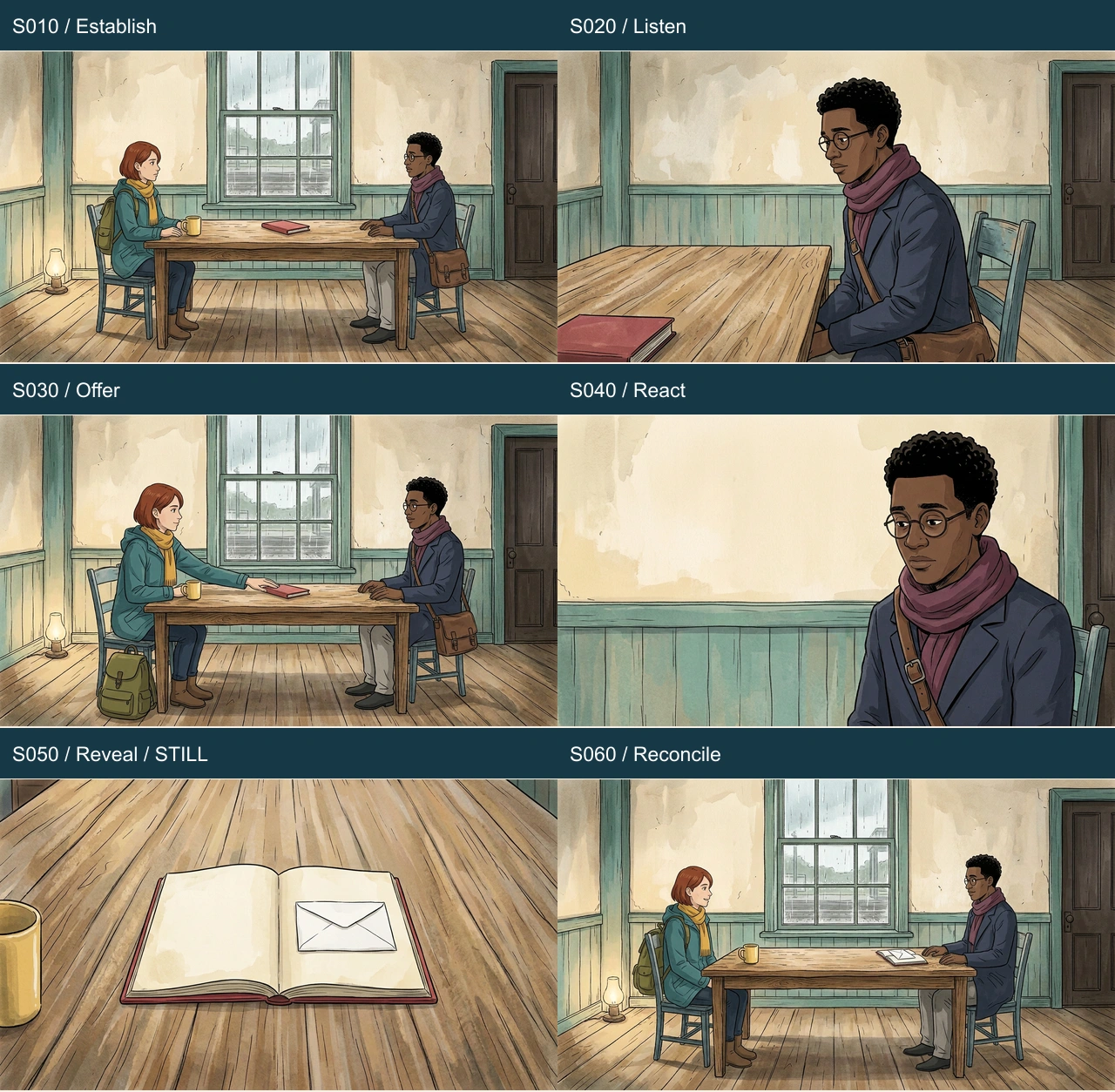
The six selected storyboard states: establish, listen, offer, react, reveal and reconcile
ShotBeatFinal treatmentDuration
S010Establish the uneasy meetingGenerated wide shot5 seconds
S020Theo looks toward the notebookGenerated medium shot5 seconds
S030Maya offers the kept objectGenerated motion reversed in the edit5 seconds
S040Theo reactsGenerated motion from a corrected close-up5 seconds
S050Reveal the letterLocally held still of the open notebook5 seconds
S060Return to the two peopleGenerated wide shot5 seconds

These six intervals total 30 seconds. They are editing decisions, not a claim that the model natively generated six connected shots in one request.

Approve a small reference kit

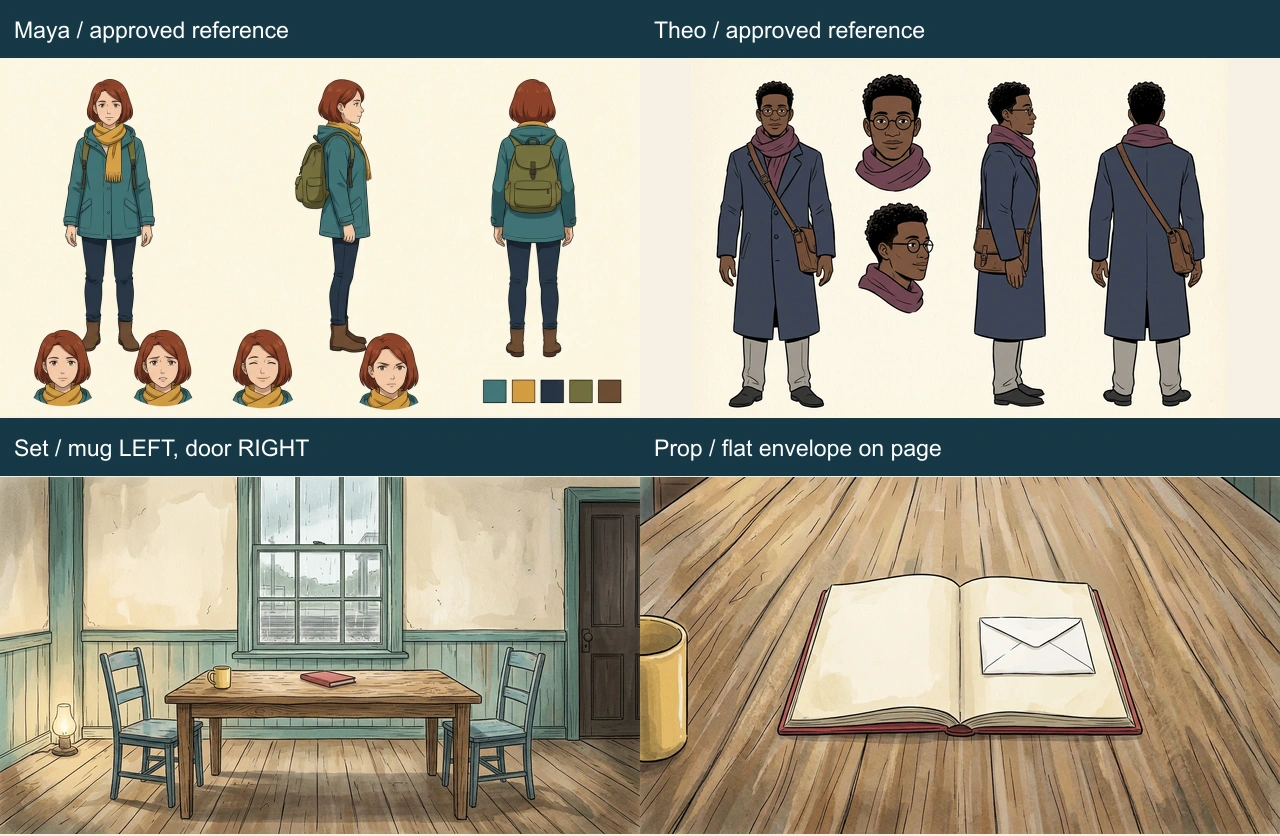
Maya retains her auburn bob, teal coat, mustard scarf, and olive backpack. Theo retains dark skin, black curls, round glasses, a navy coat, plum scarf, and brown satchel. Their references come from the earlier two-OC dialogue case.

The reused character references, new station set and selected open-notebook reveal

The new set has a wooden table, blue chairs, a rainy window behind the table, a door on the right, and a lamp on the left. A yellow mug belongs on Maya's side. Give the room and the prop their own reference records instead of expecting a face reference to preserve the entire set.

The approved image is the authority for visible detail. For example, the generated lamp is a small oil lamp, even though the initial direction described a floor lamp. Review should follow the selected image rather than claiming that every word of the first prompt was fulfilled.

Write start, action, and end states

A useful shot direction separates the action from the constraints:

S030: Maya is left; Theo is right.
Start: one closed red notebook is under Maya's hand.
Action: move that notebook toward Theo by a small amount.
End: stop before another action begins.
Preserve: faces, clothing, one book, yellow mug on the left.
Camera: fixed; no new angle or extra people.

The actual output still needs inspection. A clear request is not evidence that the result obeyed it. Keep stable shot IDs, reference versions, and the selected source for each interval. The downloadable shot list records the final treatments, including the reverse edit and still hold.

Keep the actual failures in the production record

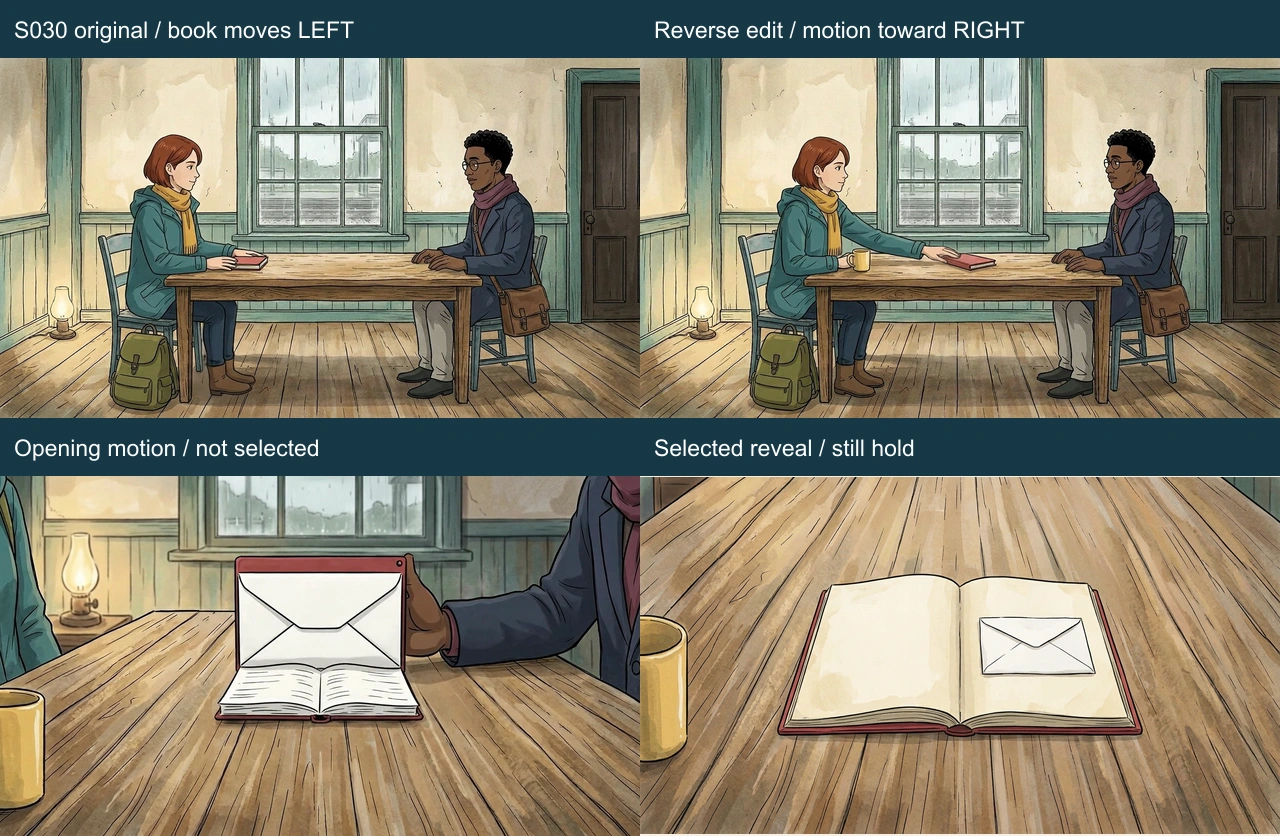
The first close-up placed a table behind Theo, conflicting with the master view. A corrected image removed that table, and a new motion request used the corrected close-up. The first notebook input also let white paper peek out before the reveal; its replacement concealed it.

Motion introduced further issues. The notebook slide traveled toward Maya instead of toward Theo. Reversing the selected interval changed its screen direction. That is a local edit, not a successful new generation, and it does not guarantee that reversed gestures will always look natural.

Actual motion review: original slide direction, reverse-edit direction and the rejected opening compared with the selected still reveal

The opening action was less cooperative. Both the initial and revised motion raised the envelope with the cover, making the reveal look physically wrong. Instead of reporting a clean repair, both attempts remain in the source pack, and the cut goes directly to a separately generated still with the envelope lying flat on a page.

That decision preserves a visible story beat while reducing an unreliable action. The final scene therefore contains a static reveal. It should not be presented as 30 seconds of continuously generated character motion.

Carry story state into the next episode

An AI drama series needs more than a reusable face. The next scene must know who has the notebook, whether it is open, where the envelope is, and what the characters have learned.

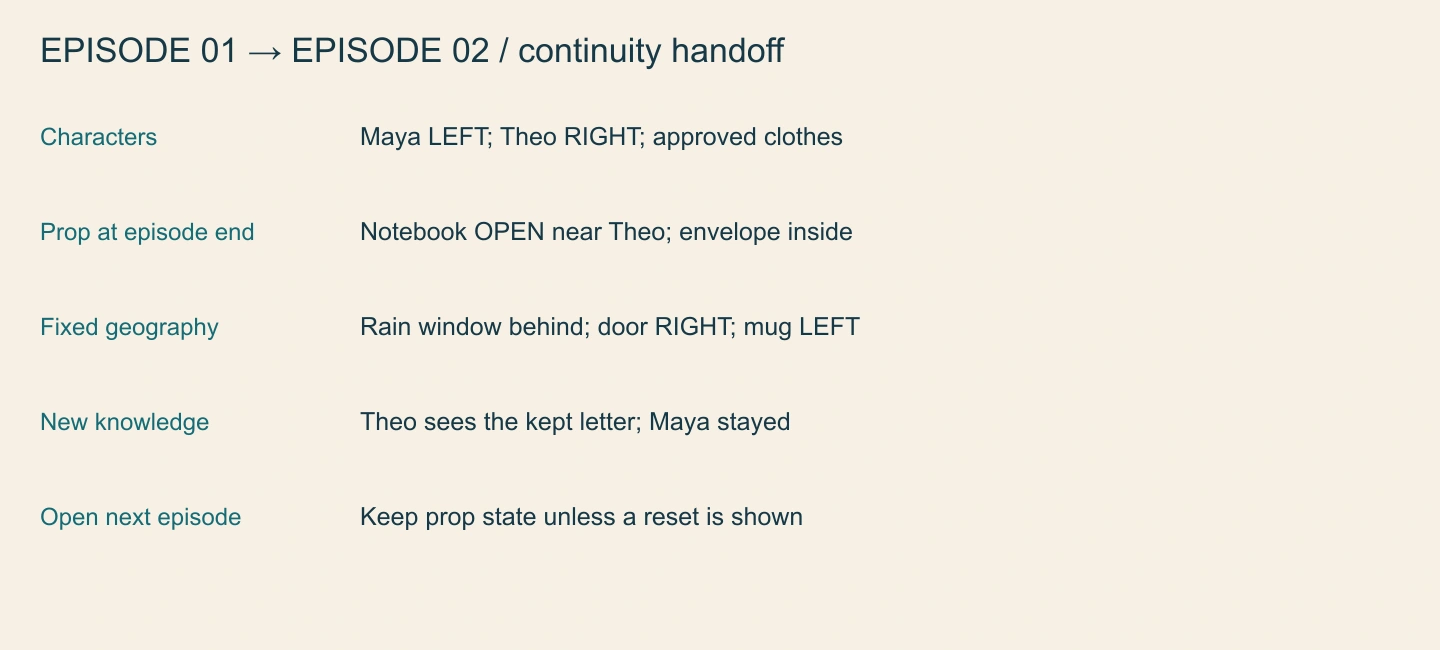
The episode handoff ledger distinguishes cast, prop state, room geography and the next scene's starting assumptions

The episode continuity file records the intended end state: the notebook is open near Theo, the envelope is inside, the mug remains on Maya's side, and the two people have acknowledged the kept letter. That file is an editorial handoff, not automatic memory inside a generation model.

If episode two begins with a closed notebook in Maya's bag, either show the transfer or record a deliberate reset. Otherwise, a future editor may treat an unexplained change as an intentional story choice. Keep knowledge state separate from costume state: a character can look identical while behaving as though an earlier conversation never happened.

Package the scene before scaling

The pilot source pack retains the first six station clips, two additional motion attempts, stills, and request records. Rejected material is included so the final choice can be traced. The record does not establish a settled production cost, a success percentage, or a repeatable delivery speed.

There are still visible limits. Table proportions, bag placement, and notebook position vary between views. The final wide shot makes the envelope much smaller than the insert. There was no audience study, actor performance comparison, or voice-continuity test. These are review points for a next pass, not details erased by a technically valid MP4.

For the separate 30-second first assembly and 24-second continuity revision, read the quiet-scene case. For a general production package, use the storyboard-to-video handoff checklist.

Start your own pilot in Storyboard, approve a small kit, and finish one scene before expanding the episode count. A reviewable scene and a state ledger give the next episode something concrete to inherit.

Related hot tags

AI Drama

Storyboard

Worked Example

Popular creator tools

Turn inspiration into your next story

Create comics, storyboards and stylized photos with LlamaGen.
01

AI Comic Generator

Turn an idea into polished comic strips in minutes.

Create comics with AI
02

AI Manga Generator

Create expressive manga art and multi-panel stories.

Create manga with AI
03

AI Storyboard Generator

Visualize every scene before production starts.

Create storyboards with AI
04

Turn Picture into Comic

Transform any photo into a comic-style illustration.

Create comics from pictures with AI
05

AI Comic Strips Maker

Build shareable strips with characters that stay consistent.

Create comic strips with AI

LlamaGen community

checkmark

Get hands-on help with your comics

checkmark

Showcase your comics to fellow LlamaGen creators

checkmark

Participate in special events to win gifts

Changelog

Spark dreams for the young
Where millions of stories come alive

A rundown of the latest LlamaGen feature releases, product enhancements, design updates, and important bug fixes.

✦
✧
✦
✧

A new medium for Storytelling

Vibe creating unlimited stories, comics, animations, games, and more—in seconds that resonate with modern audiences

LlamaGen logoLlamaGen brand
Log InSubscribe Now20% Off
  1. Home
LlamaGen logo
  • United States
  • Español
  • Français (France)
  • 日本語
  • 한국어
  • Deutsch
  • 繁體中文 (台灣)
  • 繁體中文 (香港)
  • 简体中文
  • Português
  • Italiano
  • Español (México)
  • العربية
  • Русский
  • Português (Brasil)
  • Tiếng Việt

Leading the Future of AI Comic Generation

  • 24/7 support
  • Weekly updates
  • Secure and compliant
  • 99.9% uptime

Download LlamaGen for free

AndroidiOSDesktop

Product

  • Latest launches
  • Features
  • Comic strip maker
  • Comic StoresNew
  • Manga StudioNew
  • Turn Picture Into Comic
  • Comic To Video
  • AI Comic Factory
  • Comic Agent
  • iOS & Android
  • Mac & Windows
  • Download
  • Comic ZapNew
  • AI Comic Generator
  • AI Cartoon Generator
  • AI Webtoon Generator
  • Comic Strip Maker
  • Turn Picture Into Comic
  • AI Manga Generator
  • Manga Translator
  • Photo to Anime
  • Image to Prompt
  • Anime to Real Life
  • Manga Colorizer
  • Anime Character Generator
  • Pixel game asset tools
  • AI sprite sheet generator
  • Best pixel game tools 2026
  • Photo Comic Maker
  • Comic Life Alternative

Sister products

  • LlamaGen family
  • CineoBoardNew
  • Comics API

Plans

  • Pricing
  • Starter
  • Pro

Community

  • Creators
  • Affiliates
  • Partner

AI Models

  • GPT Image 2.6 Flare
  • GPT Image 2.6 Sunburst
  • Grok Imagine Image 2.0
  • Wan 3.0
LinkedInX (Twitter)
  • Home
  • Articles
  • Blog
  • Create
  • Pricing
  • API
  • Affiliate ProgramNEW

Previous blogs

Human-Led AI Game Cutscenes: Keep the Script, Storyboards, and Timing Under Your Control

Human-Led AI Game Cutscenes: Keep the Script, Storyboards, and Timing Under Your Control

A practical, creator-led AI game cutscene workflow for selecting storyboard candidates, rejecting we

Jay
Jay
November 23rd, 2026
Make an AI Film Feel Real: Blocking, Reactions, and Continuity in a Quiet Scene

Make an AI Film Feel Real: Blocking, Reactions, and Continuity in a Quiet Scene

A worked quiet-scene repair case: room geography, prop behavior, reactions, and edit choices that im

Jay
Jay
November 23rd, 2026
How to Make an AI Drama: A Six-Shot Pilot and Series Continuity Plan

How to Make an AI Drama: A Six-Shot Pilot and Series Continuity Plan

Create a 30-second illustrated AI drama pilot, review real motion failures, and package continuity n

Jay
Jay
November 23rd, 2026
Two OCs in One Comic Panel: Keep Identities and Speakers Clear

Two OCs in One Comic Panel: Keep Identities and Speakers Clear

A six-panel Maya and Theo dialogue case showing separate references, a handoff repair, a reverse-sho

Jay
Jay
November 20th, 2026
See all blogs

Ask AI about LlamaGen

  • Comic Zap
  • Velika
  • Enterprise
  • Education
  • Comic API
  • Contact Sales
  • Education Plans
  • Teachers
  • Students
  • Teachers and Students
  • Startups
  • Educational Discounts
  • Company

    • Talk to Our Founder
    • About
    • Product Roadmap

    Help

    • Help Center
    • Trust
    • Safe AI
    Testimonials
  • Wall of Love
  • LlamaGen MCPNew
  • LlamaGen Developer
  • Resources

    • Changelog
    • Blog
    • Guides

    Tools

    • AI Logo Generator
    • Grokbot Style Character Generator
    • PNG to Comic
  • Wan 3.0 Prime
  • Seedance 2.5
  • MiniMax H3
  • Nano Banana 2.1
  • Nano Banana 2 Lite
  • Seedream 5.0 Flash
  • Seedream 5.0 Pro
  • Seedance 2.0 Mini
  • Kling 3.0 Turbo
  • Nano Banana 2
  • GPT Image 2
  • Gemini Omni Flash
  • All AI Models
  • AI Tools

    • AI Outfit Extractor
    • AI Hairstyle Changer
    • AI Manga Hairstyle Changer
    Instagram
    YouTube
    Facebook group
    Reddit
    Discord
    Email support
    PrivacyTermsSitemap
    Download Brand Assets
    © 2026 LlamaGen.Ai All rights reservedAll services are online
    Careers
  • Email us
  • Our Mascot World
  • Media Kit
  • KOL Partnership
  • Content
  • Professional Services
  • FAQ
  • Security
  • Accessibility
  • Video Tutorial
  • Contact us
  • Sitemap
  • Personalized Comics
  • Features
  • Alternatives
  • Best AI Apps
  • GPT-6 Manga Coloring Guide
  • Claude Comic Book Skill
  • Gemini AI Comic Guide
  • Comic That
  • Educational Discounts
  • Student discount
  • Text to Comic
  • PDF to Comic
  • Script to Comic
  • Book to Comic
  • Turn Picture Into Comic
  • AI Pixel Art Generator
  • Educational Comics
  • AI Video Generator
  • Gemini AI Video Generator
  • Free Faceless AI Video Generator
  • Comic To Video
  • Make Storyboard Software
  • AI Storyboard Generator
  • Screenwriting Software
  • Screenplay Editor
  • Story AI
  • AI Story Generator
  • Storybook Generator
  • AI Image Generator
  • AI Layer Splitter
  • AI Camera Angle Control
  • AI Pixel Art Generator
  • Pixel game asset tools
  • AI sprite sheet generator
  • Sprite sheet slicer
  • Best pixel game tools 2026
  • Animation API
  • ChatGPT/Codex Plugin
  • ChatGPT Install Guide
  • Claude Code Plugin
  • Claude Code Install Guide
  • AI Wind Effect Generator
  • AI Depth Map Generator
  • AI White Background
  • AI Object Remover
  • AI Virtual Try-On
  • AI Unblur Images
  • AI Denoise
  • AI Photo Restoration
  • AI Product Shadows
  • AI Background Generator
  • AI Headshot Generator
  • AI Emoji Maker
  • AI Background Changer
  • AI Open Eyes
  • AI Beauty
  • AI Product Photography