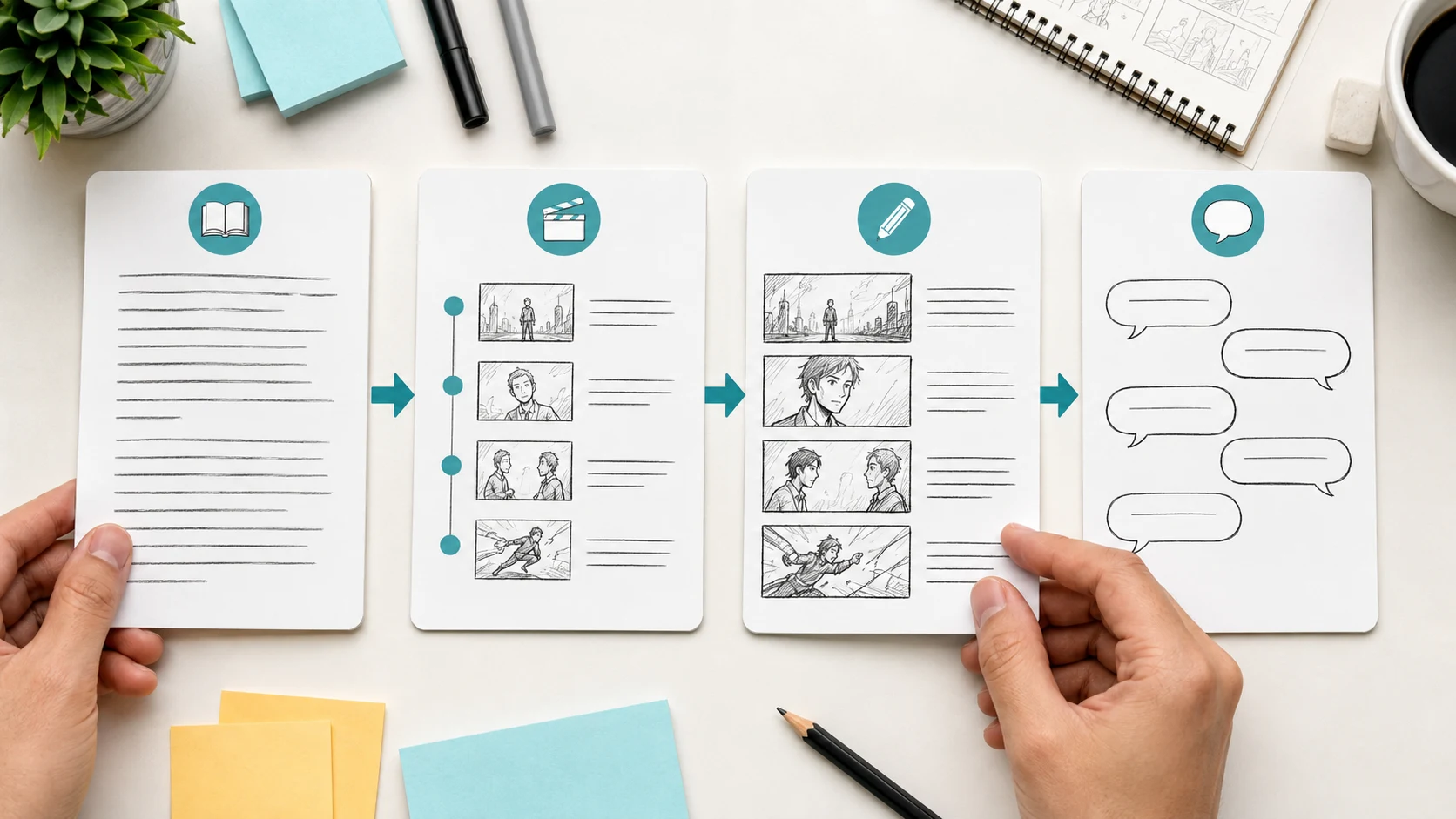
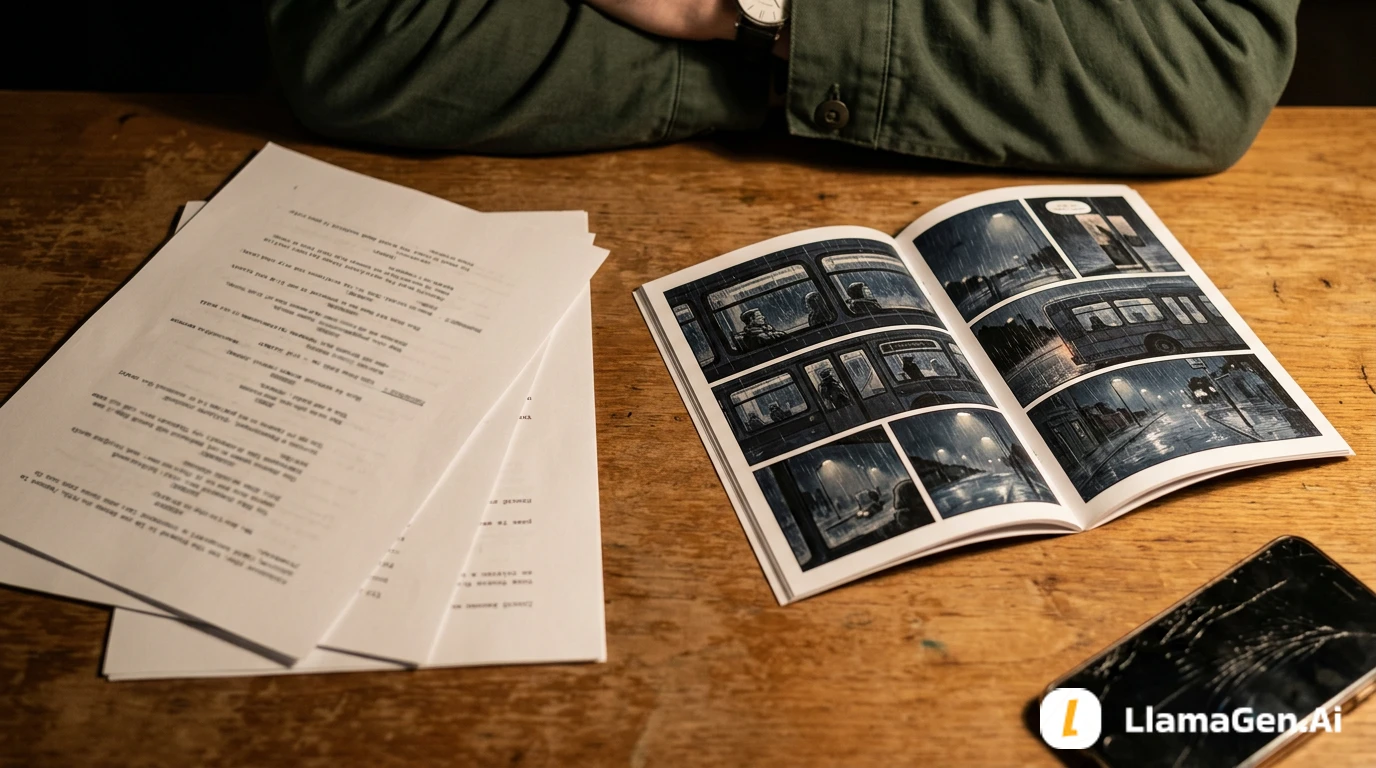
Novel pages do not become comic pages by changing paragraph breaks.
Use this format instead:
scene goal -> beat -> panel image -> camera -> dialogue -> continuity note
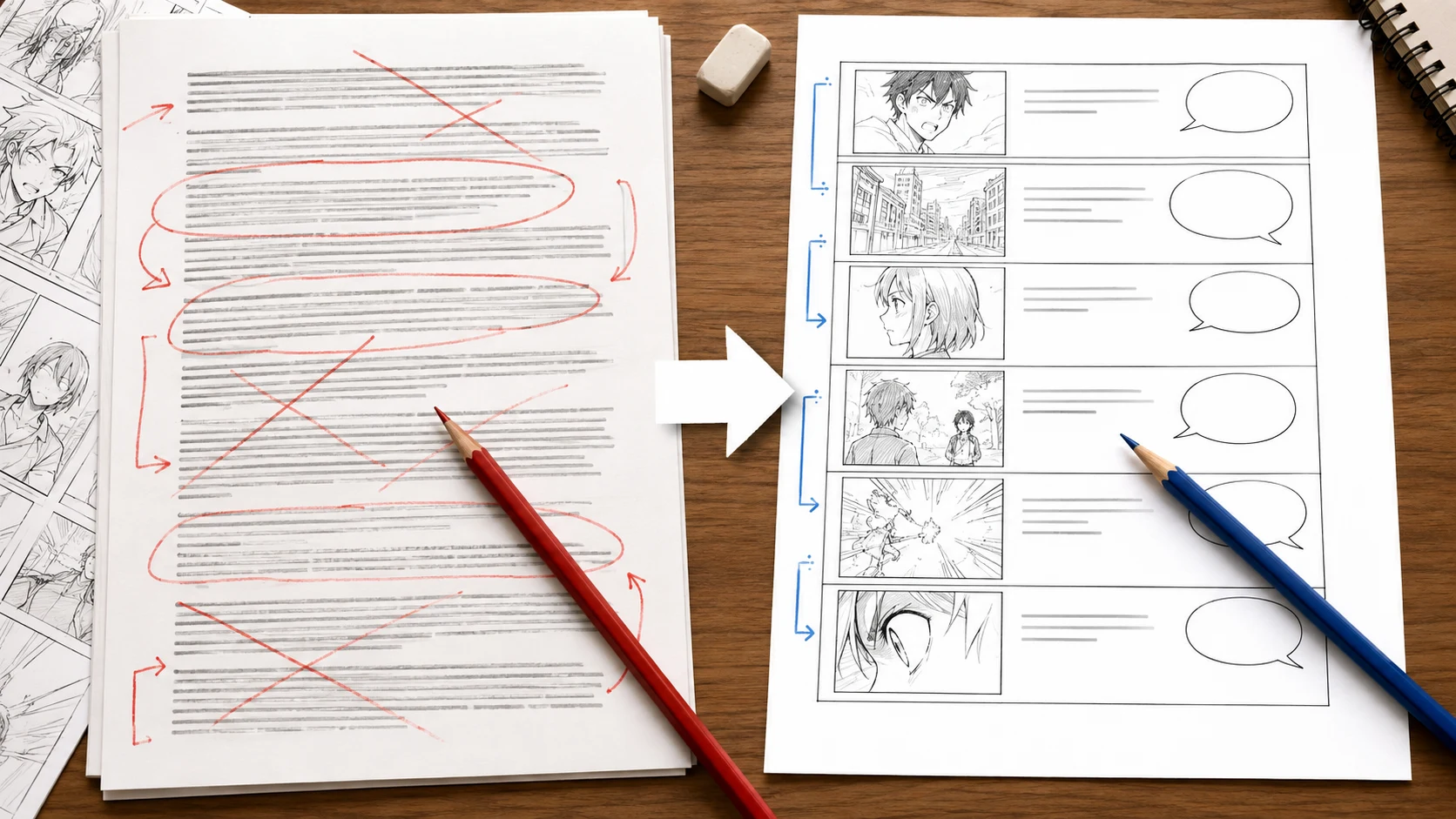
A comic script for novel writers should tell the image system what must be seen, what should be implied, and which prose details can disappear.
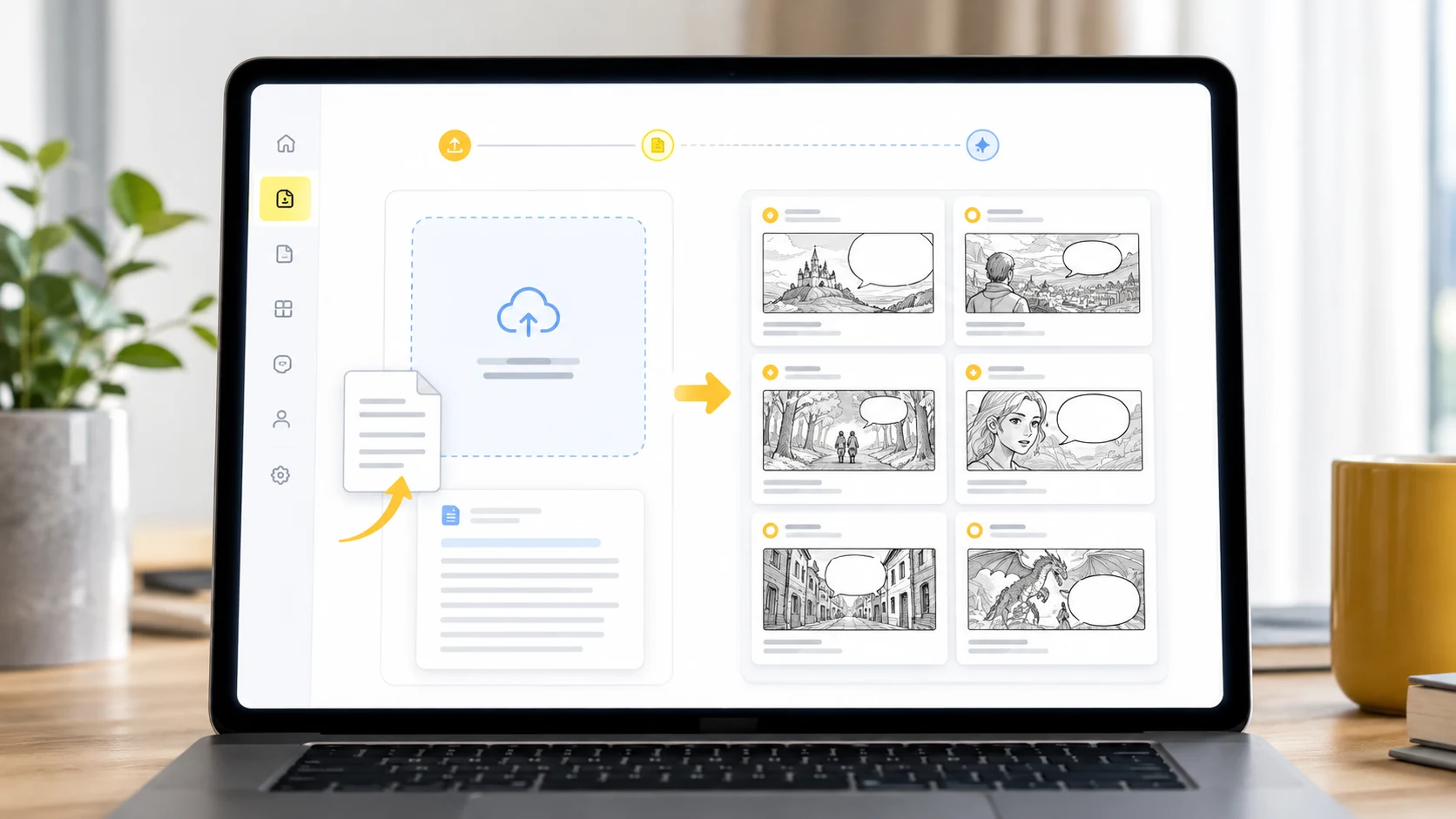
For a fast first pass, upload your chapter or scene to LlamaGen.AI Upload and ask for an AI Comic script conversion before generating final panels.
Why Novel Formatting Fails in Comics
A novel scene can hold memory, emotion, setting, subtext, action, and dialogue in the same paragraph. A comic page cannot draw all of that at once. It needs decisions.
The usual failure is sending prose directly into a comic generator and hoping it will choose the right moments.
Novel habit
Comic problem
Better script move
Long interior paragraphs
The page becomes caption-heavy
Convert thought into image evidence
Scene description before action
The page opens slowly
Pick one establishing panel
Dialogue with every reply
Speech bubbles crowd the art
Keep only turns that change the scene
Changelog
Spark dreams for the young Where millions of stories come alive
A rundown of the latest LlamaGen feature releases, product enhancements, design updates, and important bug fixes.
✦
✧
✦
✧
A new medium for Storytelling
Vibe creating unlimited stories, comics, animations, games, and more—in seconds that resonate with modern audiences
Emotional explanation
The image repeats the caption
Show expression, gesture, or object
Backstory inside the scene
Pacing stalls
Use one prop, flash image, or later reveal
A good comic script does not copy every sentence. It gives each panel a job.
Test Setup
This tutorial uses one original prose scene and converts it into a comic-ready script.
This is a workflow test for writers, not a pricing benchmark.
The test question was:
Can a prose scene become a structured comic script without losing the writer's intent?
Source Scene
Here is the fictional prose input:
Mira found the envelope behind the loose tile under her mother's workbench.

For ten years the room had smelled the same: machine oil, old lavender soap, and the sour dust of locked places. She had promised herself she would not search the house again. She had promised that on the day of the funeral, then again the week after, then every winter when the roof leaked above the kitchen.

The envelope was sealed with blue wax. Her mother's initials were pressed into it, but the second letter was wrong. It was not the way her mother signed private notes.

"You said there was nothing left," Jonas said from the stairs.

Mira did not turn around. She slid the envelope into her coat.

"There isn't," she said.
The scene is short, but it contains many layers: memory, smell, grief, suspicion, a hidden object, and a lie. The comic script has to choose what becomes visible.
Step 1: Convert Prose into Beats
Do not start by counting panels. Start by naming the beats.
Beat
Story job
Visual evidence
Mira searches the workbench
Shows she is breaking her promise
Dusty room, hand under loose tile
Envelope appears
Creates the plot object
Blue wax seal, old paper, hidden space
Initials are wrong
Creates suspicion
Close-up of wax seal and her reaction
Jonas enters
Adds pressure
Figure on stairs, Mira still crouched
Mira hides the envelope
Shows the lie before she says it
Envelope sliding into coat
"There isn't"
Confirms conflict
Small bubble, closed body language
Now the scene has six story units. Some may become one panel. Some may need two.
Step 2: Use a Writer-Friendly Comic Script Template
Use this template for each panel:
Panel:
Story job:
Image:
Camera:
Character acting:
Dialogue:
Caption:
Continuity:
AI generation note:
Each field has a reason.
Field
Why it matters
Panel
Keeps sequence clear
Story job
Prevents decorative panels
Image
Tells the art system what must be visible
Camera
Controls pacing and emphasis
Character acting
Preserves emotional meaning
Dialogue
Keeps bubbles intentional
Caption
Saves only the prose that must remain verbal
Continuity
Locks props, outfit, setting, and timeline
AI generation note
Gives LlamaGen.AI a clean production instruction
Writers often want to preserve language. Comics often need to preserve decisions.
Step 3: Rewrite the Scene into Panels
Here is the first conversion pass.
Panel 1
Story job: Establish the room and Mira's private search.
Image: A narrow workbench room with old tools, a leaking roof stain, and Mira crouched beside a loose floor tile.
Camera: Wide, slightly high angle.
Character acting: Mira is careful, tense, and trying not to make noise.
Dialogue: None.
Caption: "She had promised herself she would not search the house again."
Continuity: Blue-gray coat, old workbench, dusty tile floor.
AI generation note: Keep the room grounded and realistic; no fantasy glow yet.

Panel 2
Story job: Reveal the hidden envelope.
Image: Mira's hand lifts an old envelope from under the tile.
Camera: Close insert on hand, tile edge, envelope.
Character acting: Fingers pause before touching the wax.
Dialogue: None.
Caption: None.
Continuity: Envelope is cream paper with blue wax seal.
AI generation note: Make the envelope the visual focus.

Panel 3
Story job: Show the clue that makes the object suspicious.
Image: Close-up of the blue wax initials, with Mira's eyes reflected faintly above it.
Camera: Extreme close-up.
Character acting: Her eyes narrow, not frightened yet.
Dialogue: None.
Caption: "The second letter was wrong."
Continuity: Blue wax must remain visible.
AI generation note: No readable letters needed; show a wrong-looking stamped mark.

Panel 4
Story job: Add outside pressure.
Image: Jonas stands halfway down the stairs while Mira stays crouched near the workbench.
Camera: Medium wide from Mira's side.
Character acting: Jonas is suspicious; Mira freezes.
Dialogue: "You said there was nothing left."
Caption: None.
Continuity: Stairs connect to the workbench room.
AI generation note: Keep speech bubble small and leave room around faces.

Panel 5
Story job: Show the lie before the spoken line.
Image: Mira slips the envelope inside her coat.
Camera: Close on coat and hand.
Character acting: Controlled movement, no panic.
Dialogue: None.
Caption: None.
Continuity: Envelope remains cream with blue seal.
AI generation note: Make the action readable without showing text.

Panel 6
Story job: End with conflict.
Image: Mira turns only halfway toward Jonas, face calm, hand still inside coat.
Camera: Medium close-up.
Character acting: Her face says she has chosen the lie.
Dialogue: "There isn't."
Caption: None.
Continuity: Keep Jonas in background if possible.
AI generation note: The line should feel quiet, not dramatic.
This is now usable for AI Comic generation because every panel has a job, a visual target, and a continuity instruction.
Step 4: Avoid the Dense Prose Trap
The first failed pass tried to keep too much of the novel paragraph.
Failed script habit
What happened
Repair
Kept every smell detail
Captions got too long
Keep one sensory phrase only if it changes mood
Explained grief in narration
Image became redundant
Show the old workbench and roof stain
Described initials literally
Image generated unreadable letters
Use "wrong-looking stamped mark" instead
Used a big speech bubble
Covered the face
Shorten dialogue and place bubble above empty wall
Skipped continuity notes
Envelope changed color
Lock cream paper and blue wax every time
The repair rule is simple: if the reader can understand the beat through a face, hand, object, or camera choice, cut the explanatory prose.
Step 5: Upload for an AI Comic Script Conversion
Use LlamaGen.AI Upload when you have a chapter, scene, outline, or messy draft.
Use this instruction:
I am adapting this prose scene into a comic page.

Please return:
1. A beat list with the story job for each beat.
2. A comic script table with Panel, Story job, Image, Camera, Character acting, Dialogue, Caption, Continuity, and AI generation note.
3. A dialogue budget so the page does not become crowded.
4. A continuity list for characters, props, setting, and timeline.
5. One failed version and a repaired version.
6. A final AI Comic prompt I can use to generate the page.

Do not rewrite the story. Convert the prose into visual production decisions.
After the first result, ask for one more pass:
Reduce any caption that repeats the image. Keep only captions that preserve voice, irony, or necessary context.
That second pass usually makes the page much cleaner.
Practical Format: One-Page Version
For a quick workflow, use this shorter table:
Panel
Image
Camera
Dialogue
Caption
Must keep
1
Mira crouches by loose tile in old workroom
Wide
None
Promise not to search
Workbench, roof stain
2
Envelope under tile
Close insert
None
None
Cream paper, blue wax
3
Wax seal looks wrong
Extreme close-up
None
Second letter wrong
Suspicion
4
Jonas appears on stairs
Medium wide
"You said there was nothing left."
None
Mira hidden low
5
Envelope goes into coat
Close
None
None
Blue wax still visible
6
Mira lies calmly
Medium close
"There isn't."
None
Jonas behind her
This version is enough for a short AI Comic test.
Final Prompt for AI Comic
Create a six-panel comic page from this script.

Style: grounded cinematic mystery comic, clean linework, restrained color, realistic lighting.
Continuity: Mira wears a blue-gray coat. The envelope is cream paper with a blue wax seal. The workroom has an old wooden bench, dusty tile floor, and a roof stain.
Panel flow:
1. Wide shot of Mira crouched beside a loose floor tile in an old workbench room.
2. Close insert of her hand lifting a cream envelope from under the tile.
3. Extreme close-up of a wrong-looking blue wax seal; Mira's eyes show suspicion.
4. Jonas stands on the stairs behind her. Small dialogue bubble: "You said there was nothing left."
5. Close shot of Mira sliding the envelope into her coat.
6. Medium close-up of Mira half-turned toward Jonas. Small dialogue bubble: "There isn't."

Keep speech bubbles small. Do not add extra narration. Make the envelope visually consistent across panels.
Open LlamaGen.AI Upload, upload the scene, and ask for this script format before you generate the full page.
Checklist for Novel Writers
Before you generate, check:
Does every panel have one story job?
Is each line of dialogue short enough to fit a bubble?
Did you cut any prose that only repeats the image?
Did you preserve the one or two sentences that carry the writer's voice?
Are props and outfits named consistently?
Does the camera move for a reason?
Is the final panel a choice, reveal, question, or emotional turn?
FAQ
Should I write a full screenplay format?
Not unless your team needs it. For AI Comic work, a panel-first format is usually clearer than screenplay formatting.
How much prose should stay as captions?
Keep captions that add voice, irony, time, or inner contradiction. Cut captions that only explain what the image already shows.
Can I upload a whole chapter?
Yes. Upload the chapter to LlamaGen.AI Upload, then ask for beats first. Do not jump straight from a full chapter to final art.
What is the best first output?
Ask for a beat list and panel script before asking for images. The better the visual script, the cleaner the generated comic page.
Bottom Line
The best comic script format for novel writers is not a rigid industry template. It is a translation layer.
It turns prose into image decisions, dialogue budgets, camera choices, and continuity rules. Once you have that layer, LlamaGen.AI Upload can help move the scene toward AI Comic panels with much less drift.
Related hot tags
Writers
AI Comic
Comic Script
Novel to Comic
Popular creator tools
Turn inspiration into your next story
Create comics, storyboards and stylized photos with LlamaGen.