
LlamaGen logoLlamaGen brand
Log InSubscribe Now20% Off
  1. Home
Batch Comic Production Workflow: Draft, Approve, Repair, and Export 40 Pages
All posts

Batch Comic Production Workflow: Draft, Approve, Repair, and Export 40 Pages

Jay
Jay
October 30th, 2026
Copy link
  • Why a long comic needs a production ledger
  • Step 1: Lock the brief and divide the book
  • Step 2: Make the pilot representative
  • Step 3: Use documented requests and retain job IDs
  • Step 4: Separate technical success from editorial approval
  • Step 5: Repair only the affected panel
  • Step 6: Audit the 40-page ledger before export
  • What time and credits should you track?
  • Release checklist
  • FAQ
  • Can I request all forty pages at once?
  • Does a completed API job mean a page is approved?
  • Should a failed panel trigger a full batch rerun?
elevate-your-comics.png
Elevate your Comics with LlamaGen

To produce a 40-page comic reliably, approve a small pilot, generate in reviewable batches, repair failed panels, and assemble exports from approved versions. A successful generation request is only one stage of production.

Begin with the LlamaGen.AI Comic API when you need a repeatable integration. This guide provides a worked planning example for forty four-panel pages. It does not claim that forty finished pages were generated or benchmarked for this article.

Why a long comic needs a production ledger

The hard question is usually not whether one page changed, but which other pages depend on that change. A creator discussion about a 40-page comic describes how updating a character can leave teams unsure about affected pages and downstream assets.

Give each page a stable ID and connect it to the approved script, reference version, generation job, review decision, and export. That record makes corrections traceable and helps protect already approved work.

Our example follows Mira through a railway-station mystery. Her copper bob, teal coat, and brass compass remain fixed. The book contains forty pages with four planned panels per page: 160 planned panel slots. Covers and promotional crops are separate deliverables.

Step 1: Lock the brief and divide the book

Write a short production brief before submitting work:

Project: Station Compass
Length: 40 story pages, 4 panels per page
Character: Mira, copper bob, teal coat, brass compass
Location: rainy station, blue train, warm lamps
Reading direction: left to right
Dialogue: maintained separately for final lettering
Approval owner: named editor

Then choose a batch schedule that leaves room for review:

StagePagesPurpose
Pilot1–3Verify identity, pacing, panel count, and lettering space
Batch A
Related hot tags

Comic Production

Comic API

Character Consistency

Popular creator tools

Turn inspiration into your next story

Create comics, storyboards and stylized photos with LlamaGen.

01

AI Comic Generator

Turn an idea into polished comic strips in minutes.

Create comics
02

AI Manga Generator

Create expressive manga art and multi-panel stories.

Create manga
03

AI Storyboard Generator

Visualize every scene before production starts.

Create storyboards
04

Turn Picture into Comic

Transform any photo into a comic-style illustration.

Create comics from pictures
05

AI Comic Strips Maker

Build shareable strips with characters that stay consistent.

Create comic strips

LlamaGen community

checkmark

Get hands-on help with your comics

checkmark

Showcase your comics to fellow LlamaGen creators

checkmark

Participate in special events to win gifts

Changelog

Spark dreams for the young
Where millions of stories come alive

A rundown of the latest LlamaGen feature releases, product enhancements, design updates, and important bug fixes.
✦
✧
✦
✧

A new medium for Storytelling

Vibe creating unlimited stories, comics, animations, games, and more—in seconds that resonate with modern audiences

4–11
Establish a repeatable production rhythm
Batch B12–19Check the first major scene transition
Batch C20–27Review the central reveal and recurring props
Batch D28–35Protect continuity during the climax
Final batch36–40Resolve the story and check the complete sequence

These are editorial batches, not a promise about the maximum pages accepted by an API request. Check current account limits before choosing request sizes.

Step 2: Make the pilot representative

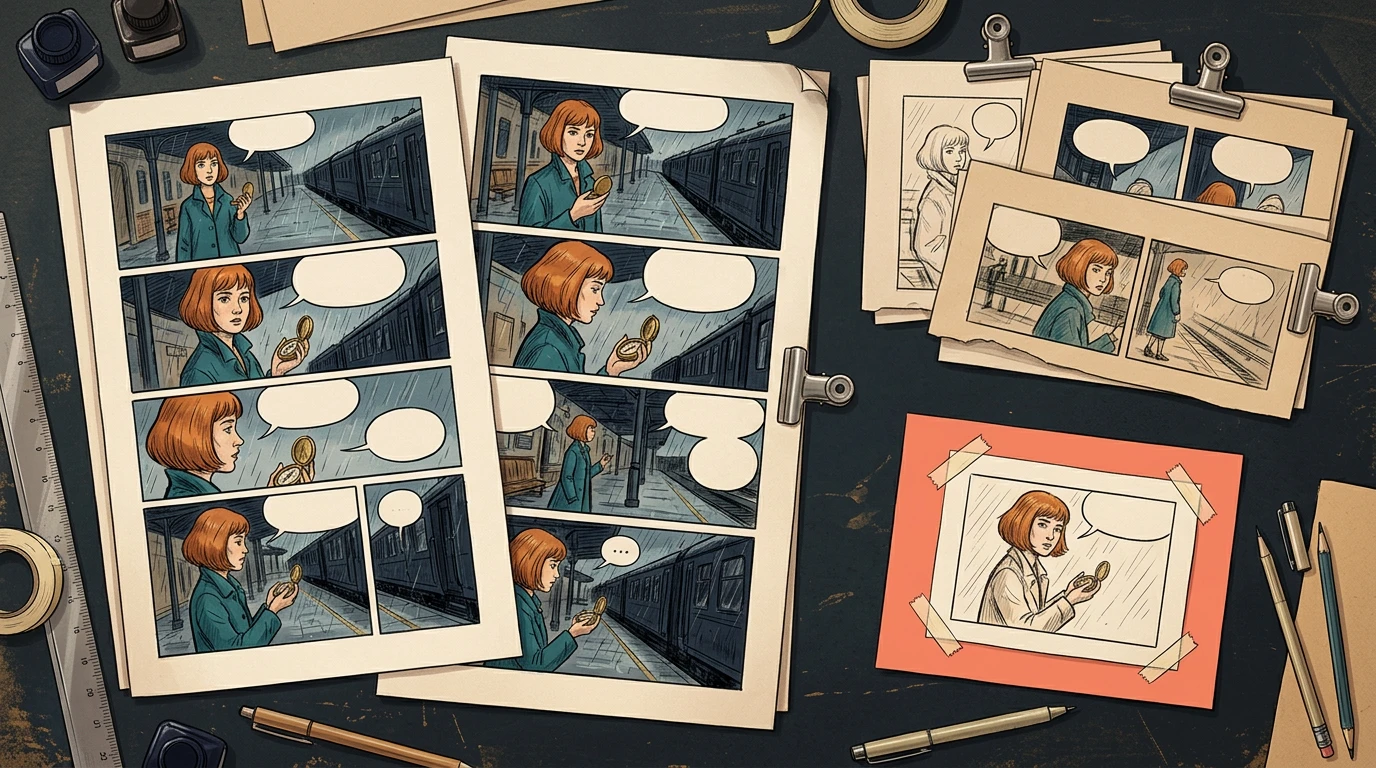
Include a wide establishing shot, a face close-up, a prop interaction, a two-character exchange, and a page turn somewhere in the first three pages. Three nearly identical portrait pages will not reveal the book's hardest problems.

A conceptual production board with pilot pages, review gates and later batches

The illustration shows the approval structure. It is not a screenshot of forty generated pages.

Review the pilot for story clarity as well as image quality. Check that the compass stays recognizable, the character does not drift between camera distances, and dialogue can fit without covering a hand or face. Save the approved references and script versions before expanding production.

If the pilot fails, record the cause and update the shared brief. Correcting a shared instruction during the pilot limits how many later pages can inherit the same problem.

Step 3: Use documented requests and retain job IDs

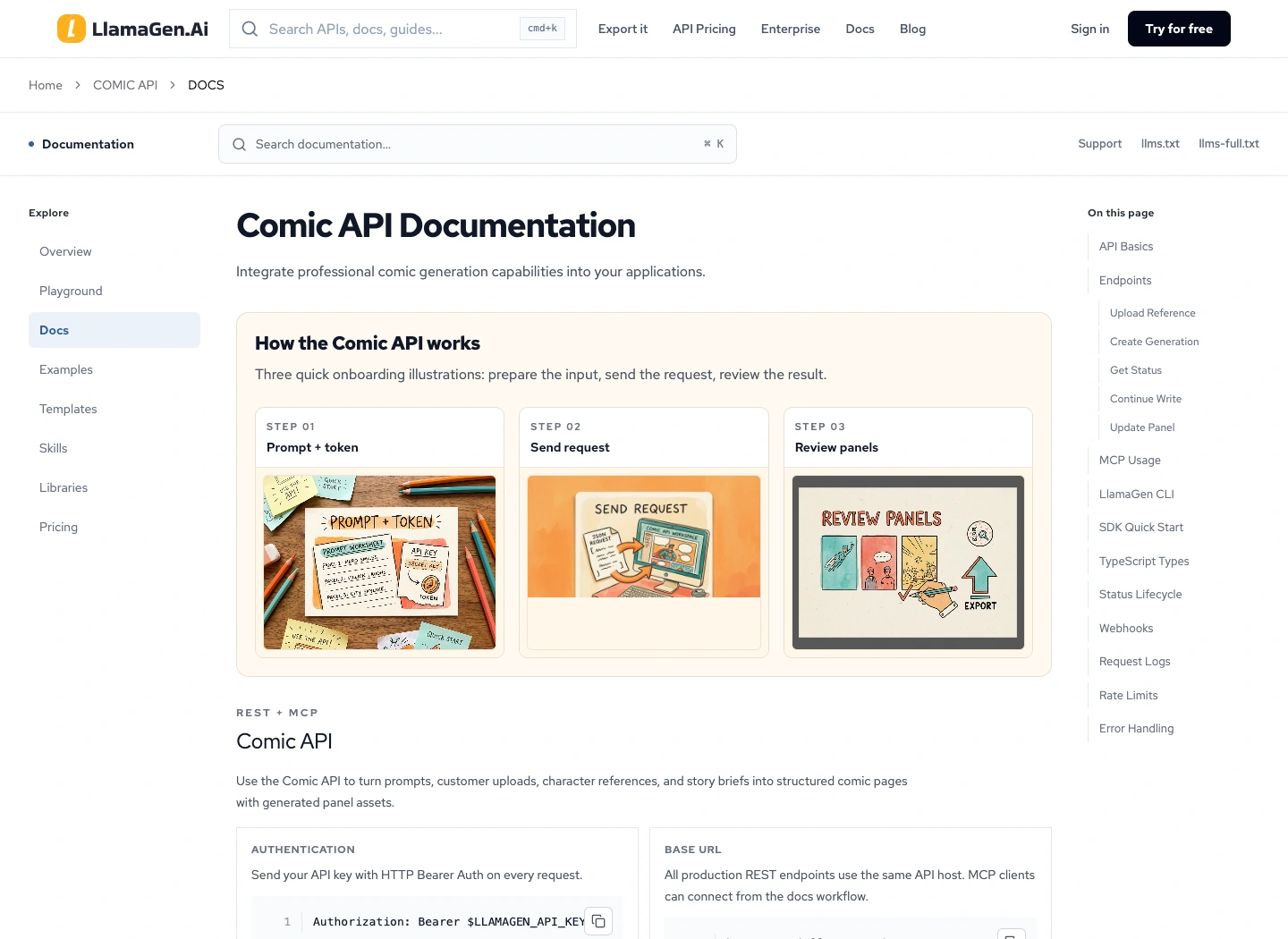
The current Comic API documentation supports multi-page input through a nested pagination object. The following is a request-shape example, not a request executed by this article:

{
  "prompt": "Create the first three pages of Station Compass from the approved panel script.",
  "preset": "japanese_manga",
  "pagination": {
    "totalPages": 3,
    "panelsPerPage": 4
  }
}

Do not combine this pagination mode with fixPanelNum. Keep API tokens private. Store the returned generation ID, then retrieve status and assets using the documented status endpoint. Record returned usage rather than estimating a universal price per page.

The public Comic API documentation page captured during preparation

For each submitted job, preserve the input and the response together. When a response is delayed, inspect the existing job before submitting another request. Follow the documented idempotency behavior; changing a retry key can create a separate job and additional cost.

Step 4: Separate technical success from editorial approval

A job can complete while a page still has a missing beat, an incorrect coat, or unreadable balloon space. Keep generation state and editorial state in separate fields.

page_id,batch,script_version,reference_version,job_id,review_state,export_version
P001,pilot,v03,mira-v02,record-returned-id,approved,v01
P002,pilot,v03,mira-v02,record-returned-id,repair-required,
P003,pilot,v03,mira-v02,record-returned-id,awaiting-review,

Use explicit decisions such as awaiting-review, repair-required, and approved. Assign an owner and a reason to every rejection. Keep earlier approved files until the replacement has passed review.

At the end of each batch, inspect the transition into the next one. A correct last panel and a correct first panel can still disagree about where a character is standing or which hand holds the prop.

Step 5: Repair only the affected panel

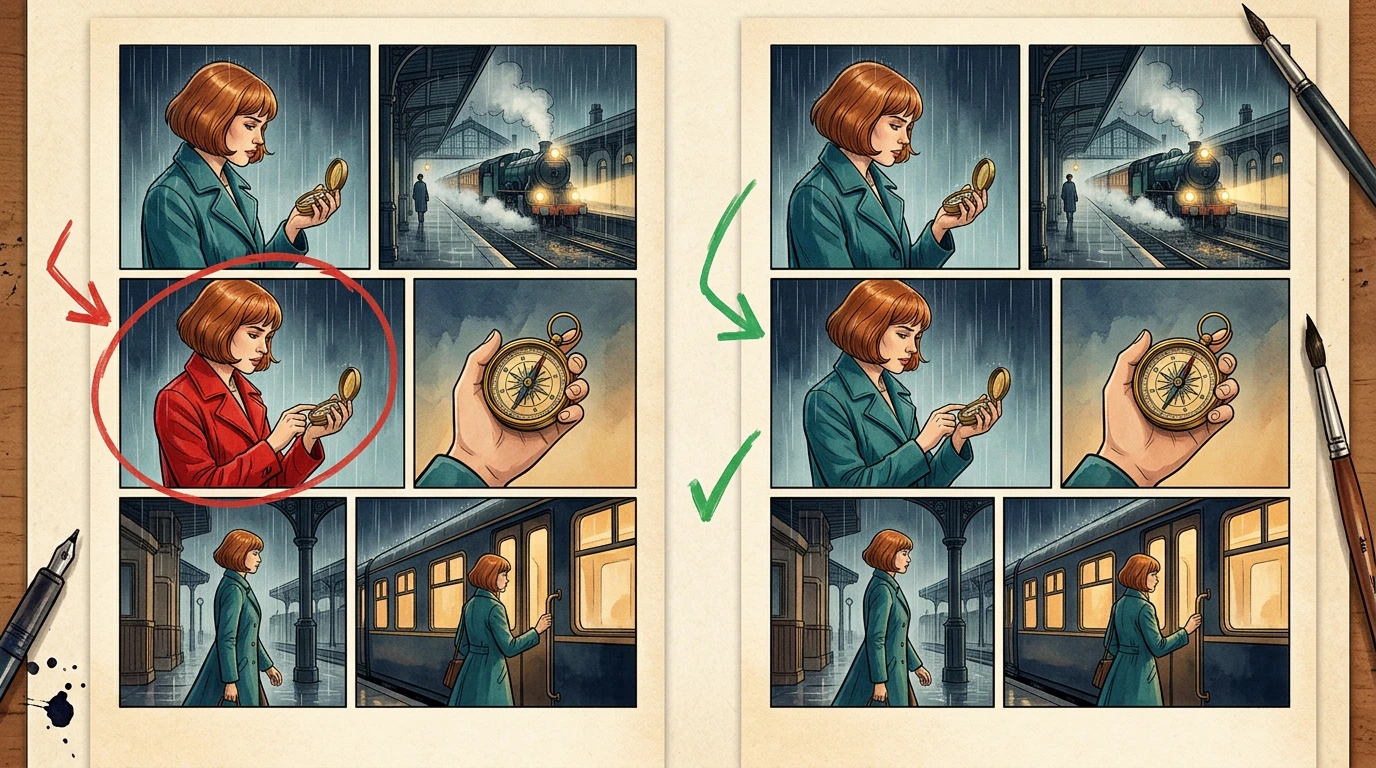
Suppose P017 has one panel where Mira wears a red coat. Record that single defect rather than rejecting every image in the batch.

A conceptual before-and-after comic page illustrating a single coat-color correction

The API documents a panel-update request on an existing generation. Page and panel indexes are zero-based. Map those indexes from the actual job result; P017 in your book is not automatically page index 16 inside every batch.

Use a repair brief such as:

Restore Mira's teal coat and copper bob in this panel.
Preserve the camera, station, compass, pose and other characters.
Do not revise the surrounding panels.

After repair, review the adjacent panels and refresh only the exports that use the changed page. The reference-change audit guide covers broader dependency changes.

Step 6: Audit the 40-page ledger before export

Check uniqueness, complete page coverage, approval, and current export versions. A simple local planning check can catch missing records before anyone assembles the book:

expected = {f"P{i:03d}" for i in range(1, 41)}
actual = [row["page_id"] for row in pages]
assert len(actual) == len(set(actual)), "Duplicate page ID"
assert set(actual) == expected, "Missing or unexpected page"
assert all(row["review_state"] == "approved" for row in pages)
assert all(row["export_version"] for row in pages)

In the accompanying local planning exercise, one deliberately unapproved page blocks export until its review record is corrected. This tests the ledger rule, not the visual quality of forty comic pages. An editor still needs to read the full book.

What time and credits should you track?

Track generation, review, repair, lettering, assembly, and final reading separately. Save actual returned usage for each job and measure human review time with the same boundaries for each batch.

Use this budget structure:

Total production cost = pilot + accepted batches + repairs + export work
Total elapsed time = generation waits + review + repair + assembly

Do not extrapolate a whole book from one attractive panel. A useful pilot estimate includes rejected results and cleanup.

Release checklist

  • Forty unique story-page IDs are present in the intended order.
  • Every page has an editorial approval and current export version.
  • Character, location, and prop references are traceable.
  • Dialogue and credits have been proofread.
  • Page boundaries and scene transitions read continuously.
  • Files reopen on another device without missing assets.
  • Cover, thumbnails, and promotional crops use approved versions.

Start with a three-page brief in Comic API. Expand only after you can explain why those pages pass. For team production requirements, the enterprise route can help scope the integration.

FAQ

Can I request all forty pages at once?

Use the current API and account limits to determine what is accepted. Editorial batch size should also reflect how much your team can inspect before continuing.

Does a completed API job mean a page is approved?

No. Completion is a technical state. Approval requires review of the result against the brief.

Should a failed panel trigger a full batch rerun?

First identify the cause. A local defect can often be repaired individually; a shared reference or script problem may affect several pages and should trigger an impact audit.

Product documentation reviewed November 2, 2026. Figures and the planning ledger are instructional examples; no forty-page speed or cost benchmark is claimed.

LlamaGen logo
  • United States
  • Español
  • Français (France)
  • 日本語
  • 한국어
  • Deutsch
  • 繁體中文 (台灣)
  • 繁體中文 (香港)
  • 简体中文
  • Português
  • Italiano
  • Español (México)
  • العربية
  • Русский
  • Português (Brasil)
  • Tiếng Việt

Download LlamaGen for free

iOSDesktop

Product

  • Home
  • Articles
  • Blog
  • Create

Ask AI about LlamaGen

Latest launches
  • Features
  • Comic strip maker
  • Manga StudioNew
  • Turn Picture Into Comic
  • Comic To Video
  • AI Comic Factory
  • Comic Agent
  • iOS & Android
  • Mac & Windows
  • Download
  • Comic ZapNew
  • AI Comic Generator
  • AI Cartoon Generator
  • AI Webtoon Generator
  • Comic Strip Maker
  • Turn Picture Into Comic
  • AI Manga Generator
  • Manga Translator
  • Photo to Anime
  • Anime to Real Life
  • Manga Colorizer
  • Anime Character Generator
  • Pixel game asset tools
  • AI sprite sheet generator
  • Best pixel game tools 2026
  • Photo Comic Maker
  • Comic Life Alternative
  • Sister products

    • LlamaGen family
    • CineoBoardNew
    • Comics API

    Plans

    • Pricing
    • Starter
    • Pro

    Community

    • Creators
    • Affiliates
    • Partner

    AI Models

    • Grok Imagine Image 2.0
    • Wan 3.0
    • Wan 3.0 Prime
    • Seedance 2.5
    LinkedInX (Twitter)
  • Pricing
  • API
  • Affiliate ProgramNEW
  • Leading the Future of AI Comic Generation

    • 24/7 support
    • Weekly updates
    • Secure and compliant
    • 99.9% uptime

    Previous blogs

    Storyboard-to-Video Handoff Checklist: Shots, Timing, Audio, and Continuity

    Storyboard-to-Video Handoff Checklist: Shots, Timing, Audio, and Continuity

    Turn approved storyboard frames into a clear video handoff with stable shot IDs, timing, motion note

    Jay
    Jay
    November 1st, 2026
    How to Localize a Comic Without Redrawing the Artwork

    How to Localize a Comic Without Redrawing the Artwork

    Preserve approved comic art while translating dialogue, rebuilding editable lettering, checking read

    Jay
    Jay
    October 31st, 2026
    Batch Comic Production Workflow: Draft, Approve, Repair, and Export 40 Pages

    Batch Comic Production Workflow: Draft, Approve, Repair, and Export 40 Pages

    Plan a 40-page AI comic with a pilot, reviewable batches, a page ledger, selective repairs, and expo

    Jay
    Jay
    October 30th, 2026
    From a Flat AI Image to an Editable Comic Page

    From a Flat AI Image to an Editable Comic Page

    Turn a finished comic image into an editable comic page by reviewing an asset sheet, extracting tran

    Jay
    Jay
    October 28th, 2026
  • Comic Zap
  • Velika
  • Enterprise
  • Education
  • Comic API
  • Contact Sales
  • Education Plans
  • Teachers
  • Students
  • Teachers and Students
  • Startups
  • Educational Discounts
  • Company

    • Talk to Our Founder
    • About
    • Product Roadmap
    • Careers
    • Email us
    • Our Mascot World
    • Media Kit
    • KOL Partnership
    • Content

    Help

    • Help Center
    • Trust
    • Safe AI
    • Professional Services
    • FAQ
    • Security
    • Accessibility
    • Video Tutorial
    • Contact us
    • Sitemap
    Testimonials
  • Wall of Love
  • LlamaGen MCPNew
  • LlamaGen Developer
  • Resources

    • Changelog
    • Blog
    • Guides
    • Personalized Comics
    • Features
    • Alternatives
    • Best AI Apps
    • GPT-6 Manga Coloring Guide
    • Claude Comic Book Skill
    • Gemini AI Comic Guide
    • Comic That
    • Educational Discounts
    • Student discount

    Tools

    • AI Logo Generator
    • Grokbot Style Character Generator
    • PNG to Comic
    • Text to Comic
    • PDF to Comic
    • Script to Comic
    • Book to Comic
    • Turn Picture Into Comic
    • AI Pixel Art Generator
    • Educational Comics
    • AI Video Generator
    • Gemini AI Video Generator
    • Free Faceless AI Video Generator
    • Comic To Video
    • Make Storyboard Software
    • AI Storyboard Generator
    • Screenwriting Software
    • Screenplay Editor
    • Story AI
    • AI Story Generator
    • Storybook Generator
    • AI Image Generator
    • AI Layer Splitter
    • AI Camera Angle Control
    • AI Pixel Art Generator
    • Pixel game asset tools
    • AI sprite sheet generator
    • Sprite sheet slicer
    • Best pixel game tools 2026
    • Animation API
    • ChatGPT/Codex Plugin
    • ChatGPT Install Guide
    • Claude Code Plugin
    • Claude Code Install Guide
  • MiniMax H3
  • Nano Banana 2.1
  • Nano Banana 2 Lite
  • Seedream 5.0 Flash
  • Seedream 5.0 Pro
  • Seedance 2.0 Mini
  • Kling 3.0 Turbo
  • Nano Banana 2
  • GPT Image 2
  • Gemini Omni Flash
  • All AI Models
  • AI Tools

    • AI Outfit Extractor
    • AI Hairstyle Changer
    • AI Manga Hairstyle Changer
    • AI Wind Effect Generator
    • AI Depth Map Generator
    • AI White Background
    • AI Object Remover
    • AI Virtual Try-On
    • AI Unblur Images
    • AI Denoise
    • AI Photo Restoration
    • AI Product Shadows
    • AI Background Generator
    • AI Headshot Generator
    • AI Emoji Maker
    • AI Background Changer
    • AI Open Eyes
    • AI Beauty
    • AI Product Photography
    Instagram
    YouTube
    Facebook group
    Reddit
    Discord
    Email support
    PrivacyTermsSitemap
    Download Brand Assets
    © 2026 LlamaGen.Ai All rights reservedAll services are online
    See all blogs
    Batch Comic Production Workflow: Draft, Approve, Repair, and Export 40 Pages - LlamaGen.AI Blog