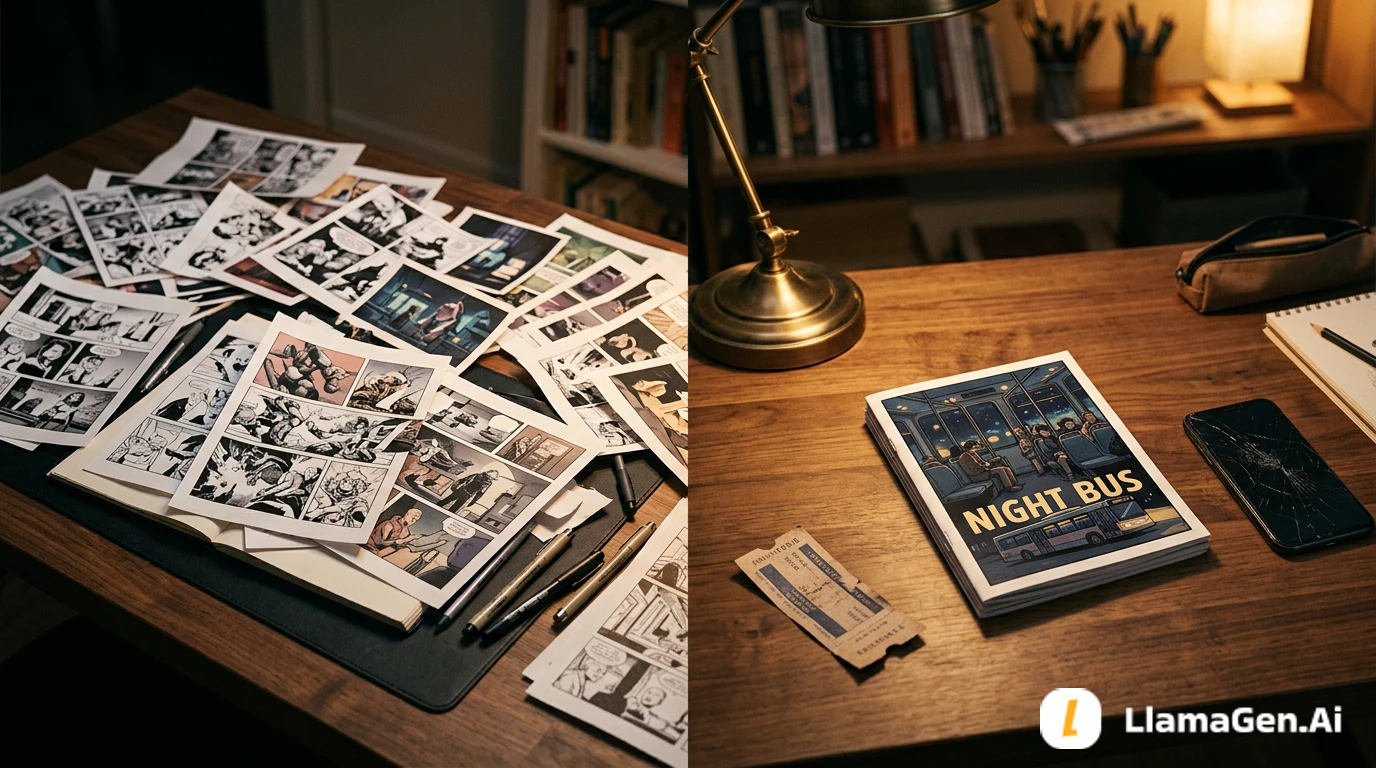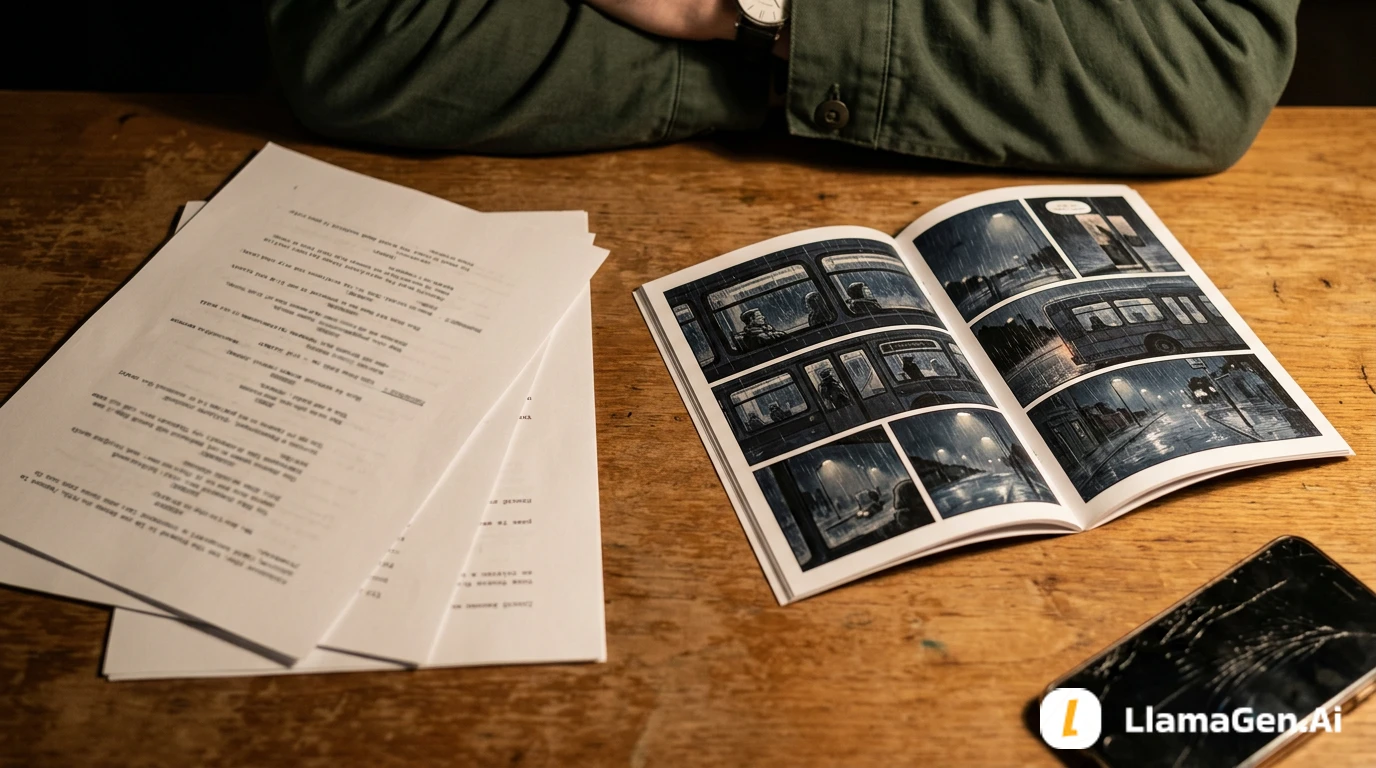

Character continuity is not one prompt. It is a system.
For long-form novel-to-comic adaptation, use this order:
character role -> visual lock file -> scene variation -> continuity review -> repair pass
The lock file defines what must not change. Scene variation defines what can change. Review catches drift before it spreads across a chapter.
For a faster first pass, upload your character notes, chapter excerpt, or cast bible to LlamaGen.AI Upload and ask for a character continuity map before generating panels.
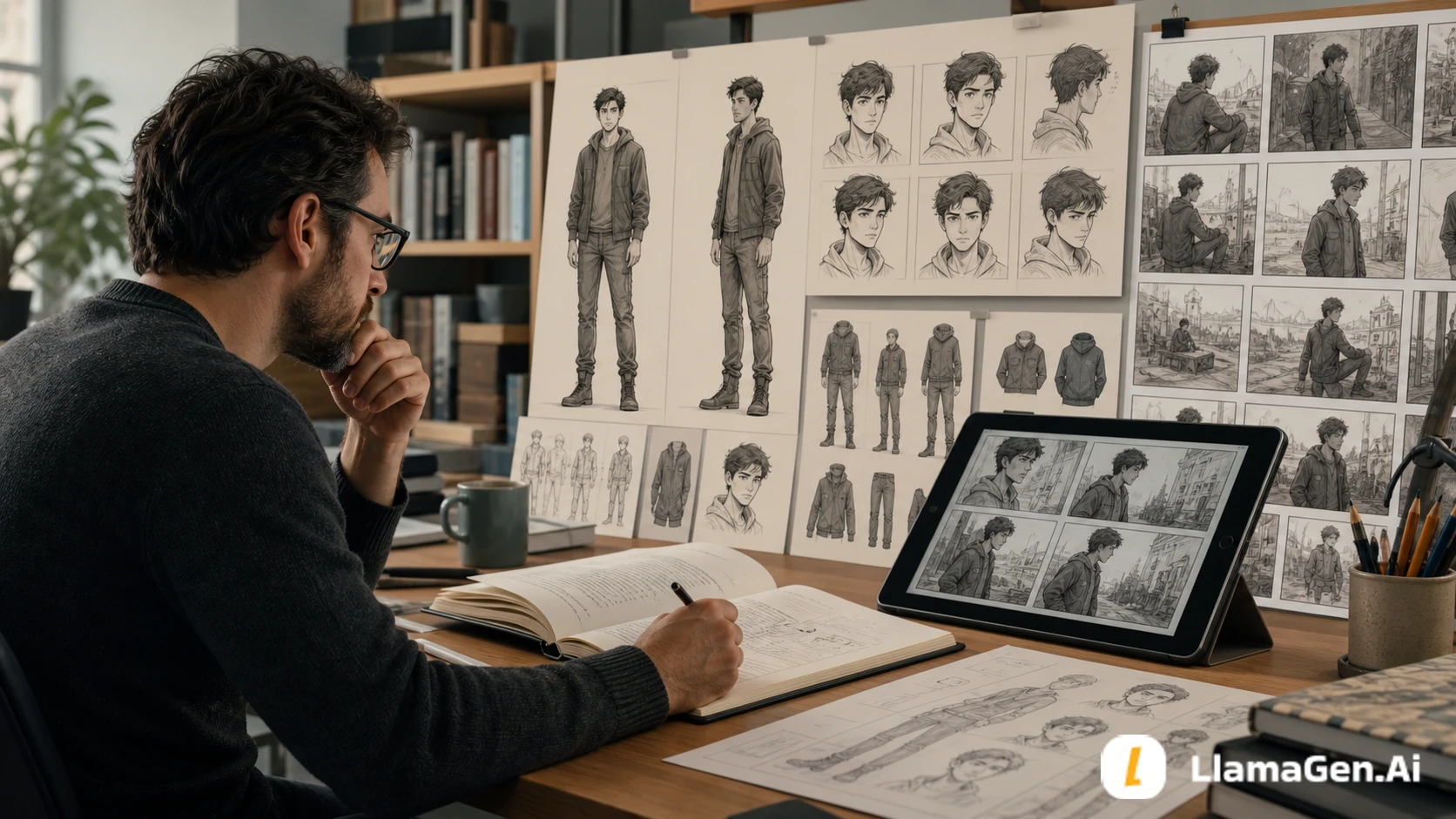
A single comic panel only has to look good once. A long-form adaptation has to survive repeated scenes, time jumps, outfit changes, emotional shifts, weather, lighting, camera angles, and multiple chapters.
The usual failure is not that the character looks bad. The failure is that the character slowly becomes someone else.
| Continuity problem | What the reader notices | What to lock |
|---|---|---|
| Face drift | The protagonist looks like a different person | Face shape, eyes, hairline, expression range |
| Silhouette drift | The character is hard to recognize from a distance | Height, posture, body shape, jacket or coat shape |
| Outfit drift | Clothing changes without story reason | Core outfit, layers, shoes, bag, accessories |
| Prop drift | Meaningful objects lose identity | Size, material, placement, damage state |
| Age drift | Teen becomes adult or adult becomes younger | Facial maturity, body proportions, styling |
| Mood drift | Character emotion stops matching the scene | Expression bank and acting rules |
Continuity is a reading experience. The reader should not have to re-identify the cast every page.
This tutorial uses an original novel character and adapts him across comic panels.
A rundown of the latest LlamaGen feature releases, product enhancements, design updates, and important bug fixes.
| Test item | Setup |
|---|---|
| Date tested | September 1, 2026 |
| Source | Fictional character notes from a long-form mystery novel |
| Target output | Character sheet, comic panels, storyboard scenes, visual novel sprite references |
| Main tool entry | LlamaGen.AI Upload |
| Output needed | Lock file, allowed variations, panel prompts, repair checklist |
| Creator stage | Before and during chapter generation |
| Active editing time | About 27 minutes |
| Total elapsed time | About 58 minutes including review |
| Editorial note | This is a workflow test for writers, not a pricing benchmark. |
The test question was:
Can a novel character remain visually recognizable across a multi-scene comic adaptation?
Here is the fictional source character:
Name: Eli Rowan
Age: 24
Role: apprentice archivist and reluctant investigator

Personality:
Quiet, observant, anxious under pressure, tries to look more composed than he feels.

Visual prose notes:
Messy dark hair, narrow face, tired eyes, oversized gray hoodie under a worn denim jacket, black high-top shoes, canvas messenger bag. He often grips the bag strap when nervous.

Story function:
Eli is not a fighter. He solves scenes by noticing details other people ignore.
These notes are good for prose, but a comic workflow needs clearer visual rules.
The lock file is the source of truth for a character.
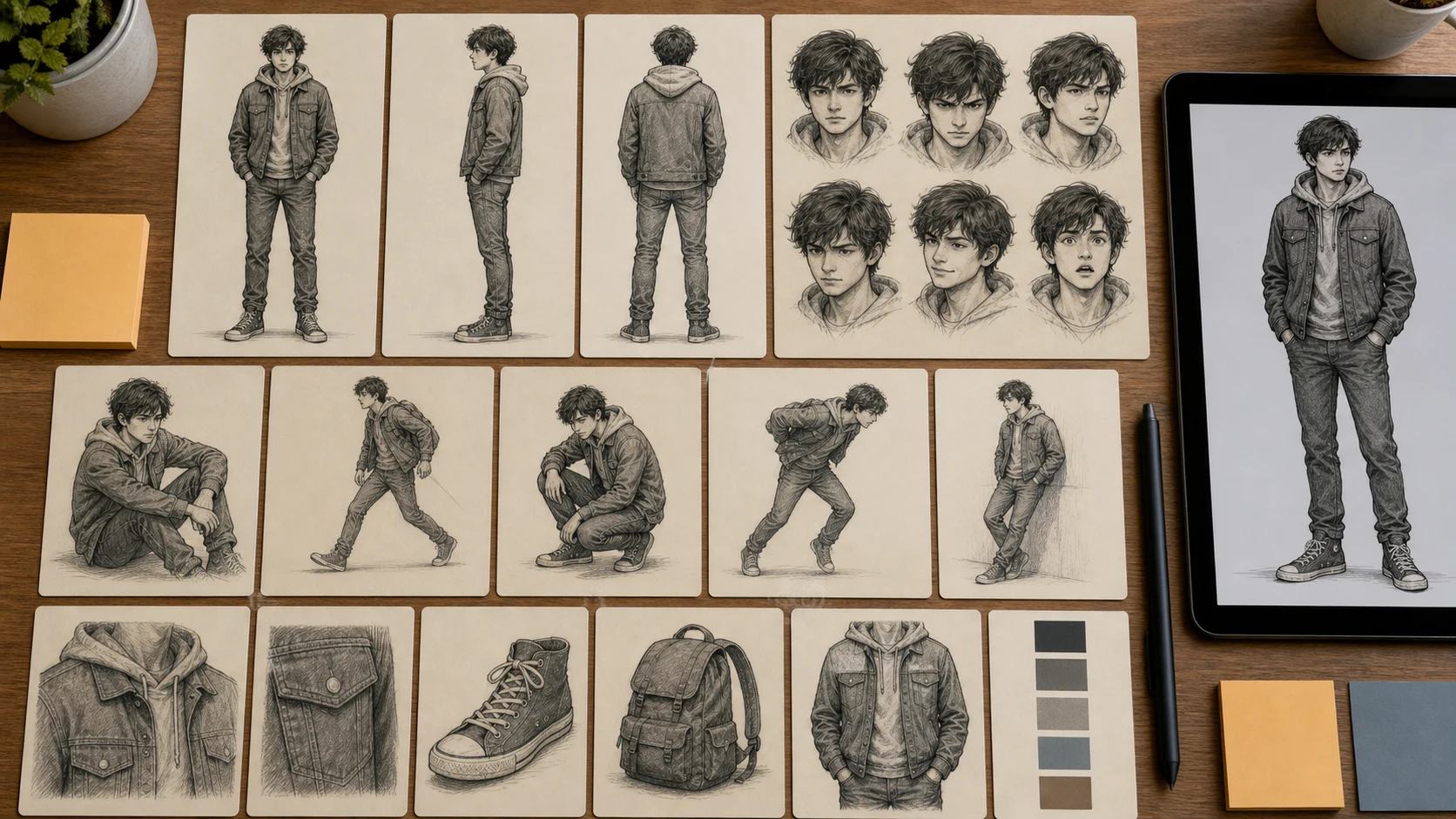
Start with this table:
| Lock item | Eli's rule | Why it matters |
|---|---|---|
| Hair | Messy dark hair, uneven volume, visible forehead breaks | Fast recognition |
| Face | Narrow face, tired eyes, soft jaw, not heroic | Preserves character type |
| Body | Lean, slightly folded posture | Shows anxiety and observation |
| Outfit | Gray hoodie under worn denim jacket | Strong silhouette |
| Shoes | Black high-tops | Recurring lower-body anchor |
| Bag | Canvas messenger bag, strap across chest | Nervous gesture and prop |
| Acting | Notices before reacting, grips strap under pressure | Personality in panels |
This is the part that should not drift unless the story changes it.
If you lock everything too tightly, the character becomes stiff. Long-form comics need controlled variation.
| Element | Locked | Allowed to change |
|---|---|---|
| Hair | Shape and color | Wind, rain, mess level |
| Jacket | Denim layer and silhouette | Open, zipped, wet, torn |
| Hoodie | Gray base layer | Hood up, hood down, sleeves pushed |
| Bag | Cross-body strap | Shifted position, held in hand, dropped during action |
| Expression | Tired eyes and restraint | Fear, relief, suspicion, focus |
| Posture | Slightly closed body language | Standing, crouching, running, leaning |
This gives the adaptation enough range without losing identity.
Writers often describe personality in abstract terms. For comics, translate those traits into visible behavior.
| Prose trait | Visual signal |
|---|---|
| Quiet | Fewer large gestures, smaller speech moments |
| Observant | Eyes move toward clues before other characters react |
| Anxious | Hand grips strap, shoulders lift, feet angle away |
| Trying to look composed | Straightens jacket before entering a room |
| Not a fighter | Steps back, uses cover, protects the notebook instead of punching |
| Notices ignored details | Close-ups of his gaze and the object |
Now the character can act consistently, not just look consistent.
Use LlamaGen.AI Upload when you have character notes, a chapter excerpt, or a full cast bible.
Ask for this:
I am adapting this novel character into long-form comic panels.

Please return:
1. The character's visual identity in one sentence.
2. A lock file for face, hair, body, outfit, props, and posture.
3. Allowed variations by scene type.
4. Acting rules that show personality visually.
5. A first character sheet prompt.
6. A 6-panel continuity test plan.
7. Common drift risks.
8. A repair checklist for inconsistent panels.

Do not rewrite the character. Convert the prose notes into visual continuity decisions.
Upload the notes through LlamaGen.AI Upload, then review the result as a production file.
Before adapting an entire chapter, test the character in different conditions.
| Panel test | Scene | What to check |
|---|---|---|
| 1 | Neutral front view | Face, hair, outfit baseline |
| 2 | Side view walking | Silhouette and posture |
| 3 | Close-up under stress | Expression without face drift |
| 4 | Rain scene | Outfit still readable |
| 5 | Low-angle scene | Body proportions stay stable |
| 6 | Object interaction | Bag strap, hands, prop relationship |
If the character survives this test, you can expand into a chapter.
Do not only review whether the art is attractive. Review whether the character is still the same person.
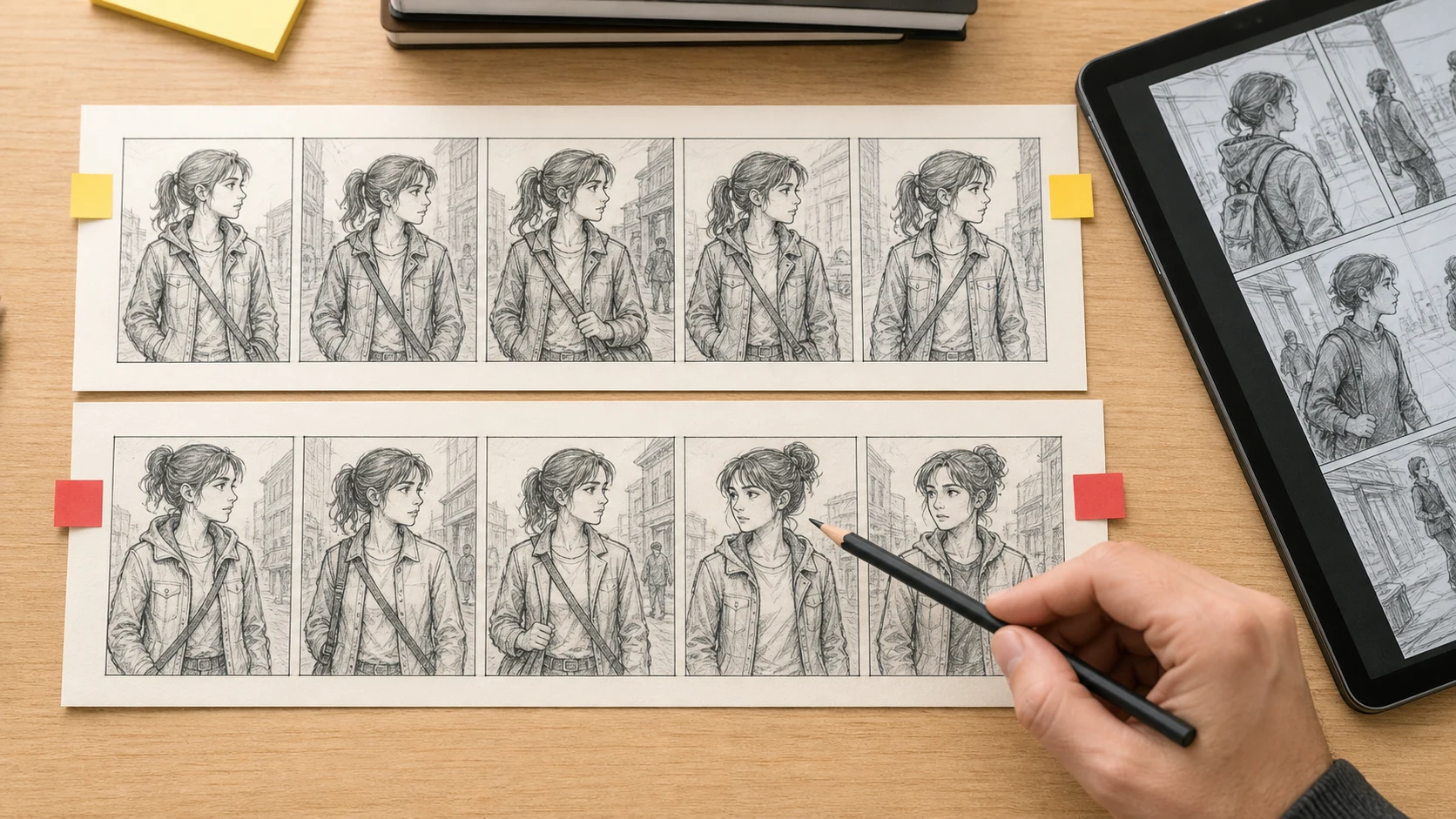
Use this review pass:
| Review question | Pass condition |
|---|---|
| Would a reader recognize the character without dialogue? | Yes |
| Is the hair shape still within the lock file? | Yes |
| Did the face age or change structure? | No |
| Is the outfit variation justified by the scene? | Yes |
| Is the body language still connected to personality? | Yes |
| Did the important prop stay the same object? | Yes |
Mark any failing panel before generating the next batch.
When a panel drifts, do not rewrite the story. Repair the visual constraints.
| Drift | Repair instruction |
|---|---|
| Face changed | Restore narrow face, tired eyes, same hairline, same age |
| Outfit changed | Keep gray hoodie under worn denim jacket, same silhouette |
| Bag disappeared | Restore canvas messenger bag and cross-body strap |
| Character became too heroic | Return to quiet, observant, slightly guarded posture |
| Proportions changed | Match lean build and same height relationship |
| Expression became too extreme | Use restrained anxiety or focused attention |
The best repair prompts are boring in a good way. They name exactly what must return.
Once the lock file works, reuse it across chapters.
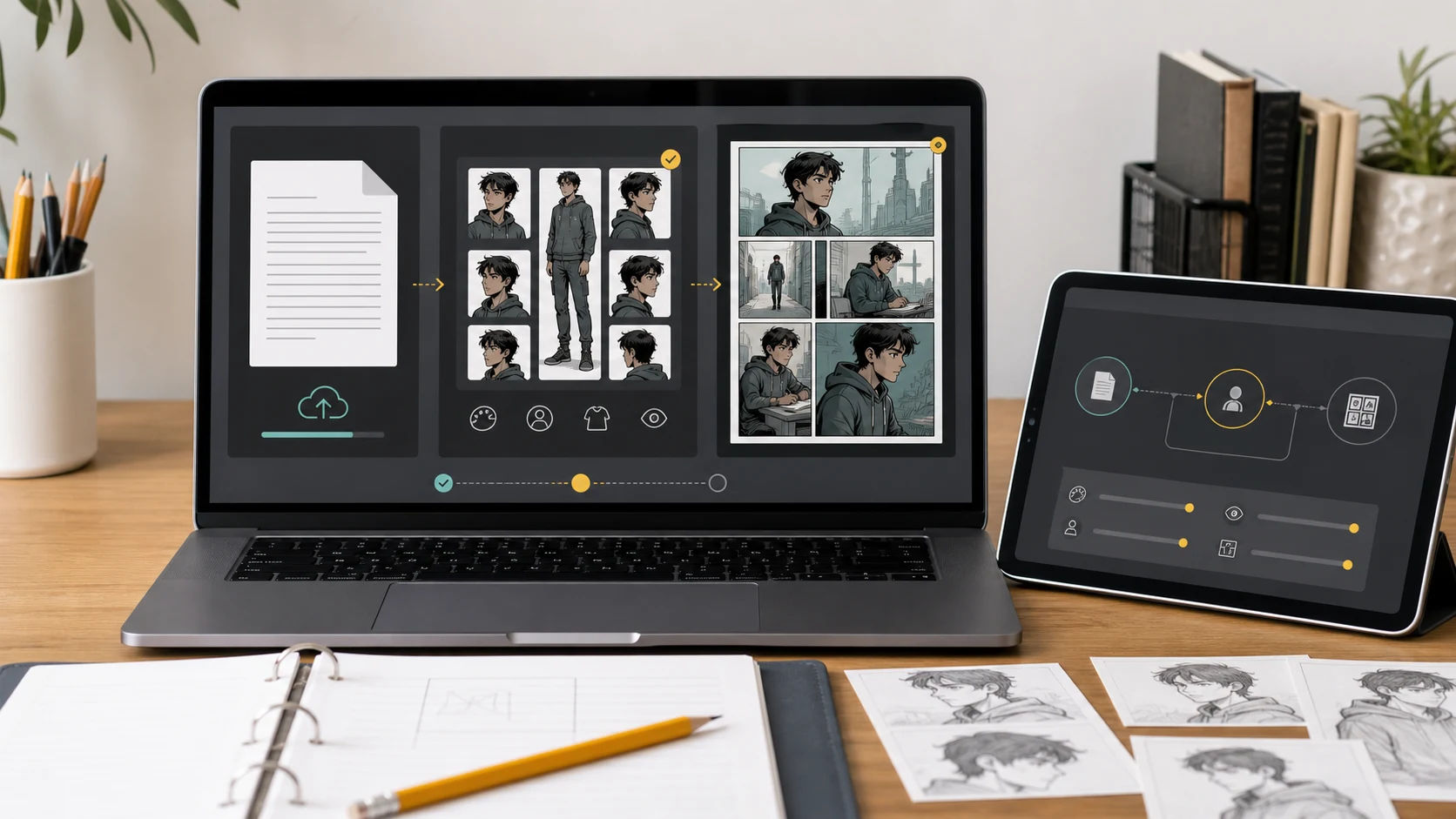
A stable long-form workflow looks like this:
| Stage | Writer action | Output |
|---|---|---|
| 1. Upload | Send character notes to LlamaGen.AI Upload | Continuity map |
| 2. Lock | Approve face, hair, outfit, props, acting rules | Character lock file |
| 3. Test | Generate six panels under different conditions | Continuity test |
| 4. Review | Compare against lock file | Drift notes |
| 5. Repair | Fix only failed visual traits | Stable panel set |
| 6. Expand | Use the character across chapter beats | Long-form adaptation |
This gives writers a repeatable workflow instead of a fresh gamble every scene.
The failed prompt was:
Make comic panels of Eli, a quiet apprentice archivist with messy dark hair.
It produced decent art, but the character drifted.
| Problem | Cause | Fix |
|---|---|---|
| Eli looked older in some panels | Age was not locked | Add age range and facial maturity |
| Hoodie disappeared | Outfit hierarchy was vague | Lock hoodie under denim jacket |
| Personality became generic | Acting rules were missing | Add observation and nervous strap gesture |
| Bag changed into different bags | Prop identity was too loose | Define canvas messenger bag and strap |
| Scene lighting changed his identity | No continuity review | Run a six-panel test before chapter generation |
The solution was not a longer character description. It was a clearer continuity system.
Use this before generating a long-form comic adaptation:
| Section | Fill this in |
|---|---|
| Character role | What does this person do for the story? |
| Recognition sentence | What should readers notice first? |
| Face lock | Shape, eyes, age, hairline |
| Hair lock | Color, length, silhouette, texture |
| Body lock | Height, build, posture |
| Outfit lock | Core layers, shoes, accessories |
| Prop lock | Objects tied to identity or plot |
| Acting rules | How the character moves, hesitates, reacts |
| Allowed variations | Weather, damage, emotion, time jump |
| Avoid list | What the character should never become |
Upload this template to LlamaGen.AI Upload with a chapter excerpt and ask for continuity gaps.
Usually no. One image helps, but long-form continuity needs multiple views, expressions, outfit details, props, and acting rules.
Lock both. A character can look consistent but act wrong. Personality becomes visual through posture, gesture, pacing, and expression range.
Start with front, side, back, three expressions, two poses, outfit details, and any recurring prop. Then test those in a six-panel scene.
Yes. The same lock file can support sprites, CG scenes, background interactions, and choice moments.
Repair it. A beautiful off-model panel weakens a long-form adaptation because readers lose trust in who they are following.
Character continuity is how a long-form comic earns reader trust.
If your protagonist changes face, age, outfit, posture, and props every few panels, the story starts to feel unstable even when the art looks polished.
Start with a lock file, test across six panels, review for drift, and then expand. Upload your character notes to LlamaGen.AI Upload and turn prose description into a reusable continuity system before generating the full chapter.
Popular creator tools
Go from comics and storyboards to stylized photos with LlamaGen.
Visualize every scene before production starts.
© 2026 LlamaGen.Ai All rights reserved
Leading the Future of AI Comic Generation