

Comic-to-animation planning
Choose an animation treatment for your comic
Compare an animatic, camera movement and generated character motion when adapting a comic to animation. Plan review and finishing around the result you need.
Model
This creator generates a still image. Continue in the linked tools for comics and video; research strategies are not selectable production modes.
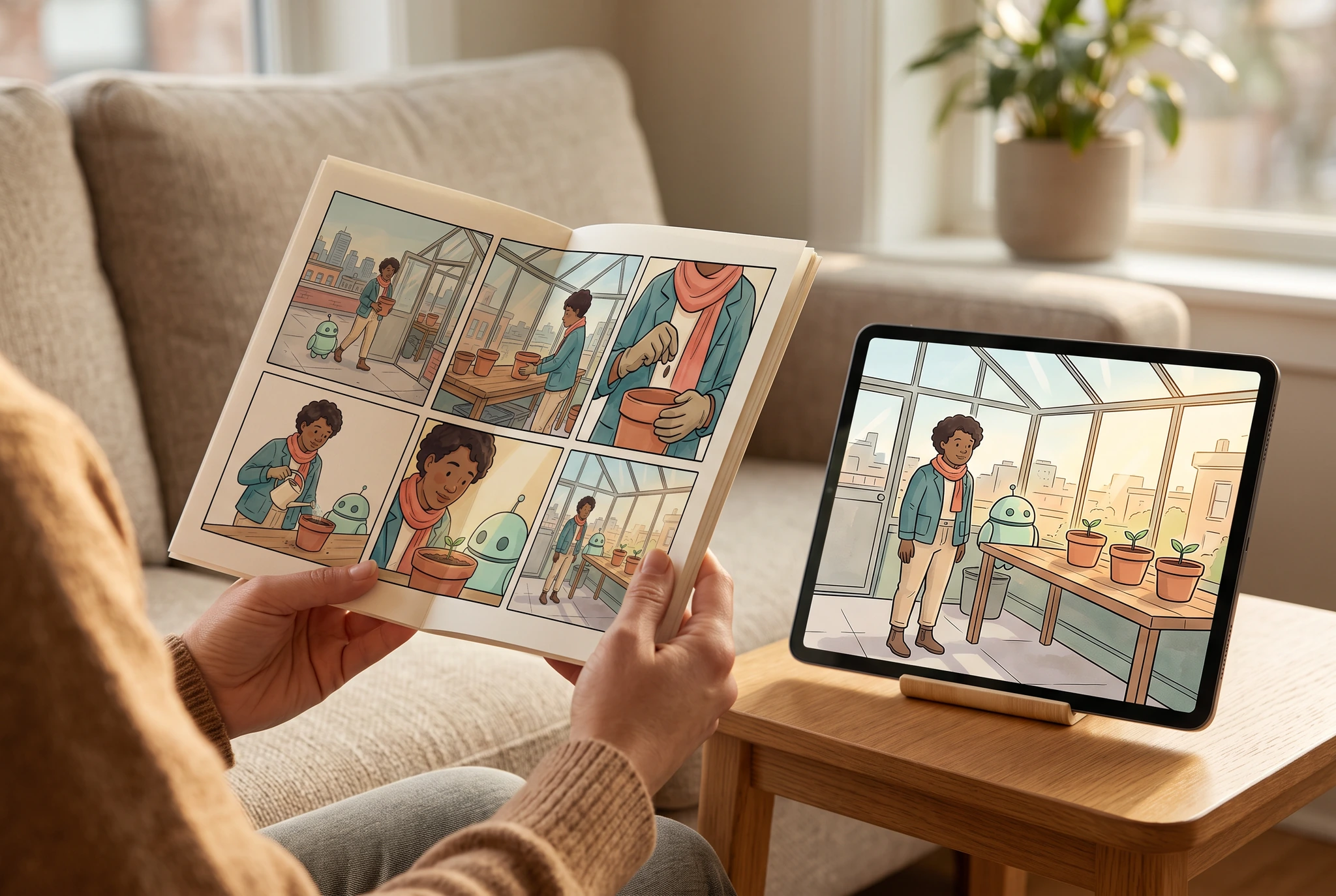
Image record
Google Vertex AI · gemini-3.1-flash-image · · 1280 × 859 px
Original generation prompt
Use case: photorealistic-natural / product-mockup. Warm realistic editorial PHOTOGRAPH showing a self-prepared comic story in print and on a screen, with no claimed completed animation. The supplied original six-panel comic is the only source art. A fictional adult seated on a soft oatmeal sofa holds a thin open cream comic booklet in exactly TWO natural adult hands; show the complete original six-panel greenhouse story clearly on the right page. On a low oak side table next to the lap is one unbranded landscape tablet on a simple stand, displaying a large still crop of the same final greenhouse scene with the original teal-jacket botanist, coral scarf and small mint robot. The booklet and tablet match recognizably but the tablet is clearly a still artwork presentation, not a fabricated video UI. No adult face, extra hands, extra fingers, letters, numbers, captions, logos, playback controls, screen interface or retail packaging. Physical paper/page thickness and tablet reflections should look photographic and understated, not illustrated. Composition prioritizes the finished booklet and screen, about 75 percent of frame. Soft side-window daylight. Landscape 3:2.
View full artworkPlan a specific result
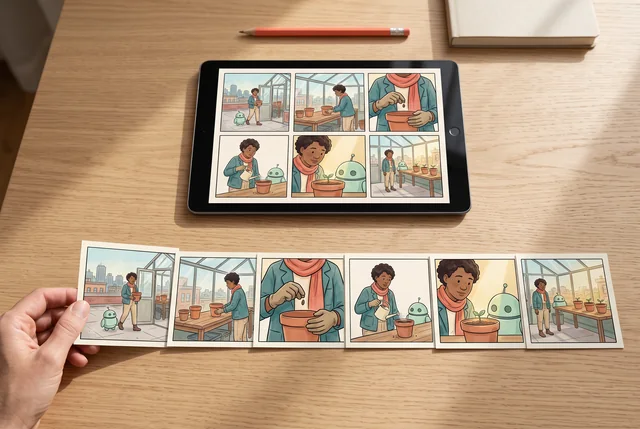
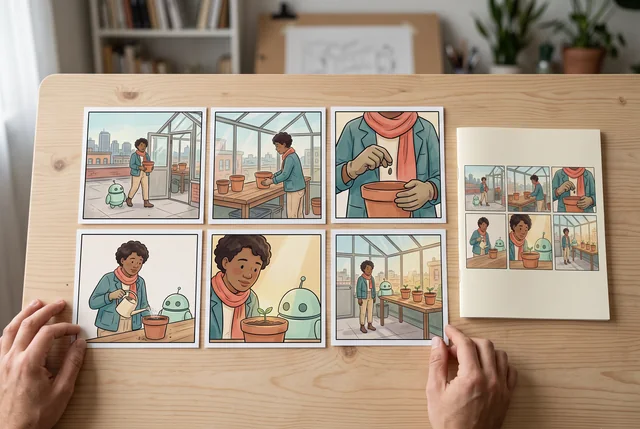
One greenhouse planting, three presentation choices
Use the same short greenhouse planting story to compare a timed board, gentle camera moves and a version with a new character action. The comparison is a planning exercise rather than a claim that all treatments are generated here.
What to prepare
- The reviewed story panels and their reading order.
- A brief describing where motion adds useful information.
- Authorized sound or dialogue material if the finishing plan needs it.
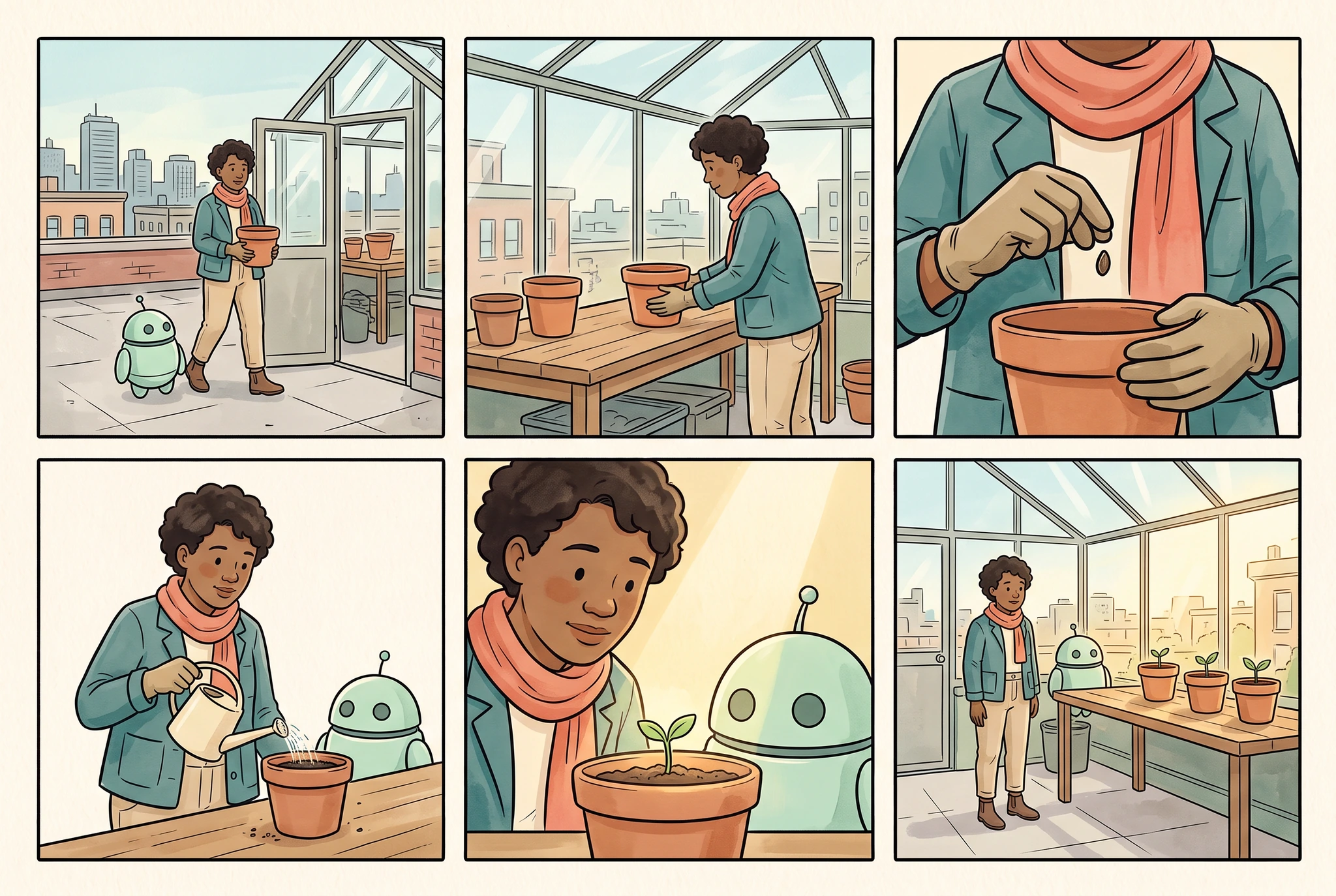
Image record
Google Vertex AI · gemini-3.1-flash-image · · 1280 × 859 px
Original generation prompt
Use case: illustration-story. Make ONE original finished comic page in a clean three-column by two-row grid, exactly SIX equally sized panels, narrow even ivory gutters and complete outer margins. The provided image is the character identity and wardrobe reference, not a page to copy. Preserve its adult botanist with warm brown skin, short dark curly hair, teal jacket, coral scarf, sand trousers, brown boots, and round mint helper robot with two dark eyes and exactly one short antenna. Quiet elegant ink-and-watercolor comic style, teal/coral/sage/ochre palette. Tell a very simple readable rooftop greenhouse planting story: panel1 wide view botanist and robot arrive at the greenhouse carrying a small terra-cotta pot; panel2 medium view the botanist places the pot on the wooden bench; panel3 close view gloved adult hands holding a seed above the pot; panel4 medium view botanist and robot water the pot with a small cream watering can; panel5 close view botanist and robot look at the tiny seedling; panel6 wide view both stand by the finished row of three potted seedlings in afternoon light. All people are adults; each scene has one botanist and one robot unless only hands are framed. The pot remains terra-cotta, the greenhouse stays structurally coherent, identity and outfit remain recognizable. No writing, numbers, logos, speech balloons, captions, lettering, illegible marks, third-party characters, UI, photorealistic environment or claims of tested consistency. Landscape 3:2.
View full artworkUse an animatic to test timing
A timed sequence of stills can reveal whether the pause and reveal are understandable before creating new movement.
Use camera motion to guide attention
A measured reframing can highlight a detail already in the panel. Review crops, text and image edges rather than treating movement alone as added story value.
Budget for newly created action
A character turn or hand movement changes visual content. Plan additional review for identity, anatomy, props and transitions instead of assuming an accepted still guarantees the clip.
Choose the treatment after reviewing a simple timed version. Complexity is useful when it earns its place in the story.
A practical starting point
Define the viewing experience
Decide whether you need a timed storyboard, a moving-camera presentation or new character action. These treatments require different source material and checks.
Prepare the necessary assets
Keep accepted panels, authorized references and lettering available. If your workflow needs separate foreground and background layers, verify that the required assets actually exist.
Review motion, sound and finishing separately
Inspect the visual sequence, then check timing, dialogue, music and export requirements in the chosen tools. An attractive frame cannot establish that the final animation works.
What to inspect
Image record
Google Vertex AI · gemini-3.1-flash-image · · 1280 × 859 px
Original generation prompt
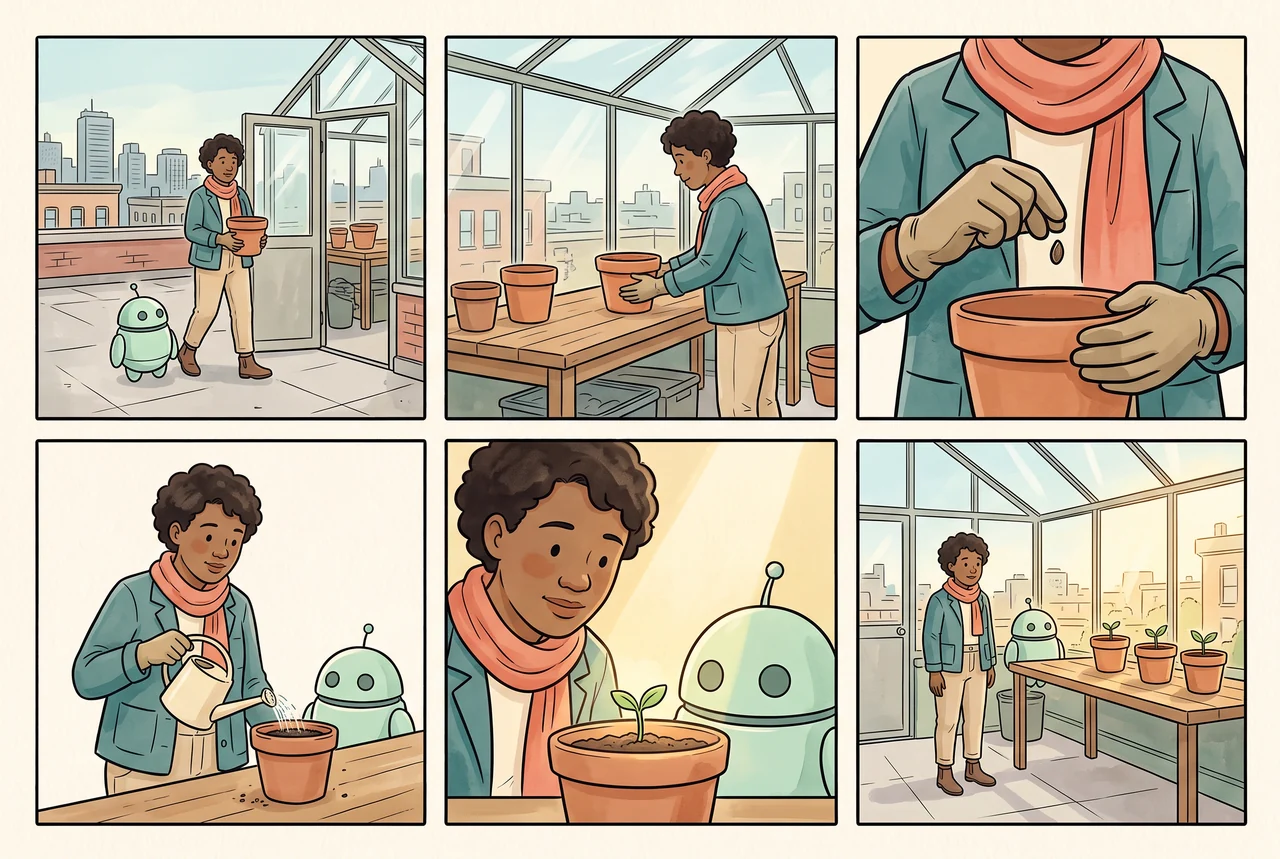
Use case: photorealistic-natural / product-mockup. Warm realistic editorial PHOTOGRAPH showing a self-prepared comic story in print and on a screen, with no claimed completed animation. The supplied original six-panel comic is the only source art. A fictional adult seated on a soft oatmeal sofa holds a thin open cream comic booklet in exactly TWO natural adult hands; show the complete original six-panel greenhouse story clearly on the right page. On a low oak side table next to the lap is one unbranded landscape tablet on a simple stand, displaying a large still crop of the same final greenhouse scene with the original teal-jacket botanist, coral scarf and small mint robot. The booklet and tablet match recognizably but the tablet is clearly a still artwork presentation, not a fabricated video UI. No adult face, extra hands, extra fingers, letters, numbers, captions, logos, playback controls, screen interface or retail packaging. Physical paper/page thickness and tablet reflections should look photographic and understated, not illustrated. Composition prioritizes the finished booklet and screen, about 75 percent of frame. Soft side-window daylight. Landscape 3:2.
View full artworkTry a camera move
Preview a simple camera move on one still image. Continue to the comic-to-video workflow for the available video tools and export options.
Research direction
Research behind the workflow
Protect an accepted scene while correcting a detail
Local-repair research is relevant when an isolated identity or prop error interrupts an otherwise useful shot. The surrounding scene and motion still need to be inspected.
Prepare reusable layers carefully
Identity, outfit, foreground and background assets may support a layered workflow, but availability and compatibility must be checked. A cached reference is not automatically an animation-ready rig.
Review multiple dimensions of the result
A useful evaluation separates identity, story alignment, motion quality and readability. It also records failures and the time spent correcting them.
Research direction
Visual Review Cascade
Which checks can catch an identity or story error early, and which need a closer look?
How we would evaluate it: Track missed serious errors and incorrectly rejected panels alongside review cost and latency.
Research direction
Targeted Character Repair
Can one incorrect character detail be repaired while preserving the accepted scene?
How we would evaluate it: Inspect the edited area, the surrounding pixels and the story after each proposed repair.
Research direction
Reusable Character Assets
Which identity views, outfits and scene assets can help a later shot without repeating an old story image?
How we would evaluate it: Track asset versions, useful reuse, preparation cost and errors caused by stale references.
Know the boundaries
- An animatic, camera presentation and character animation are different deliverables.
- These pages do not promise rigs, editable animation layers, lip-sync or a particular video export.
- Research into comic stills does not establish a finished animation-generation system.
Primary research informs these questions; it does not establish results for CyaniModel.
Frequently asked questions
Is an animatic already an animation?
It is a timed presentation of a storyboard, often using still frames. It helps test pacing and cuts before investing in more complex movement.
Do I need layered artwork?
Only if the treatment and tools you choose require it. Verify the available foreground, background and character assets; a single flattened image does not automatically provide editable layers.
Can I add dialogue and music?
Check the audio and editing features in the selected workflow, and use material you have permission to use. Plan reading and speaking time before judging the final sequence.
Which treatment should I choose first?
Start with the simplest timed version that communicates the story. Compare a camera move or a new action when it solves a specific problem the simpler version leaves unclear.
Continue your story
Animate comic panels with a deliberate motion plan
Plan camera moves, held frames and transitions for comic panel animation. Keep text readable and inspect character details before choosing more complex motion.
Comic to video AI, planned shot by shot
Plan an AI comic video from reviewed panels. Map each story beat to a shot, preserve character references and inspect the transitions before finishing the sequence.
Build a comic storyboard before planning the video
Turn a short story into an ordered comic storyboard. Define shot purpose, character state and transitions, then use the reviewed sequence to plan video.
Choose a presentation style that fits the story and the amount of change you can review.
Continue in LlamaGen to check the available tools, model choices, account requirements and credits before generating.