

Comic-making fundamentals
AI manga generator for fantasy: keep the world consistent across pages
Fantasy manga needs more than a dramatic castle or creature. Readers must recognize recurring characters, landmarks, rules, props, scale, weather, and travel paths as the story moves between panels and pages.
Published by LlamaGen Editorial TeamUpdated
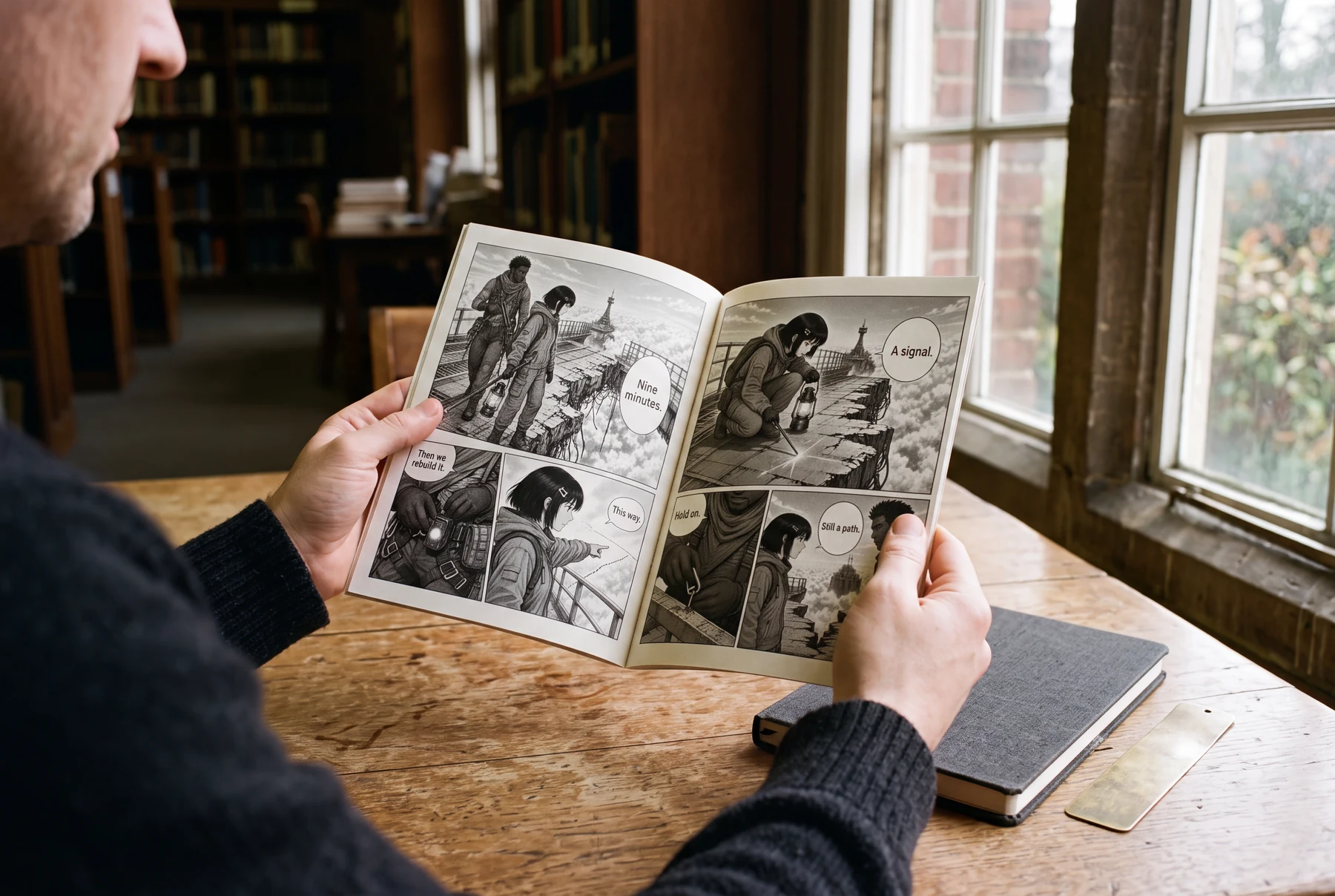
Quick answer
Build a compact world reference with a map, recurring landmarks, cast, props, scale cues, and rules that affect visible action. Carry only the relevant facts into each page brief, then compare the chapter for unexplained changes before polishing individual panels.
These references explain the underlying craft. The original exercises below are LlamaGen examples; the authors do not endorse LlamaGen.
Fantasy mood without continuity
Dramatic but unlocated castle
Bridge without stable anchors
Prop attached to a new structure
World facts carried across pages
Map entrance and destination
Repeat a landmark edge
Carry props and damage forward
Original instructional illustration with fictional characters; not a customer comic or a product screenshot.
Turn worldbuilding into visible constraints
A world bible becomes useful when its facts can be checked in a panel.
- Map the route
- Mark entrances, heights, distances, bridges, rooms, and character starting positions before choosing camera angles.
- Choose recurring anchors
- Reuse a tower silhouette, broken post, lantern, crest, or weather condition so readers know they remain in the same place.
- Define the rule through action
- If magic requires light, time, distance, or a physical cost, show that condition affecting a character rather than explaining it only in lore.
- Use scale references
- Keep doors, weapons, creatures, and architecture believable relative to the same character across views.
Review continuity across the chapter
World consistency is a sequence property. Compare pages side by side before accepting a beautiful isolated image.
- Track character state
- Carry clothing, equipment, damage, fatigue, and carried objects from one page to the next.
- Track environment state
- Record weather, light direction, broken structures, open doors, smoke, and moved props.
- Repeat selectively
- Show enough of an anchor to orient the reader without redrawing the entire background in every close-up.
- Log intentional changes
- If a tower shifts, a bridge collapses, or a spell changes the sky, make the cause visible in the story.
Worked example: crossing the sky bridge
Two couriers must reach a split tower while fog closes around a damaged bridge.
Panel 1
Establish the couriers, bridge entrance, split tower, and lantern.
Panel 2
Reverse angle keeps the cracked post and tower spire visible.
Panel 3
Close view shows the rope attaching to the same damaged post.
Panel 4
Next page carries the lantern, rope, weather, and character order forward.
The fantasy setting remains readable because a few concrete facts survive every camera change.
Comic pages in everyday use
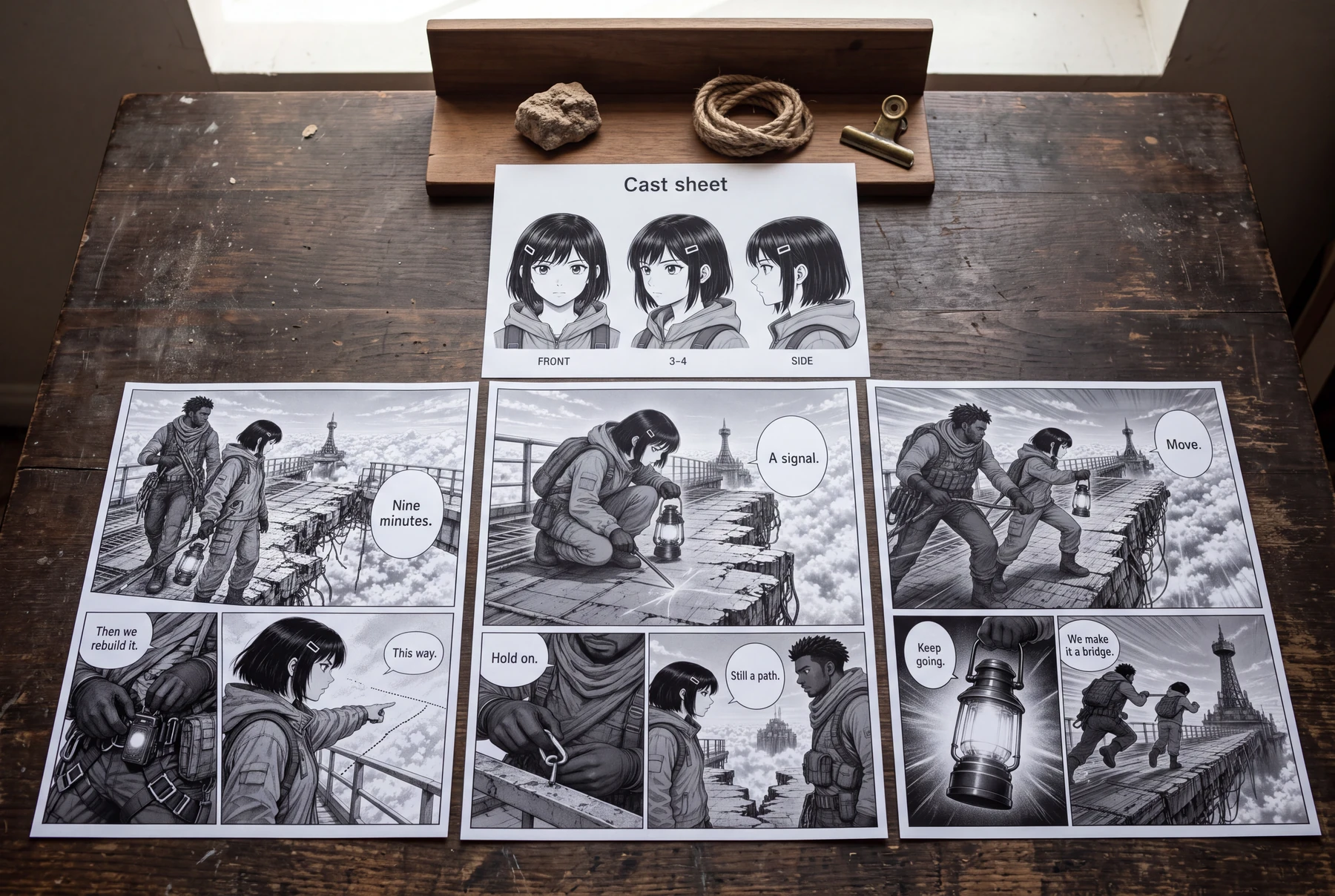
Compare a mood board with a continuity-ready world brief
Use the same two couriers, bridge, lantern, fog, rope, and split tower.
Fantasy mood without continuity
- Epic floating castle in dramatic clouds.
- Beautiful fantasy bridge from another angle.
- Close-up of a rope on an unrelated stone post.
World facts carried across pages
- Map the entrance, cracked post, bridge span, and split tower.
- Keep one landmark edge visible after the camera reverses.
- Carry lantern, rope, weather, and damage into the next page.
How to compare
- Draw a simple top-down route map.
- List five world facts that can be seen.
- Mark which fact appears in each thumbnail.
- Compare consecutive pages and record every unexplained change.
What to look for
The revised version should feel like one traversable place rather than three unrelated fantasy images.
What this exercise cannot prove
This exercise checks visual continuity; it does not validate historical architecture, physics, or the originality of every generated detail.
Before you publish: review the page
- The route and landmarks are mapped.
- Recurring cast and props use stable references.
- Fantasy rules affect visible action.
- Scale remains plausible across views.
- Intentional world changes have an on-page cause.
Frequently asked questions
How much worldbuilding belongs in a manga prompt?
Include only the facts that affect the current page, while keeping the full world reference separately for later scenes.
How do I keep fantasy backgrounds consistent?
Use a map, recurring anchors, camera notes, and a page-to-page environment log. Compare the sequence rather than relying on memory.
Can AI create a whole fantasy world automatically?
It can draft visual material, but the creator still needs to define rules, select results, maintain continuity, and correct contradictions.
Sources and further reading
- Clip Studio Paint — Perspective Drawing Basics ↗
Official introduction to horizon lines, vanishing points, and perspective construction.
- Krita Manual — Assistant Tool ↗
Official documentation for perspective, vanishing-point, and other drawing assistants.
Take the next step in your comic workflow
Plan a visible story beat, try the relevant tool, and review the result yourself. These guides do not promise to automatically analyze or repair your comic.