

Comic-making fundamentals
Comic panel transitions: make every cut serve the story
A panel transition is the change a reader infers between two drawings. Use Scott McCloud’s six-category vocabulary to describe that change, then choose the cut that makes your story clear.
Published by LlamaGen Editorial TeamUpdated
Quick answer
Use moment-to-moment for a pause, action-to-action for a movement, subject-to-subject for a conversation, scene-to-scene for a jump in time or place, aspect-to-aspect for mood, and non-sequitur only when the disconnect is intentional.
These references explain the underlying craft. The original exercises below are LlamaGen examples; the authors do not endorse LlamaGen.
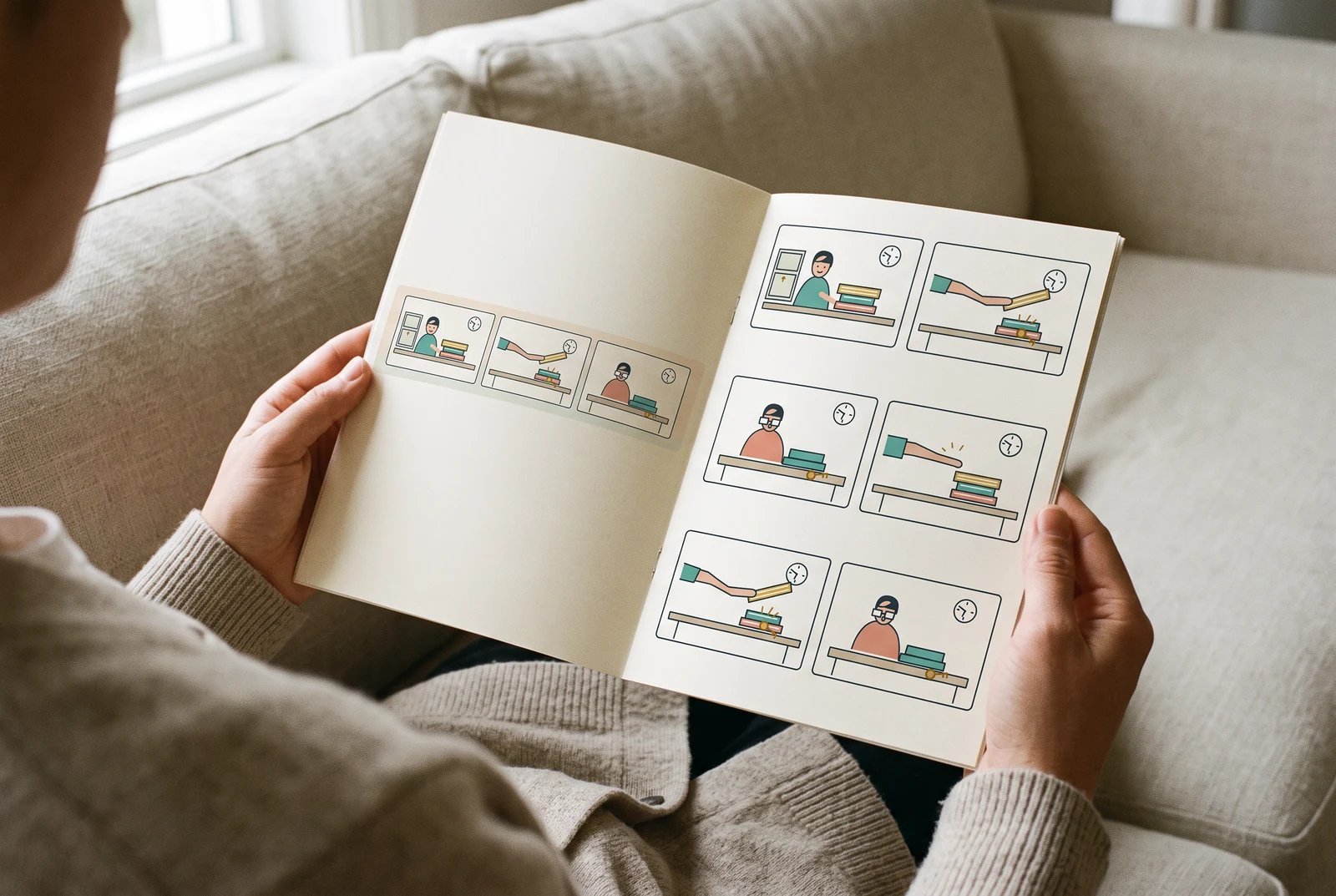
A direct opening
Find the book stack
Lift the book; reveal the key
The librarian reacts
An opening that emphasizes hesitation
Hold on the hovering hand
Lift the book; reveal the key
The librarian reacts
Original instructional illustration with fictional characters; not a customer comic or a product screenshot.
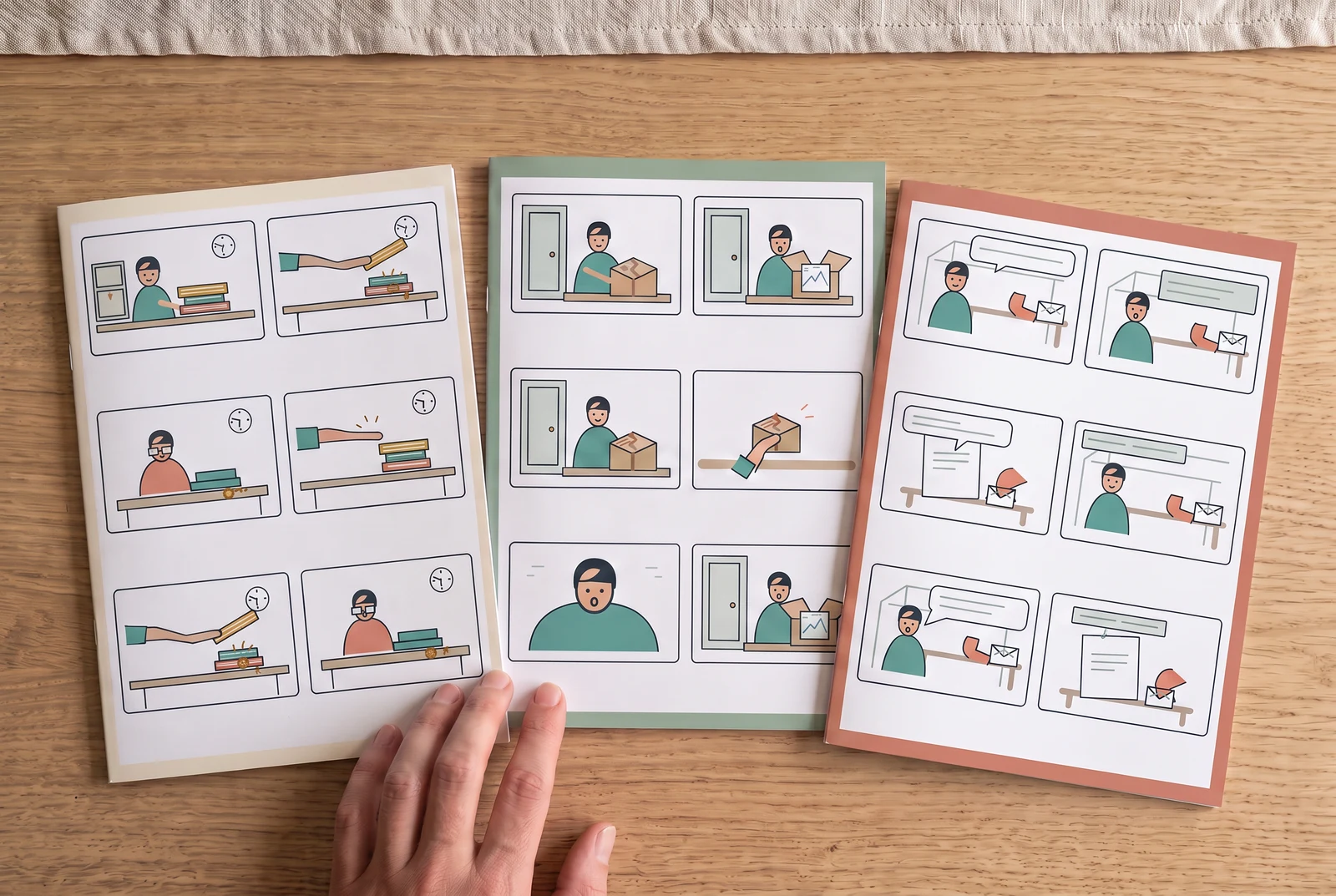
See how a layout shapes a page
Compare three panel arrangements using original composited illustrations.
Original composited samples for layout comparison, not recorded results from the comic generator.
Explore all 30 free layoutsChoose a transition by what changes
McCloud’s categories describe relationships between adjacent panels, not six mandatory page templates. Our examples below use an original library scene.
- Moment-to-moment
- Keep a tiny interval: the same hand hovers above a book, then its fingertips touch the cover. The small change draws attention to hesitation.
- Action-to-action
- Keep the subject but advance a distinct action: the hand touches the book, then lifts it. Include enough visual evidence for the reader to infer the movement.
- Subject-to-subject
- Shift attention within one scene: a key drops onto a desk, then the librarian reacts. Reuse a visible landmark so the reaction belongs to the same place.
- Scene-to-scene
- Move across time or location: the train departs; hours later it reaches the coast. Establish the new context clearly.
- Aspect-to-aspect
- Show the rain on a window, a deserted street, and a stopped clock. These related details establish atmosphere rather than advancing one action.
- Non-sequitur
- Make a jump with no obvious narrative connection. This can serve an experimental sequence; in a causal scene, first check whether missing context is simply confusing the reader.
Keep the reading path unambiguous
Transition design cannot rescue a page whose panels and balloons are read in the wrong order.
- Anchor the scene
- Reuse a background landmark, camera axis, or clear establishing panel so a change of angle does not feel like a change of location.
- Reserve room for lettering
- If the next panel carries a response, leave balloon space where the eye is naturally headed.
- Check direction
- Western left-to-right, manga right-to-left, and scrolling webtoon layouts need different eye paths. Review the actual page, not an isolated thumbnail.
Worked example: finding a library key
The library is closing. A student checks a stack of returned books while the librarian waits nearby.
Panel 1
A close view holds on the student’s hand hovering over the top book. The desk edge and return tray establish the space.
Panel 2
The student lifts the book and a brass key slips out. The subject advances a distinct action: action-to-action.
Panel 3
The librarian turns toward the key on that same desk. Attention shifts to another participant: subject-to-subject.
The first image emphasizes hesitation. The cut from 1→2 advances an action; 2→3 changes the subject within the scene. To make a moment-to-moment pair, insert an almost identical close view of the fingertips touching the cover before the book lifts.
Comic pages in everyday use
Compare a quick discovery with a deliberate pause
Keep the book, key, desk, and ending the same in both three-panel drafts. Change only the opening focus.
A direct opening
- The student looks at the stack of returned books.
- The student lifts the top book; a key slips onto the desk.
- The librarian looks toward the key.
An opening that emphasizes hesitation
- A closer view holds on the student’s hand hovering above the same book.
- The student lifts the book; the same key slips onto the desk.
- The librarian gives the same reaction.
How to compare
- Thumbnail both openings with the same desk edge or return tray visible.
- Under each gap, write what changes: action, subject, time, or place.
- Compare whether the closer opening makes the hesitation noticeable. If the discovery becomes hard to follow, restore enough of the desk to orient the reader.
- For a separate moment-to-moment experiment, add a nearly identical frame showing the fingertips touch the cover before lifting it.
What to look for
Both versions can be clear. The closer opening invites attention to the hand; it is not automatically a better cut. A change of framing alone does not make a transition moment-to-moment.
What this exercise cannot prove
These are original editing examples, not a measured reader test. The diagrams show possible choices; they do not demonstrate every transition category or prove a fixed effect on reading time.
Before you publish: review the page
- Can a new reader explain what changed between every two panels?
- Does the transition preserve time, location, or the reason for a deliberate jump?
- Could removing one panel improve clarity without erasing the emotional beat?
- Does the eye reach dialogue and the next panel in the intended order?
Frequently asked questions
Which panel transition should I use for action?
Action-to-action is often a good starting point. Add a moment-to-moment beat before a decisive move when anticipation matters.
Can a page mix different transition types?
Yes. The labels describe relationships between adjacent panels; they are not exclusive page templates.
Does AI automatically choose the best transition?
No automatic result guarantees readable pacing. Review the generated panels and revise unclear jumps yourself.
Sources and further reading
- Scott McCloud — Understanding Comics ↗
The author’s overview identifies closure, time, motion, and word–picture relationships as topics of the book. The six transition categories come from its discussion of closure.
- Anina Bennett — Comic Book Writing Guide ↗
The “Between the Panels” section names and explains McCloud’s six categories; useful when checking which relationship a cut actually depicts.
Take the next step in your comic workflow
Plan a visible story beat, try the relevant tool, and review the result yourself. These guides do not promise to automatically analyze or repair your comic.