

Give the character a concrete task and a physical obstacle, then show how the body solves it. Check weight, silhouette and object contact before relying on a face to explain the emotion.
An expression can tell us Mira is relieved, but her body can show why: she stops rushing, releases the compass and no longer guards it against her chest. Character acting connects feeling to an action the reader can observe. This workshop develops the return scene through physical tasks rather than a catalog of stock emotion poses.
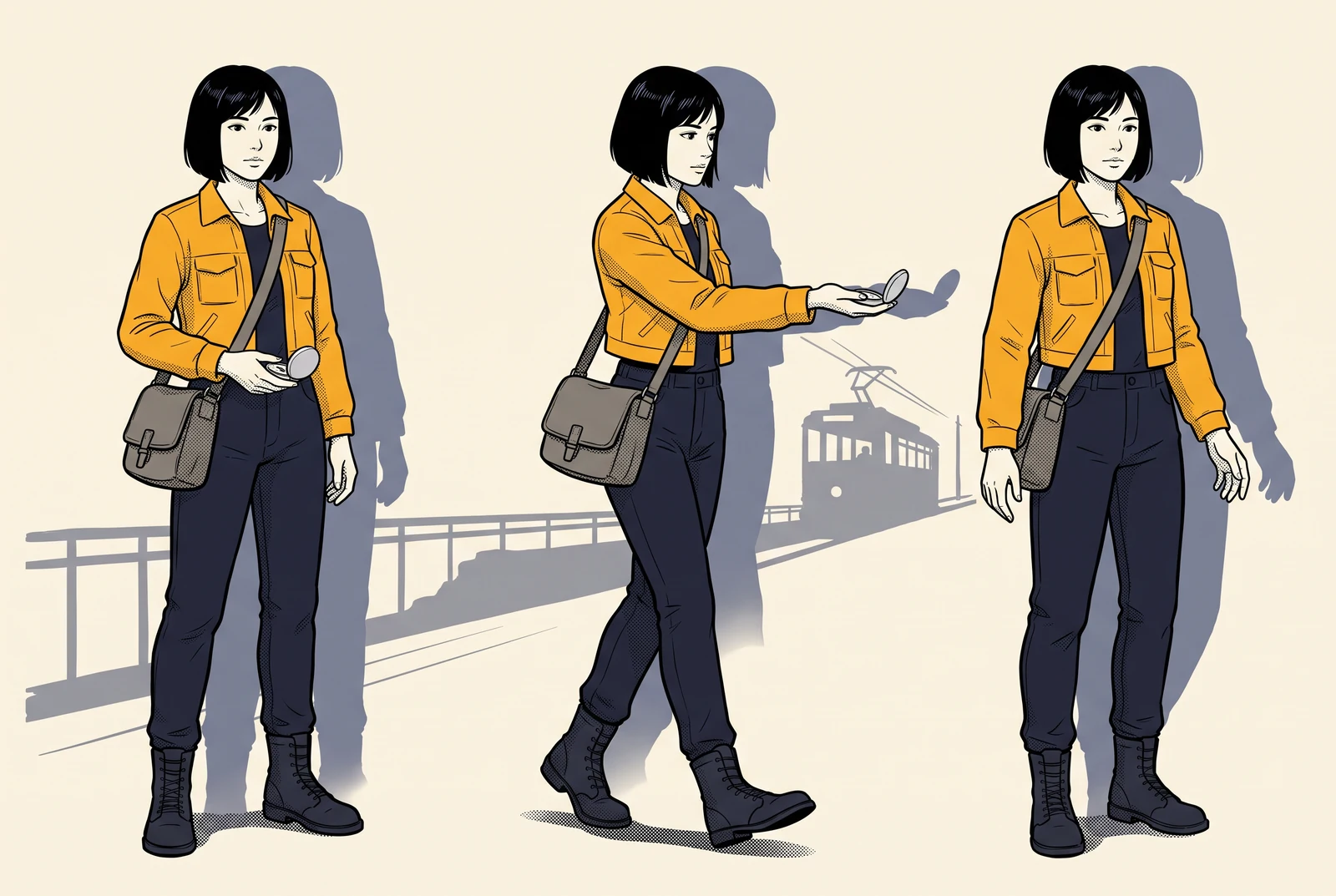
Original teaching illustrations generated with Google Vertex AI / Nano Banana 2.1. Fictional characters; not product screenshots or calibrated print samples. The illustrations use left-to-right or top-to-bottom sequencing as described in their captions.
1. Replace the emotion label with a playable task
An instruction such as look grateful is broad. Try make sure the compass reaches Ivo safely before the tram leaves. The task tells Mira where to look, how close to stand and why she steadies her hand. Ivo’s task might be confirm that this is the object he lost, then accept it without delaying her.
Add an obstacle that belongs to the scene. Mira is breathless from running; Ivo has begun to turn toward the tram. The resulting pause and adjustment can communicate urgency and consideration without exaggerating every limb. Do not invent an injury or a mobility limitation merely to make a pose more dramatic; keep the character’s established physical circumstances consistent.
2. Find the moment that explains the action
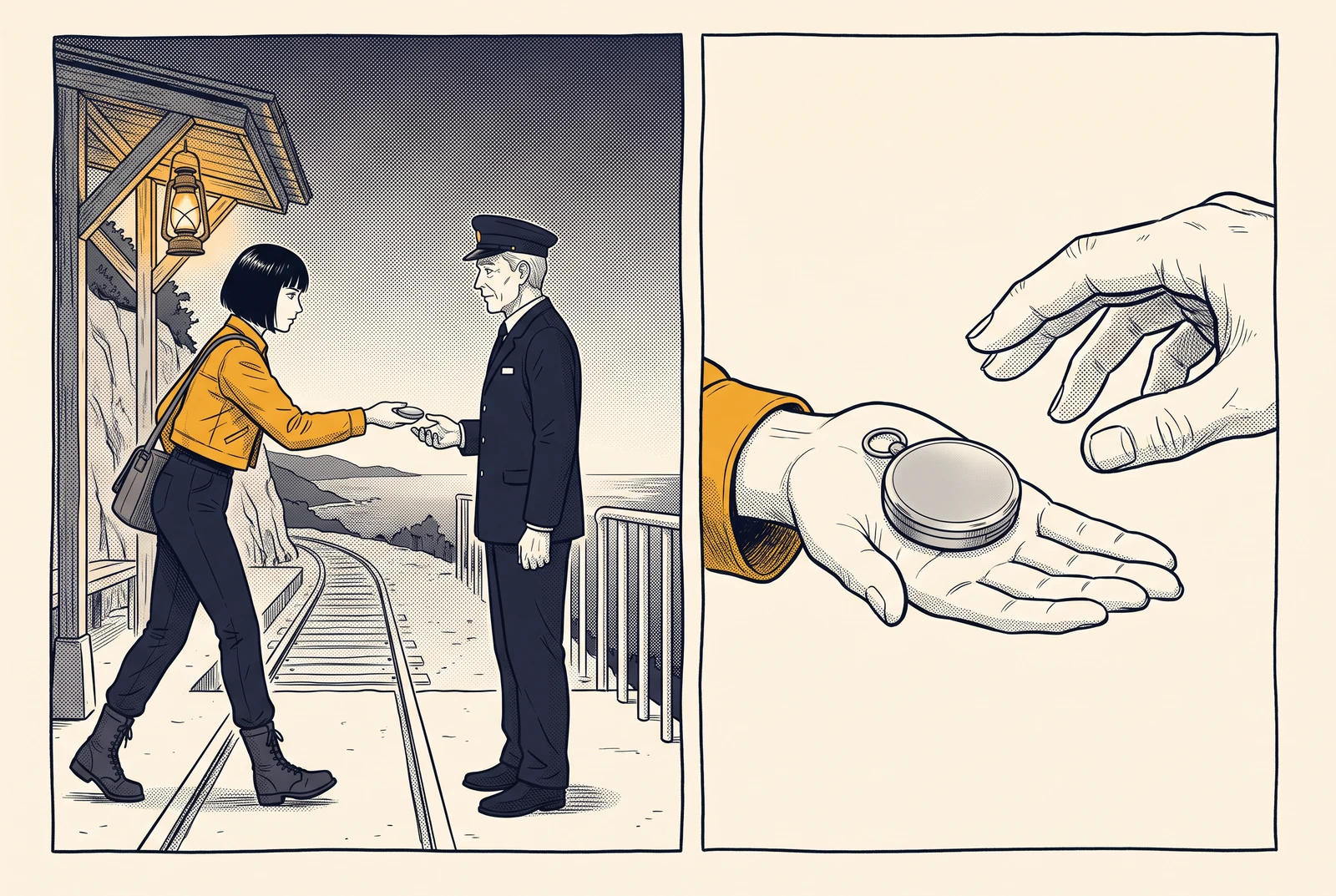
Act the exchange slowly with a safe substitute object. Notice preparation, contact and release. Before contact, Mira supports the compass alone. During transfer, both hands may support it. After release, Ivo bears the weight and Mira’s fingers open. A drawing halfway between these states can become physically ambiguous unless the support is clear.
Select the moment the story needs. An open palm before contact communicates an offer; a closed grip around someone else’s wrist changes the relationship. Keep fingers and the object visible enough for the reader to recognize that distinction. Gesture is a statement about intention, not just attractive anatomy.
| Action stage | Physical evidence | Possible story reading |
|---|---|---|
| Preparation | Compass close to body; attention on Ivo | She is deciding or waiting |
| Offer | Supported open palm enters shared space | She invites acceptance |
| Contact | Receiving hand takes support | Both participate in the exchange |
| Release | Her fingers withdraw; his hand supports the object | The return is complete |
| Afterward | Shoulders settle and hands stop guarding | Immediate tension has eased |
3. Build the support before the costume
Place the ground plane and the supporting foot, then block the pelvis and rib cage as simple masses. For a still standing pose, the body’s weight should appear supported over its contact area. A running or stumbling figure may move beyond that area, but then the next step or an external support must explain the instability.
Only after the large masses work should you refine the jacket, bag and hair. Clothing can emphasize movement, but it cannot repair a floating foot. In Mira’s offer, the forward step brings her within reach; leaning the entire torso impossibly far from planted heels would suggest falling rather than care.
4. Check the task in a simple silhouette
Reduce the figure to a small dark shape. Can you distinguish the offering arm from the torso, and can you see which way the action travels? If the hand merges into the bag or the compass hides against the jacket, change the overlap or viewpoint before adding detail.
The silhouette does not need to communicate a precise emotion by itself. Gratitude, politeness and hesitation can share similar shapes. Use it to check the broad action and clear separation; use context, timing, facial expression and dialogue for nuance. Avoid treating any single body gesture as a universal emotional code.
5. Give hands and props a separate continuity pass
Draw the compass as a simple solid before polishing fingers around it. Identify the contact points: which surface supports it, which fingers approach, and where the receiving thumb can reach. Compare the drawing with a reference you own or may legitimately use. Do not force the prop through a palm to keep a pleasing finger outline.
Across panels, track the same hand, the compass hinge and lid state, and the bag strap. If Mira switches hands, show or allow a plausible moment for it. If a generated draft duplicates the compass or fuses fingers, repair that contact area and then recheck the whole pose. Correct finger count alone does not guarantee believable support.
6. Let a restrained action carry a second thought
A character can complete the task while revealing a competing wish. Mira may offer the compass promptly but keep the other hand on her bag because she still needs to catch the tram. Ivo can accept it while moving aside to let her pass. These practical choices can express care more specifically than an exaggerated smile.
Choose a small number of readable signals and preserve their cause. Randomly turning head, shoulders and feet in different directions produces noise. Ask what the character is attending to and what they are about to do. Keep that answer compatible with the surrounding panels.
7. Prepare a pose brief for human or AI drawing
Include the physical task, the stage of action, support, essential contact and the chosen view. Example: Mira has stopped beside Ivo. Weight rests on her forward foot; her left palm supports one silver compass at waist height. Her elbow separates from her jacket. Ivo’s right hand approaches from the opposite side. Both faces and the compass are visible. No lettering.
For LlamaGen exploration, keep approved identity and clothing references with the brief, then compare the result with the physical task. A polished pose can still be wrong for the scene. Do not change the story to excuse an accidental gesture; revise the image or choose another candidate.
8. Workshop: make the transfer readable without words
Draw five small poses covering preparation, offer, contact, release and recovery. Use simple figures and one clearly shaped object. Then choose three that communicate the whole transfer. This is an exercise in selecting information, not a requirement to use every stage on a published page.
Have a reader identify who supports the compass in each image and what each person intends to do next. Add expressions only after those answers are clear. Finally compare the acting with the dialogue: an appreciative line paired with a dismissive shove may be useful subtext, but it should be intentional.
- The task and next action are identifiable.
- The body has convincing ground contact or a clear reason for instability.
- The important hand separates from the torso and bag.
- Object support and transfer remain consistent.
- Expression, gesture and dialogue create the intended relationship.
Questions and answers
Should I draw the face or the body first?
Start with the task and the large physical arrangement. Block support and body masses, then add the head and hands where they clarify intention. The best order is the one that keeps you from polishing a face on an unusable pose.
Can I use AI pose images as anatomy references?
Use generated images as composition candidates and inspect them critically. Verify anatomy and contact against reliable references or observation. Generated hands, balance and object relationships can be plausible at a glance and still be wrong.
Put the lesson into a manga draft
Prepare the beats, references and layout first, then review each generated image against the action you intended.
Open LlamaGen Manga MakerContinue the workshop
References and further reading
- Oyasumi Game Development Club — original topic reference (Japanese)
Further reading that prompted this lesson topic. The compass story, production briefs, exercises and illustrations here are original LlamaGen teaching material.