

Character continuity
Create comic sequences with recognizable characters
Plan consistent-character AI comics with identity references, current outfits and panel-by-panel review. Learn what to check when camera, pose or scene changes.
Model
This creator generates a still image. Continue in the linked tools for comics and video; research strategies are not selectable production modes.
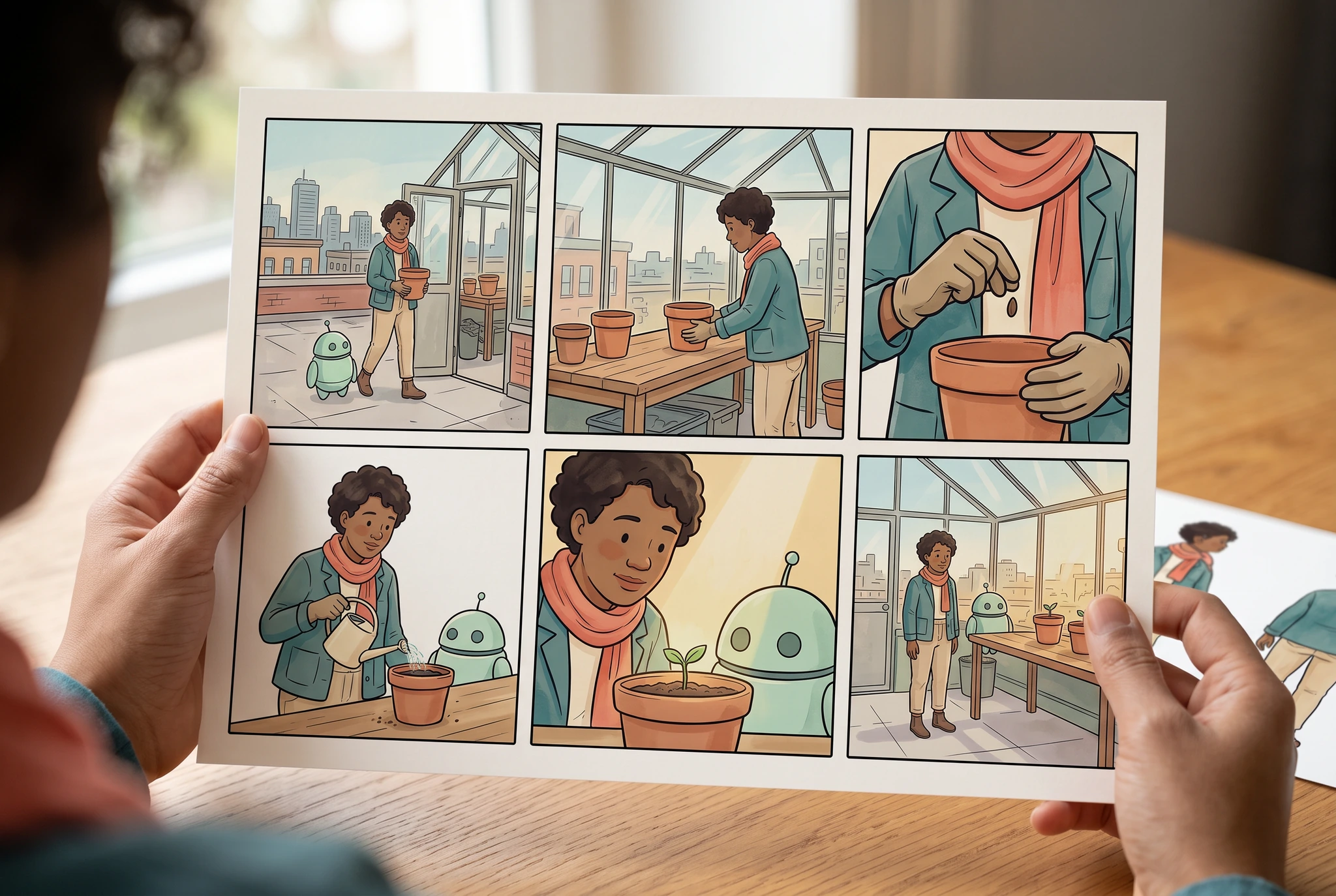
Image record
Google Vertex AI · gemini-3.1-flash-image · · 1280 × 859 px
Original generation prompt
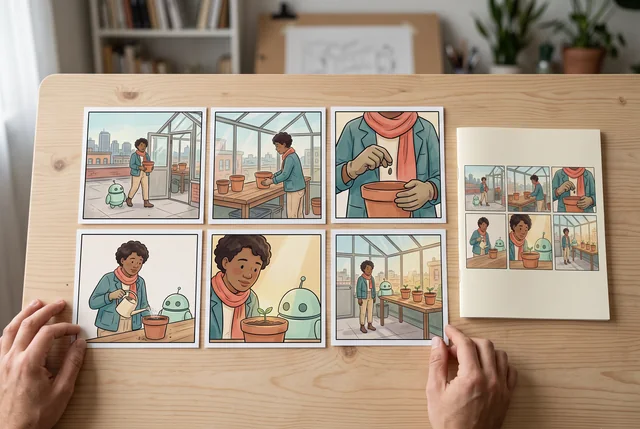
Use case: photorealistic-natural / product-mockup. Create a natural window-lit editorial PHOTOGRAPH of exactly TWO anatomically normal adult hands holding one landscape matte comic proof sheet above a real warm oak desk. Image1 supplied is the original adult botanist and mint robot reference sheet; image2 is the COMPLETE original SIX-PANEL greenhouse comic. The held paper must have landscape 3:2 proportions so Image2 fits WITHOUT rearrangement. Put the exact complete Image2 sequence on the held sheet as THREE columns by TWO rows, with a clean ivory outer margin: upper row arrival, pot on bench, gloved seed close-up; lower row watering, seedling reaction, final greenhouse view. Preserve all six distinct scenes in that order; DO NOT repeat watering, remove seed, reformat into two columns, add text or combine panels. Keep the original adult's teal jacket, coral scarf, dark curly hair, sand trousers and original mint round robot. Hold the paper by its two lower blank outside corners only; all artwork corners remain visible and hands cover no panels. The source character-reference sheet from Image1 rests flat farther back on the desk, partly visible beside the held print. Only the printed artwork is ink/watercolor illustration; hands, table, thin paper grain and room are a convincing photograph. No visible faces, booklet, screen, logos, titles, numbers, writing, fake UI, metrics or product packaging. Natural skin/five fingers, coherent optical perspective, subtle paper flex, quiet soft daylight. The completed hand-held story takes 75 percent of frame. Fictional lifestyle presentation only, never a customer photograph or research result. Landscape 3:2.
View full artworkPlan a specific result
The same botanist, three camera distances
Plan a greenhouse sequence with an establishing view, a planting action and a close-up. The adult botanist keeps short dark curly hair, a teal work jacket and a coral scarf while the framing changes; the small mint robot keeps two eyes and one antenna.
What to prepare
- An original identity image with clearly visible defining features.
- The current outfit and prop notes for the greenhouse scene.
- Three shot briefs that identify the action and camera distance.
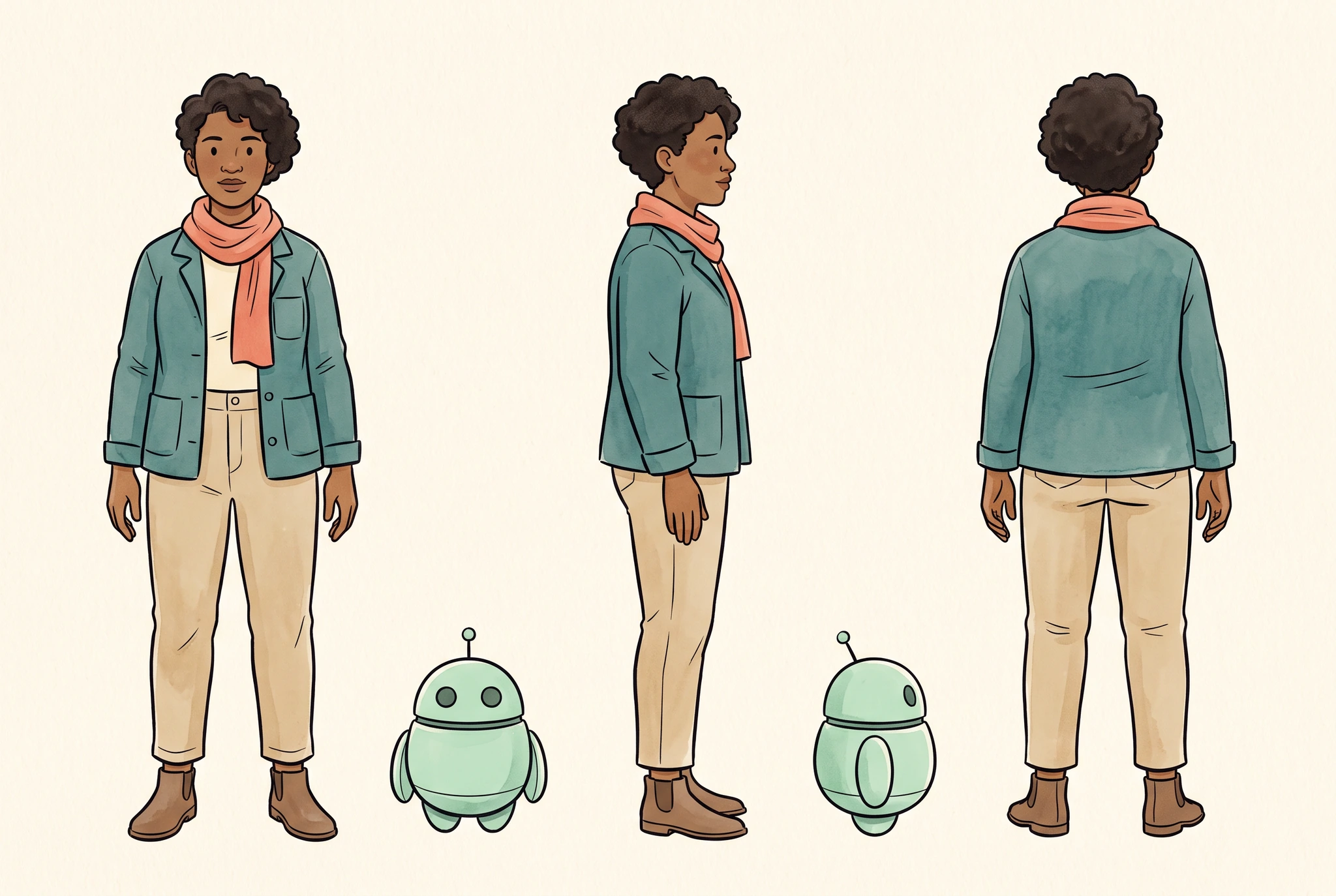
Image record
Google Vertex AI · gemini-3.1-flash-image · · 1280 × 859 px
Original generation prompt
Use case: illustration-story. Original character reference sheet on warm ivory paper, editorial comic style with elegant clean dark ink lines, restrained watercolor washes and sophisticated readable shapes. Show the same fictional adult botanist, about 32, warm brown skin, short dark curly hair, teal work jacket over cream shirt, one coral scarf, sand trousers and simple brown ankle boots, in THREE clear full-body views: front, side and back, spaced evenly. Below or beside the adult show a small round mint-green helper robot in front and side view, with two dark circular eyes and exactly one short antenna. Leave comfortable margins, warm ivory background. Keep clothing color, hair, build and robot construction consistent between views. No writing, labels, logos, speech bubbles, charts, numbers, duplicated limbs, weapons, third-party IP or sexualized clothing. This is original illustration, not a technical accuracy or model benchmark claim. Landscape 3:2.
View full artworkSeparate identity from an outfit change
A jacket removal is a story-state change, not an identity failure. Record when it happens so a later panel is compared with the correct appearance.
Choose a useful view
A back view needs the silhouette and clothing shape; a close-up needs facial detail. Compare relevant reference sets rather than copying the same selection into every shot.
Review interactions explicitly
In a two-character panel, check each face, outfit and relative position independently. A correct character count alone is not enough.
Consistency is a set of review questions. A character should stay recognizable while remaining free to act, turn and change naturally.
A practical starting point
Define identity and the current appearance
Choose an original reference and record stable features separately from the outfit, accessories and story state that can change.
Match references to the shot
A face close-up, full-body action and rear view need different visual information. Start with a small set of relevant references rather than assuming more images are always better.
Review the sequence together
Compare the panels side by side. Check who appears, what they wear, where they stand and whether each change is explained by the story.
What to inspect
Image record
Google Vertex AI · gemini-3.1-flash-image · · 1280 × 859 px
Original generation prompt
Use case: photorealistic-natural / product-mockup. Create a natural window-lit editorial PHOTOGRAPH of exactly TWO anatomically normal adult hands holding one landscape matte comic proof sheet above a real warm oak desk. Image1 supplied is the original adult botanist and mint robot reference sheet; image2 is the COMPLETE original SIX-PANEL greenhouse comic. The held paper must have landscape 3:2 proportions so Image2 fits WITHOUT rearrangement. Put the exact complete Image2 sequence on the held sheet as THREE columns by TWO rows, with a clean ivory outer margin: upper row arrival, pot on bench, gloved seed close-up; lower row watering, seedling reaction, final greenhouse view. Preserve all six distinct scenes in that order; DO NOT repeat watering, remove seed, reformat into two columns, add text or combine panels. Keep the original adult's teal jacket, coral scarf, dark curly hair, sand trousers and original mint round robot. Hold the paper by its two lower blank outside corners only; all artwork corners remain visible and hands cover no panels. The source character-reference sheet from Image1 rests flat farther back on the desk, partly visible beside the held print. Only the printed artwork is ink/watercolor illustration; hands, table, thin paper grain and room are a convincing photograph. No visible faces, booklet, screen, logos, titles, numbers, writing, fake UI, metrics or product packaging. Natural skin/five fingers, coherent optical perspective, subtle paper flex, quiet soft daylight. The completed hand-held story takes 75 percent of frame. Fictional lifestyle presentation only, never a customer photograph or research result. Landscape 3:2.
View full artworkPersonal Agent · Creative Intelligence research
From Personal Agent memory to better creative results
A Personal AI Agent uses permissioned, evolving context to help someone complete work over time. For comic creators, the challenge is not only remembering a character, but retrieving the right story state, controlling the next image and verifying a creator-approved result. CyaniModel explores the visual-workflow layer of this larger architecture; DeepStory, Agent Loop and Feedback Learning are distinct proposed responsibilities, not claims of a fully deployed personal agent.
Research direction
Research behind the workflow
Use fewer, more relevant references
We are exploring how to compare reference choices such as identity-only, face-enhanced and camera-matched sets. Better results with fewer references remain a hypothesis to test.
Keep identities attached to the right people
Multi-character research studies how each identity stays associated with the intended position, outfit and scale instead of leaking into another character.
Evaluate people and mascots appropriately
A realistic face and a stylized seed-delivery robot need different checks. For non-human characters, inspect the whole silhouette, signature structures and human judgments alongside image similarity.
Research direction
Character Consistency Benchmark
How reliably does a character remain recognizable across changes in camera, pose, clothing and scene?
How we would evaluate it: Evaluate identity, wardrobe, character count, story alignment and total cost per accepted panel separately.
Research direction
Adaptive Reference Selection
Which identity, full-body, outfit or camera-view reference helps a particular shot?
How we would evaluate it: Compare fixed reference sets with shot-matched sets using the same stories and acceptance rules.
Research direction
Multiple Character Identity
Can each character keep the correct face, clothes, scale and place during an interaction?
How we would evaluate it: Check identity-to-position correspondence, character count and relative size in each shot.
Know the boundaries
- References and prompts do not guarantee perfect identity across every panel.
- Clothing, age, pose and style changes need an explicit story state to be judged fairly.
- The research questions and illustrative scenes are not published consistency scores or customer results.
Primary research informs these questions; it does not establish results for CyaniModel.
Frequently asked questions
What should be in my character reference set?
Start with an authorized identity image, a clear full-body view when needed and the current outfit. Add a side or rear view when the planned shot requires information the first image does not show.
Is sending every reference image better?
That is an experimental question. Extra images may be irrelevant or conflict with the current outfit. Compare a small relevant set with a larger set using the same shot brief.
How should I evaluate an animal or mascot?
Inspect the full shape, proportions, colors and distinctive structures. A human-face score by itself cannot establish that a cartoon animal or robot is the same character.
Does CyaniModel train a model for each character?
This guide does not establish a character-specific training service. Character LoRA and shared identity adapters are research options whose preparation cost and benefits need separate evaluation.
Continue your story
Prepare a character for more than one image
Build a reference-led plan for recurring original characters. Record identity, outfit and useful views before reviewing new poses and scenes.
Give each AI comic panel a clear story purpose
Plan a single AI comic panel with a defined story beat, camera distance and character placement. Review the composition before building a complete sequence.
Build a comic storyboard before planning the video
Turn a short story into an ordered comic storyboard. Define shot purpose, character state and transitions, then use the reviewed sequence to plan video.
Keep a character recognizable while allowing the story, pose and camera to change.
Continue in LlamaGen to check the available tools, model choices, account requirements and credits before generating.