Start from the source
Paste the relevant passage or upload a readable document. A link alone does not provide its contents.


Class notes or assignment to Comic
Explore a four-panel water cycle comic strip example, download a printable worksheet, or use your class notes to create an editable AI comic draft.
One source passage. One comic-page draft. Continue editing in Studio.
Paste source text or upload TXT, Markdown, DOCX, or PDF. Choose a readable excerpt rather than an entire archive.
Name your audience, language, cast, and facts or lines to preserve. Start with four panels on one page.
Generate with your account credits, open the result in Studio, and review it against the source before sharing.
Paste the relevant passage or upload a readable document. A link alone does not provide its contents.
Choose a beginning, a change, and a clear final beat before generating artwork.
Compare the draft with your source, then refine the captions, visual details, and reading order in the comic workspace.
Check plans and credits before generating, or turn a picture into a comic, open the comic strip maker, or start from AI comic strips.
Choose the stages required by your assignment, give each panel one process, and connect them with a water-drop narrator or arrows. Start with the illustrated four-panel example and check your captions against your class notes.
A simple example can cover evaporation, condensation, precipitation, and runoff or infiltration. The full water cycle includes many other paths and stores; your rubric may also require transpiration or groundwater.
Yes. The worksheet below is a free US Letter PDF with four drawing spaces, example captions, and a science checklist. The worksheet download does not require AI generation.
Paste the relevant lesson text, transcript, or class notes instead, or upload a supported readable document. This page does not fetch a lesson or video transcript automatically from a URL.
No. The four-panel illustration and captions are a prepared teaching example. Your AI-generated draft will vary and needs a science and lettering review.
Reading the example and downloading the worksheet are free. Sign in to create an AI draft; generation uses account credits, and the existing account flow explains upgrade options when needed.
Paste a short story or upload a readable document. Adapt one scene into an editable comic-page draft, then review its characters, dialogue, and ending in LlamaGen Studio.
Start with a novel excerpt, choose the scene that matters, and turn it into a comic-page draft. Keep a cast checklist as you adapt the next scene in LlamaGen Studio.
Generate your first comic in under a minute. No credit card required.
From source to panels
Read the example, draw your own version on the printable worksheet, or use the generator above with your class notes.
Water absorbs energy and evaporates from a lake. Water vapor condenses into tiny droplets that form clouds. Water falls as precipitation. Some water flows back to rivers and lakes; some enters the soil. This is one simplified path through a much larger water cycle.
Adapt the vocabulary and required stages to your teacher’s rubric.
1. Evaporation
Water absorbs energy and becomes water vapor.
2. Condensation
Water vapor condenses into cloud droplets.
3. Precipitation
Water returns as rain, snow, or other precipitation.
4. Runoff and infiltration
Some water flows over land; some enters the soil.
One US Letter page with four drawing spaces, the example captions, and a science checklist.
The review pass
Science reference: NOAA: The water cycle. The example is not a NOAA-endorsed lesson.
Create a four-panel water cycle comic strip from the supplied class notes. Cover evaporation, condensation, precipitation, and runoff or infiltration in that order. Use a recurring water-drop narrator as a storytelling symbol, not a claim that vapor is a visible droplet. Keep captions short and scientifically accurate. Preserve the vocabulary and language required by the assignment. Do not imply that all water follows this single path.
Paste the source passage into the source field above. Put your audience, language, and extra instructions in Advanced options. Review all names, facts, and lettering before sharing.
These original English-language illustrations were created directly with Vertex AI. They are editorial examples, not customer projects or proof of the website’s upload, credit deductions or generation flow. Interface and notes are translated; lettering in artwork remains English.
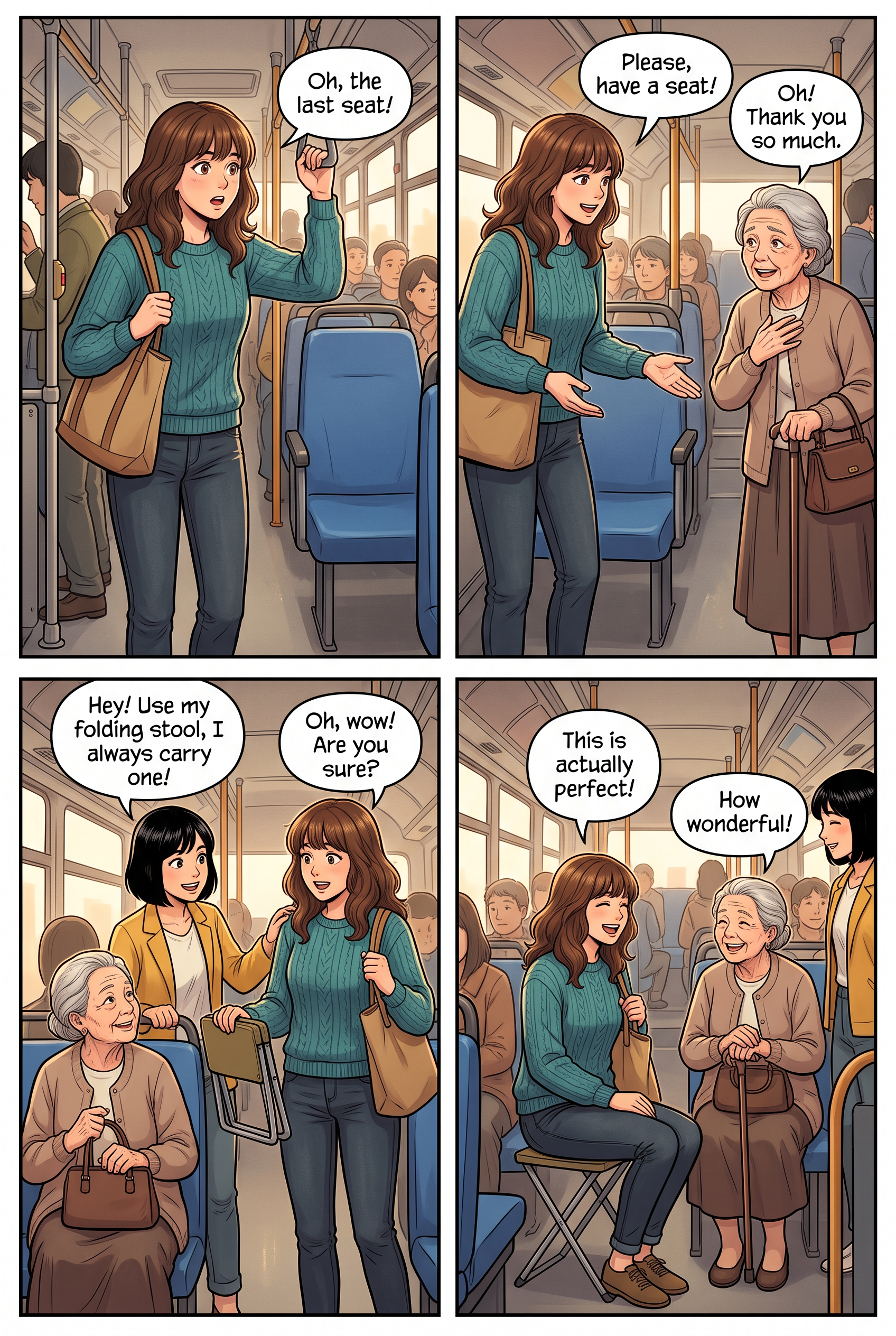
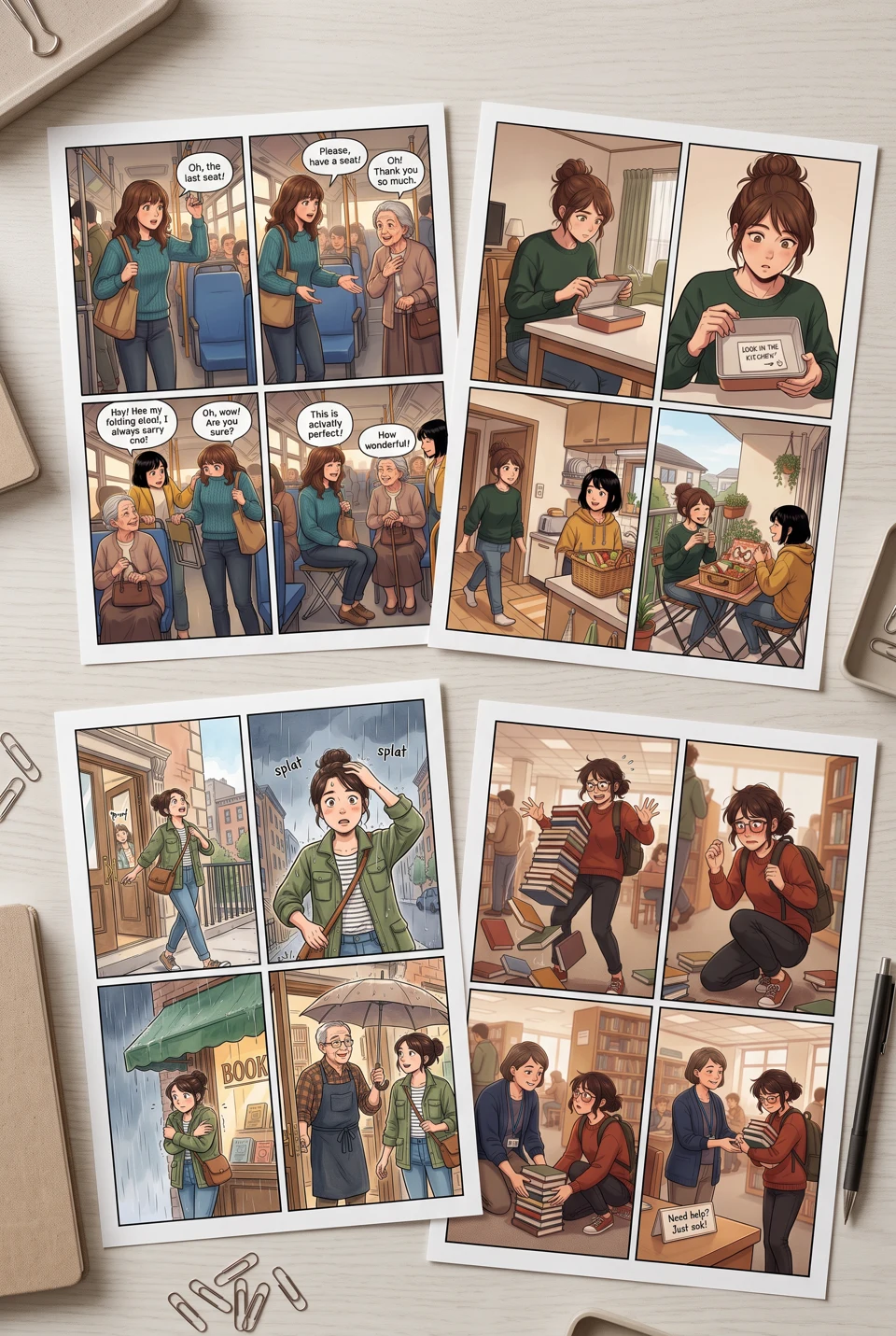
A commuter notices the last bus seat. She offers it to an older passenger. A friend offers her a folding stool. She laughs beside the seated passenger.
Create an ORIGINAL finished four-panel comic page in portrait 2:3, exactly two rows and two columns with four clear equal panels and white gutters. Warm professional color manga, adult female lead, fully clothed casual contemporary clothing. Maintain identical face, hair, clothing and props through the four panels. English story, mostly visual storytelling, no extra captions, no title printed on image, no watermark, no borrowed franchise characters. Clear left-to-right top-to-bottom sequence. Four beats: A commuter notices the last bus seat. She offers it to an older passenger. A friend offers her a folding stool. She laughs beside the seated passenger. Natural hands and readable staging. This is original editorial artwork, not a photograph or a customer testimonial.
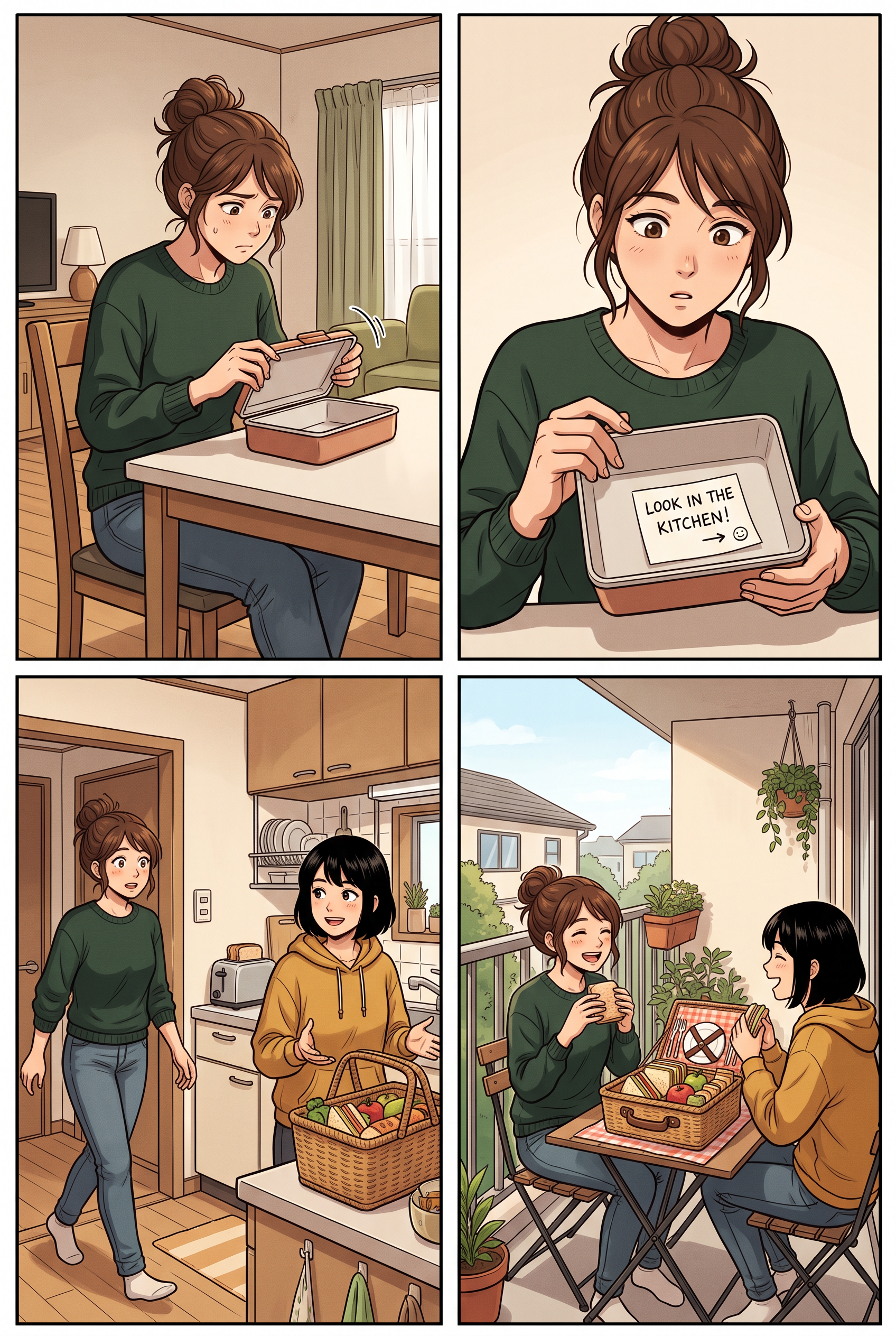
A woman opens an empty lunch box. She finds a note pointing to the kitchen. Her roommate reveals a picnic basket. They eat together on the balcony.
Create an ORIGINAL finished four-panel comic page in portrait 2:3, exactly two rows and two columns with four clear equal panels and white gutters. Warm professional color manga, adult female lead, fully clothed casual contemporary clothing. Maintain identical face, hair, clothing and props through the four panels. English story, mostly visual storytelling, no extra captions, no title printed on image, no watermark, no borrowed franchise characters. Clear left-to-right top-to-bottom sequence. Four beats: A woman opens an empty lunch box. She finds a note pointing to the kitchen. Her roommate reveals a picnic basket. They eat together on the balcony. Natural hands and readable staging. This is original editorial artwork, not a photograph or a customer testimonial.
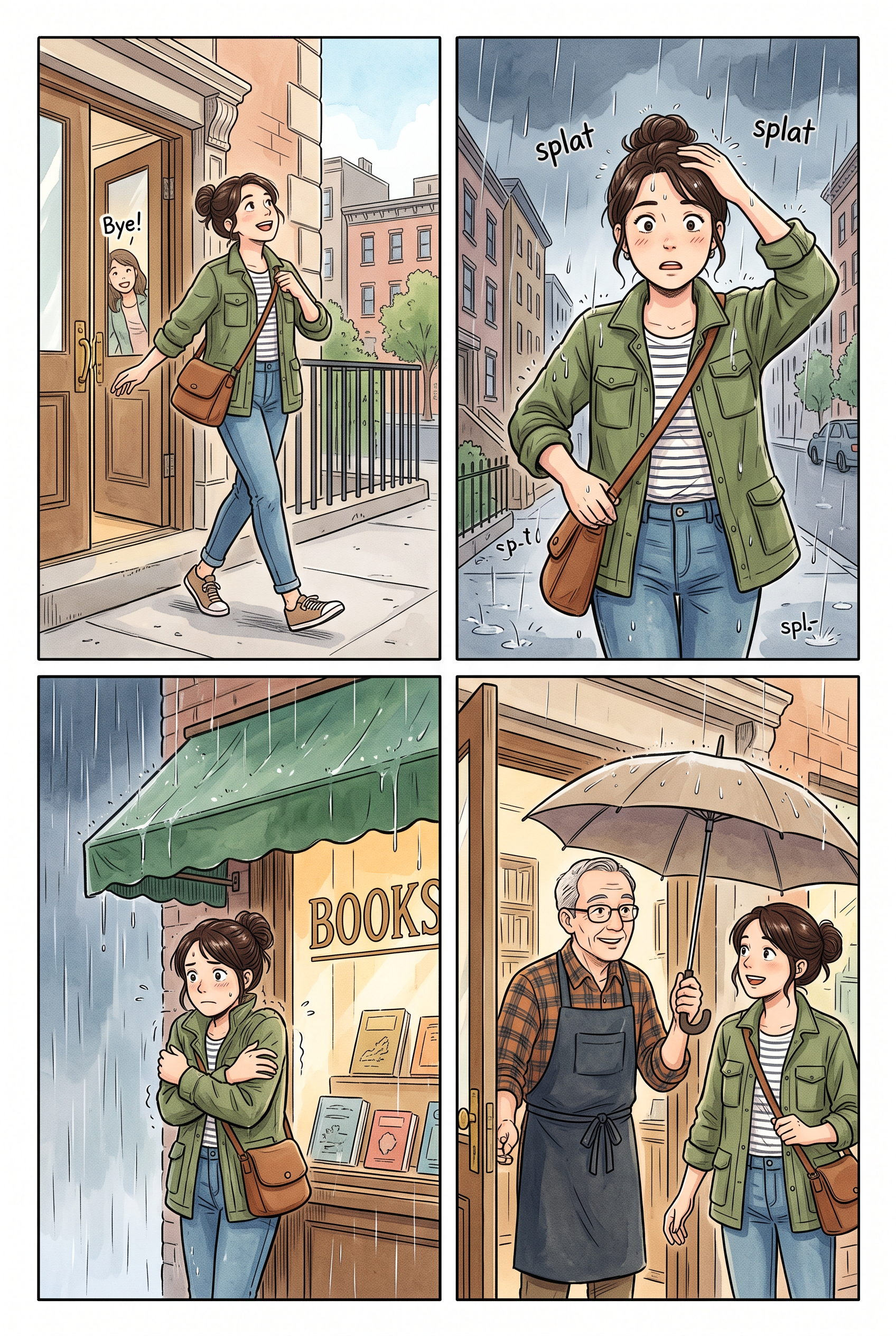
A woman leaves home without an umbrella. Rain begins. She shelters under a bookshop awning. The bookseller shares an umbrella and they smile.
Create an ORIGINAL finished four-panel comic page in portrait 2:3, exactly two rows and two columns with four clear equal panels and white gutters. Warm professional color manga, adult female lead, fully clothed casual contemporary clothing. Maintain identical face, hair, clothing and props through the four panels. English story, mostly visual storytelling, no extra captions, no title printed on image, no watermark, no borrowed franchise characters. Clear left-to-right top-to-bottom sequence. Four beats: A woman leaves home without an umbrella. Rain begins. She shelters under a bookshop awning. The bookseller shares an umbrella and they smile. Natural hands and readable staging. This is original editorial artwork, not a photograph or a customer testimonial.
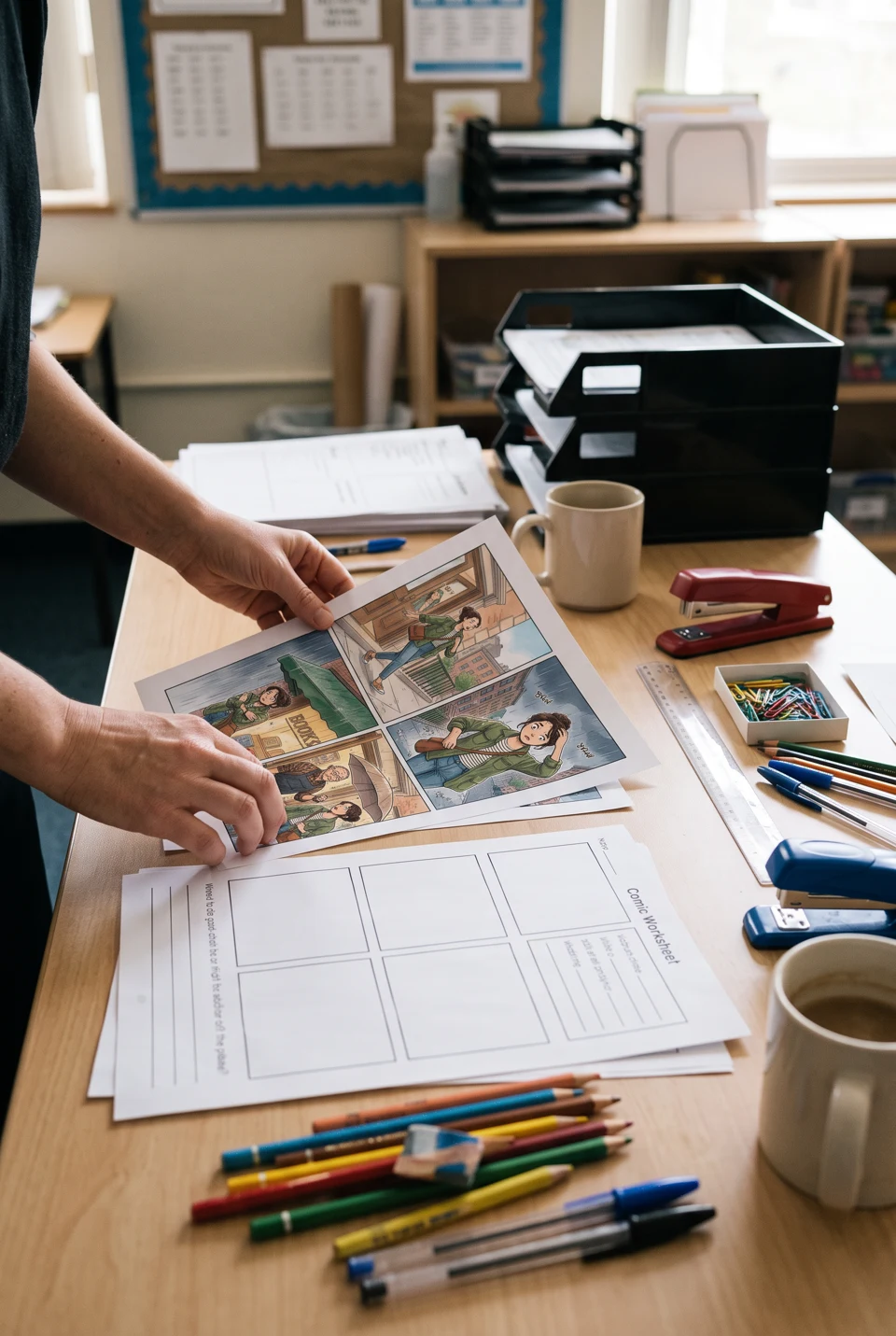
The sample images, blank templates and PDFs can be downloaded without an account. AI generation uses the existing sign-in, plan and credit rules. Check the displayed cost before submitting. A4 and Letter files fit the whole image inside a half-inch margin; physical printer output has not been tested.