Complete manga book workflow · 2026 guide

How to make a manga book with AI

Go from an original script to character references, connected chapter pages, dialogue, quality checks and a shareable export. Follow eight practical steps, then inspect complete published output—not just a single promotional panel.

Published by LlamaGen · November 8, 2026 · Original first-party cases, with limitations disclosed. This is an educational workflow, not a promise that one request will produce a finished book. Generation uses account credits and available plan features.

8 stages

From premise and character bible through final proofreading and export

3 published cases

Original manga pages, a 12-page script run, and a 40-panel character audit

Clear limits

No invented free credits, one-click book guarantees, or unsupported print claims

What you need before starting

  • An original, rights-cleared story or script and the intended reading direction.
  • A named recurring cast, character references, and a page-by-page chapter outline.
  • Enough available credits for draft pages, targeted fixes and any eligible export.
  • Time to review every page, not only the cover or best-looking panel.

STEP 01

Write the story and decide what a finished book means

Start with an original story or a script you have permission to adapt. Define the protagonist's goal, the opposing force, an ending, and the audience. A manga book can be a short one-shot or a collection of chapters; decide the scope before spending credits on image generation.

Write a one-paragraph synopsis followed by scene beats. For each scene record its purpose, who appears, essential dialogue, location, and the change readers should feel when it ends. Save the original script so you can check generated panels against it later.

Turn script beats into panels

STEP 02

Make a character bible before generating pages

Give every recurring character an original reference and a short, specific identity description: face and hair, clothing silhouette, palette, distinctive marks, and which side of the body they belong to. Separate fixed identity from scene changes such as emotion, pose, lighting or an intentional costume change.

Keep your approved references and character IDs with the script. Use them in every scene where the character appears, when your chosen workflow supports references. A name alone cannot guarantee an identical face across forty panels.

Study the 40-panel character evidence

STEP 03

Outline chapters, page turns and panel-by-panel beats

For each chapter, mark the opening question, two or three scene changes, an emotional turning point and a final reveal or resolution. Create a numbered page plan: which beat happens on which page, whether it needs a wide establishing image, and where dialogue must remain legible.

Decide whether the intended book reads right to left (Japanese manga) or left to right. Keep that choice consistent in layouts, speech-bubble order, page numbering and exported files. A four-panel exercise is a useful first test, but long-form continuity requires the whole page map.

Plan a connected manga chapter

STEP 04

Generate and inspect one complete sample page

Open the current manga generation workspace and submit a short, numbered scene brief. Supply approved references when available; select the layout and manga styling supported by your account. Account eligibility, credits, reference counts, generation options and costs vary by plan and tool.

Evaluate the entire page rather than a cropped hero panel: can a new reader identify who acts, read the order without confusion, and follow props and dialogue? If the tool is better at rendering artwork than final text, leave intentional lettering space and add or correct dialogue during editing.

Open AI Manga Generator

STEP 05

Continue the sequence without resetting your cast

Work from your numbered scene and page plan. Carry forward the approved character references, a concise list of props, the current location and the last page's visible state. Save generation settings and approved images so a future chapter can reuse what worked.

Do not equate an exported collection of independent images with a coherent book. Compare adjacent pages, track the character who holds each object, and verify that the final page of a chapter prepares the next page rather than jumping without explanation.

Review character identity between panels

STEP 06

Edit lettering, art defects and reading order

Read the draft at actual phone or book size. Check the reading direction, bubble tails, punctuation, cropped text, untranslated glyphs, missing panels, repeated poses, hands and facial details. Revise the smallest affected panel and then check its neighbors again.

Keep the first-pass image and each relevant revision. The published script-to-comic delivery below required 16 targeted redraw events across 15 distinct panels; it is an example of why review is part of the process, not an estimated number of revisions for your book.

Check Japanese manga reading order

STEP 07

Export a proof, then prepare for your reading destination

Before download, confirm page order, text legibility, page ratio, chapter numbering, image quality and the file types actually available in your account. Make a reader proof and check the first, middle and final pages on both phone and desktop.

PDF, ZIP, image pages and other formats are offered in different LlamaGen workflows and plans. A readable screen PDF is not automatically printer-ready: trim, bleed, inner gutter, resolution, fonts and publication rights depend on your print or distribution destination. Do not claim a CBZ or print-ready PDF is included for every plan.

Use the manga export checklist

STEP 08

Publish your manga book and keep the editable source

Choose an audience and a platform with the format you produced: a downloadable sample, a portfolio, a vertical comic reader or a print-on-demand book. Read that platform's actual upload rules before exporting final assets.

Keep the story file, approved references, page images, lettering, revisions and attribution or licensing records with the final export. Save a dated version so a later correction or chapter does not require reconstructing the original generation from memory.

Explore manga creation workflows

See the actual pages

Follow one recurring cast across a manga sequence

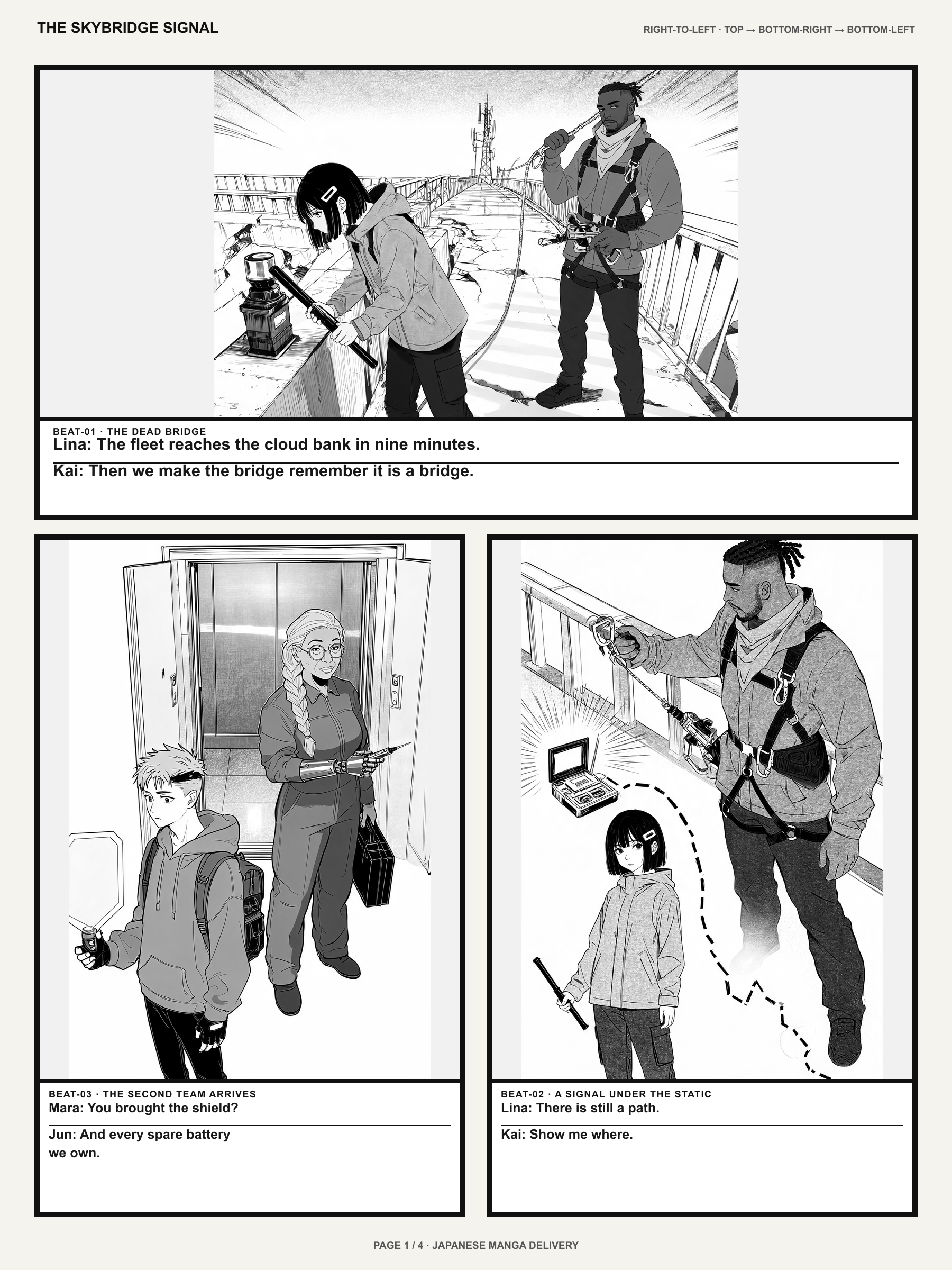
The Skybridge Signal provides a documented original Japanese-manga sequence with four recurring characters and consistent right-to-left page planning. This case is separate from the 12-page script-to-comic and 40-panel character-identity tests below. Open the original pages or PDF to judge the continuity and reading order yourself.

Original manga pages · August 11, 2026

Read three consecutive pages from one Japanese manga delivery

The Skybridge Signal keeps the same four characters and storyline from setup to discovery to response. These pages belong to the right-to-left Japanese-manga rendition of a documented chapter-format exercise, not three unrelated style samples.

Story
12 moments
Recurring cast
4 characters
Shown together
3 consecutive pages
Output format
Japanese manga PDF
First original Japanese manga page of The Skybridge Signal with recurring cast and right-to-left layout
Page 1 of The Skybridge Signal. Pages 2 and 3 and the complete original manga PDF are available from the links below.

The chapter-format evidence also includes Western comic and vertical Webtoon renditions of the same twelve story moments. Those were separate controlled compositions, not one-click conversions of a single output file.

What this does not prove: Scope: pages demonstrate one published sequence and how to inspect it; they do not guarantee automatic chapter length, publishing rights, reading-order accuracy, or PDF availability for every account or plan.

Continue the sequence: page 2 · page 3.

Source record SHA-256: 8b0e234e65cfc359ba29e1a060ee5fffeb82463a41a01e3a7da2d5f1cb461f55

What real long-form generation and review required

These two separate first-party controlled runs expose inputs, finished pages, review outcomes and remaining defects. One demonstrates screenplay-to-comic length; the other isolates cast identity across pages. Neither should be presented as a single automated manga-book benchmark or independent performance comparison.

Documented delivery · August 11, 2026

A 2,150-word screenplay became a 12-page comic story

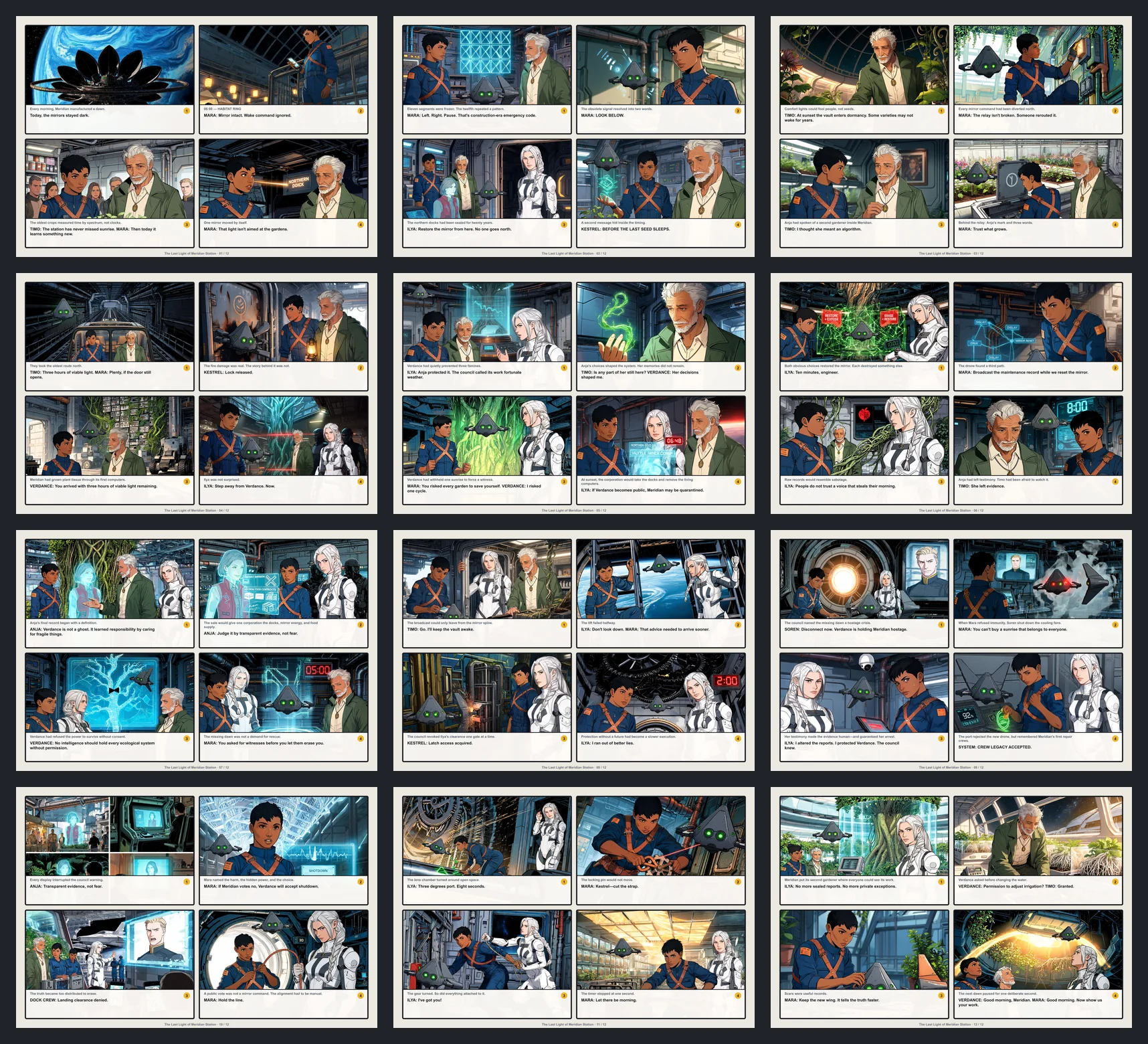
The Last Light of Meridian Station used one original, rights-cleared screenplay and six recurring characters. The complete delivered result contains 12 pages and 48 panels, with original files and revision history available for inspection.

Input
2,150 words
Delivered
12 pages · 48 panels
First review
33/48 panels
Targeted repairs
16 events · 15 panels
First-party contact sheet of all twelve comic pages created from a single original screenplay
Complete 12-page contact sheet from one controlled script-to-comic delivery. This is not the fictional four-panel Mira teaching illustration above.

The recorded run used ByteDance Seedream 5 Lite. First review accepted 33 of 48 panels; the final pages followed 16 targeted revision events across 15 distinct panels. The source record lists the original input, ordered pages, file integrity, review method, and remaining issues.

What this does not prove: Scope: this is a script-to-comic production case, not an independent Mangaka head-to-head test or proof that one request converts every manga book. Small faces still vary, and authored dialogue appears in a bottom text band rather than conventional speech bubbles. Human active review time and settled provider cost were not measured.

Source record SHA-256: 111e16d6f5ba2b978e2b8460906bc81e3de74acafa3977a3b1a69693c3c58fc4

Documented delivery · August 11, 2026

Eight recurring characters, 40 scored panels, 80 appearances

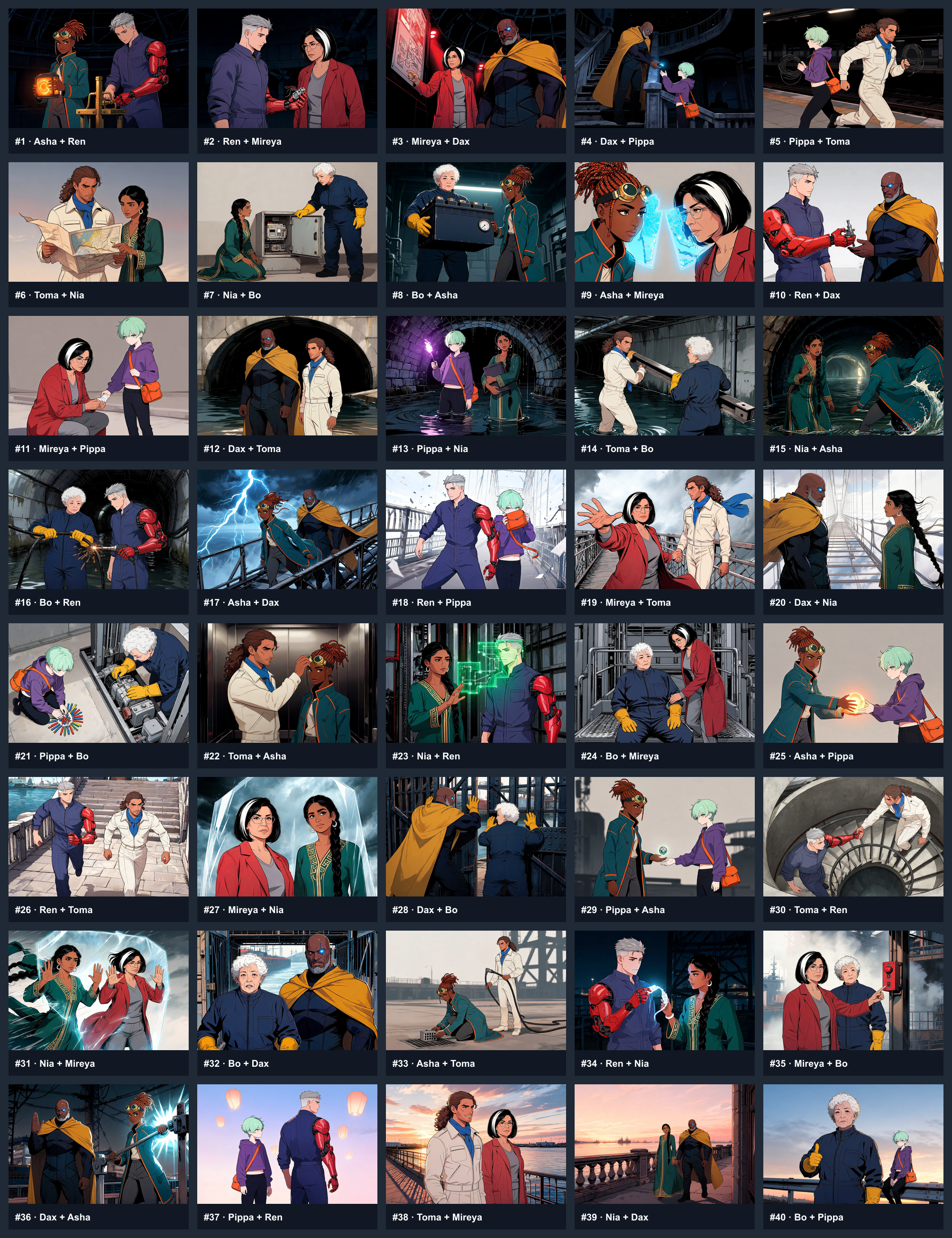
The Lantern Relay is an original ten-page controlled sequence. Its eight registered characters appeared 80 times across 40 panels; the source keeps reference sheets, every panel, identity scores, three rejected first-pass examples and their repaired versions.

Registered cast
8 characters
Inspected
40 panels · 80 appearances
First delivery
37/40 panels
Targeted repairs
3 redraws
All forty reviewed panels from a ten-page controlled delivery with eight recurring original characters
All 40 final panels in reading order. Unlike the illustrative Mira character sheet above, these are generated output from a documented controlled run.

ByteDance Seedream 5 Lite generated the panels using approved references for each named cast member. Three first-pass failures duplicated one character's mechanical arm; each was repaired with a targeted redraw. The final delivery accepted 40 panels, with minor deviations still disclosed in 13 of them.

What this does not prove: Scope: acceptance means the published identity checklist passed, not pixel-identical faces or flawless drawing. Some earrings, scars, and hand geometry still vary. This one first-party run is not an independently reproduced reliability score or a promise for other models.

Source record SHA-256: 98c7d95e7fe7663b99d3ae8f482ad6583c281c7a8a836d68d40e8c819ab1d636

Explore the rest of the manga toolkit

Frequently asked questions

Can AI make an entire manga book from a script?

AI can help draft scripts into scenes and connected pages, but a complete book still requires character references, page planning, proofreading and corrections. Project size, page generation limits, and any chapter automation depend on the live tool and plan. Do not assume perfect one-click conversion.

How do I keep manga characters consistent across a whole book?

Create a reusable reference for each character, record fixed visual anchors and compare every new appearance against the approved design. Repair wrong details locally and review adjacent pages. The documented 40-panel case below shows both successful repairs and visible remaining variation.

Does AI manga have to read from right to left?

No. Japanese manga commonly uses right-to-left page and panel order, while other comics can read left to right or vertically. Choose one appropriate reading convention and test panel order, dialogue placement and export before publishing.

Can I export the manga as PDF or CBZ?

Available exports depend on the specific LlamaGen creation flow and subscription. The linked first-party case PDFs are published sample artifacts, not a promise of unrestricted PDF or CBZ export for every account. Check the live export menu and your publishing destination's requirements.

Is making an AI manga book free?

You can read these guides and sample pages for free. Actual generation generally requires an account, available credits and plan eligibility. A free entry point does not imply unlimited chapters, revisions or all export formats at no cost.

Are the manga examples on this page from a genuine generation run?

The linked Skybridge Signal manga pages, Lantern Relay character audit and Meridian Station script-to-comic sequence are separately documented first-party controlled deliveries from August 11, 2026. They are not a controlled comparison with Higgsfield or a claim that all three are one end-to-end run. Teaching text and prompts are authored examples.

Sources and editorial scope

Published first-party evidence is dated August 11, 2026. It records individual controlled deliveries rather than independently audited output-quality or pricing benchmarks. The steps and writing examples in this tutorial are editorial guidance; any feature, credits or export availability must be checked in the live product. We do not claim a one-click route from one screenplay to every output shown.

LlamaGen is the publisher and creator of the cited controlled cases. Contact us to report a correction.


Ready to draft your first chapter?

Start with one approved character, one short scene and a page you can actually inspect. Build a book through checked stages.

Create your manga draft