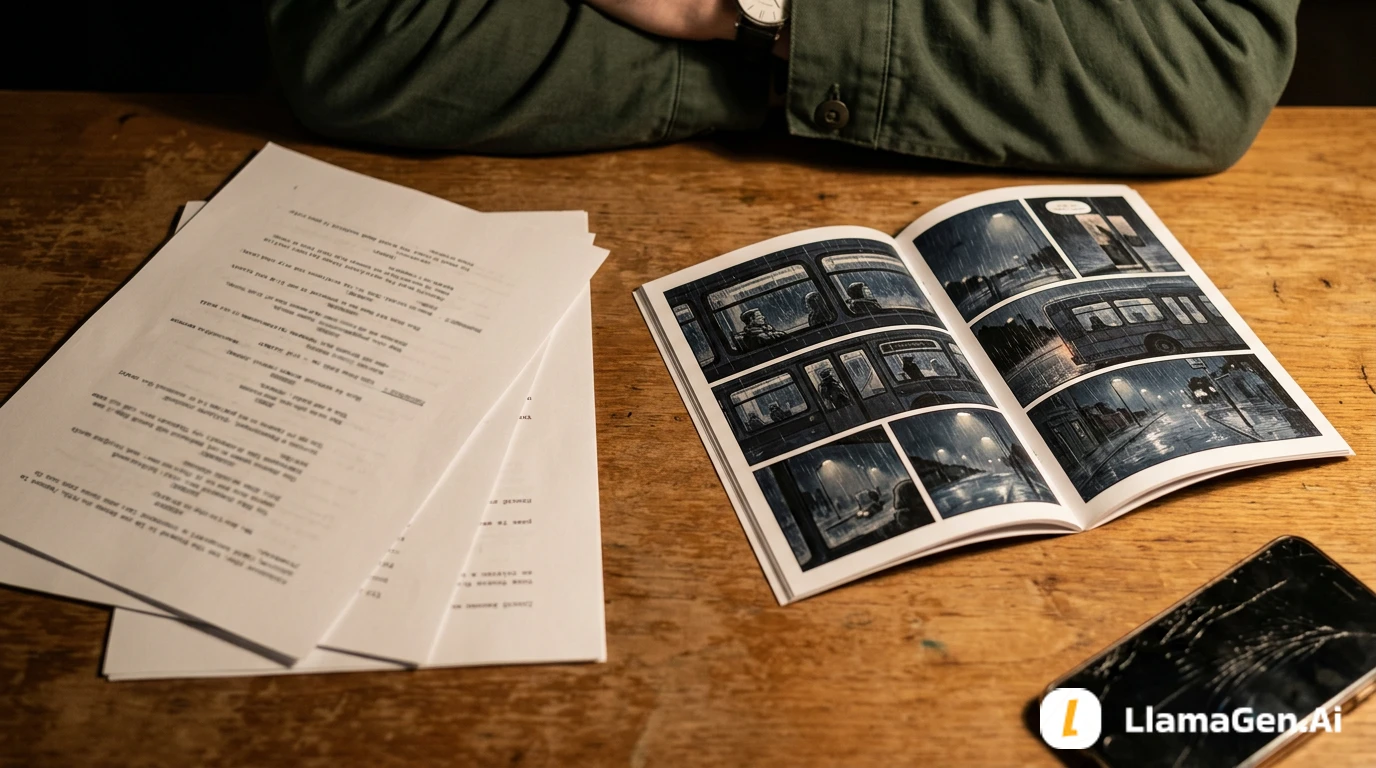

Storyboard first when the scene's pacing, shot order, dialogue density, or reveal size is still uncertain. Generate finished panels first only when those decisions are already locked.
In our controlled eight-beat test, the direct-to-panel workflow needed 13 finished-panel generations to reach the approved sequence. The storyboard-first workflow needed 9. That is a 31% reduction in finished-panel generation work for this specific scenario, not a universal platform benchmark.
You can run the same test with your own scene in the LlamaGen.AI Storyboard Generator before committing to polished comic art.

AI makes a finished-looking panel fast. That speed can hide a planning problem.
If beat three should come before beat two, the reveal needs twice as much space, or a speech balloon covers the only readable action, the panel is not merely an image problem. It is a sequence problem. Regenerating prettier versions of the same weak sequence does not solve it.
Comic creators describe thumbnailing as the stage where pacing, page layout, and dialogue become visible. In a ComicBookCollabs workflow discussion, one creator specifically noted that thumbnails save the cost of redrawing full panels when visual storytelling changes. Another discussion about difficult production stages focused on how panel size, dialogue, page turns, and time all affect pacing.
Those are exactly the decisions a storyboard should expose.
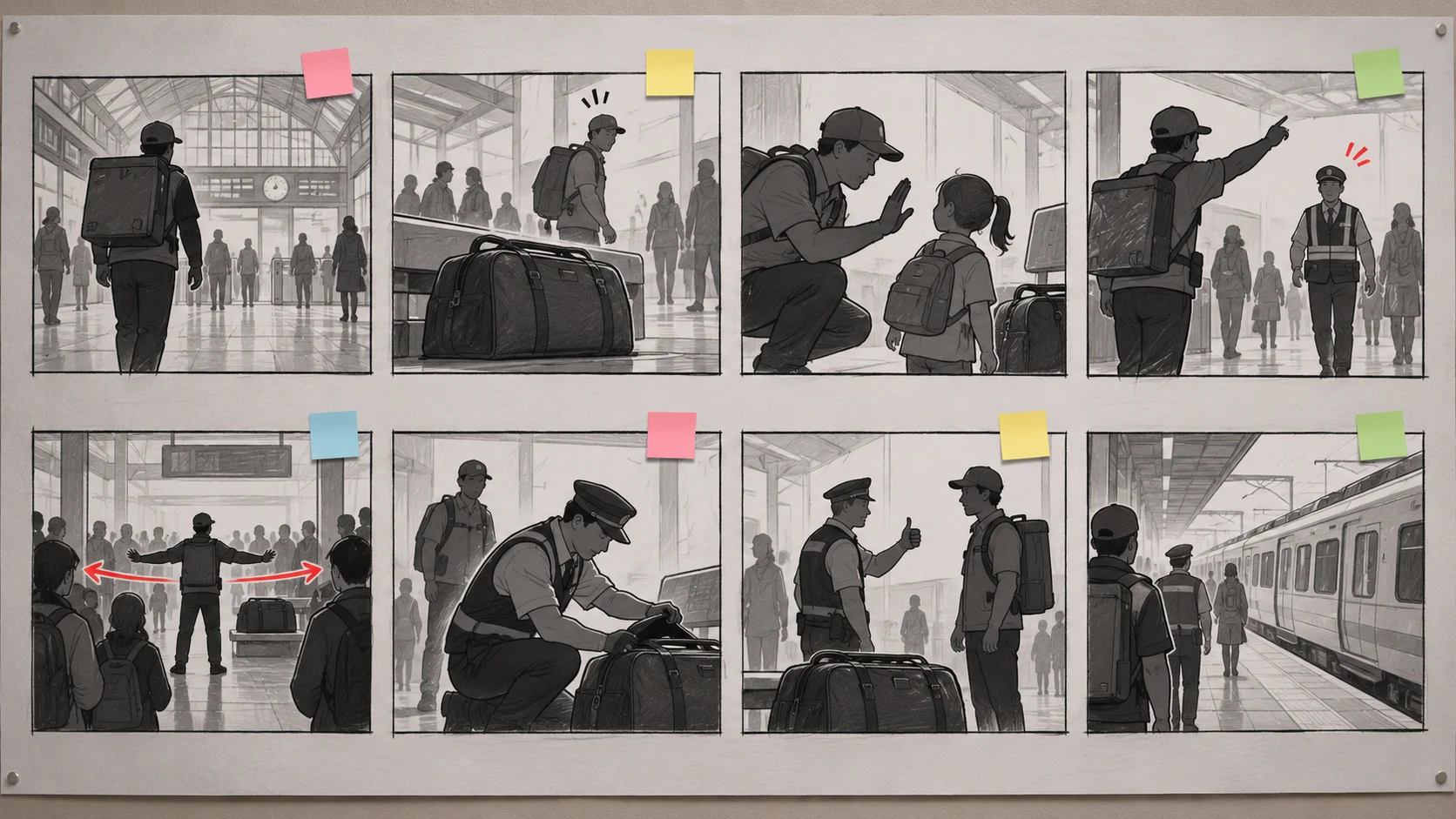
We used one original eight-beat station scene and took it through two workflows.
1. A courier enters a crowded station.
2. He notices an unattended bag.
3. A child reaches toward it.
4. The courier stops the child.
5. He signals station staff.
6. The crowd moves back.
7. Staff checks the bag and finds a harmless costume prop.
8. The train leaves as the child waves goodbye.
The narrative goal was simple: build tension, keep the action readable, and release the tension without making the courier look reckless.
We counted production decisions instead of inventing dollars, model latency, or account-specific credits.
| Metric | Definition |
|---|---|
| Finished-panel generations | New polished panel outputs created |
| Thumbnail revisions | Rough frames moved, redrawn, merged, or resized |
| Layout passes | Full-page or sequence arrangements rebuilt |
| Dialogue cuts | Lines shortened after testing available space |
| Late repairs | Changes made after polished panels existed |
This was an editorial workflow test conducted on October 10, 2026. The illustrated frames document the scenario and revision logic. It is not a claim about guaranteed savings for every comic, model, or subscription.
The first workflow converted all eight beats directly into polished panels.
The initial page looked complete, but review exposed three structural problems:
Fixing those problems touched five finished panels. The page also needed a second layout pass and three dialogue cuts because the first balloons competed with faces and hand actions.
A rundown of the latest LlamaGen feature releases, product enhancements, design updates, and important bug fixes.
| Direct-to-panel result | Count |
|---|---|
| Initial finished panels | 8 |
| Finished panels regenerated after sequence review | 5 |
| Total finished-panel generations | 13 |
| Full layout passes | 2 |
| Dialogue cuts after art existed | 3 |
| Thumbnail revisions | 0 |
The problem was not that the first images were unattractive. They had been polished before the sequence earned that polish.
The second workflow began with eight low-detail frames in the AI Storyboard Generator.
Before generating finished art, we made five cheap changes:
Then we generated the eight approved panels. One final panel still needed a targeted repair because the courier's bag disappeared.
| Storyboard-first result | Count |
|---|---|
| Initial rough thumbnails | 8 |
| Thumbnail revisions | 5 |
| Approved finished panels generated | 8 |
| Late finished-panel repairs | 1 |
| Total finished-panel generations | 9 |
| Full layout passes after final art | 0 |
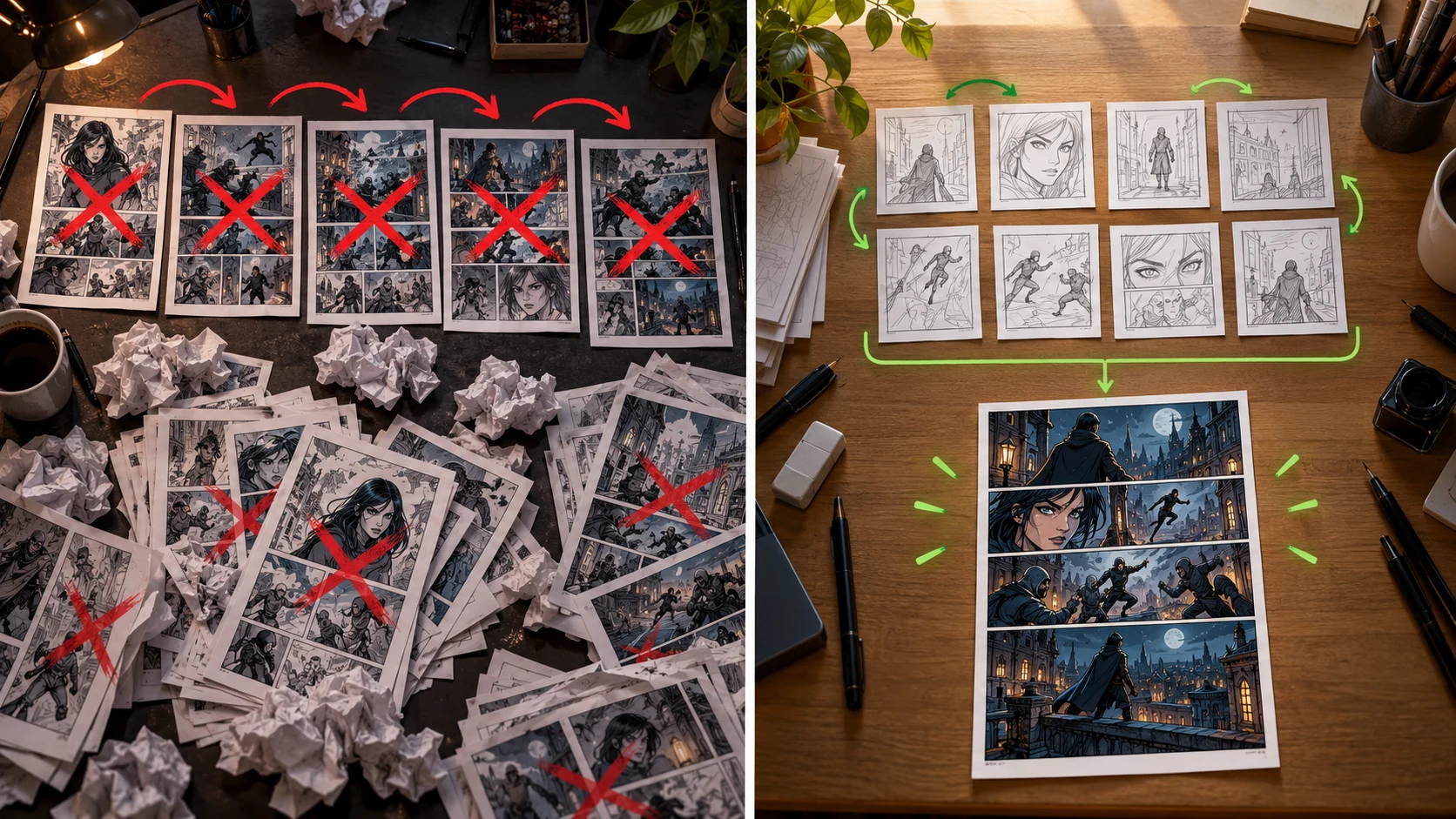
The test did not eliminate revision. It moved revision earlier, when each change affected a rough frame instead of polished art.
For this eight-beat scene:
direct-to-panel: 13 finished-panel generations
storyboard-first: 9 finished-panel generations
reduction: (13 - 9) / 13 = 30.8%
The important result is not the exact percentage. It is the source of the savings.
| Change type | Cheapest stage |
|---|---|
| Reorder story beats | Beat list or storyboard |
| Change shot size | Storyboard |
| Merge two actions | Storyboard |
| Reserve room for dialogue | Storyboard |
| Correct a face or costume detail | Targeted panel repair |
| Improve final lighting or texture | Final panel stage |
Storyboarding is valuable when the expected cost of a late structural change is higher than the cost of making rough frames.
Use this worksheet before deciding whether to storyboard:
expected late rework
= uncertain beats
* affected panels per beat
* cost per finished-panel attempt
Now compare it with:
storyboard cost
= number of rough frames
+ expected thumbnail revisions
You do not need perfect estimates. If the scene has a reveal, multiple characters, crowded dialogue, action geography, or a page-turn surprise, the uncertainty is usually high enough to justify rough planning.
Keep each beat focused on a state change:
weak: The station is busy and the courier is walking and thinking.
strong: The courier spots an unattended bag beside a child.
The strong version tells you why the frame exists.
For each frame, write down:
Zoom out until details disappear. The sequence should still communicate:
If every frame is a close-up, the reader loses location and action geography. If every frame is wide, emotion disappears.
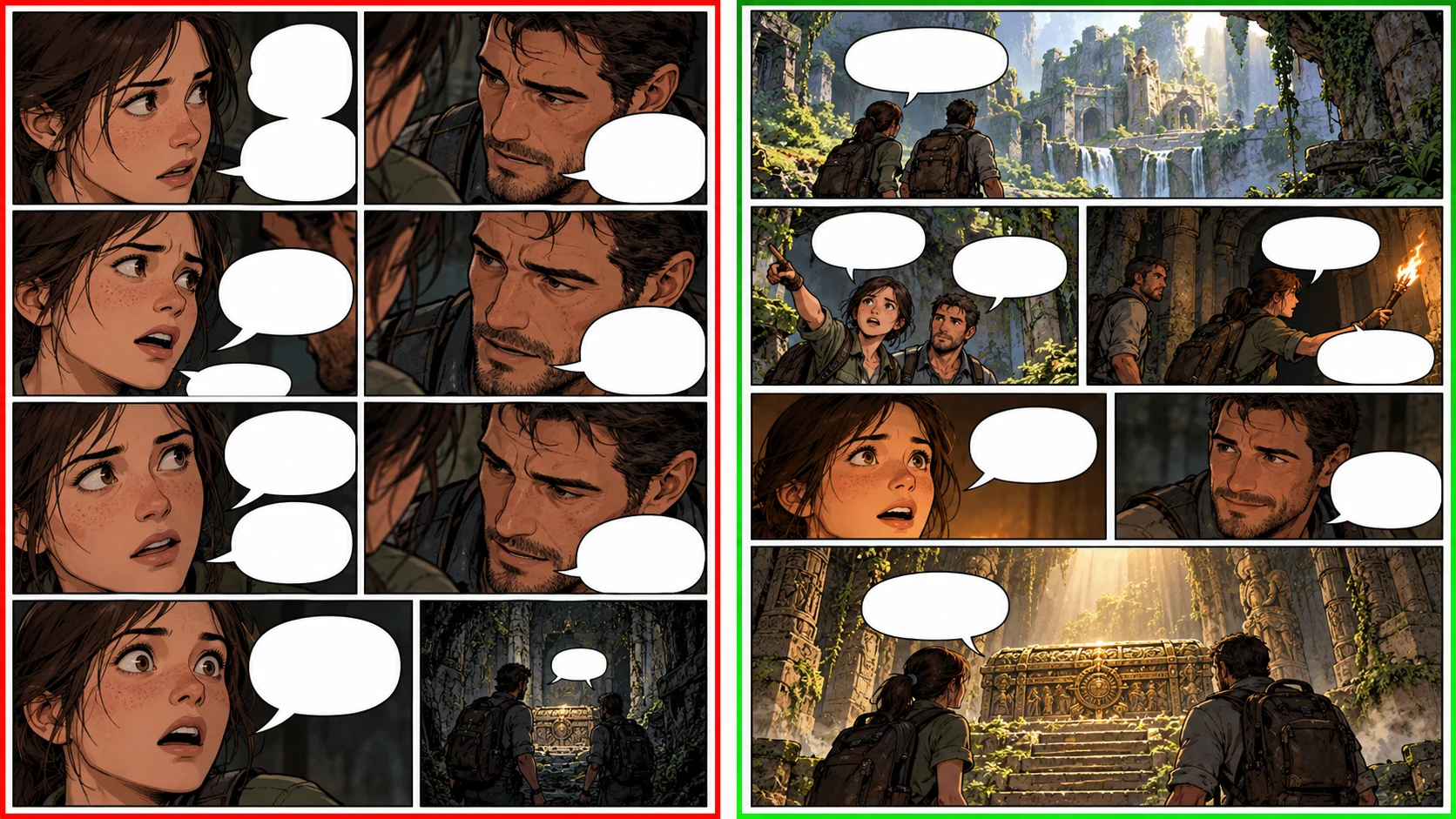
The failed layout below repeats faces, crowds the balloons, and squeezes the reveal. The repaired layout uses an establishing shot, varied framing, clean balloon space, and a larger resolution beat.
Mark a storyboard as approved only when these are stable:
Then move into finished AI comic panels.
Storyboarding is not mandatory for every job.
Generate finished panels first when:
For a one-off social post, rough planning can become overhead. For an eight-page scene with dialogue and a reveal, skipping it usually moves the same decisions into a more expensive stage.
Record your model, date, settings, and account usage if you publish the result. A credible case study explains its conditions.
No. It needs to make sequence, framing, character placement, and dialogue space understandable. A beautiful storyboard that hides a pacing problem is less useful than an ugly one that exposes it.
They overlap, but a comic must also solve page or scroll rhythm, panel size, reading order, and static dialogue placement. A film storyboard primarily anticipates time-based shots and edits.
Start with one frame per story beat. Split a beat only when the reader must see two distinct changes. Merge frames that repeat the same information.
Add provisional dialogue during storyboard review. You need its approximate volume to reserve space, but polish the exact wording after the visual sequence works.
No. Savings depend on how uncertain the scene is and how your tools charge. This test reduced finished-panel attempts for one eight-beat scenario. Run the same count with your own workflow.
Written by Jay and reviewed by the LlamaGen.AI content team. The result is a disclosed editorial workflow test, not a claim of guaranteed credit, time, or cost savings.
Ready to test your own scene? Open the LlamaGen.AI Storyboard Generator, keep the input fixed, and count how many expensive decisions move into the rough stage.
Popular creator tools
Go from comics and storyboards to stylized photos with LlamaGen.
© 2026 LlamaGen.Ai All rights reserved
Leading the Future of AI Comic Generation