An umbrella, a puzzled reader, and a phrase that does not mean what it says.
Help readers infer figurative meaning from context, then explain why an idiom should not always be read literally.
An original teaching example. Read the complete panel script, checks and references below the book.
03
Language arts · LlamaGen
01 · Source materials
One phrase. Two readings.
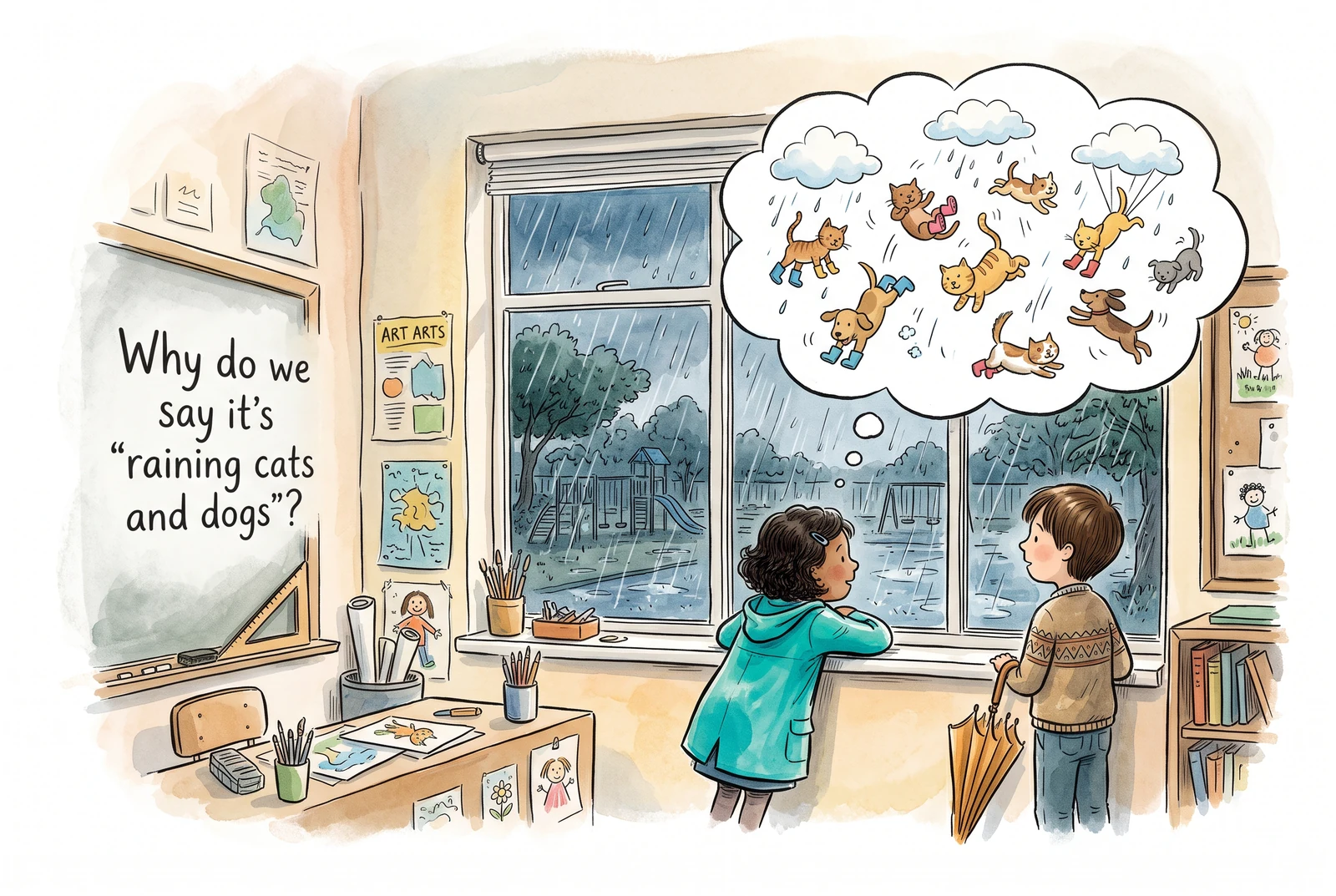
Our original classroom example uses “raining cats and dogs,” meaning that rain is very heavy. The literal picture is deliberately impossible. Before drawing, write the intended meaning and a sentence in which a speaker would naturally use the phrase. Idioms depend on language and culture; a word-for-word translation may not carry the same meaning.
04
Language arts · LlamaGen
02 · The challenge
Can a reader tell the imagined picture from the actual event?
Context
Does the dialogue show heavy rain before anyone explains the idiom?
Contrast
Is the impossible literal scene clearly marked as a thought?
Meaning
Can a learner explain the phrase without repeating its words?
Language
Would the expression be understood by this intended audience?
05
Language arts · LlamaGen
03 · Planning the page
A story takes shape.
Plan six panels for this task: Help readers infer figurative meaning from context, then explain why an idiom should not always be read literally. Keep visual symbols consistent, leave caption space, and use the complete reviewed script below.
Illustrated planning concept, not an editor screenshot or recorded session.
06
Language arts · LlamaGen
04 · The creative process
Make a draft. Make it yours.
Choose
Write one idiom, its figurative meaning and a realistic situation.
Contrast
Sketch a thought bubble containing the literal interpretation.
Resolve
Return to the real scene and explain the intended meaning in dialogue.
Transfer
Ask students to write a fresh situation using the same idiom.
07
Language arts · LlamaGen
05 · Comic concept
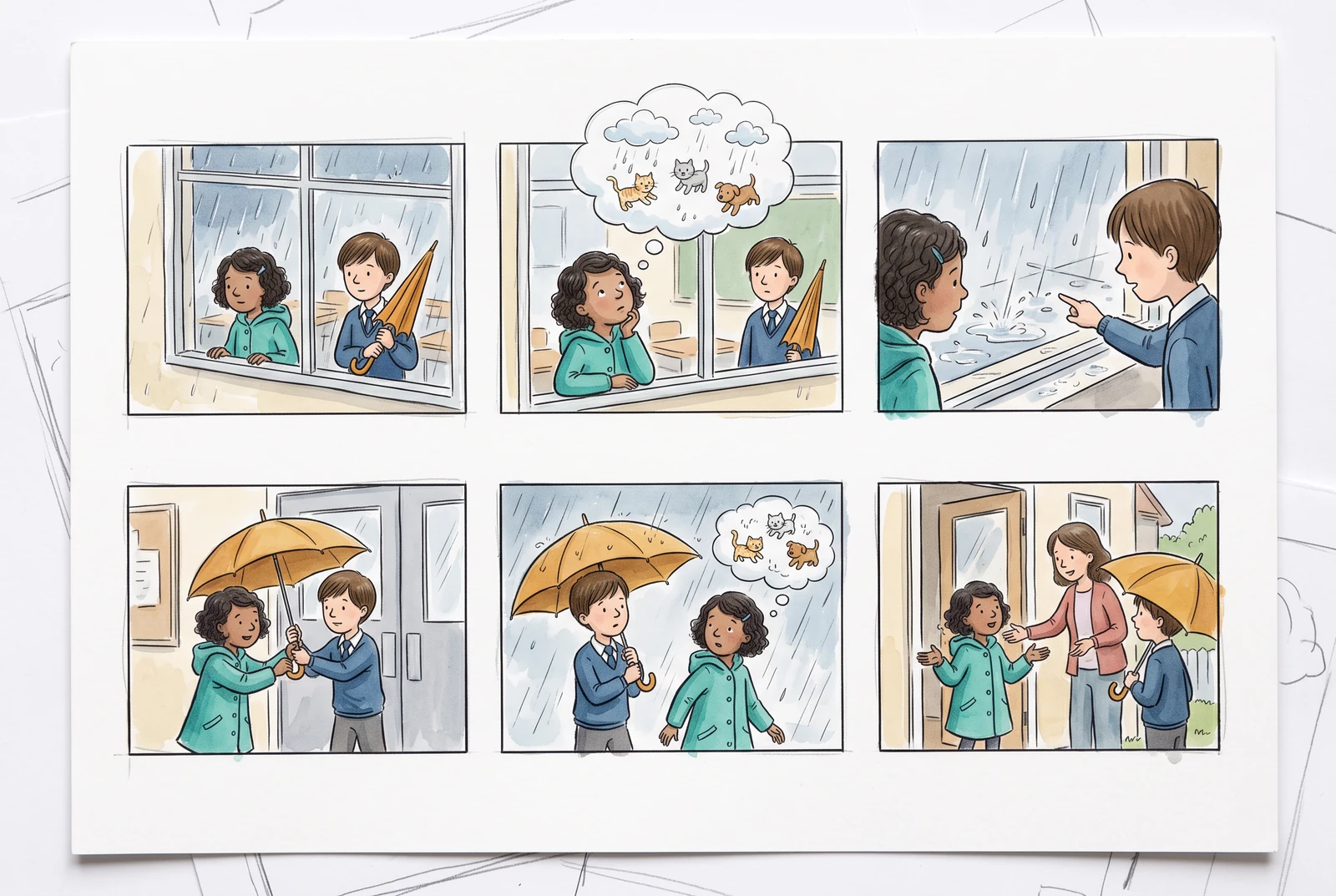
Six panels, ready to read and question.
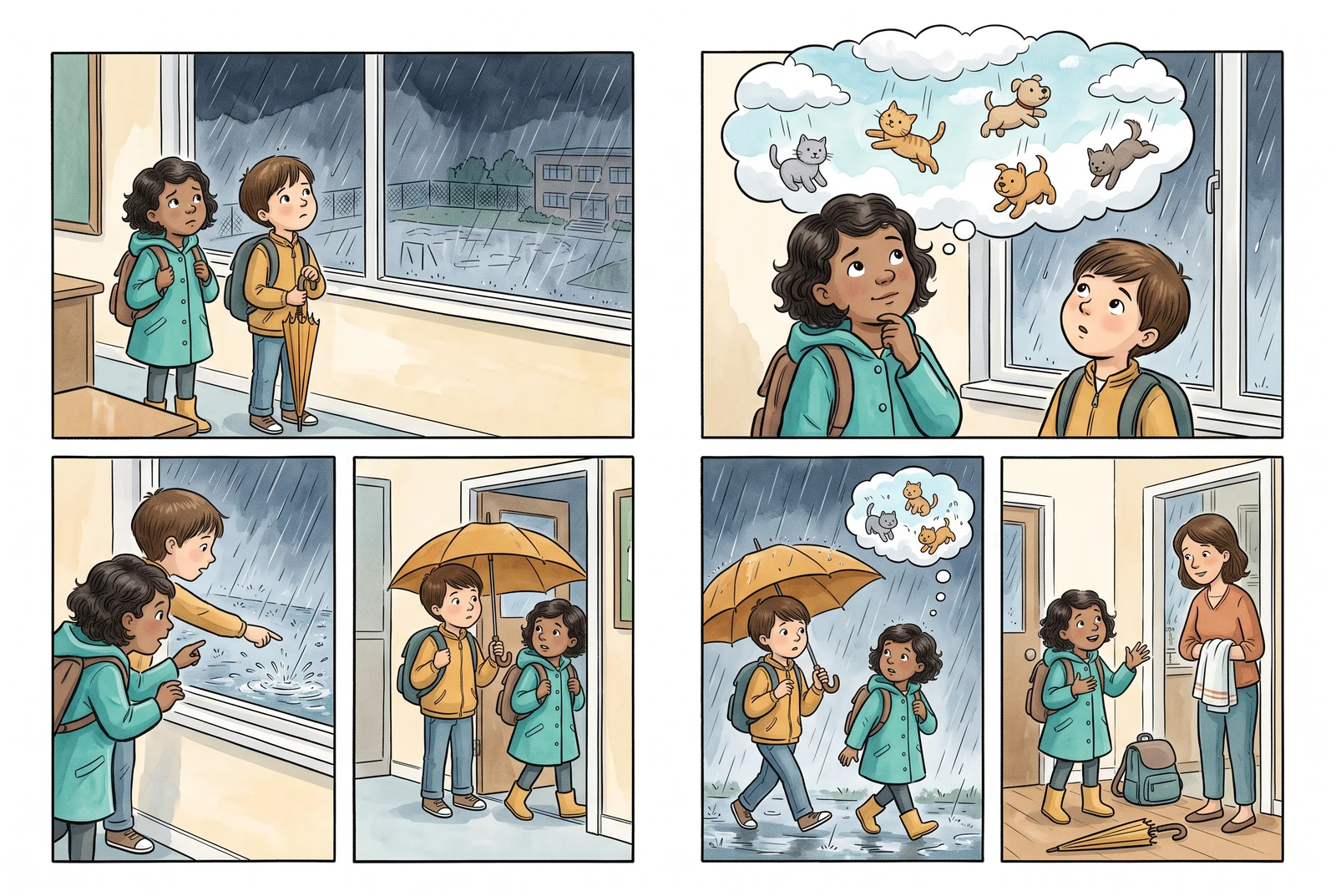
AI-generated editorial artwork accompanies an original lesson script. Read the captions and subject checks below; the illustration is not a scientific record, a classroom outcome or a product screenshot.
08
Language arts · LlamaGen
The next page is yours
Make your own version. Check every caption.
Start with one short scene. Review the words, the characters and the details before making the next page.
Sign-in and generation credits may apply. Features and export options depend on your workspace and plan.
09
By LlamaGen · Original classroom example · Edition
The complete classroom example
Help readers infer figurative meaning from context, then explain why an idiom should not always be read literally.
Suggested audience: Language learners and upper-elementary writers; adjust the vocabulary to your class.
AI-generated comic concept. Open the full-size image; use the numbered script below for the explanation and captions.
Read the six-panel script
The illustrations are concepts. These editable captions carry the explanation; read and check them even when images or animation are unavailable.
1. The situation
Two classmates watch heavy rain through a school window.
“It is raining cats and dogs!”
2. The literal thought
One classmate imagines toy-like cats and dogs falling from clouds inside a thought bubble.
“Animals? Really?”
3. The reality
The other classmate points to raindrops splashing on the pavement.
“No animals. I mean the rain is very heavy.”
4. The decision
Both classmates open an umbrella by the door.
“Then let us wait under cover.”
5. The explanation
The puzzled classmate looks back at the imagined thought bubble.
“The words made one picture. The situation gave me the meaning.”
6. A new context
Later, a classmate tells a parent why the walk home was delayed.
“We waited because it was raining cats and dogs.”
Use the script in your own comic
Copy the prompt and panel script below into the comic workspace. Prepare the images first, add captions using supported editing controls, then check the draft. This page does not promise automatic factual accuracy or a one-click finished worksheet.
Sign-in and generation credits may apply. Do not upload student names or photographs without the appropriate permission. Printing and shipping are not included.
Check the subject before sharing
The literal scene is a visual joke, not a report of an event. Avoid teaching that every unusual phrase is an idiom; have learners use surrounding words and a suitable dictionary to justify their reading.
Try a different version
Replace the rainy-day setting with an original context for “break the ice.” Show a social introduction, a clearly imaginary literal thought, and an explanation. Ask a partner to identify which panel supplies the strongest context clue.
Questions about this example
How many idioms should one comic include?
Start with one idiom and one meaning. After readers can explain the contrast, try a second expression in a separate short sequence. Adding several unrelated idioms can make the story difficult to follow.
Can I use this for language learning?
Yes, as an adaptable writing activity. Check that the expression is appropriate for the learner’s language variety, age and experience. Discuss the meaning before asking learners to use it independently.
Sources and how this page was made
LlamaGen authored this teaching example using the references below. The script and activity are original; the source scene, storyboard sheet and wordless comic were generated separately with Google Vertex AI. They do not demonstrate automatic source-to-comic conversion. No teacher endorsement, measured learning benefit or independent expert review is claimed.
Reviewed against these linked sources for this edition on November 13, 2026. Teachers should adapt vocabulary and verify the final draft against their curriculum.
Your story, one scene at a time
Make your own version. Check every caption.
Make an idiom comic strip with a literal-versus-figurative example, a six-panel script, a student activity and an editable creation prompt.
Start with one idiom and one meaning. After readers can explain the contrast, try a second expression in a separate short sequence. Adding several unrelated idioms can make the story difficult to follow.
How was this classroom example made?+
An original LlamaGen classroom example with AI-generated editorial illustrations. Not a customer project, scientific observation or verified product output. Check the supplied captions and sources before classroom use. No customer quotation, endorsement or measured outcome is claimed.
More ways to tell a story
Another page. Another possibility.
An original LlamaGen classroom example with AI-generated editorial illustrations. Not a customer project, scientific observation or verified product output. Check the supplied captions and sources before classroom use. Images were created with Google Vertex AI. The illustrated planning and comic stages do not demonstrate an automatic transformation of the source illustration.
Idiom Comic Strip: The Meaning Between the Panels | LlamaGen