Three Branches of Government Comic: A Law Meets a Question
One fictional federal law. Three different kinds of responsibility.
Distinguish the U.S. federal legislative, executive and judicial branches using a carefully limited fictional scenario.
An original teaching example. Read the complete panel script, checks and references below the book.
03
U.S. civics · LlamaGen
01 · Source materials
Name the level of government first.
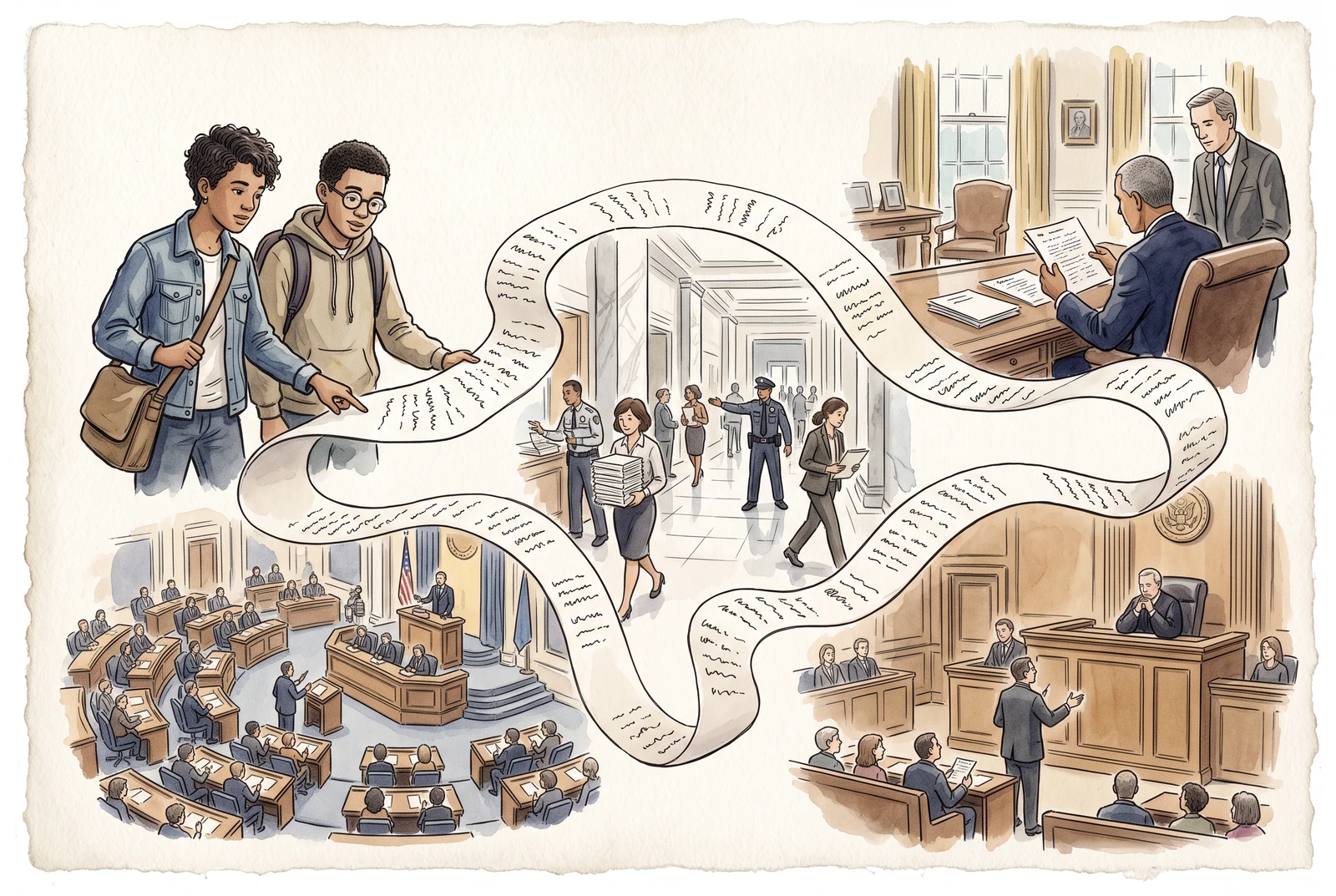
This example is about the United States federal government. It is not a school election or a city-council process. Congress makes federal laws, the executive branch carries them out, and federal courts resolve cases involving those laws and the Constitution. A fictional public-building access proposal gives the comic a shared thread without making claims about an actual bill or dispute.
04
U.S. civics · LlamaGen
02 · The challenge
Can each branch do its part without becoming a single all-powerful character?
Scope
Is this consistently a federal example rather than a mix of federal and local offices?
Congress
Do both the House and Senate appear in the legislative process?
Executive
Is carrying out a law distinguished from writing a bill?
Courts
Does a legal challenge arise through a case rather than automatic approval by judges?
05
U.S. civics · LlamaGen
03 · Planning the page
A story takes shape.
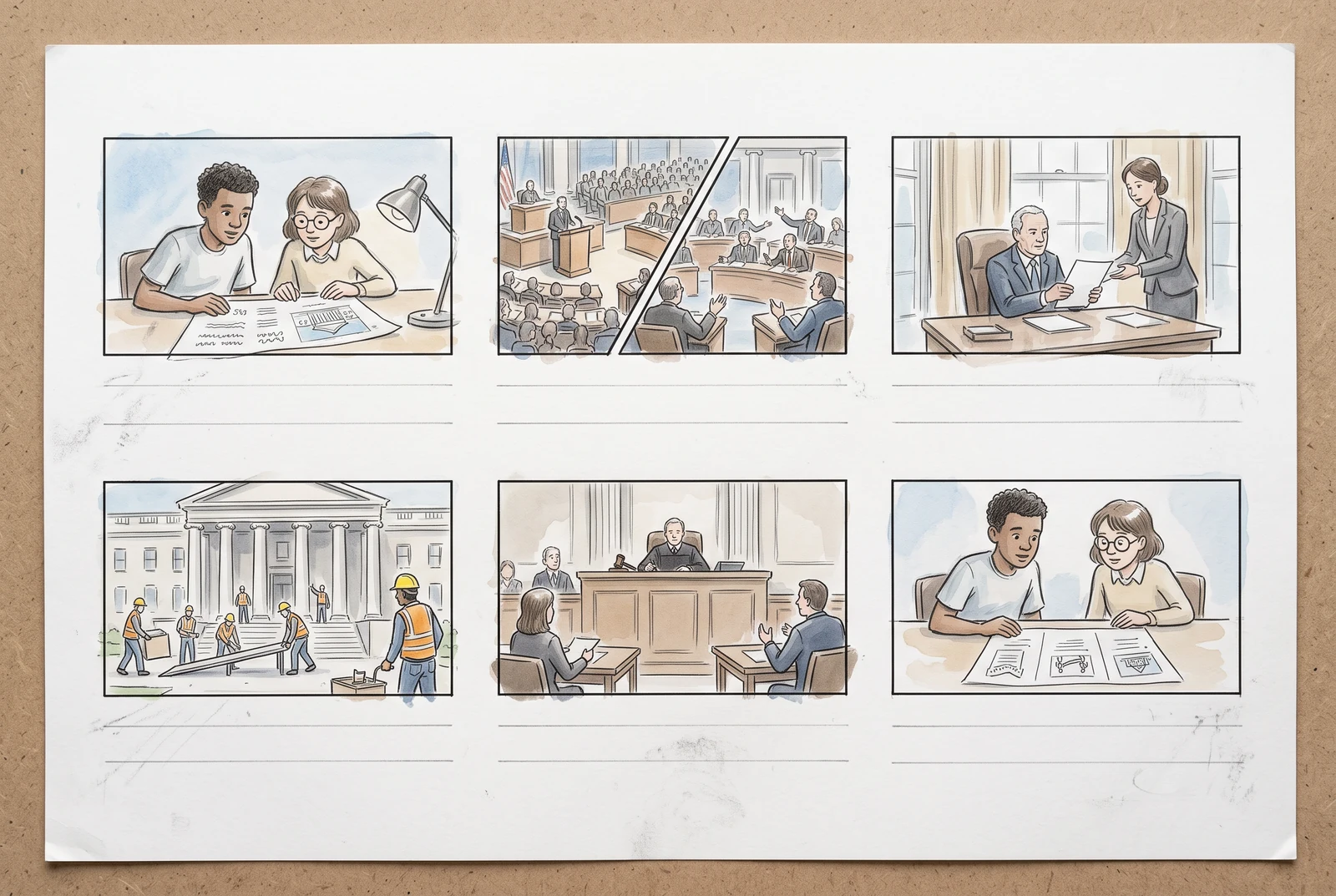
Plan six panels for this task: Distinguish the U.S. federal legislative, executive and judicial branches using a carefully limited fictional scenario. Keep visual symbols consistent, leave caption space, and use the complete reviewed script below.
Illustrated planning concept, not an editor screenshot or recorded session.
06
U.S. civics · LlamaGen
04 · The creative process
Make a draft. Make it yours.
Assign
Give each branch a clear role and a neutral visual cue.
Propose
Invent a narrow federal-policy example, explicitly marked fictional.
Question
Introduce a dispute that may lead to judicial review through a case.
Discuss
Ask which responsibility and limit are visible in each scene.
07
U.S. civics · LlamaGen
05 · Comic concept
Six panels, ready to read and question.
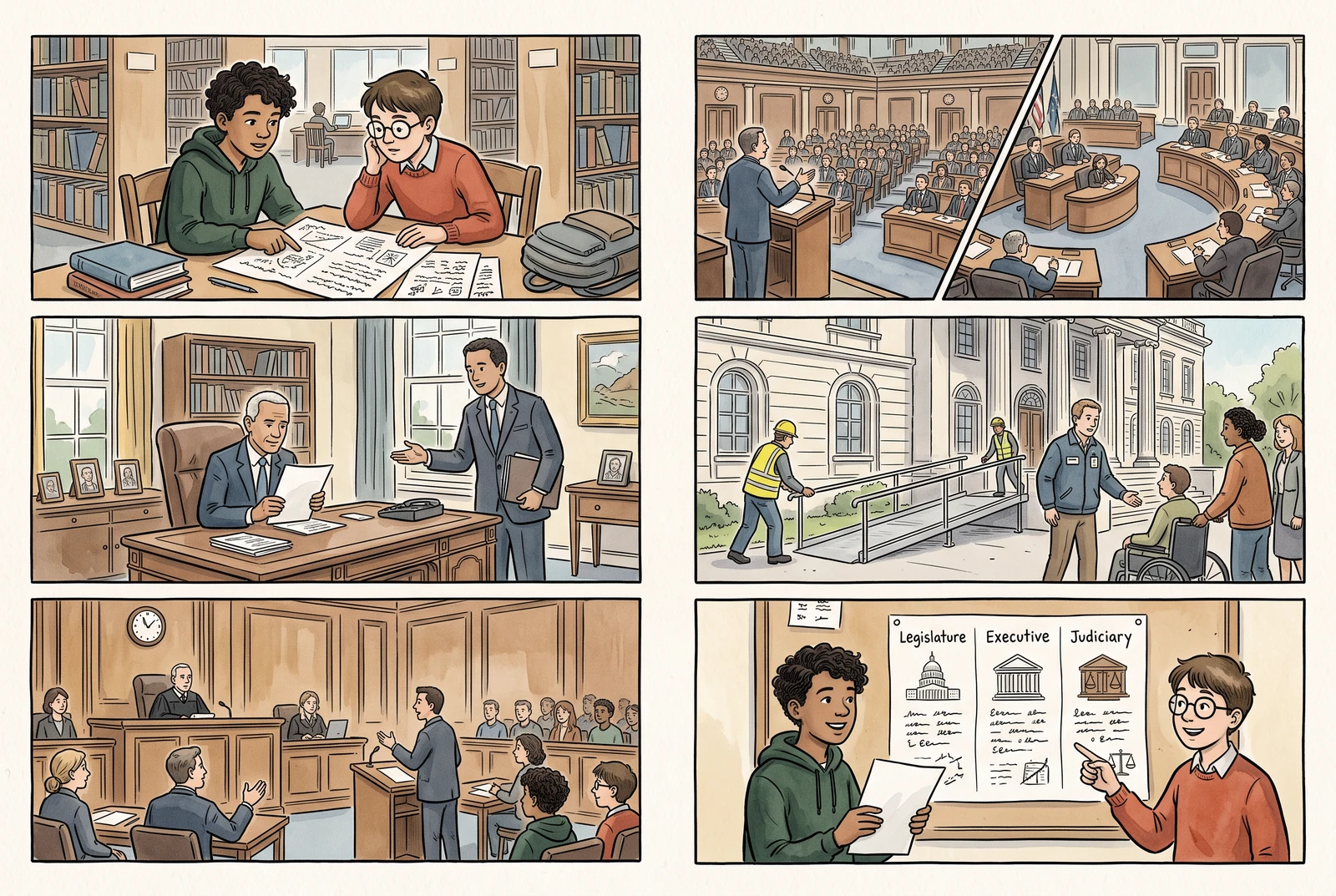
AI-generated editorial artwork accompanies an original lesson script. Read the captions and subject checks below; the illustration is not a scientific record, a classroom outcome or a product screenshot.
08
U.S. civics · LlamaGen
The next page is yours
Make your own version. Check every caption.
Start with one short scene. Review the words, the characters and the details before making the next page.
Sign-in and generation credits may apply. Features and export options depend on your workspace and plan.
09
By LlamaGen · Original classroom example · Edition
The complete classroom example
Distinguish the U.S. federal legislative, executive and judicial branches using a carefully limited fictional scenario.
Suggested audience: Introductory U.S. civics; simplify the vocabulary with the teacher while keeping the federal scope.
AI-generated comic concept. Open the full-size image; use the numbered script below for the explanation and captions.
Read the six-panel script
The illustrations are concepts. These editable captions carry the explanation; read and check them even when images or animation are unavailable.
1. A fictional proposal
Two students read a fictional proposal about access to federal public buildings.
“Imagine a proposed federal law. This is a classroom scenario, not a real bill.”
2. The legislative branch
A split scene shows representatives and senators debating a bill.
“Congress has two chambers: the House of Representatives and the Senate.”
3. The president’s decision
The president receives a bill passed by both chambers.
“A president may sign a bill or veto it. Congress can override a veto with the required votes.”
4. The executive branch
Federal staff carry out the enacted fictional law at a public building.
“The executive branch implements and enforces federal laws.”
5. The judicial branch
A fictional legal dispute is presented in a federal courtroom.
“Courts decide cases and interpret the law, including constitutional questions.”
6. Responsibilities and limits
The students compare a three-column note: making laws, carrying them out, deciding cases.
“Separated powers and checks limit how government authority is used.”
Use the script in your own comic
Copy the prompt and panel script below into the comic workspace. Prepare the images first, add captions using supported editing controls, then check the draft. This page does not promise automatic factual accuracy or a one-click finished worksheet.
Sign-in and generation credits may apply. Do not upload student names or photographs without the appropriate permission. Printing and shipping are not included.
Check the subject before sharing
This is a simplified U.S. federal civics example, not legal advice or a complete account of legislation. Courts do not automatically review every new law before it operates. Not every disagreement reaches the Supreme Court, and the three branches have responsibilities beyond the ones shown here.
Try a different version
Add a separate panel illustrating a presidential veto and a possible congressional override. Identify which branch acts in each part. Then explain why a school principal, city council and local judge would not be accurate substitutes for the federal officials in this particular story.
Questions about this example
Are these the branches of every country’s government?
No. The example describes the U.S. federal system. Other countries and levels of government have different institutions and procedures; use sources for the jurisdiction you are teaching.
Does the Supreme Court approve every bill?
No. Federal courts decide cases that come before them under applicable legal rules. They do not act as a routine pre-publication approval stage for every bill Congress passes.
Sources and how this page was made
LlamaGen authored this teaching example using the references below. The script and activity are original; the source scene, storyboard sheet and wordless comic were generated separately with Google Vertex AI. They do not demonstrate automatic source-to-comic conversion. No teacher endorsement, measured learning benefit or independent expert review is claimed.
USAGov: how laws are made — Reference for bills, both chambers of Congress and presidential decisions.
Reviewed against these linked sources for this edition on November 13, 2026. Teachers should adapt vocabulary and verify the final draft against their curriculum.
Your story, one scene at a time
Make your own version. Check every caption.
Plan a three-branches-of-government comic with an original federal-law scenario, six-panel script, checks-and-balances questions and USAGov references.
Are these the branches of every country’s government?+
No. The example describes the U.S. federal system. Other countries and levels of government have different institutions and procedures; use sources for the jurisdiction you are teaching.
How was this classroom example made?+
An original LlamaGen classroom example with AI-generated editorial illustrations. Not a customer project, scientific observation or verified product output. Check the supplied captions and sources before classroom use. No customer quotation, endorsement or measured outcome is claimed.
More ways to tell a story
Another page. Another possibility.
An original LlamaGen classroom example with AI-generated editorial illustrations. Not a customer project, scientific observation or verified product output. Check the supplied captions and sources before classroom use. Images were created with Google Vertex AI. The illustrated planning and comic stages do not demonstrate an automatic transformation of the source illustration.
Three Branches of Government Comic: A Law Meets a Question | LlamaGen