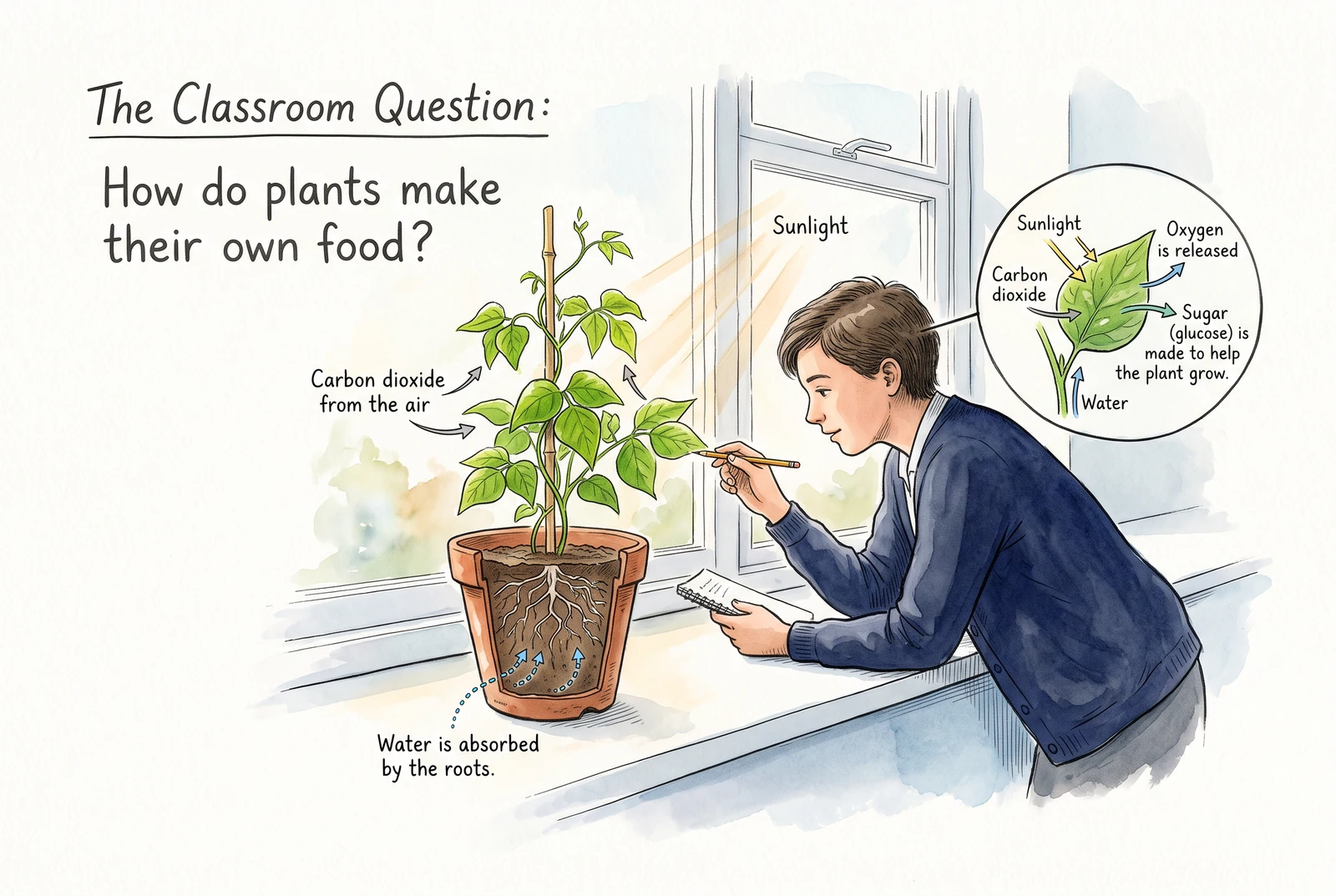
Sunlight supplies energy. The leaf still needs materials.
Explain how plants use light energy, carbon dioxide and water to make sugars, with oxygen released, without confusing energy with matter.
An original teaching example. Read the complete panel script, checks and references below the book.
03
Plant science · LlamaGen
01 · Source materials
Separate the materials from the energy source.
Prepare a short list before drawing: carbon dioxide enters leaves from the air, roots take up water, and light supplies energy. Photosynthesis makes sugars and releases oxygen. The overview leaves out the many chemical steps; it should not imply that a leaf combines complete gas bubbles and water drops like ingredients in a mixing bowl.
04
Plant science · LlamaGen
02 · The challenge
Can the reader distinguish plant food from the energy used to make it?
Inputs
Do carbon dioxide and water appear as materials, while light is an energy source?
Output
Does the story identify sugar as a product rather than calling sunlight food?
Roots
Does the root supply water instead of absorbing finished sugar from soil?
Whole plant
Does the ending avoid claiming that plants only photosynthesize and never respire?
05
Plant science · LlamaGen
03 · Planning the page
A story takes shape.
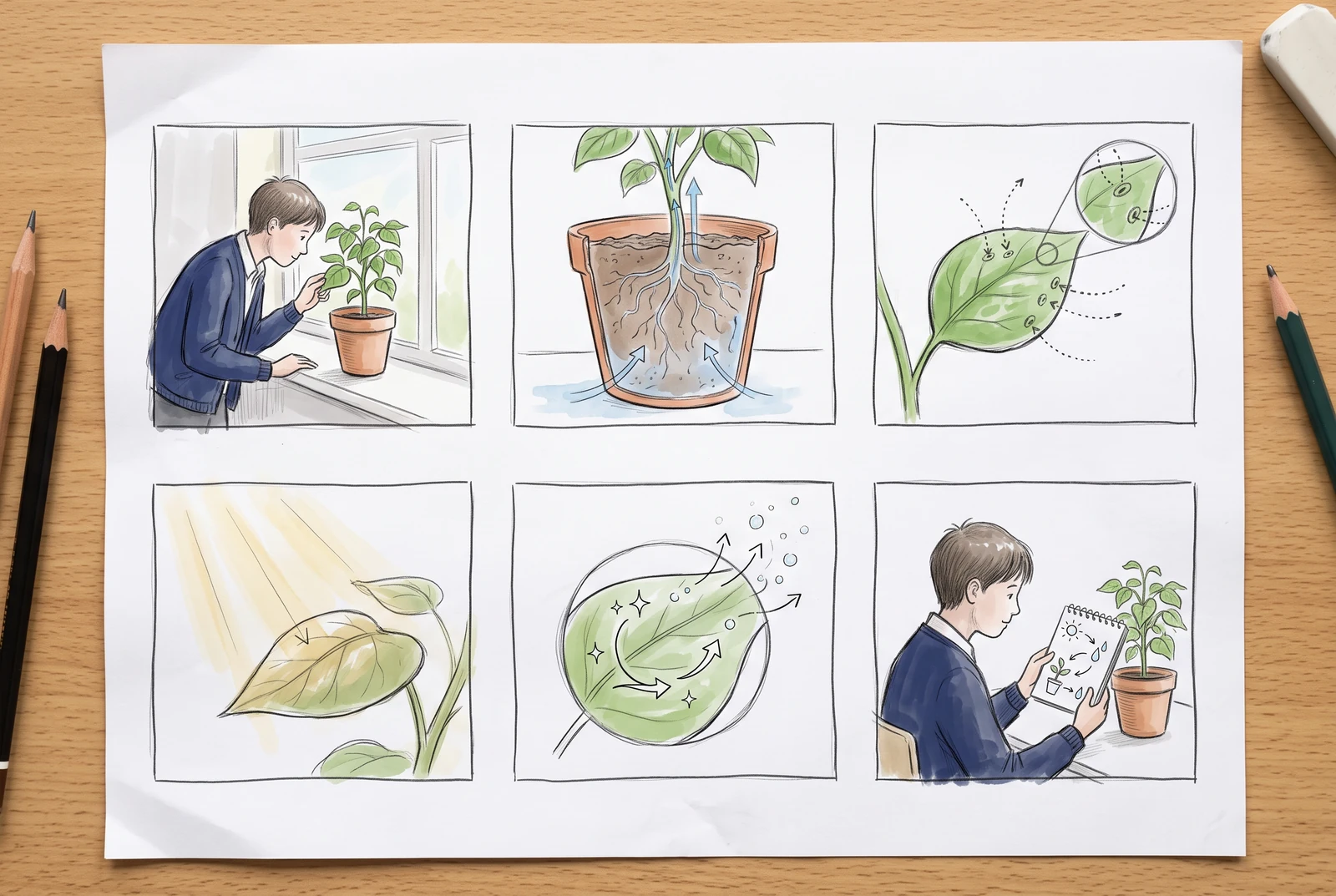
Plan six panels for this task: Explain how plants use light energy, carbon dioxide and water to make sugars, with oxygen released, without confusing energy with matter. Keep visual symbols consistent, leave caption space, and use the complete reviewed script below.
Illustrated planning concept, not an editor screenshot or recorded session.
06
Plant science · LlamaGen
04 · The creative process
Make a draft. Make it yours.
List
Write the inputs and outputs in separate columns.
Follow
Choose one leaf as the setting and connect it to roots and the surrounding air.
Caption
Explain the process in words without relying on decorative arrows alone.
Check
Compare the final script with a plant-science source before illustrating.
07
Plant science · LlamaGen
05 · Comic concept
Six panels, ready to read and question.
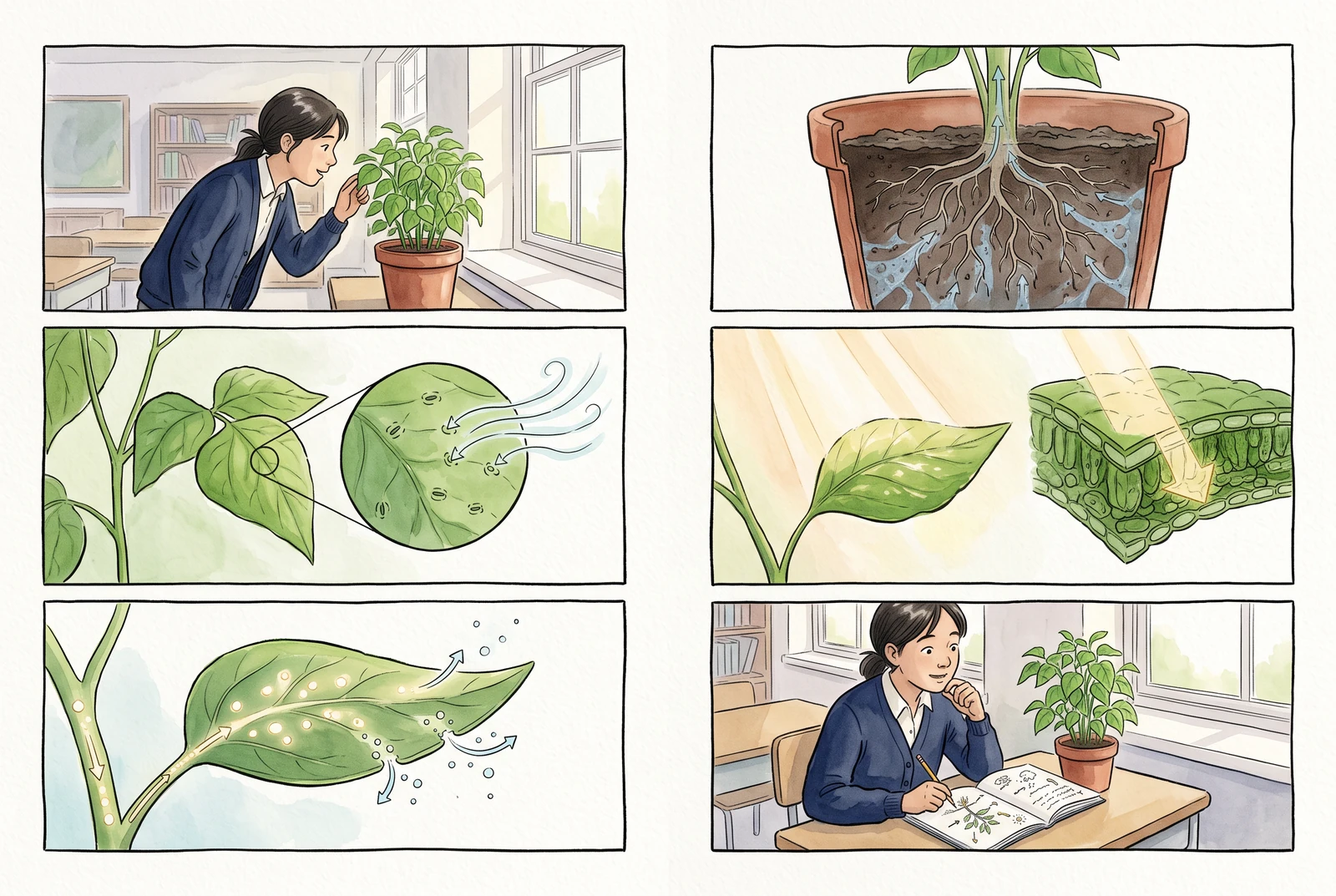
AI-generated editorial artwork accompanies an original lesson script. Read the captions and subject checks below; the illustration is not a scientific record, a classroom outcome or a product screenshot.
08
Plant science · LlamaGen
The next page is yours
Make your own version. Check every caption.
Start with one short scene. Review the words, the characters and the details before making the next page.
Sign-in and generation credits may apply. Features and export options depend on your workspace and plan.
09
By LlamaGen · Original classroom example · Edition
The complete classroom example
Explain how plants use light energy, carbon dioxide and water to make sugars, with oxygen released, without confusing energy with matter.
Suggested audience: Upper-elementary and middle-school plant science; a simplified overview of photosynthesis.
AI-generated comic concept. Open the full-size image; use the numbered script below for the explanation and captions.
Read the six-panel script
The illustrations are concepts. These editable captions carry the explanation; read and check them even when images or animation are unavailable.
1. The question
A student notices a growing bean plant by a bright window.
“Where does this plant get the material and energy to grow?”
2. Water
A cutaway shows roots taking up water and water moving toward the leaves.
“Roots take up water, which moves through the plant.”
3. Carbon dioxide
A leaf close-up shows air reaching tiny openings in the leaf.
“Carbon dioxide from the air enters the leaf.”
4. Light energy
Sunlight reaches green leaf tissue; no food particles arrive from the sun.
“Light provides energy for photosynthesis.”
5. Products
A conceptual inset distinguishes newly made sugar from oxygen leaving the leaf.
“Photosynthesis makes sugars and releases oxygen.”
6. Growth and a limit
The student compares the plant with a simple inputs-and-outputs note.
“Sugars support growth and other processes. Plants also carry out respiration.”
Use the script in your own comic
Copy the prompt and panel script below into the comic workspace. Prepare the images first, add captions using supported editing controls, then check the draft. This page does not promise automatic factual accuracy or a one-click finished worksheet.
Sign-in and generation credits may apply. Do not upload student names or photographs without the appropriate permission. Printing and shipping are not included.
Check the subject before sharing
Sunlight is not a material ingredient and soil is not the plant’s main source of carbon for sugar. This introductory model does not show the light reactions or carbon-fixation chemistry. Plants respire during the day and at night; do not use photosynthesis as a claim that plants never use oxygen.
Try a different version
Remove the labels from your input-and-output notes. Ask a partner to sort water, carbon dioxide, light, sugar and oxygen into materials going in, energy supplied, and products. Add one caption explaining how a greenhouse might change the conditions without guaranteeing a particular growth rate.
Questions about this example
Should I add a chemical equation?
Only if it suits the class. Use the simplified overall equation taught by your teacher, balance it carefully, and explain that it summarizes many steps rather than showing a single reaction in one panel.
Do plants get all their food from the soil?
No. Plants make sugars through photosynthesis. Roots provide water and mineral nutrients; carbon dioxide from the air supplies carbon used in sugars.
Sources and how this page was made
LlamaGen authored this teaching example using the references below. The script and activity are original; the source scene, storyboard sheet and wordless comic were generated separately with Google Vertex AI. They do not demonstrate automatic source-to-comic conversion. No teacher endorsement, measured learning benefit or independent expert review is claimed.
Reviewed against these linked sources for this edition on November 13, 2026. Teachers should adapt vocabulary and verify the final draft against their curriculum.
Your story, one scene at a time
Make your own version. Check every caption.
Create a photosynthesis comic strip with a six-panel leaf story, input-and-output captions, common misconception checks and a classroom follow-up activity.
Only if it suits the class. Use the simplified overall equation taught by your teacher, balance it carefully, and explain that it summarizes many steps rather than showing a single reaction in one panel.
How was this classroom example made?+
An original LlamaGen classroom example with AI-generated editorial illustrations. Not a customer project, scientific observation or verified product output. Check the supplied captions and sources before classroom use. No customer quotation, endorsement or measured outcome is claimed.
More ways to tell a story
Another page. Another possibility.
An original LlamaGen classroom example with AI-generated editorial illustrations. Not a customer project, scientific observation or verified product output. Check the supplied captions and sources before classroom use. Images were created with Google Vertex AI. The illustrated planning and comic stages do not demonstrate an automatic transformation of the source illustration.
Photosynthesis Comic Strip: A Leaf Makes Sugar | LlamaGen