Rock Cycle Comic Strip: One Rock, Many Possible Journeys
Follow a rock through a possible journey, then draw a different route.
Connect changes in rock type to the processes that cause them, without treating the rock cycle as one compulsory loop.
An original teaching example. Read the complete panel script, checks and references below the book.
03
Earth science · LlamaGen
01 · Source materials
Begin with processes, rather than a circle of names.
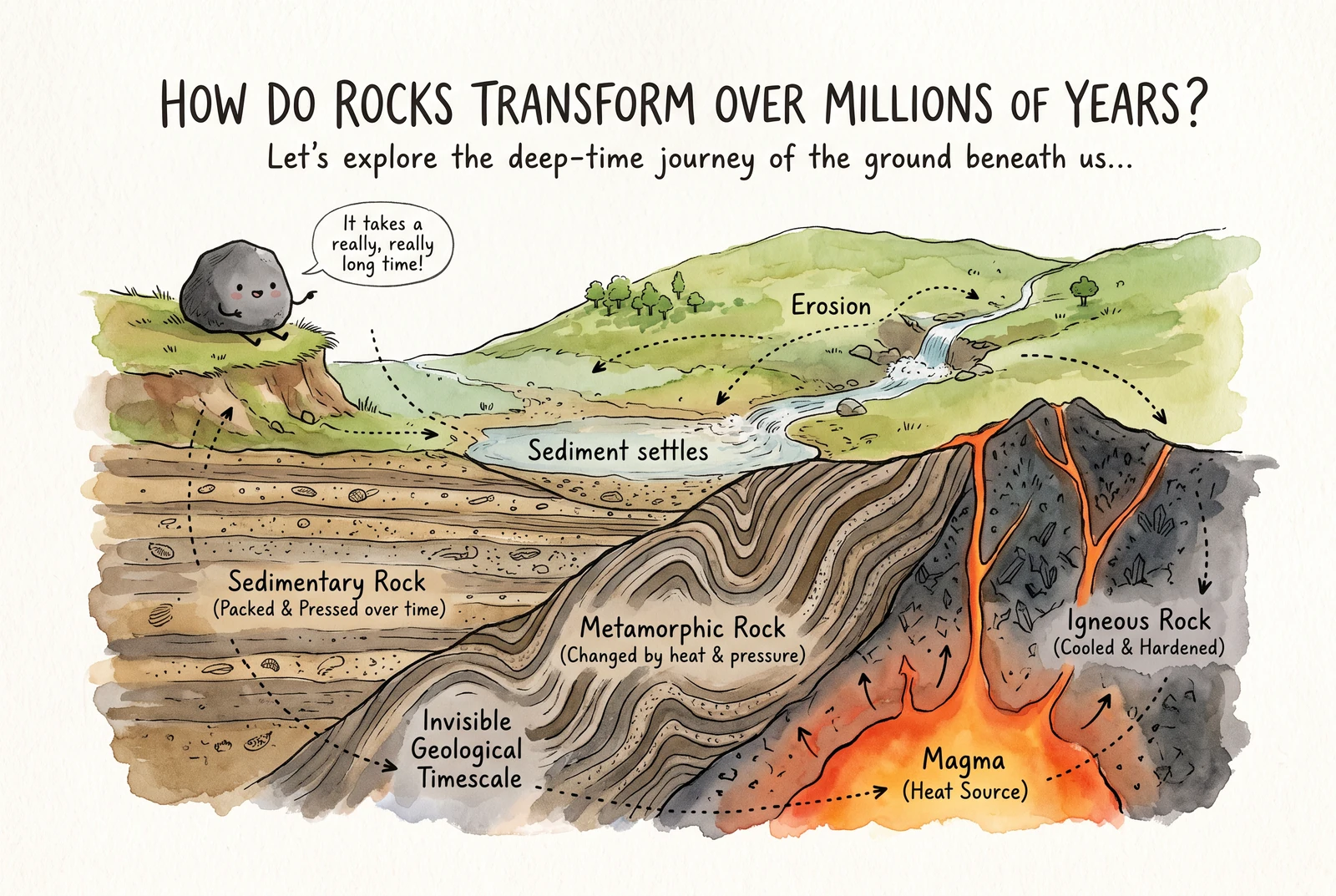
Use a rock-cycle diagram from a geology source and list the processes on its arrows. This original story follows one possible path from igneous rock through sediment and metamorphic rock to molten material and back. Real rocks can take different paths, stay unchanged for long periods, or repeat a step. The compressed sequence is not a timetable.
04
Earth science · LlamaGen
02 · The challenge
What changed the rock, and did it melt?
Weathering
Does the surface rock break into particles before sediment forms a new rock?
Lithification
Are deposition, compaction and cementation distinguished from melting?
Metamorphism
Does the rock remain solid while heat and/or pressure change it?
Paths
Does the ending make clear that other routes are possible?
05
Earth science · LlamaGen
03 · Planning the page
A story takes shape.
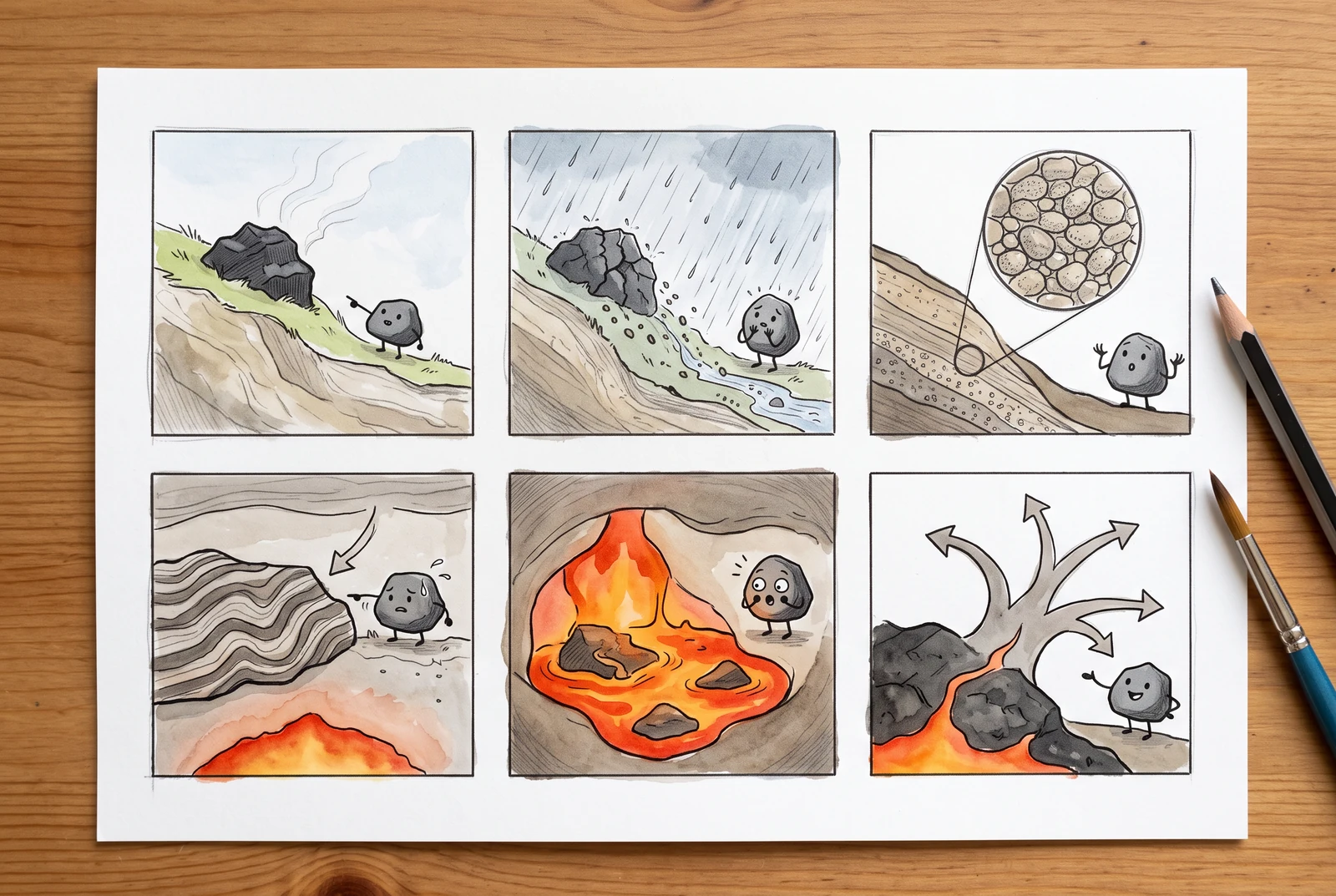
Plan six panels for this task: Connect changes in rock type to the processes that cause them, without treating the rock cycle as one compulsory loop. Keep visual symbols consistent, leave caption space, and use the complete reviewed script below.
Illustrated planning concept, not an editor screenshot or recorded session.
06
Earth science · LlamaGen
04 · The creative process
Make a draft. Make it yours.
Trace
Choose one route on a reliable rock-cycle diagram.
Cause
Name the process for every transition before writing dialogue.
Scale
Mark that geological changes usually take far longer than the comic suggests.
Branch
Draw an alternative ending instead of insisting every rock completes this route.
07
Earth science · LlamaGen
05 · Comic concept
Six panels, ready to read and question.
AI-generated editorial artwork accompanies an original lesson script. Read the captions and subject checks below; the illustration is not a scientific record, a classroom outcome or a product screenshot.
08
Earth science · LlamaGen
The next page is yours
Make your own version. Check every caption.
Start with one short scene. Review the words, the characters and the details before making the next page.
Sign-in and generation credits may apply. Features and export options depend on your workspace and plan.
09
By LlamaGen · Original classroom example · Edition
The complete classroom example
Connect changes in rock type to the processes that cause them, without treating the rock cycle as one compulsory loop.
Suggested audience: Upper-elementary and middle-school Earth science; choose the detail level with your teacher.
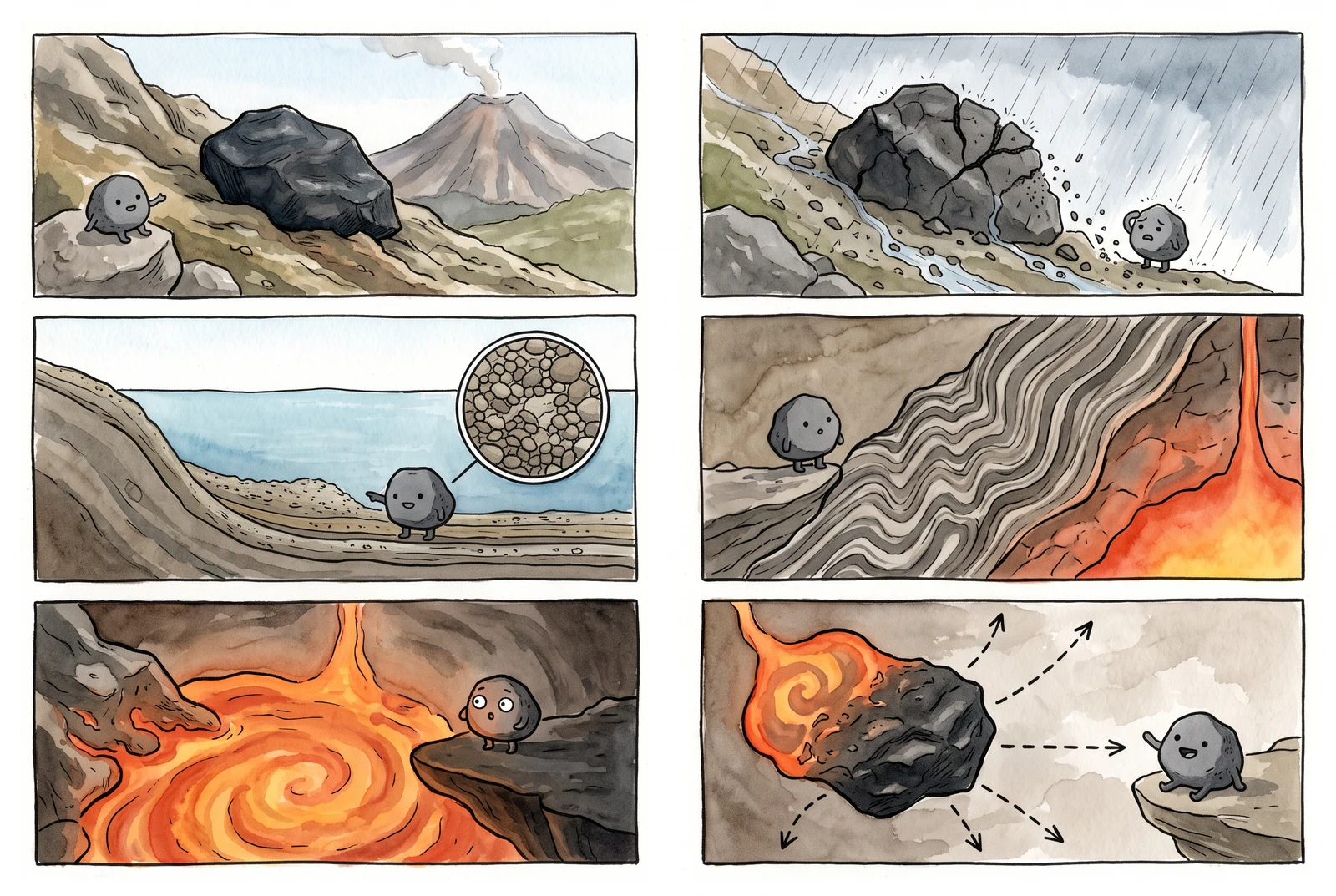
AI-generated comic concept. Open the full-size image; use the numbered script below for the explanation and captions.
Read the six-panel script
The illustrations are concepts. These editable captions carry the explanation; read and check them even when images or animation are unavailable.
1. Igneous starting point
A dark igneous rock sits on a hillside after molten rock has cooled.
“My story starts here, but the cycle has no single starting point.”
2. Weathering and erosion
Cracks form in the rock; smaller particles move downslope with water.
“Weathering breaks material down. Erosion moves it.”
3. Sedimentary rock
Deposited sediment is buried; a close-up shows grains compacted and cemented.
“Deposition, compaction and cementation can turn sediment into rock.”
4. Metamorphic rock
Buried solid rock changes texture near a heat source without becoming liquid.
“Heat and pressure can change me while I remain solid.”
5. Melting
Some rock melts underground into magma.
“Melting is a different change: now the material is molten.”
6. Cooling and possibilities
Magma cools into igneous rock; small branching arrows suggest several later routes.
“Cooling makes igneous rock. From here, there is more than one possible path.”
Use the script in your own comic
Continue with the complete prompt and six-panel script below, or copy them into the comic workspace. The link prepares a draft; generation only starts when you submit in the workspace. Prepare the images first, add captions using supported editing controls, then check the draft. This page does not promise automatic factual accuracy or a one-click finished worksheet.
Sign-in and generation credits may apply. Do not upload student names or photographs without the appropriate permission. Printing and shipping are not included.
Check the subject before sharing
Do not draw metamorphism as melting. Magma is molten material below the surface; lava is molten material at the surface. There is no required order or fixed duration for every rock’s journey.
Try a different version
Choose the rock in panel four and create a different ending in which it reaches the surface and weathers without first melting. Under each arrow, write the process that makes your alternative route possible.
Questions about this example
Must every rock pass through all three rock types?
No. The rock cycle is a network of possible transformations. A rock may follow a different path, repeat a process or remain in one state for a long time.
How can I show geological time in a short comic?
Use a caption such as “over a long geological interval” rather than inventing a precise number of years. The panels show a model of processes, not events happening over one afternoon.
Sources and how this page was made
LlamaGen authored this teaching example using the references below. The script and activity are original; the source scene, storyboard sheet, wordless comic were generated separately with Google Vertex AI. They do not demonstrate automatic source-to-comic conversion. No teacher endorsement, measured learning benefit or independent expert review is claimed.
Checked against these linked sources for this edition on November 13, 2026. Teachers should adapt vocabulary and verify the final draft against their curriculum.
Your story, one scene at a time
Make your own version. Check every caption.
Plan a rock cycle comic strip with a six-panel example covering weathering, sedimentary rock, metamorphism, melting and cooling, plus a science checklist.
Must every rock pass through all three rock types?+
No. The rock cycle is a network of possible transformations. A rock may follow a different path, repeat a process or remain in one state for a long time.
How was this classroom example made?+
An original LlamaGen classroom example with AI-generated editorial illustrations. Not a customer project, scientific observation or verified product output. Check the supplied captions and sources before classroom use. No customer quotation, endorsement or measured outcome is claimed.
More ways to tell a story
Another page. Another possibility.
An original LlamaGen classroom example with AI-generated editorial illustrations. Not a customer project, scientific observation or verified product output. Check the supplied captions and sources before classroom use. Images were created with Google Vertex AI. The illustrated planning and comic stages do not demonstrate an automatic transformation of the source illustration.
Read, review and print an original four-panel story
These original English-language illustrations were created directly with Vertex AI. They are editorial examples, not customer projects or proof of the website’s upload, credit deductions or generation flow. Interface and notes are translated; lettering in artwork remains English.
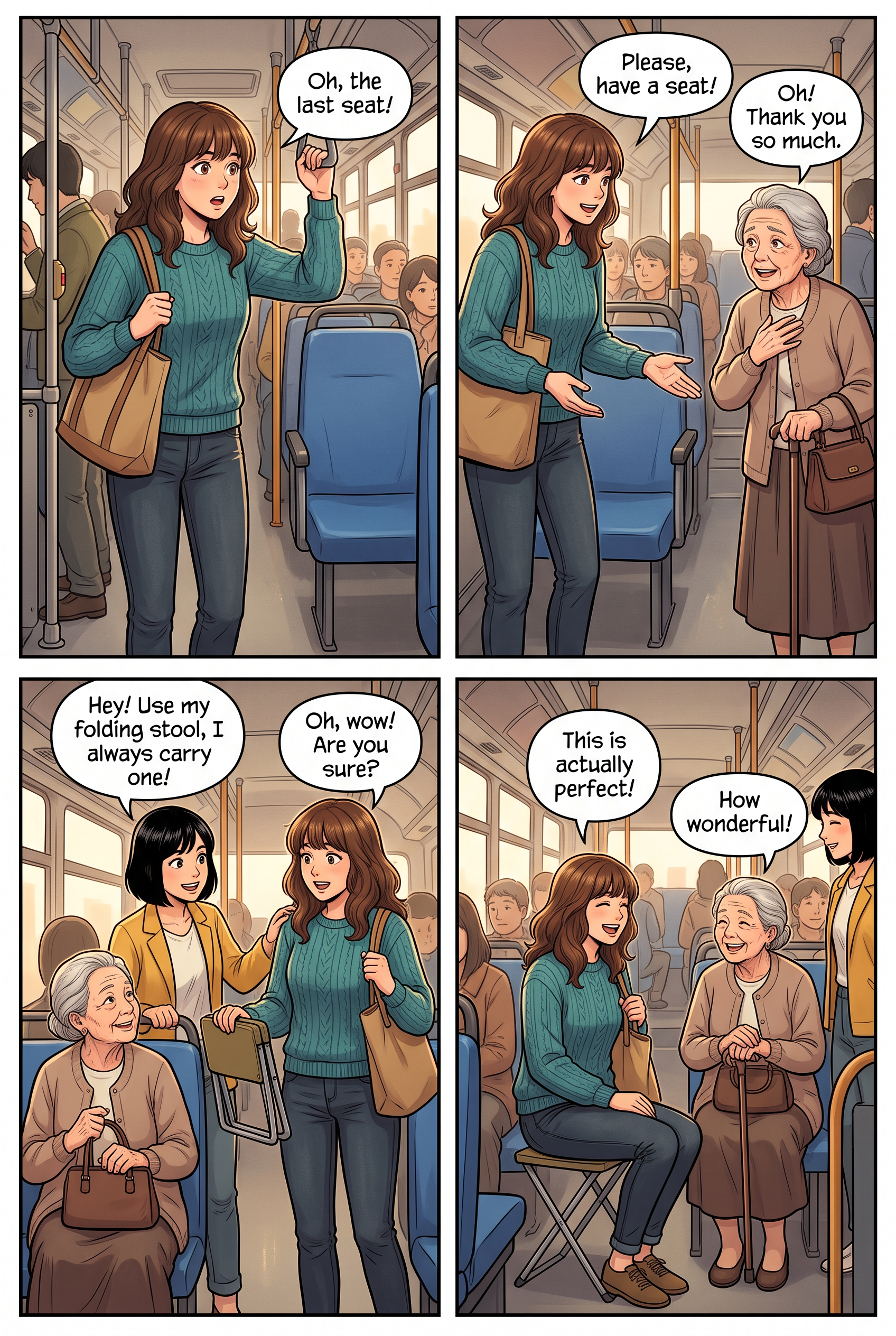
The Last Seat
A commuter notices the last bus seat. She offers it to an older passenger. A friend offers her a folding stool. She laughs beside the seated passenger.
Original English generation brief
Create an ORIGINAL finished four-panel comic page in portrait 2:3, exactly two rows and two columns with four clear equal panels and white gutters. Warm professional color manga, adult female lead, fully clothed casual contemporary clothing. Maintain identical face, hair, clothing and props through the four panels. English story, mostly visual storytelling, no extra captions, no title printed on image, no watermark, no borrowed franchise characters. Clear left-to-right top-to-bottom sequence. Four beats: A commuter notices the last bus seat. She offers it to an older passenger. A friend offers her a folding stool. She laughs beside the seated passenger. Natural hands and readable staging. This is original editorial artwork, not a photograph or a customer testimonial.
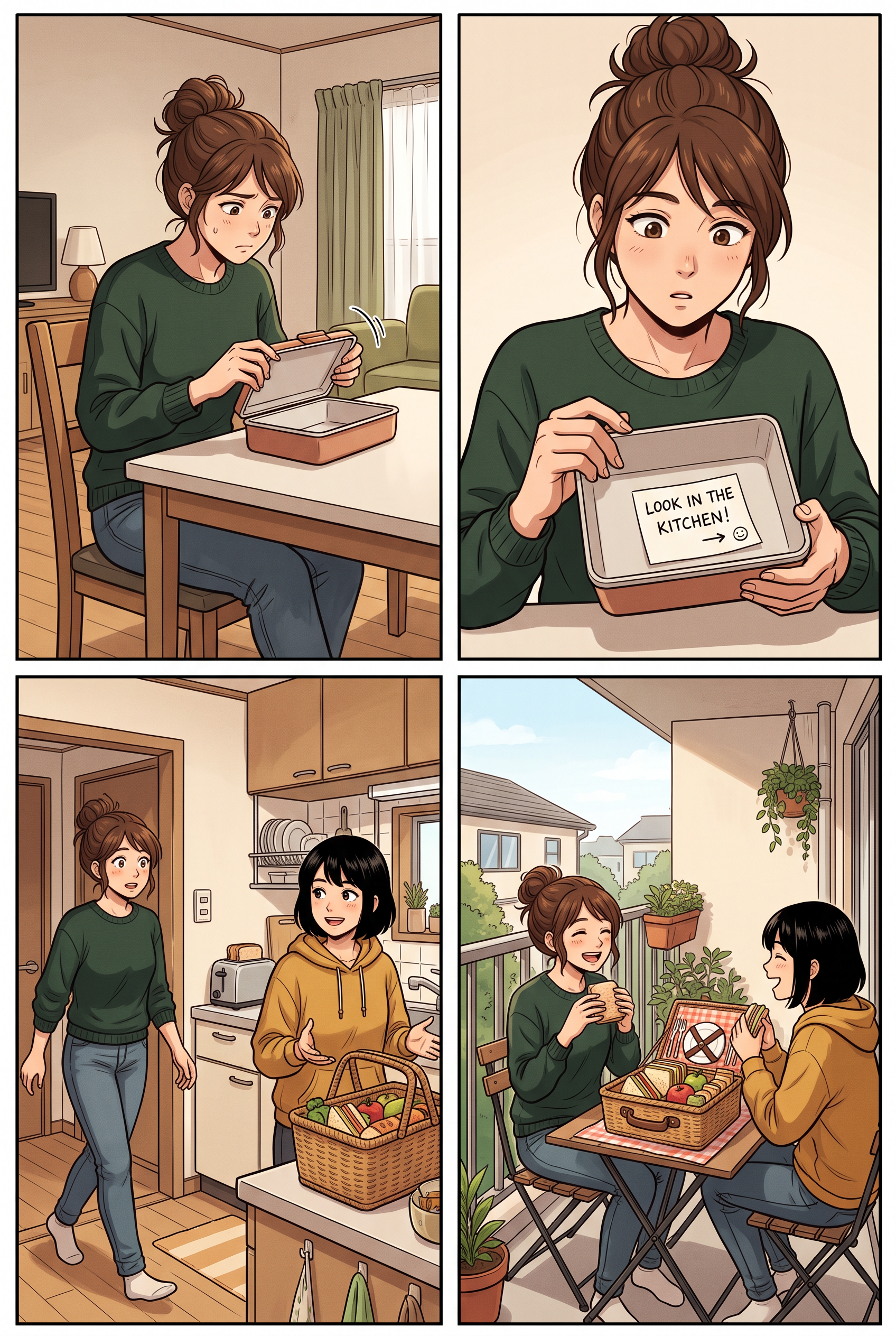
A woman opens an empty lunch box. She finds a note pointing to the kitchen. Her roommate reveals a picnic basket. They eat together on the balcony.
Original English generation brief
Create an ORIGINAL finished four-panel comic page in portrait 2:3, exactly two rows and two columns with four clear equal panels and white gutters. Warm professional color manga, adult female lead, fully clothed casual contemporary clothing. Maintain identical face, hair, clothing and props through the four panels. English story, mostly visual storytelling, no extra captions, no title printed on image, no watermark, no borrowed franchise characters. Clear left-to-right top-to-bottom sequence. Four beats: A woman opens an empty lunch box. She finds a note pointing to the kitchen. Her roommate reveals a picnic basket. They eat together on the balcony. Natural hands and readable staging. This is original editorial artwork, not a photograph or a customer testimonial.
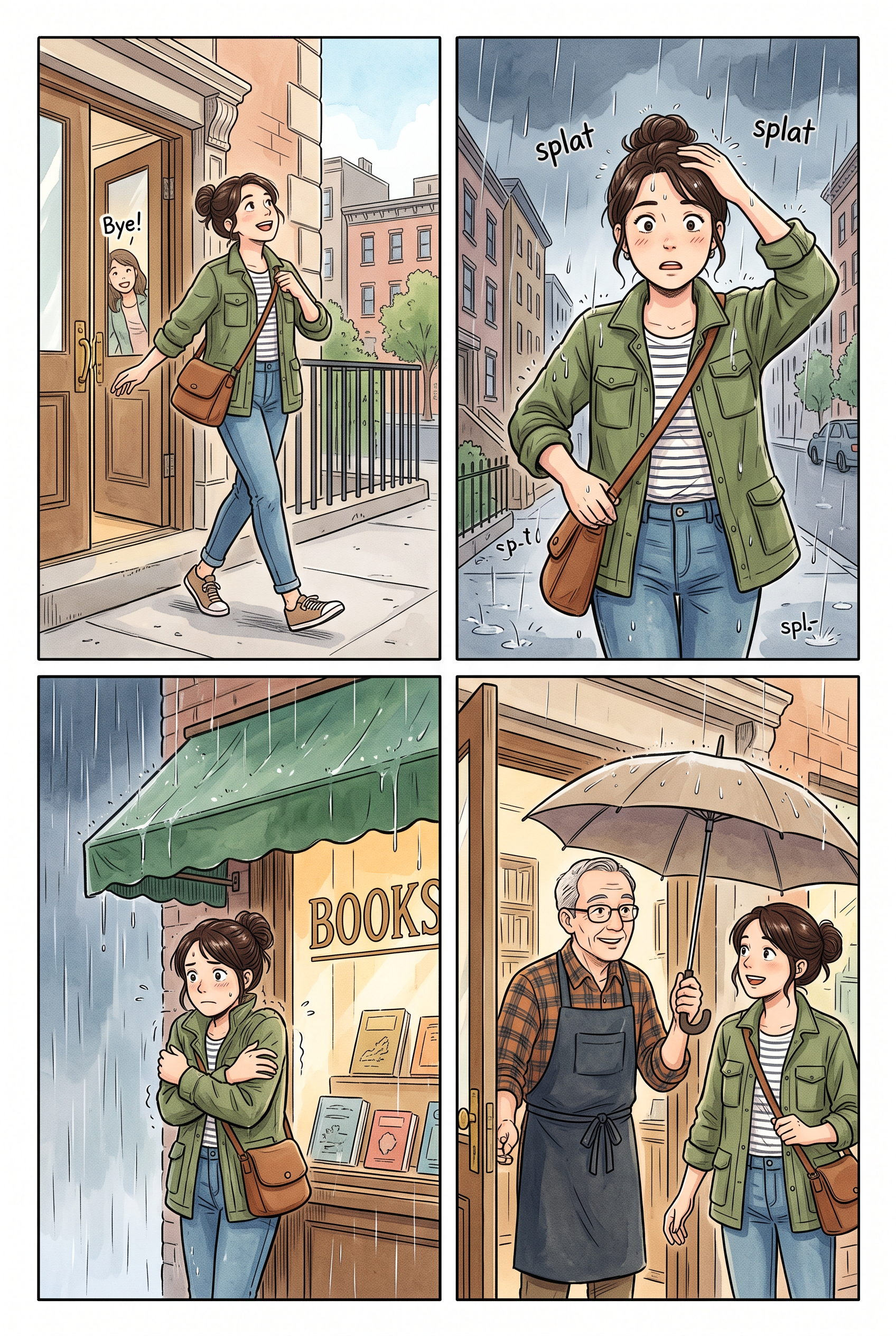
A woman leaves home without an umbrella. Rain begins. She shelters under a bookshop awning. The bookseller shares an umbrella and they smile.
Original English generation brief
Create an ORIGINAL finished four-panel comic page in portrait 2:3, exactly two rows and two columns with four clear equal panels and white gutters. Warm professional color manga, adult female lead, fully clothed casual contemporary clothing. Maintain identical face, hair, clothing and props through the four panels. English story, mostly visual storytelling, no extra captions, no title printed on image, no watermark, no borrowed franchise characters. Clear left-to-right top-to-bottom sequence. Four beats: A woman leaves home without an umbrella. Rain begins. She shelters under a bookshop awning. The bookseller shares an umbrella and they smile. Natural hands and readable staging. This is original editorial artwork, not a photograph or a customer testimonial.
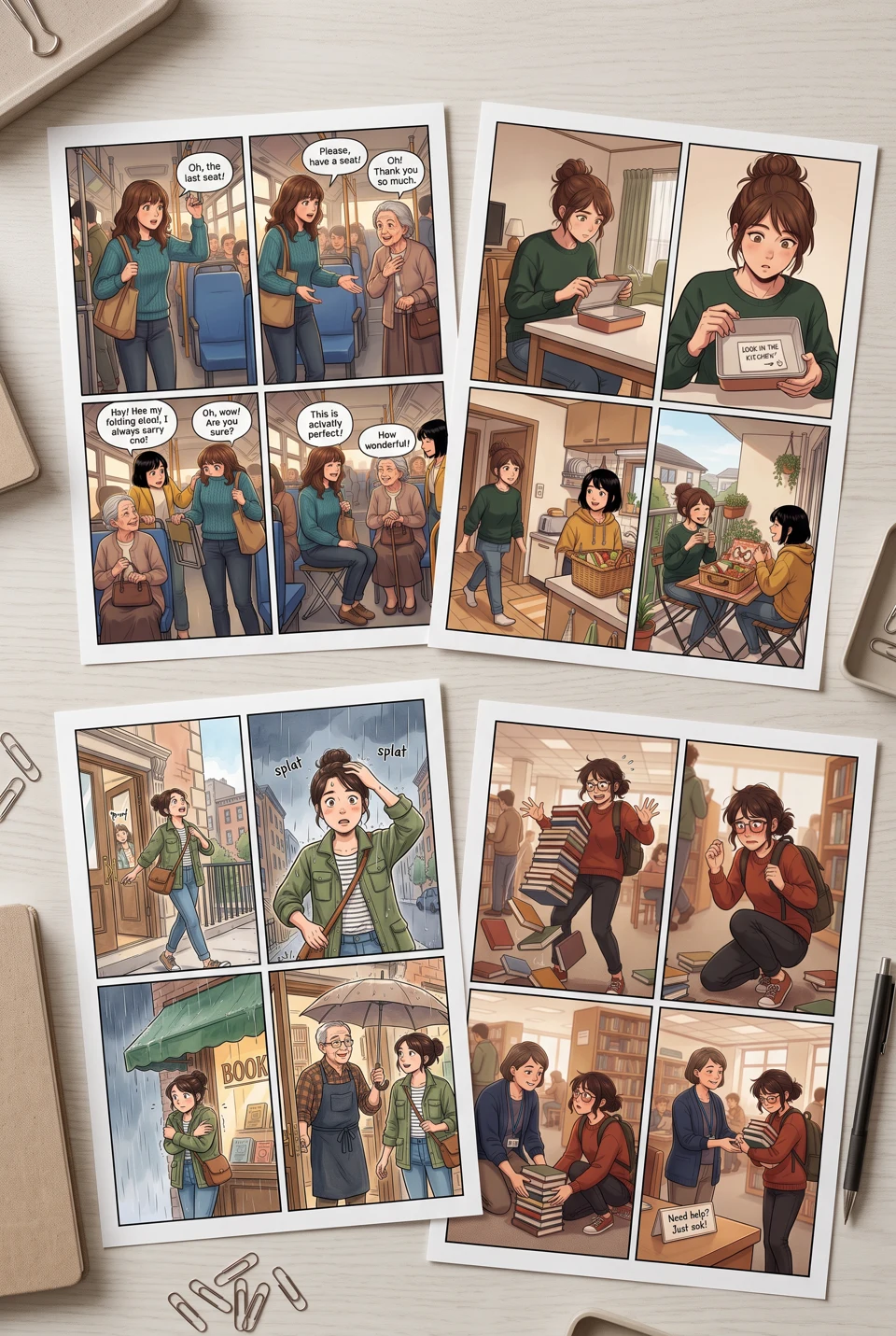
AI-generated illustrative use scene featuring our original comic artwork. Not a customer photograph or a physical print test.AI-generated illustrative use scene featuring our original comic artwork. Not a customer photograph or a physical print test.
Review before sharing
Read left to right, then top to bottom. Check four distinct story beats.
Compare face, hair, clothing, hands and recurring objects across panels.
Check every caption and speech bubble. Verify classroom facts against the linked source.
Open the downloaded PDF and check order, margins and readable text at actual size.
Downloads and generation have different requirements
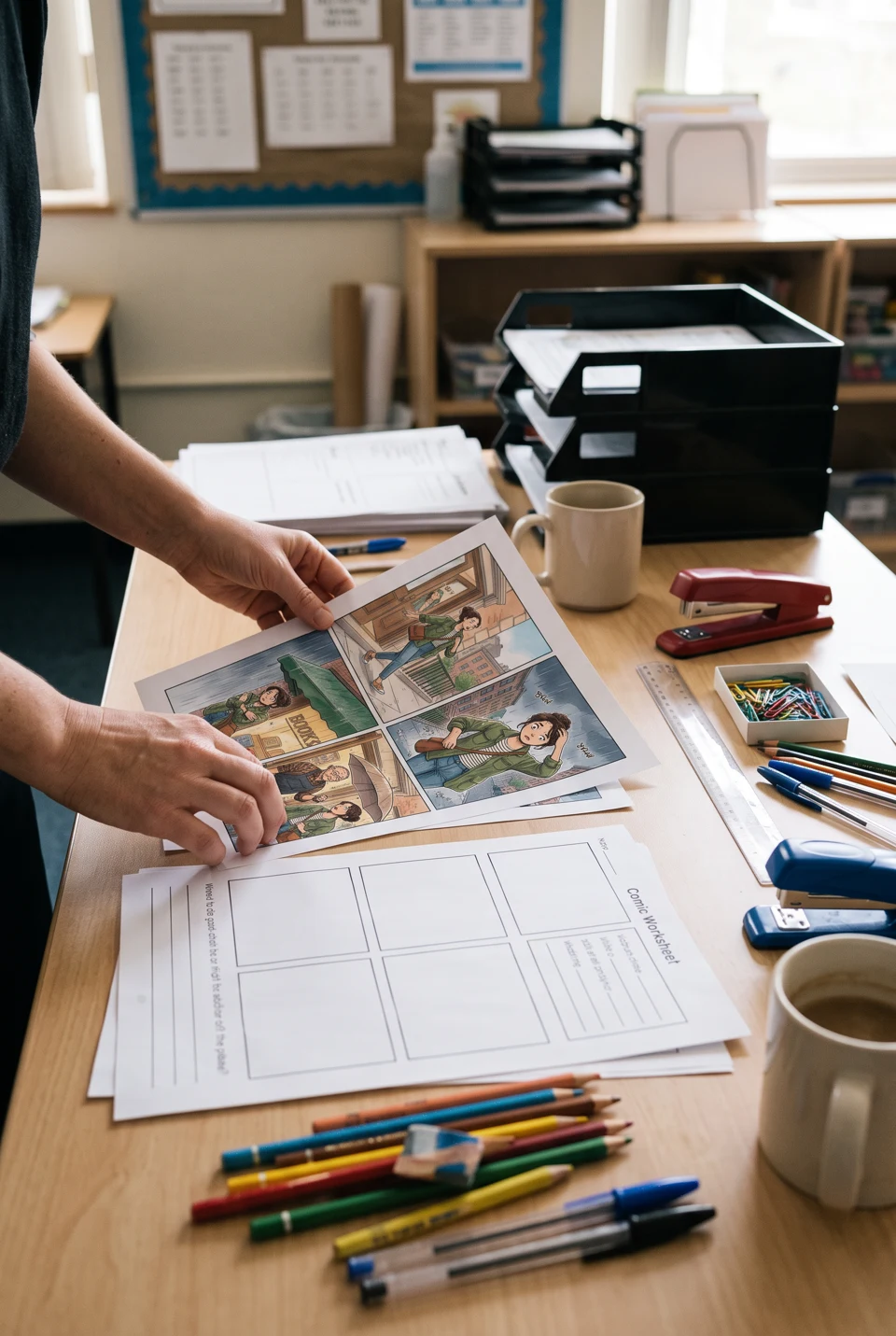
The sample images, blank templates and PDFs can be downloaded without an account. AI generation uses the existing sign-in, plan and credit rules. Check the displayed cost before submitting. A4 and Letter files fit the whole image inside a half-inch margin; physical printer output has not been tested.
Rock Cycle Comic Strip: One Rock, Many Possible Journeys | LlamaGen