

Reference-led image creation
Use an image as the start of a new visual draft
Plan an image-to-image transformation with an authorized source. Decide which structure to preserve, what to change and how to review the resulting draft.
Model
This creator generates a still image. Continue in the linked tools for comics and video; research strategies are not selectable production modes.
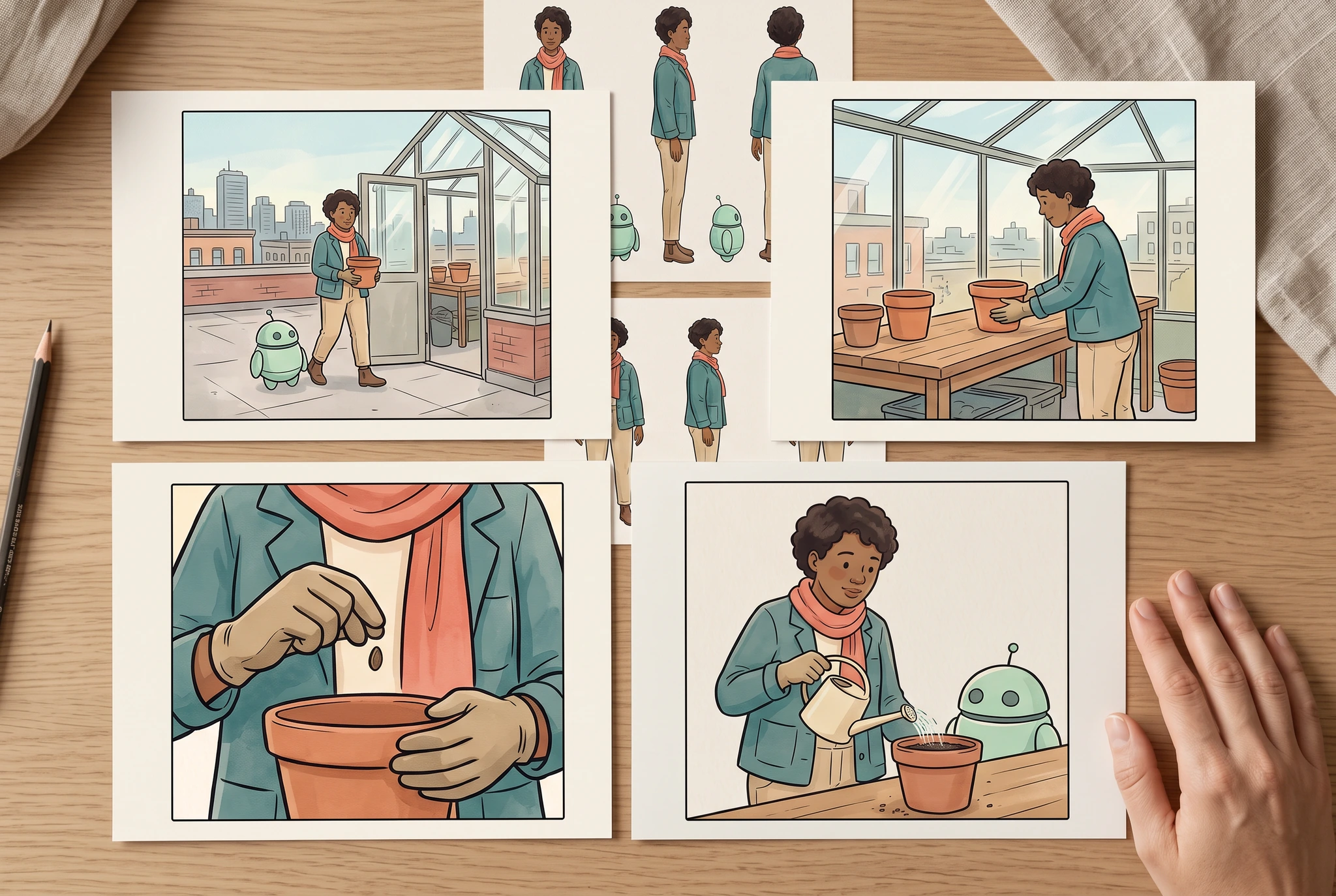
Image record
Google Vertex AI · gemini-3.1-flash-image · · 1280 × 859 px
Original generation prompt
Use case: photorealistic-natural / product-mockup. Convincing natural editorial PHOTOGRAPH at an adult artist's clean drawing table. Supplied image1 is the original character identity sheet; image2 is the original six-panel greenhouse story. Four separate medium matte landscape cards lie in a clean two-by-two arrangement on the table. Their artwork uses the SAME original adult botanist in teal jacket and coral scarf, same mint-green one-antenna robot, same greenhouse and terra-cotta pot. Show four distinct useful framings from the supplied story: wide greenhouse establishing view, medium pot-on-bench action, close-up seed-and-hands detail, and medium shared watering action. Cards have generous blank ivory borders; all four are fully inside frame and none overlap. A smaller character-reference sheet from image1 sits just behind the cards, partly visible. Exactly one relaxed realistic adult hand rests at the edge without covering the art. Natural ink/watercolor illustration stays on paper; room, wooden table and skin are photographic. No writing, numbers, arrows, logos, app UI or made-up test results. The finished framing alternatives dominate 80 percent of frame, subtle pencil and linen details only. Landscape 3:2, almost overhead.
View full artworkPlan a specific result
A rough greenhouse sketch to a visual draft
Use an original composition sketch to plan a greenhouse scene. Preserve the important arrangement while exploring a new visual direction.
What to prepare
- An authorized rough sketch with a clear subject placement.
- A brief identifying the desired visual direction and the structure to preserve.
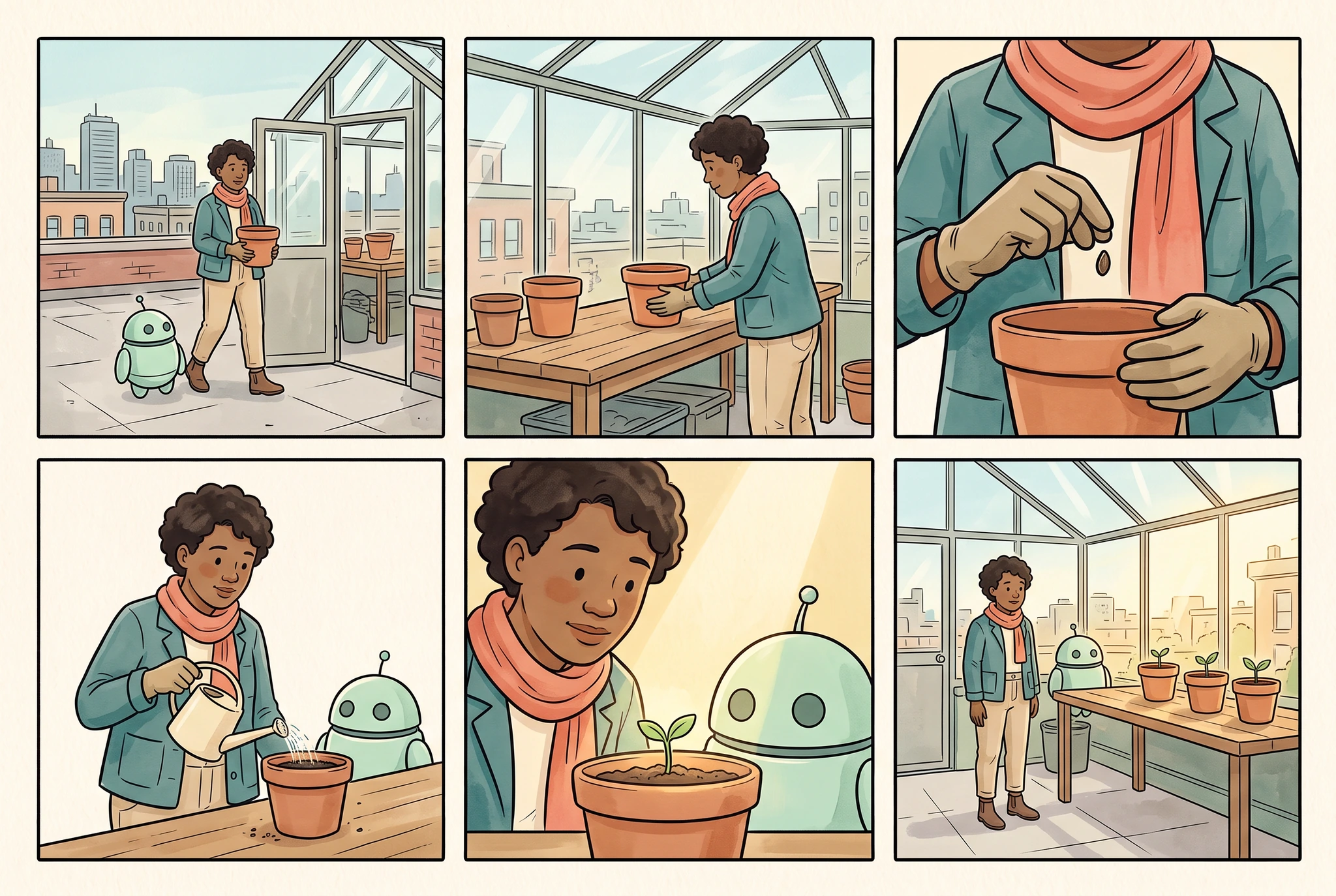
Image record
Google Vertex AI · gemini-3.1-flash-image · · 1280 × 859 px
Original generation prompt
Use case: illustration-story. Make ONE original finished comic page in a clean three-column by two-row grid, exactly SIX equally sized panels, narrow even ivory gutters and complete outer margins. The provided image is the character identity and wardrobe reference, not a page to copy. Preserve its adult botanist with warm brown skin, short dark curly hair, teal jacket, coral scarf, sand trousers, brown boots, and round mint helper robot with two dark eyes and exactly one short antenna. Quiet elegant ink-and-watercolor comic style, teal/coral/sage/ochre palette. Tell a very simple readable rooftop greenhouse planting story: panel1 wide view botanist and robot arrive at the greenhouse carrying a small terra-cotta pot; panel2 medium view the botanist places the pot on the wooden bench; panel3 close view gloved adult hands holding a seed above the pot; panel4 medium view botanist and robot water the pot with a small cream watering can; panel5 close view botanist and robot look at the tiny seedling; panel6 wide view both stand by the finished row of three potted seedlings in afternoon light. All people are adults; each scene has one botanist and one robot unless only hands are framed. The pot remains terra-cotta, the greenhouse stays structurally coherent, identity and outfit remain recognizable. No writing, numbers, logos, speech balloons, captions, lettering, illegible marks, third-party characters, UI, photorealistic environment or claims of tested consistency. Landscape 3:2.
View full artworkUse the sketch for composition
Explain which subject and object positions are important instead of treating every rough mark as a finished detail.
State the intended changes
Choose a focused visual direction and identify any detail the new image should clarify.
Inspect the story information
Check that the result still explains the intended action and relationship between the subjects.
A source image improves the brief when its role is clear. Review the result against that role rather than expecting every property to transfer automatically.
A practical starting point
Choose the source and its purpose
Decide whether the image supplies identity, composition, style or another reference. Use material you have permission to share.
Define the transformation
Describe what should change and which features are important to preserve. Avoid conflicting references or ambiguous instructions.
Compare the result with the task
Review the source and output together. Check structure, identity, requested changes and errors at the intended display size.
What to inspect
Image record
Google Vertex AI · gemini-3.1-flash-image · · 1280 × 859 px
Original generation prompt
Use case: photorealistic-natural / product-mockup. Convincing natural editorial PHOTOGRAPH at an adult artist's clean drawing table. Supplied image1 is the original character identity sheet; image2 is the original six-panel greenhouse story. Four separate medium matte landscape cards lie in a clean two-by-two arrangement on the table. Their artwork uses the SAME original adult botanist in teal jacket and coral scarf, same mint-green one-antenna robot, same greenhouse and terra-cotta pot. Show four distinct useful framings from the supplied story: wide greenhouse establishing view, medium pot-on-bench action, close-up seed-and-hands detail, and medium shared watering action. Cards have generous blank ivory borders; all four are fully inside frame and none overlap. A smaller character-reference sheet from image1 sits just behind the cards, partly visible. Exactly one relaxed realistic adult hand rests at the edge without covering the art. Natural ink/watercolor illustration stays on paper; room, wooden table and skin are photographic. No writing, numbers, arrows, logos, app UI or made-up test results. The finished framing alternatives dominate 80 percent of frame, subtle pencil and linen details only. Landscape 3:2, almost overhead.
View full artworkPersonal Agent · Creative Intelligence research
From Personal Agent memory to better creative results
A Personal AI Agent uses permissioned, evolving context to help someone complete work over time. For comic creators, the challenge is not only remembering a character, but retrieving the right story state, controlling the next image and verifying a creator-approved result. CyaniModel explores the visual-workflow layer of this larger architecture; DeepStory, Agent Loop and Feedback Learning are distinct proposed responsibilities, not claims of a fully deployed personal agent.
Research direction
Research behind the workflow
Choose references by their role
We are exploring whether explicitly matched identity, view and composition references reduce irrelevant or conflicting visual information.
Measure what the source was meant to preserve
Identity, composition and style are different evaluation questions. A useful comparison names the property the source was intended to guide.
Research direction
Character Consistency Benchmark
How reliably does a character remain recognizable across changes in camera, pose, clothing and scene?
How we would evaluate it: Evaluate identity, wardrobe, character count, story alignment and total cost per accepted panel separately.
Research direction
Adaptive Reference Selection
Which identity, full-body, outfit or camera-view reference helps a particular shot?
How we would evaluate it: Compare fixed reference sets with shot-matched sets using the same stories and acceptance rules.
Know the boundaries
- Image-to-image behavior and reference controls vary by the selected model and tool.
- A reference does not guarantee exact geometry, identity or style transfer.
Primary research informs these questions; it does not establish results for CyaniModel.
Frequently asked questions
Is image-to-image the same as a local photo edit?
An image-to-image workflow may reinterpret the full image. A local edit aims at a specific change. Check the controls and behavior of the tool you choose.
Can I use a sketch instead of a photograph?
A supported reference workflow may accept different image types. Make the sketch’s purpose clear, such as composition or pose, and inspect the actual output.
Can I guarantee the same character after a style change?
A style change can alter identity-defining details. Keep a clear identity reference and compare the result; exact preservation is not guaranteed.
Continue your story
Describe the photo edit you actually need
Plan a photo edit in everyday language. Define the intended change, identify what should be preserved and compare the edited result with the original.
Generate an image with a clear creative brief
Plan an original image from a focused brief. Choose a subject, composition and visual direction, then inspect the result for its intended use.
Prepare a character for more than one image
Build a reference-led plan for recurring original characters. Record identity, outfit and useful views before reviewing new poses and scenes.
Give the source image a clear role in the new result.
Continue in LlamaGen to check the available tools, model choices, account requirements and credits before generating.