

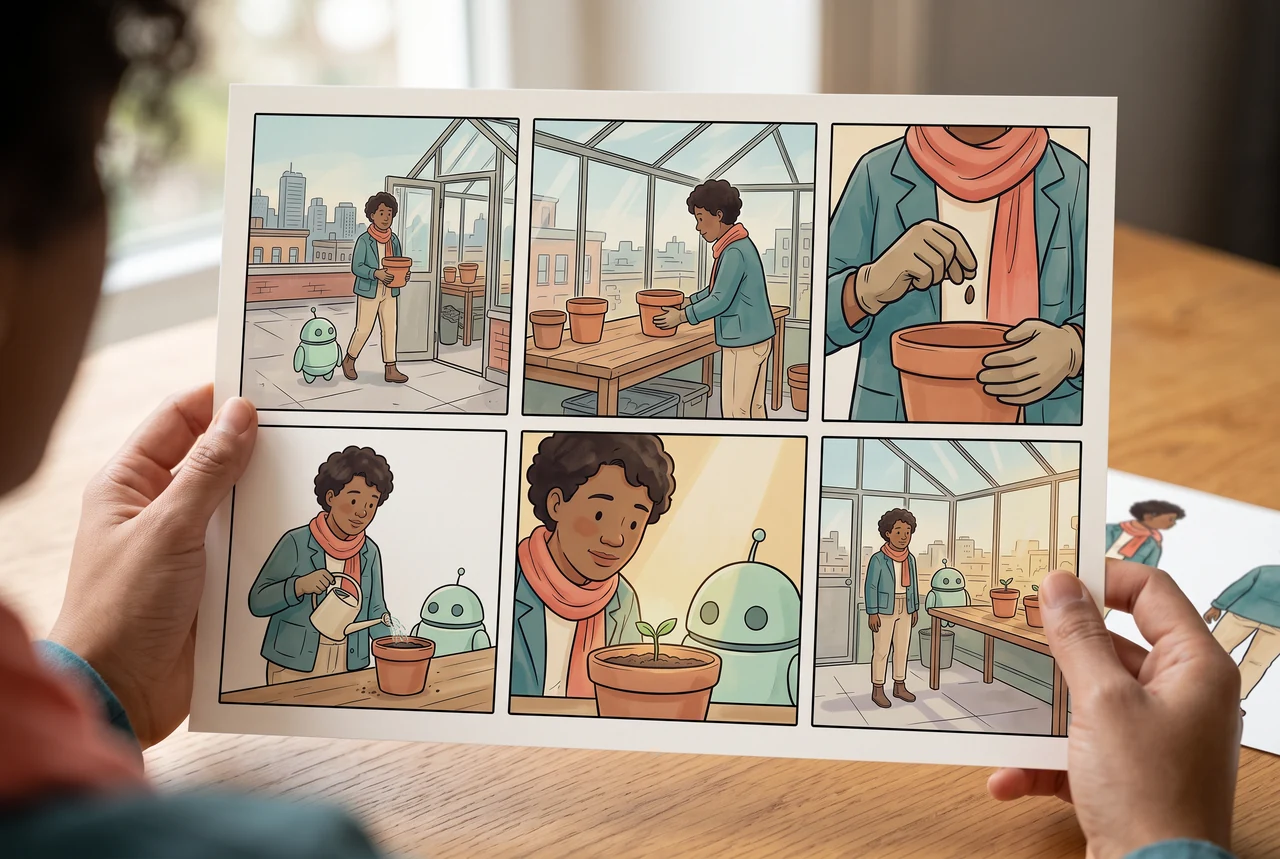
AI character consistency is the ability to depict the same character recognizably across multiple generated images while allowing the character to change pose, expression, camera angle or story state. In comics, the goal is not to reproduce an identical face in every panel. It is to preserve the character's identity while keeping each panel faithful to the scene.
This distinction explains why a character can look consistent in a portrait grid but drift across a multi-page story. A sequence asks the model to solve identity, action, composition, wardrobe, lighting and narrative context at the same time.
The short definition
AI character consistency is cross-image identity continuity under changing visual conditions. A consistent character remains recognizable across shots, while intentional changes—such as a new outfit, expression, pose or injury—are represented at the correct point in the story.
Identity and appearance state must be evaluated separately. A jacket change may be narratively correct; an unexplained change in face shape may be an identity failure.
Identity is not the same as appearance
A robust character record should distinguish at least five layers.
| Layer | What belongs in it | Example |
|---|---|---|
| Stable identity | Defining facial features, body proportions, silhouette, species or signature traits | A round mint robot with one antenna |
| Appearance state | Current outfit, accessories, hair arrangement and visible condition | A teal work jacket and coral scarf |
| Scene state | Location, lighting, weather, props and who is present | A greenhouse with a terracotta pot |
| Shot state | Camera distance, angle, pose, expression and screen position | Medium shot from a low angle |
| Style state | Line quality, palette, rendering and visual treatment | Soft ink-and-watercolor illustration |
This structure prevents two opposite errors: treating every visual change as drift, and allowing real identity changes to pass because the scene looks attractive.
A character who removes a jacket has changed appearance state, not identity. A character whose signature silhouette, facial proportions or defining markings change without a story reason may have drifted.
Why one reference image is rarely enough
A reference image carries only the information visible from its viewpoint. A close-up may be useful for facial identity but reveal little about shoes, body proportions or costume construction. A rear view may clarify silhouette and clothing shape but provide no facial evidence.
Reference selection should therefore follow the shot:
- Close-up: prioritize facial identity, expression range and defining details.
- Full-body shot: include body proportions, costume and silhouette.
- Profile or rear view: include a matching viewpoint or a reference that clearly shows the relevant side.
- Action panel: combine identity evidence with a pose or composition guide.
- Multi-character panel: bind each reference to a specific character role so attributes do not leak between subjects.
More references are not automatically better. Duplicates, conflicting outfits or unrelated viewpoints can dilute the signal. The useful question is whether each reference contributes evidence for the current shot.
See LlamaGen's practical guides to consistent-character comics and consistent character generation.
The technical approaches are complementary
Reference conditioning and identity adapters
Reference images provide subject-specific visual information. Adapter-based approaches can make image features available to a diffusion model alongside text prompts. The strength and behavior of this conditioning vary by model and implementation.
Personalization and LoRA
A LoRA can adapt a model toward a subject or style. It may help when a creator repeatedly uses the same character, but it is not a universal solution for panel-level action, camera changes or multiple subjects. A personalized model still needs the right scene and appearance state.
Multi-character binding
A scene with two characters has a role-assignment problem as well as an identity problem. The model must know which reference belongs to which character, who is speaking, who is acting and where each subject belongs in the layout.
DiffSensei explores customized manga generation by combining a multimodal language model with diffusion generation, using identity adaptation and masked cross-attention to support multiple characters and panel-specific actions. This is research context—not evidence that CyaniModel uses the same architecture.
Cross-frame and cross-shot methods
StoryBooth explores training-free approaches to reduce multi-character interference across story images. Its results help explain why identity consistency is a sequence-level problem rather than a prompt-only problem.
A practical continuity workflow
- Create a canonical character record. Store approved references, stable identity traits and source provenance.
- Track appearance states. Record which outfit, accessories and props are valid in each scene or chapter.
- Resolve the current shot. Identify the characters, camera angle, action and relevant scene state.
- Select references by viewpoint and role. Avoid giving every panel the same undifferentiated reference bundle.
- Generate the panel. Keep identity constraints separate from the requested action and composition.
- Review the result against the correct state. Compare the face, silhouette, outfit, props, cast count and action.
- Save approved changes. If a character's appearance intentionally changes, record when and why.
This is a repeatable review process, not a promise that every image model will obey every condition.
How to measure character consistency
A single face-similarity score is not enough for stylized comics, mascots or multi-character scenes. A useful evaluation separates:
| Dimension | What to inspect |
|---|---|
| Identity similarity | Does the subject match the authorized character reference? |
| Cross-panel stability | Does the character remain recognizable across viewpoints and expressions? |
| Appearance-state accuracy | Are outfit and props correct for this point in the story? |
| Cast and role accuracy | Are the right characters present, distinct and assigned correctly? |
| Action alignment | Does the character perform the requested action? |
| Style consistency | Does the panel belong to the intended visual language? |
| Copy-paste behavior | Is the model repeating the same pose or composition instead of depicting the new action? |
ViStoryBench, a story-visualization benchmark accepted at CVPR 2026, evaluates several separate dimensions, including character consistency, style consistency, prompt alignment, quality and diversity. Its metric definitions are useful when designing an evaluation protocol, but benchmark scores should not be transferred to another product or dataset.
ViStoryBench benchmark and metrics.
Common failure modes
- Identity drift: the face, silhouette or defining features change between panels.
- Wardrobe drift: an outfit changes without a story event.
- Attribute leakage: one character receives another character's clothing, colors or accessories.
- Cast errors: an extra character appears or a required character disappears.
- Action failure: the character looks correct but does not perform the requested action.
- Copy-paste consistency: the same pose is repeated even when the story requires a new gesture or camera angle.
- Style drift: the character remains recognizable but the rendering no longer fits the page.
A review should name the failure before choosing a correction. Rewriting the entire prompt when only the camera is wrong can damage details that were already correct.
What this means for CyaniModel
CyaniModel's public workflow material treats character continuity as a distinct creative problem: reference choice, identity versus wardrobe, shot context and panel review. The broader LlamaGen direction connects this visual layer to DeepStory, where canonical story facts and appearance history can be retrieved, and to Agent Loop, which can coordinate generation and review steps.
These are architectural directions, not a claim that every described memory, identity adapter or automatic benchmark is already a released customer feature. The current model, provider and controls should be verified on the relevant product route.
Start with the CyaniModel overview, then explore character continuity workflows or AI comic creation.
Research references
- DiffSensei: Bridging Multi-Modal LLMs and Diffusion Models for Customized Manga Generation, CVPR 2025
- Storybooth, ICLR 2025
- ViStoryBench, CVPR 2026