

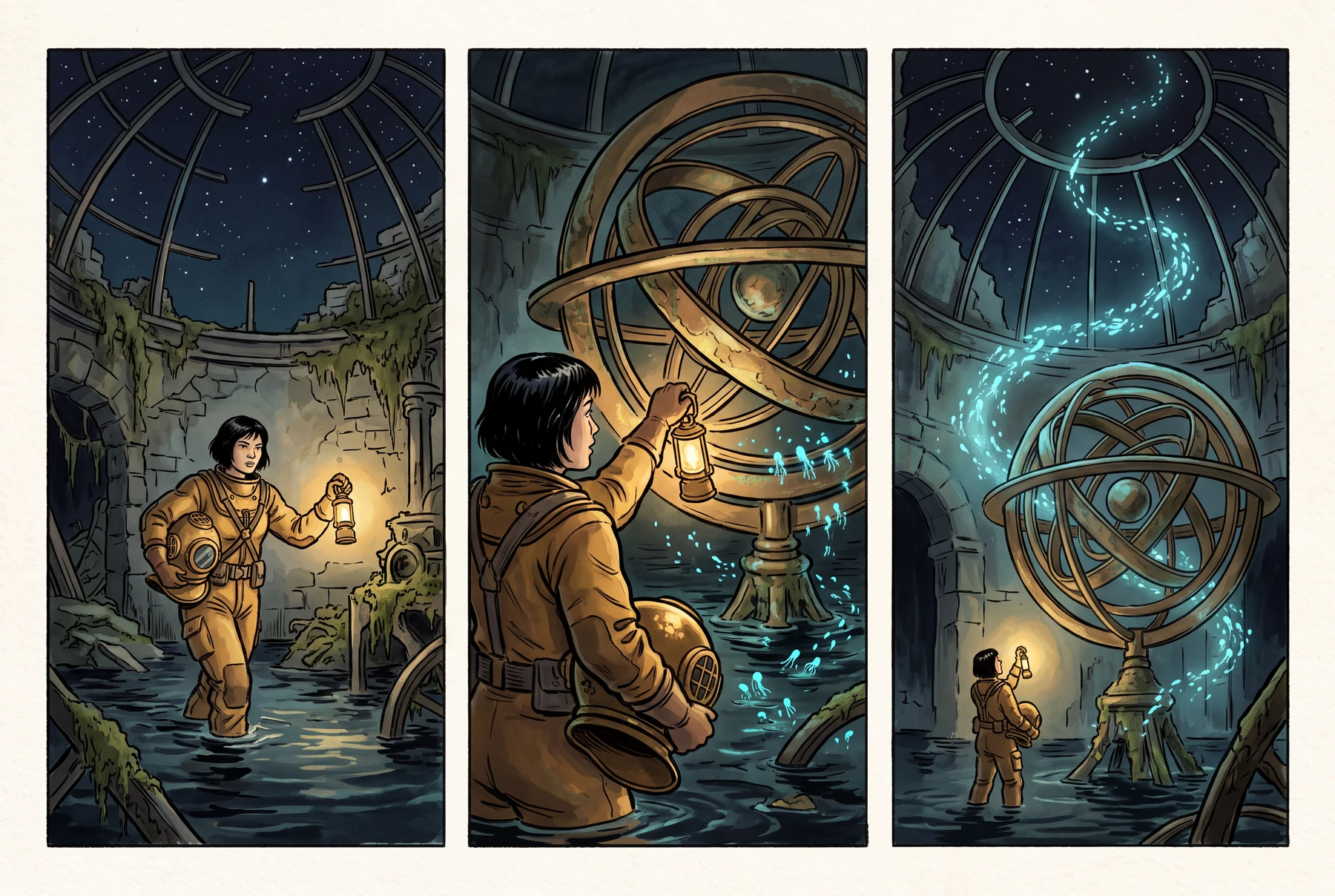
Controllable AI image generation is the practice of steering a generative model toward an intended result through explicit constraints. Those constraints can describe what must appear, what must stay the same, what may change, and how the image should be structured. A prompt is one control channel; references, spatial conditions, masks, edit instructions and review rules are others.
The distinction matters in professional visual work. A single attractive image can tolerate some variation. A comic sequence, character sheet, campaign system or product illustration cannot: identity, layout, props, wardrobe, typography and story state may all need to remain consistent while one requested detail changes.
This article defines the term, maps the main control mechanisms, and explains how LlamaGen uses CyaniModel as a product-level approach to controllable visual creation for anime, comics and game-inspired workflows.
The short definition
Controllable AI image generation is image synthesis in which a user or system can specify and inspect multiple output constraints—semantic, identity, structural, local-edit and sequence-level—so that the result follows the creative brief beyond broad prompt similarity.
It does not mean deterministic control over every pixel. Generative models remain probabilistic, and a conditioning signal improves guidance without guaranteeing perfect compliance. A useful control system therefore combines generation with explicit review and correction.
Six dimensions of visual control
Control is not one slider. In production, it is useful to separate the constraints that a task needs.
| Control dimension | What it answers | Common mechanisms |
|---|---|---|
| Semantic intent | What is happening in the image? | Natural-language prompt, structured scene brief |
| Subject identity | Who or what must remain recognizable? | Reference images, image adapters, personalization |
| Spatial structure | Where should subjects and objects appear? | Pose, edge, depth, segmentation, layout conditions |
| Edit scope | What may change, and what should be preserved? | Masks, inpainting, instruction-guided editing |
| Sequence state | What must remain coherent across panels or frames? | Character records, shot state, cross-image context |
| Delivery constraints | What makes the asset usable? | Aspect ratio, safe areas, text legibility, export specifications |
A workflow becomes more reliable when it names these constraints separately. “Keep the same character” is an identity constraint. “Keep the red coat in this scene” is an appearance-state constraint. “Move the character to the left third” is a spatial constraint. “Change only the background” is an edit-scope constraint.
Combining them into one long prompt can work for a draft, but it makes failures difficult to diagnose.
How the main control techniques fit together
Different research methods solve different parts of the problem. They are complementary, not interchangeable.
Spatial conditioning: ControlNet and related controls
ControlNet adds spatial conditioning to a diffusion model. Depending on the control model, an image can be guided by signals such as edges, depth, pose or segmentation. This is useful when composition or geometry matters more than a purely descriptive prompt.
Spatial conditioning does not automatically preserve a character's identity. A pose map can guide where a body is positioned while leaving the model free to change facial details, clothing or style. Identity and structure should therefore be evaluated separately.
Primary reference: ControlNet, ICCV 2023.
Image references: IP-Adapter and identity conditioning
An image reference provides visual information that text may describe poorly: a character's silhouette, facial design, costume language, color palette or object appearance. IP-Adapter is one research approach for injecting image-prompt features into a text-to-image diffusion model.
A reference is not a universal lock. Its influence depends on the model, adapter, reference quality, prompt and competing conditions. A close-up portrait may help with facial identity but be weak evidence for a full-body costume or rear view.
Primary reference: IP-Adapter.
Parameter adaptation: LoRA
Low-Rank Adaptation (LoRA) is a parameter-efficient way to adapt a pretrained model using smaller trainable weight updates. It is widely used in image-generation ecosystems for style or subject personalization.
LoRA is not the same as a runtime layout controller. It can make a model more familiar with a subject or style, but it does not by itself specify the exact position of a character, the reading order of a comic page or which pixels must remain untouched.
Primary reference: LoRA: Low-Rank Adaptation of Large Language Models. The method was introduced for language models and later adapted by the community to other model families.
Instruction-guided editing
Instruction-guided editing asks a model to transform an existing image according to a natural-language instruction. InstructPix2Pix is an influential example of this task formulation.
A natural-language edit such as “replace the cloudy sky with a clear sunset” is convenient, but an instruction alone does not prove that every unrelated region was preserved. If preservation is critical, define the allowed edit region, compare the before-and-after result, and reject changes outside the intended scope.
Primary reference: InstructPix2Pix, CVPR 2023.
Why comic creation needs layered control
A comic page contains more than a collection of images. Each panel has a role in a sequence. A character may keep the same identity while changing expression, pose, camera angle or clothing because the story has advanced.
A useful comic-generation brief therefore separates:
- Character identity: stable facial and body traits, silhouette and defining design.
- Appearance state: the outfit, accessories and props that are valid in this scene.
- Panel structure: cast count, placement, camera distance, action and reading order.
- Narrative state: what happened before this panel and what must remain true afterward.
- Editorial constraints: dialogue space, page layout, aspect ratio and publication format.
This is why “same character” cannot mean “copy the same image.” The model must preserve the character while allowing the character to act differently.
See the practical workflows for reference-led character consistency, single-panel composition and image-to-image creation.
A practical control loop
A controllable workflow should make each constraint inspectable.
- Write the brief as constraints. Separate identity, action, composition, style, edit scope and delivery requirements.
- Choose the right condition. Use text for intent, references for identity, spatial signals for geometry and masks or edit instructions for localized changes.
- Generate a candidate. Do not treat the first output as an accepted result.
- Inspect each constraint independently. Check subject identity, cast count, pose, layout, text space and preservation outside the edit region.
- Revise the failed dimension. Change the reference, structure or edit instruction that corresponds to the failure instead of rewriting the entire prompt.
- Record the accepted version and its evidence. Keep the source reference, prompt, settings and approval together when the asset will be reused.
The practical rule is simple: control the variable that failed; do not disturb the variables that already passed.
What CyaniModel means at LlamaGen
At LlamaGen, CyaniModel is the name used for a product-level approach to reference-led, controllable visual creation for anime, comics and game-inspired work. It connects supported image-generation and editing workflows with character references, scene planning and review.
CyaniModel should not be interpreted as a claim that LlamaGen has trained an independently owned foundation model or that every research technique described above is implemented in the current product. Provider models, available controls and production features are separate facts and should be checked on the relevant workflow page.
The broader LlamaGen architecture connects this visual-control layer with DeepStory for persistent story context, Agent Loop for task execution, and feedback-learning research for improving later decisions. Those are related system concepts, not synonyms for controllable image generation.
Explore the CyaniModel overview and its natural-language image-editing workflow.
How to evaluate controllability
A useful evaluation asks whether the output obeyed the requested constraints, not only whether it looks attractive.
| Evaluation dimension | Example review question |
|---|---|
| Identity retention | Is the subject recognizably the same character as the authorized reference? |
| Structural alignment | Did the subject, camera and major objects follow the intended layout? |
| Action alignment | Is the requested action visible and understandable? |
| Edit locality | Did unrelated regions remain acceptably unchanged? |
| Sequence continuity | Does the panel fit the character and story state established earlier? |
| Delivery readiness | Are text areas, page dimensions and export requirements satisfied? |
A score should be tied to a defined reference, a fixed evaluation procedure and the task being tested. One face-similarity score cannot establish overall comic quality, and an attractive sample cannot establish a benchmark result.
Limitations and responsible use
- References guide a generation; they do not guarantee pixel-level preservation or identity.
- A spatial condition can preserve geometry while identity drifts.
- Fine-tuning or adapters can improve a subject representation while reducing flexibility elsewhere.
- Text rendering, speech-bubble placement and small details still need direct inspection.
- Reference images must be owned, licensed or otherwise authorized for the intended use.
- Any benchmark claim should disclose its dataset, model version, settings, scoring method and human-review procedure.
Research references
- ControlNet — Adding Conditional Control to Text-to-Image Diffusion Models, ICCV 2023
- IP-Adapter — Text Compatible Image Prompt Adapter for Text-to-Image Diffusion Models
- LoRA — Low-Rank Adaptation of Large Language Models
- InstructPix2Pix — Learning to Follow Image Editing Instructions, CVPR 2023