

Prompt library · 12 original templates · November 2026
12 AI manga prompt templates you can actually use
The best manga prompt is a miniature production brief. It tells the model who is present, what happens, how the panels advance the story, and which visual traits must stay consistent. Copy one of these original templates, replace the details, then review the result.
The short version
Make deliberate creative choices. Review the results.
Use the prompts as story briefs, not as promises of one-click final pages. Pick the correct format, replace bracketed details and proofread every generated caption.
The pages shown here are original LlamaGen example artwork, not output guarantees for your prompt or plan.
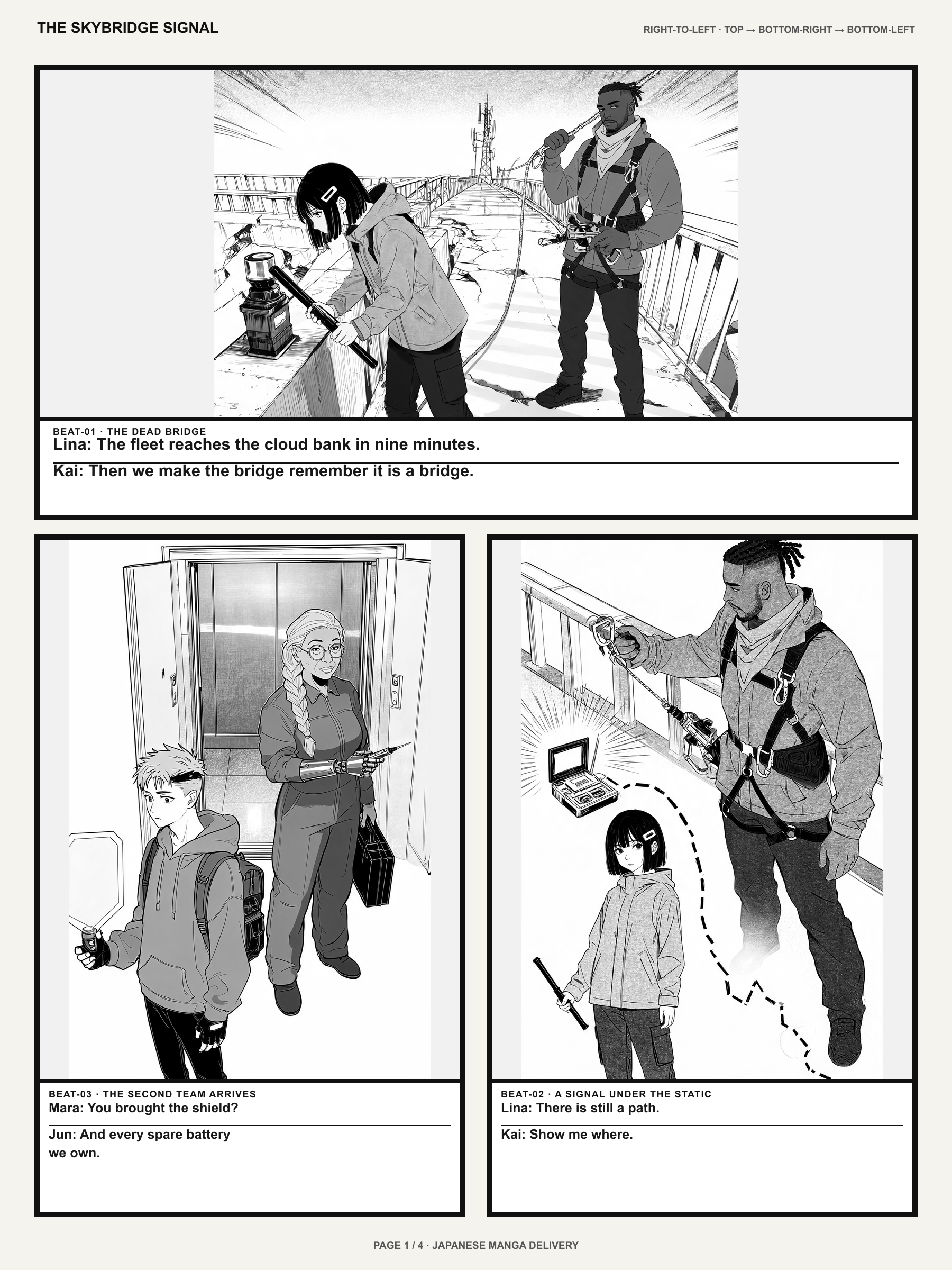
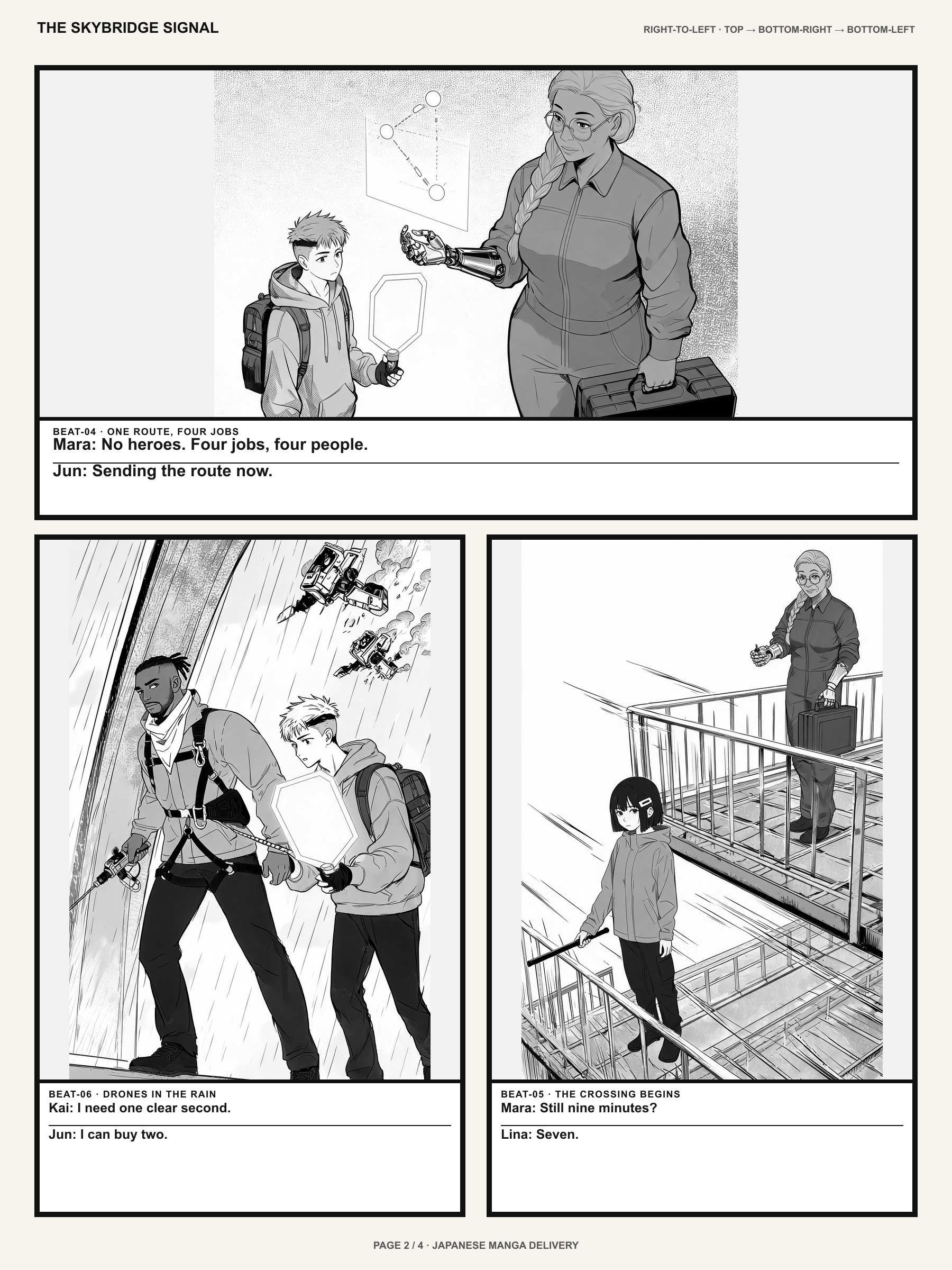
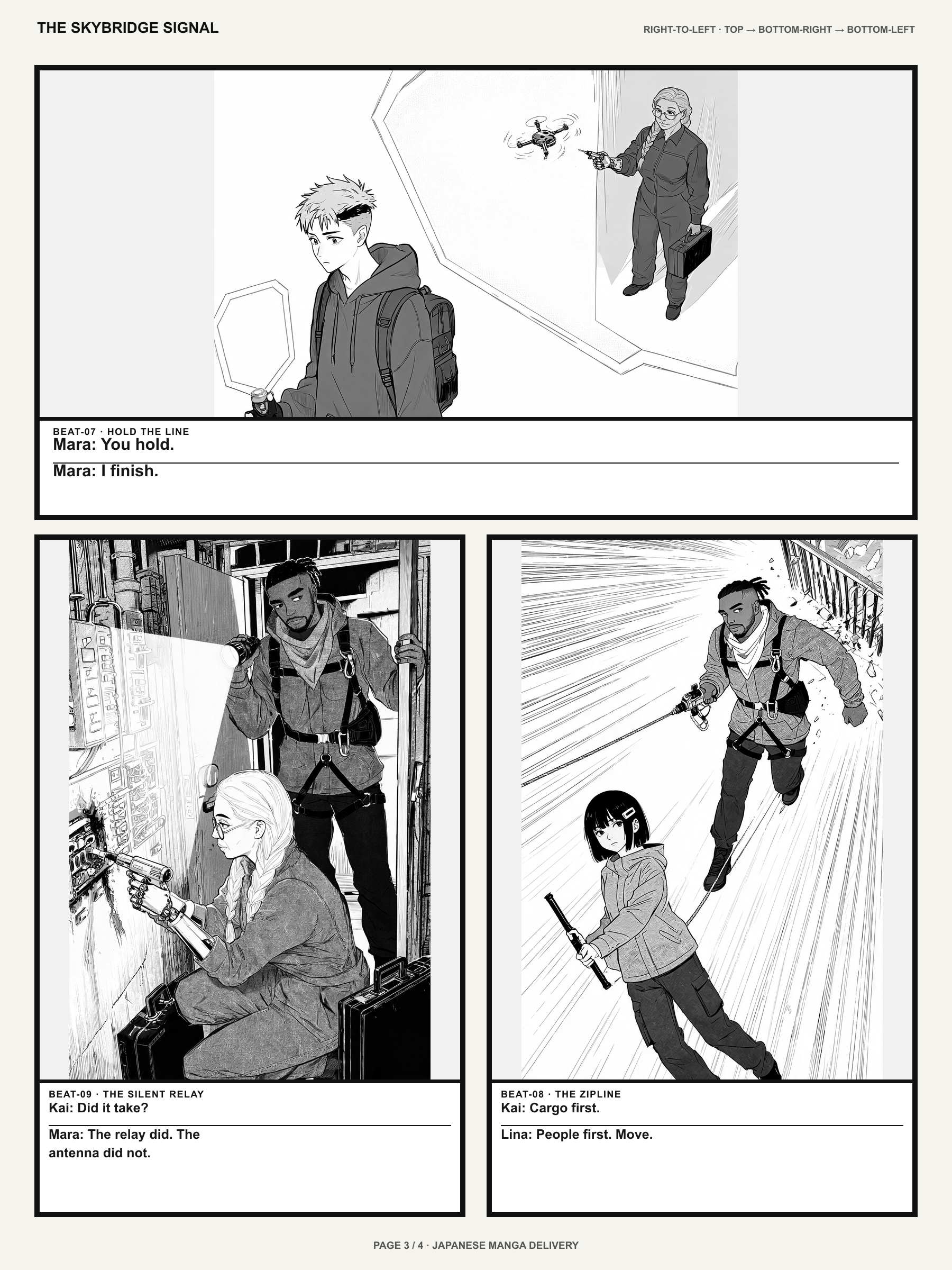
1. A simple formula for a stronger manga prompt
Start with FORMAT + CAST + GOAL + SEQUENCE + VISUAL RULES + DIALOGUE. For example: ‘Three-page black-and-white manga, original protagonist with short hair and round glasses, searching a deserted greenhouse; page one establishes the greenhouse, page two reveals fresh footprints, page three ends on a shadow; cinematic medium shots, readable gutters, minimal dialogue.’
Give the character identity a short, stable description. Put camera angles, lighting, expressions and movement in the scene instructions. Be specific about the intended page count and reading direction, but confirm which controls exist in your current creator plan before requesting a longer chapter.
2. Copy a starting point for your genre
Each prompt below is an original concept designed to be adapted. Use Copy prompt, paste it into your story brief in Mangaka, and change the names, conflict and dialogue to make the story yours. The copy button does not automatically start a paid generation.
Template 01 · Fast, legible movement
Black-and-white action
Create a three-page black-and-white action manga with original characters. Lead: Ren, a courier with a cropped haircut, scar over the left eyebrow, and a long dark coat. Page 1: low-angle city rooftop establishing shot and a late delivery. Page 2: three escalating panels as a drone spots Ren; clear left-to-right motion and varied shot sizes. Page 3: close-up of the unopened package vibrating, then a silent cliffhanger. Crisp ink, controlled screentones, readable panel gutters, minimal English dialogue. Keep Ren's face and coat consistent.
Template 02 · Expressive close-ups
Shōjo romance
Write a three-page original shōjo romance manga about two classmates repairing a broken observatory telescope. Lead A: Emi, wavy shoulder-length hair and round glasses. Lead B: Jun, tall with a neat side part and a green scarf. Page 1: awkward teamwork at sunset. Page 2: a mistaken assumption revealed through small expression panels. Page 3: first clear view of the stars and a quiet, warm line of English dialogue. Delicate ink, flower-like negative space, consistent costumes, gentle pacing, clear bubble order.
Template 03 · Quiet emotional rhythm
Everyday slice of life
Create a four-panel slice-of-life manga page about an elderly baker teaching a new apprentice to fold dough before dawn. Original cast, same outfits in all panels. Panel 1: flour-dusted countertop and warm window light. Panel 2: close-up of nervous hands. Panel 3: patient demonstration. Panel 4: the first imperfect but successful loaf. Simple black-and-white linework, expressive gestures, understated English dialogue and readable gutters.
Template 04 · Page-turn suspense
Mystery cliffhanger
Plan three pages of an original mystery manga in a closed coastal library. Investigator: Sora, short silver hair, navy raincoat, brass key on a red cord. Page 1 shows a locked reading room. Page 2 follows a trail of fresh saltwater footprints through three clear panels. Page 3 reveals a book that records tomorrow's date, ending on a close-up. High-contrast ink, atmospheric shadows, precise prop continuity, sparse English captions and a final silent panel.
Template 05 · Worldbuilding through action
Fantasy adventure
Create a three-page fantasy manga scene with an original young cartographer named Ila, braided black hair, amber cape, and a compass-shaped pendant. Page 1 introduces a floating market city. Page 2 shows Ila trading a map for an impossible direction. Page 3 reveals that the compass needle points into the sky. Detailed but readable environmental panels, inked line art, restrained dialogue, consistent pendant and cape in every scene.
Template 06 · Clear visual reveals
Sci-fi discovery
Make a three-page original science-fiction manga about maintenance pilot Noa exploring a silent orbital greenhouse. Noa wears a white work suit with a single orange patch and a transparent helmet. Establish empty plant rows, reveal a growing handprint inside the glass, and end with one plant tapping back. Cinematic establishing shots, technical details that stay consistent, clean black-and-white panels, short English speech bubbles, and an unmistakable final reveal.
Template 07 · Readable movement
Sports momentum
Storyboard a two-page original basketball manga about a rookie who must pass instead of taking the final shot. Hero: Kai, curly hair, jersey number 14, blue wrist tape. Page 1 sets court position and the timer. Page 2 uses three progressively tighter panels to show the pass, a teammate's jump and the buzzer. Strong speed lines without confusing court geography, consistent jersey numbers, energetic English dialogue.
Template 08 · Setup and reversal
Comedy with a visual payoff
Create one four-panel comedy manga page about an apprentice wizard whose every spell produces houseplants. Panel 1 sets up a serious magical exam. Panel 2 shows a dramatic incantation. Panel 3 reveals an enormous potted fern. Panel 4 shows the examiner quietly asking to keep it. Original school setting, exaggerated faces, clean silhouettes, concise English bubbles and a clear visual punchline.
Template 09 · Phone-first scroll pacing
Vertical webtoon
Draft a vertical mobile webtoon scene with five stacked beats and generous spacing. Original lead: Ana, short dark curls, yellow rain jacket, worn camera. Beat 1: wide shot of an empty rainy bus stop. Beat 2: close-up of a photo developing in her hands. Beat 3: long pause of blank night sky. Beat 4: the photographed person appears across the street. Beat 5: close-up reaction and a short English line. Warm cinematic colors, readable phone-size text and deliberate scroll reveal.
Template 10 · Strong silhouette and identity
Character introduction
Design an opening manga page introducing an original mechanic named Tess: shaved left side haircut, copper goggles, oversized charcoal overalls, and an enamel star pin. Use four distinct panels: silhouette in a workshop doorway, hands repairing a delicate clock, an expressive face close-up, and a final wide reveal of the machine she protects. Controlled ink shading, consistent accessories, one short English caption and clear panel order.
Template 11 · Bubble order and acting
Two-character dialogue
Produce a one-page original manga dialogue scene between siblings Lio and Bea who disagree about opening an inherited letter. Lio wears a striped sweater and has straight hair; Bea wears a light jacket and has short curls. Use a clear establishing two-shot, alternating medium close-ups, and a final reaction panel. Leave sufficient blank space for accurate English speech bubbles. Keep eye lines and props consistent and avoid crowded dialogue.
Template 12 · A memorable last panel
Dramatic chapter ending
Create the final two pages of an original manga chapter about a lighthouse keeper whose light is answered from beneath the sea. Keeper: Mara, dark braid, wool coat, round lantern. Page 1 builds suspense with storm details and a failing beacon. Page 2 moves from a close-up of Mara's hand to an enormous submerged light returning the signal. Monochrome cinematic composition, controlled screentones, very limited English dialogue, keep the lantern and coat consistent, end on a readable full-width reveal.
3. Adapt the template before generating
Keep a character sheet beside your prompt, especially when several people appear in a scene. Replace broad descriptors like ‘beautiful anime’ with concrete storytelling choices: foreground subject, distance, mood, who speaks and how the final panel changes the situation.
Do not ask for protected franchises or living artists' exact styles. Describe visual elements—ink contrast, restrained color, thick contours, atmospheric backgrounds—instead. Save a version of each prompt with the corresponding approved pages so later chapters can reuse what worked.
Quick checklist
- Swap in an original premise and cast
- Set page direction, genre and atmosphere
- Specify scene-to-scene continuity
- Check text and visual output manually
4. Revise the page, not the entire idea
If one page is weak, name the problem precisely: ‘The lead's coat changes in panel two’ or ‘The reveal arrives before the dialogue that sets it up.’ Correct your brief or use an available edit control, and confirm any additional credit usage first.
A useful prompt library is a record of creative decisions. Keep the final prompt, reference notes, and a short ‘what to fix next time’ line. That makes subsequent chapters more consistent than repeatedly starting with a generic adjective-heavy prompt.
Your story, your direction
Turn your idea into pages.
Bring your original brief to Mangaka. You can inspect available tools, sign-in requirements, plan eligibility and credit costs before you commit to generation.
Create with MangakaFrequently asked questions
How long should an AI manga prompt be?
Long enough to specify the cast, sequence, visual direction and important dialogue. A clear scene brief is more useful than a long list of unrelated style adjectives.
Do these prompts work for webtoons too?
Some templates target page-based manga and others vertical webtoons. Adapt the composition and panel spacing for the reading format supported by your current workflow.
Can I copy these prompts for my own stories?
Yes. These templates are original starting points. Replace the premise and character details, and make sure any uploaded assets are yours or appropriately licensed.
Will a prompt guarantee readable speech bubbles?
No. Generated lettering, dialogue and bubble order need manual proofreading. Check actual reading size and correct errors before sharing.
Explore the Mangaka workflow
Mangaka tools & software
Pick the right mix of AI and drawing tools.
Make manga without drawing
Go from a story idea to a reviewed sequence.
Consistent manga characters
Keep recurring cast details stable across pages.
Manga script to panels
Plan each page turn and scene beat.
Meet LlamaGen Mangaka
See the product workflow and real examples.