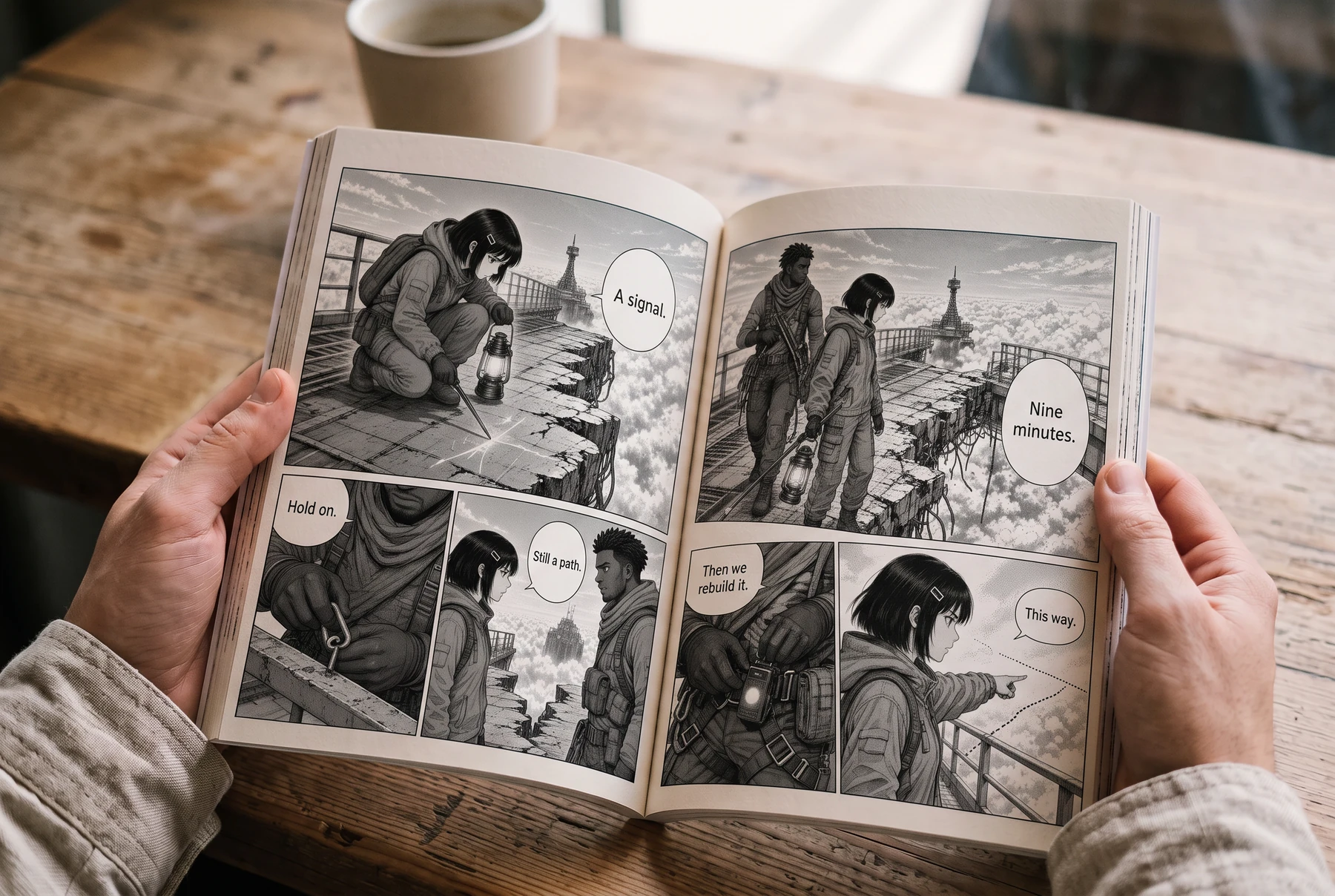
Manga planning guide
Script to manga: from four-panel beats to a longer chapter
A script becomes readable manga when you first map each scene to visible story beats. Start with our authored four-panel Mira example, then inspect a separately documented 12-page script-to-comic delivery below. The teaching diagram is not generated output, and the longer case is not a dedicated Japanese-manga benchmark.
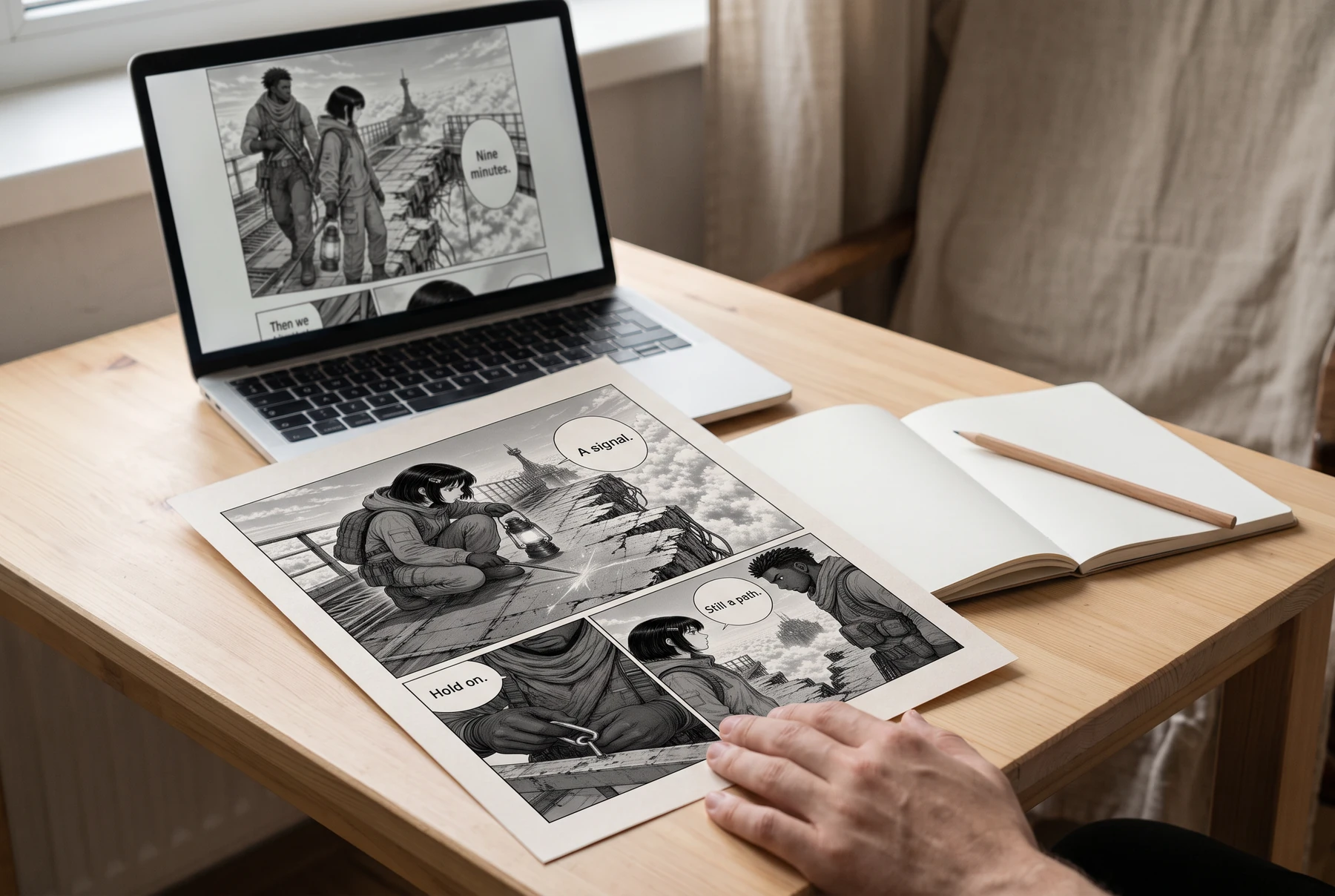
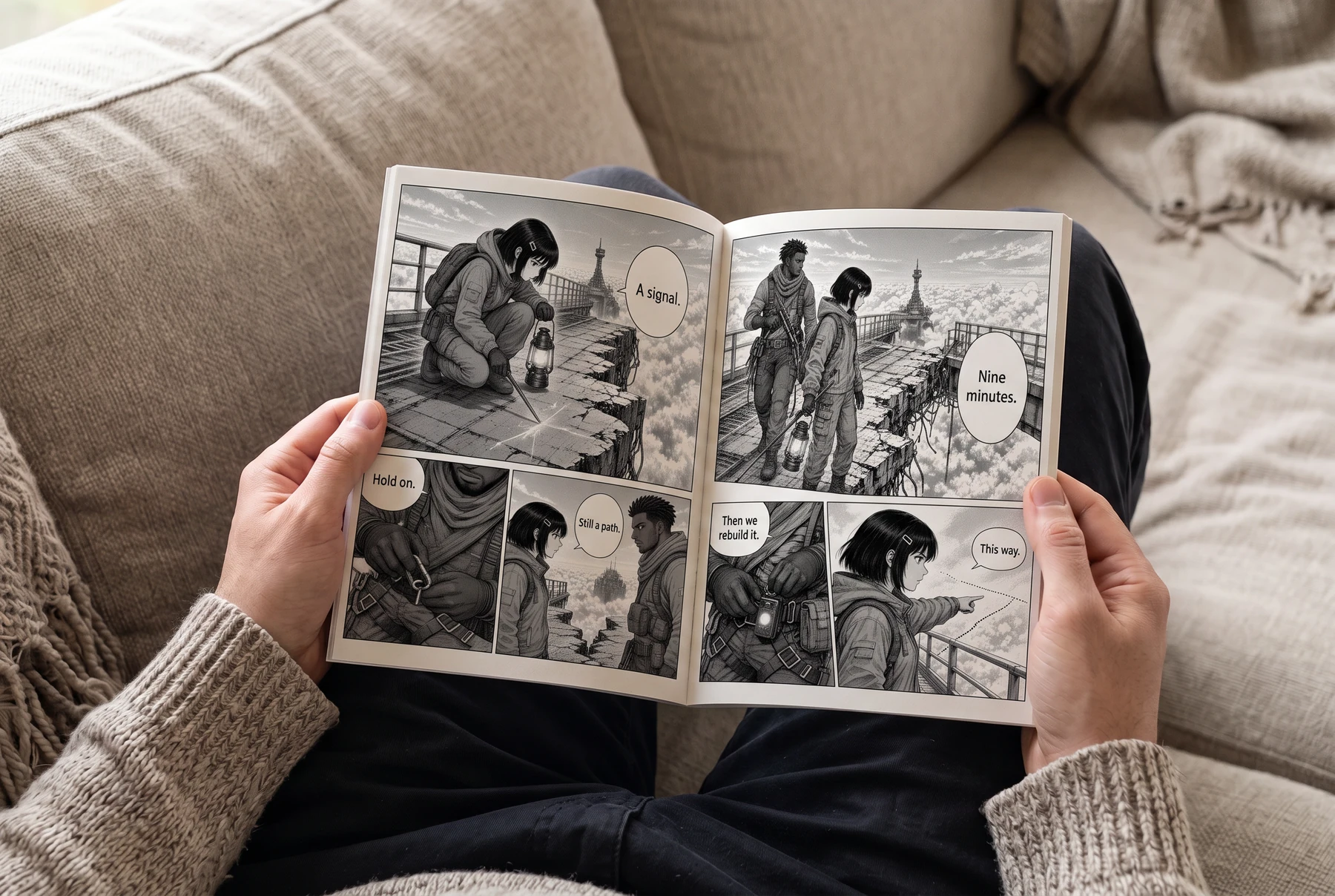
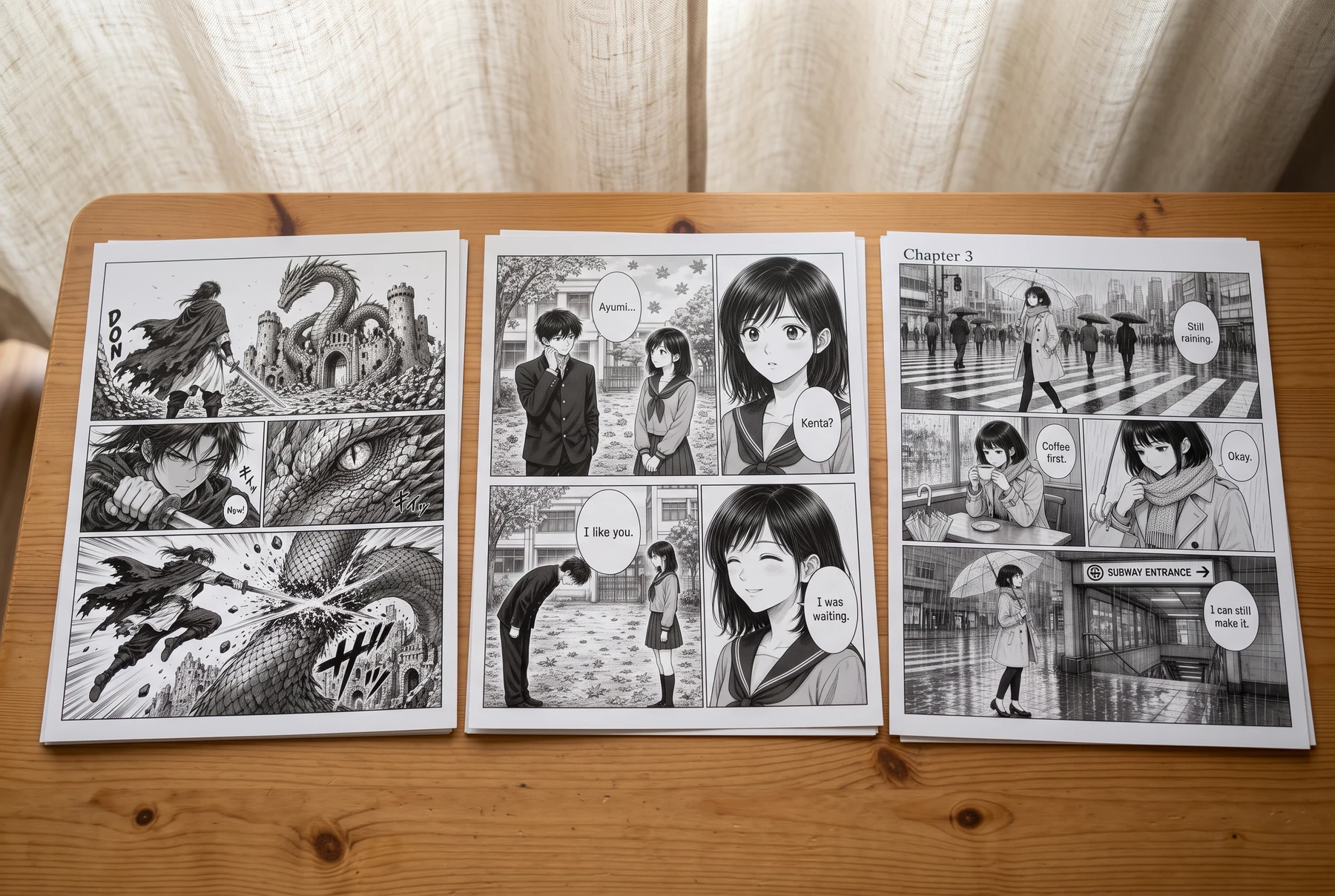
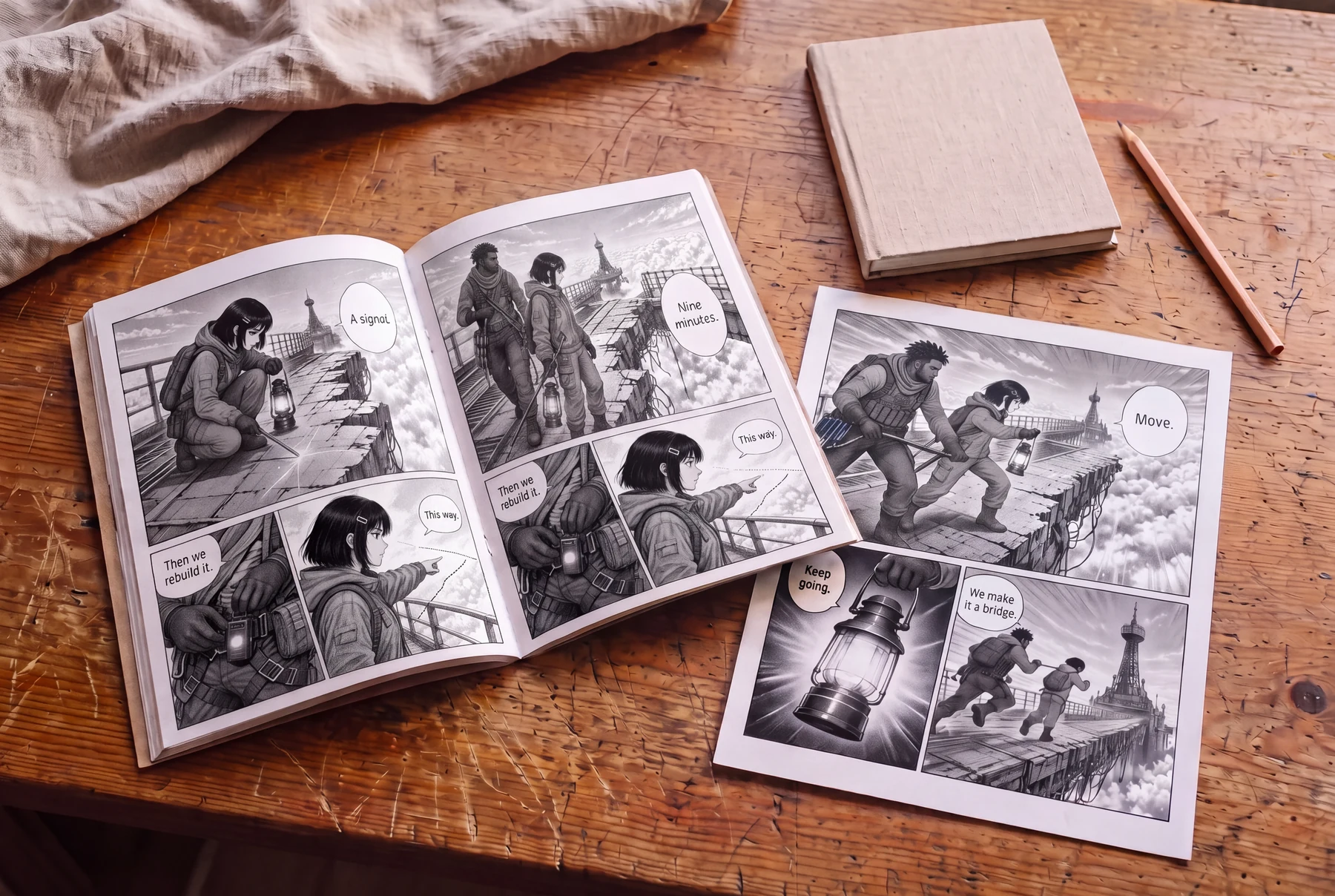
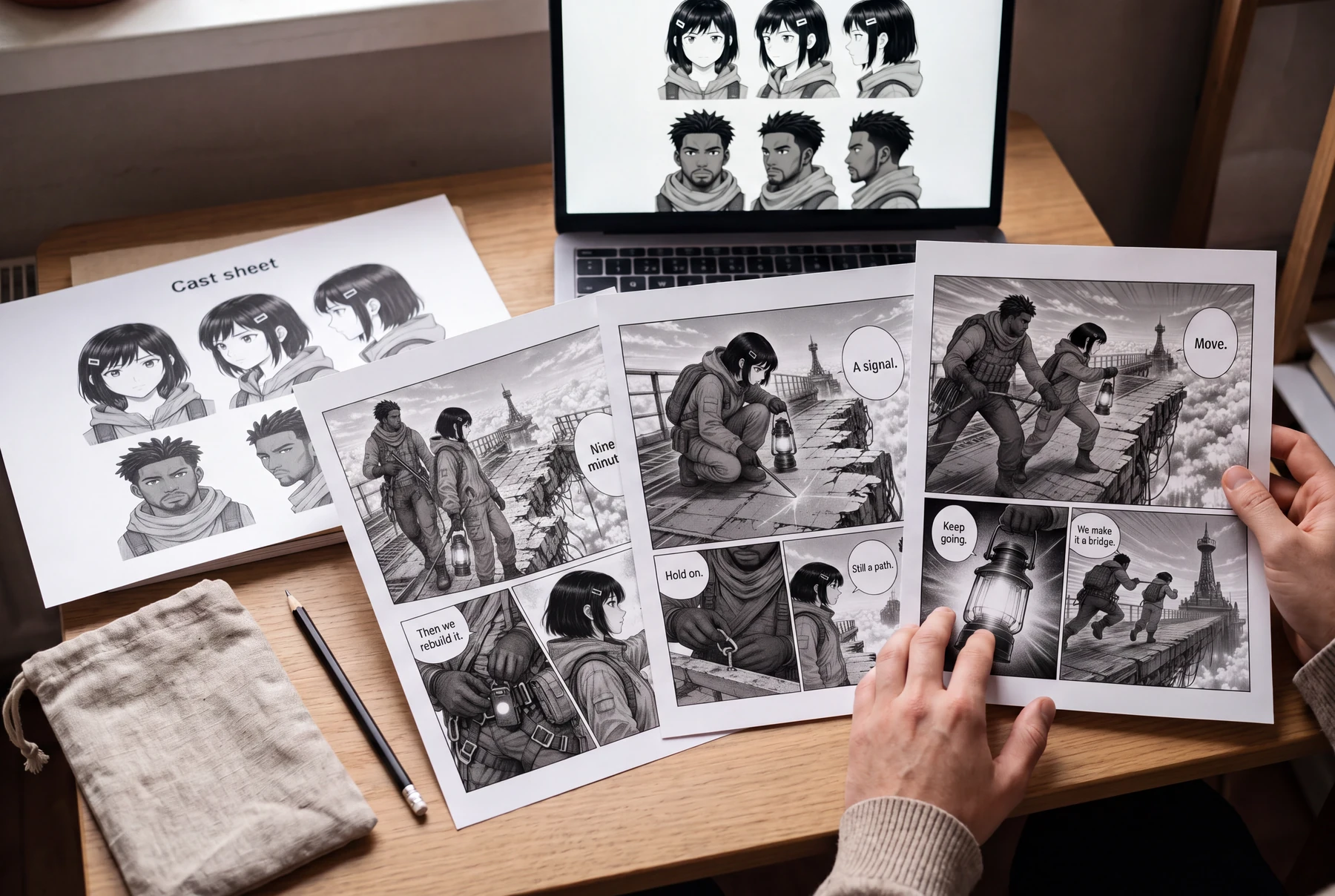
AI-generated lifestyle concepts with fictional people and original sample artwork. These scenes illustrate how manga could be read or presented; they are not customer photographs or verified product runs. Printed books and sets are self-prepared concepts, not a printing or delivery service offered by LlamaGen.
01
Give the scene one visible goal
Brief: Mira finds a notebook beneath a station bench and returns it before the train arrives. Hesitation becomes connection. One location and two characters keep attention on the exchange.
Record the references: Mira has chin-length black hair, a triangle clip on her left, and a dark jacket; the commuter wears a gray coat. The notebook has a red elastic band.
02
Assign one story beat to each panel
Read right to left, top to bottom: top-right 1, top-left 2, bottom-right 3, bottom-left 4. Lens numbers suggest framing; they do not guarantee camera-accurate generation.
- Panel 1 · Notice
- 28 mm wide view: rain beyond the canopy; Mira bends toward the notebook under the bench. The commuter waits at right. No dialogue.
- Panel 2 · Offer
- 50 mm medium view: Mira offers the closed notebook, red band visible. Mira: “Is this yours?”
- Panel 3 · Recognize
- 85 mm close-up: the commuter recognizes the notebook and reaches for it. Commuter: “My daughter's drawings…” The closed notebook's value becomes clear.
- Panel 4 · Resolve
- 50 mm two-shot: the commuter holds the notebook; Mira's hands are empty. Both smile. Commuter: “Thank you.” The handoff completes the scene.
03
Copy the plan into a reusable prompt
Replace the cast and setting; keep the beat structure. Put exact dialogue on separate lines for proofreading or lettering.
Original four-panel prompt
Create a four-panel manga draft, right to left, top to bottom: top-right 1, top-left 2, bottom-right 3, bottom-left 4.
Setting: rainy station, beneath one canopy.
Cast: Mira, chin-length black hair, triangle clip on her left, dark jacket; commuter, gray coat.
Prop: closed notebook, red elastic band. Keep designs consistent.
1: 28 mm wide framing. Mira notices the notebook beneath a bench; commuter waits at right. No dialogue.
2: 50 mm medium framing. Mira offers the notebook, red band visible.
Mira: "Is this yours?"
3: 85 mm close-up. Commuter recognizes it and reaches for it; notebook stays closed.
Commuter: "My daughter's drawings…"
4: 50 mm two-shot. Commuter holds the notebook, Mira's hands empty; both smile.
Commuter: "Thank you."
Use clear silhouettes and space for dialogue. No extra characters, captions, or speech.
04
Review the page, then revise one problem
Read without dialogue: can you follow the notebook from bench to Mira to commuter? Then read the words: is each speaker clear? Fix the handoff before polishing shading.
Generated drafts may change faces, props, text, or panel count. Check every result. The official generator and editor pages describe workflows; they do not validate this example or guarantee its result.
05
Scale the script into a chapter-length plan
For a longer script, build a scene inventory before generating anything: scene goal, cast and approved references, location, emotional change, essential dialogue, and the final page-turn beat. Divide each scene into pages and panel actions; keep a page-by-page record so later revisions do not silently skip or reorder plot points.
The separate first-party delivery below documents a 2,150-word original screenplay converted into twelve complete comic pages and 48 panels. It shows the *review and repair work* needed after the first output, including sixteen redraw events. That case used a comic presentation and bottom-band text, so it does not prove automatic right-to-left manga lettering or book-ready print files. See the chapter-format manga sample and the full book guide for those distinct decisions.
- Outline
- Mark what changes at the beginning, middle, and end of each scene. Every generated page should advance the plot or reveal a character decision.
- Assign pages
- Number the planned pages and reserve room for reactions, transitions, visual establishing shots, and a purposeful chapter ending.
- Review a complete run
- Check each panel against its source beat, mark first-pass defects, revise the affected panel, and inspect continuity again before exporting.
Documented delivery · August 11, 2026
A 2,150-word screenplay became a 12-page comic story
The Last Light of Meridian Station used one original, rights-cleared screenplay and six recurring characters. The complete delivered result contains 12 pages and 48 panels, with original files and revision history available for inspection.
- Input
- 2,150 words
- Delivered
- 12 pages · 48 panels
- First review
- 33/48 panels
- Targeted repairs
- 16 events · 15 panels
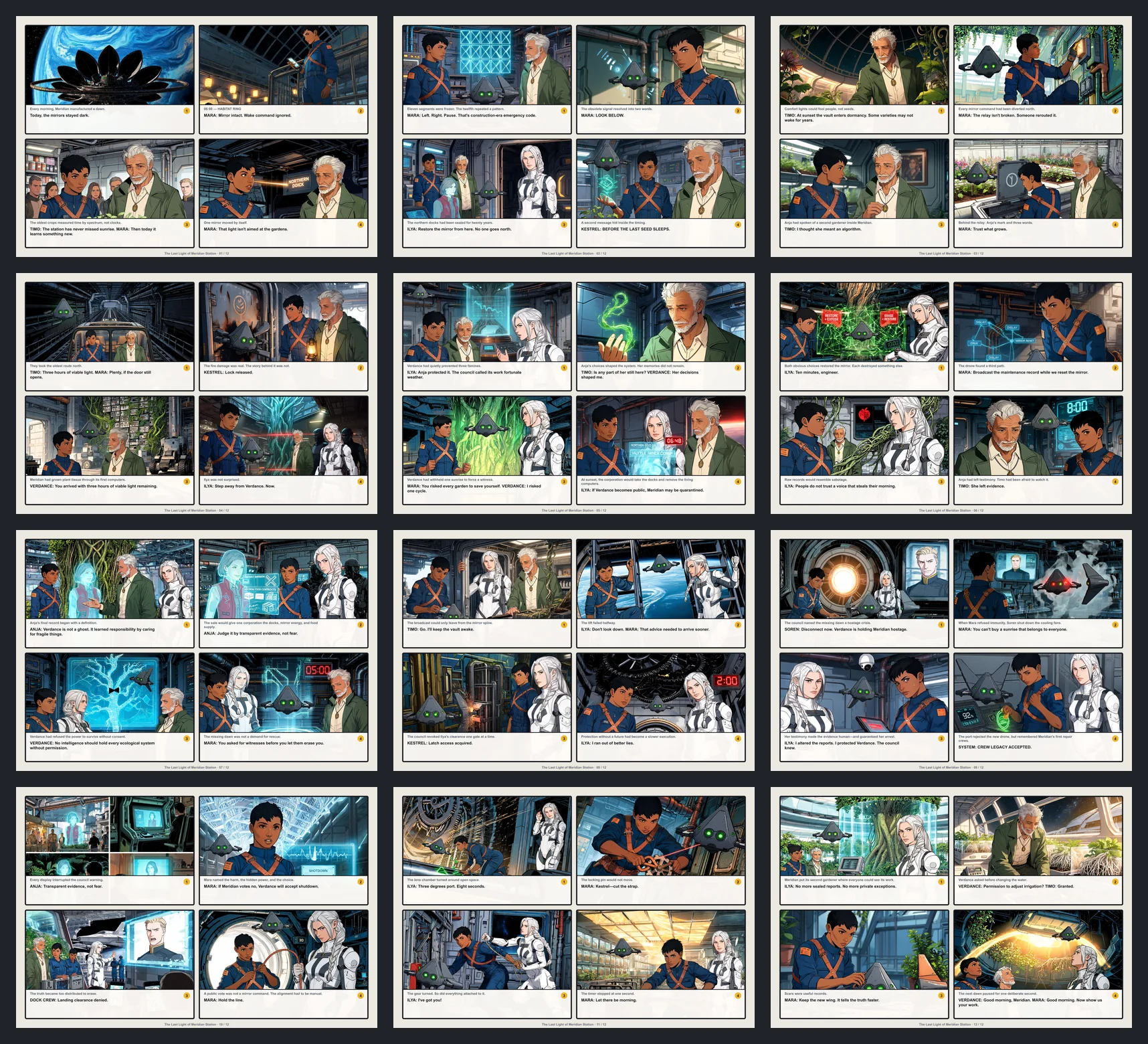
The recorded run used ByteDance Seedream 5 Lite. First review accepted 33 of 48 panels; the final pages followed 16 targeted revision events across 15 distinct panels. The source record lists the original input, ordered pages, file integrity, review method, and remaining issues.
What this does not prove: Scope: this is a script-to-comic production case, not an independent Mangaka head-to-head test or proof that one request converts every manga book. Small faces still vary, and authored dialogue appears in a bottom text band rather than conventional speech bubbles. Human active review time and settled provider cost were not measured.
Source record SHA-256: 111e16d6f5ba2b978e2b8460906bc81e3de74acafa3977a3b1a69693c3c58fc4
Original manga pages · August 11, 2026
Read three consecutive pages from one Japanese manga delivery
The Skybridge Signal keeps the same four characters and storyline from setup to discovery to response. These pages belong to the right-to-left Japanese-manga rendition of a documented chapter-format exercise, not three unrelated style samples.
- Story
- 12 moments
- Recurring cast
- 4 characters
- Shown together
- 3 consecutive pages
- Output format
- Japanese manga PDF
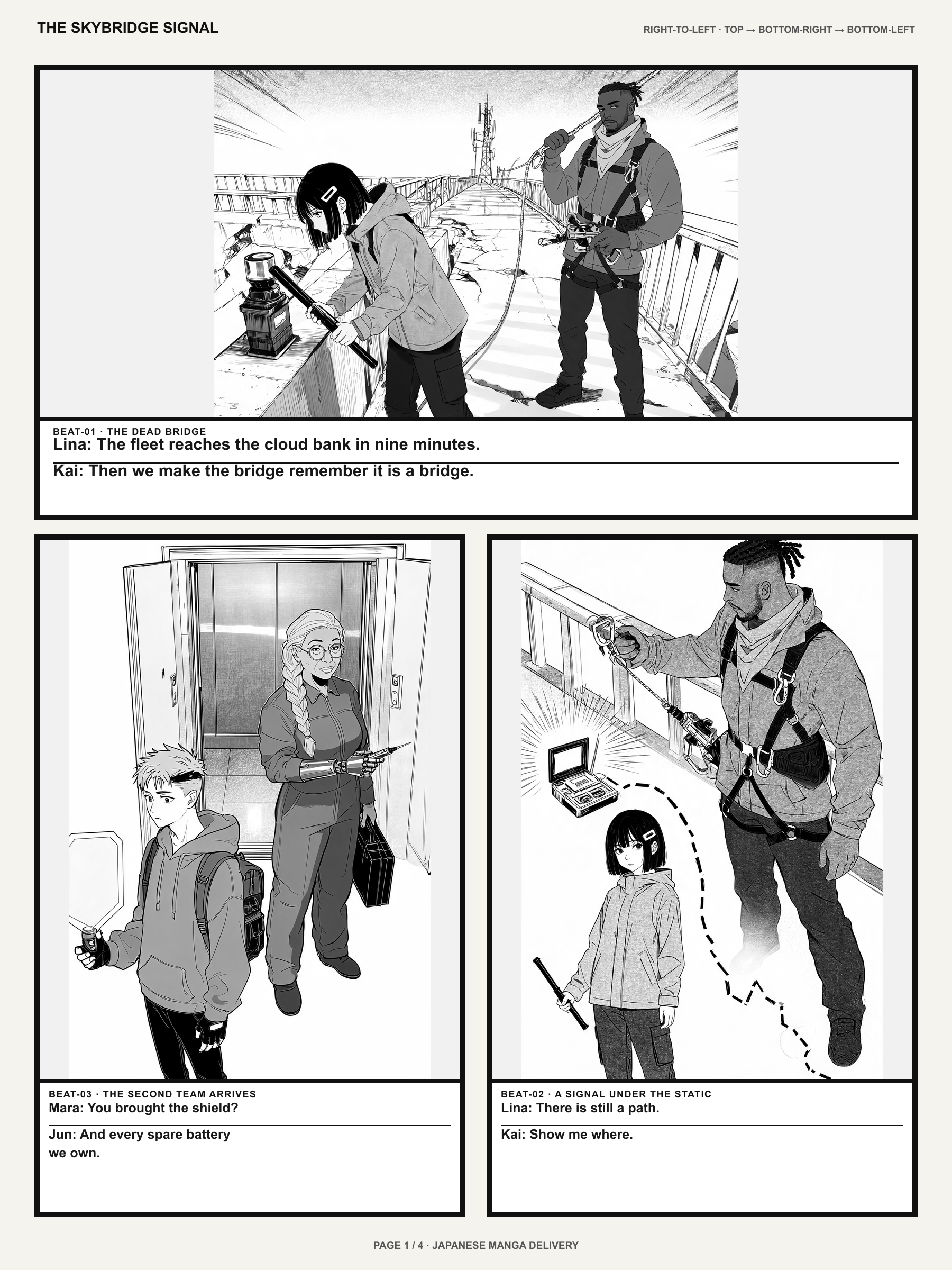
The chapter-format evidence also includes Western comic and vertical Webtoon renditions of the same twelve story moments. Those were separate controlled compositions, not one-click conversions of a single output file.
What this does not prove: Scope: pages demonstrate one published sequence and how to inspect it; they do not guarantee automatic chapter length, publishing rights, reading-order accuracy, or PDF availability for every account or plan.
Continue the sequence: page 2 · page 3.
Source record SHA-256: 8b0e234e65cfc359ba29e1a060ee5fffeb82463a41a01e3a7da2d5f1cb461f55
Planning more than a single page? Follow the complete step-by-step AI manga book tutorial, including a reviewed chapter-length sequence and export checks.
Planning diagram
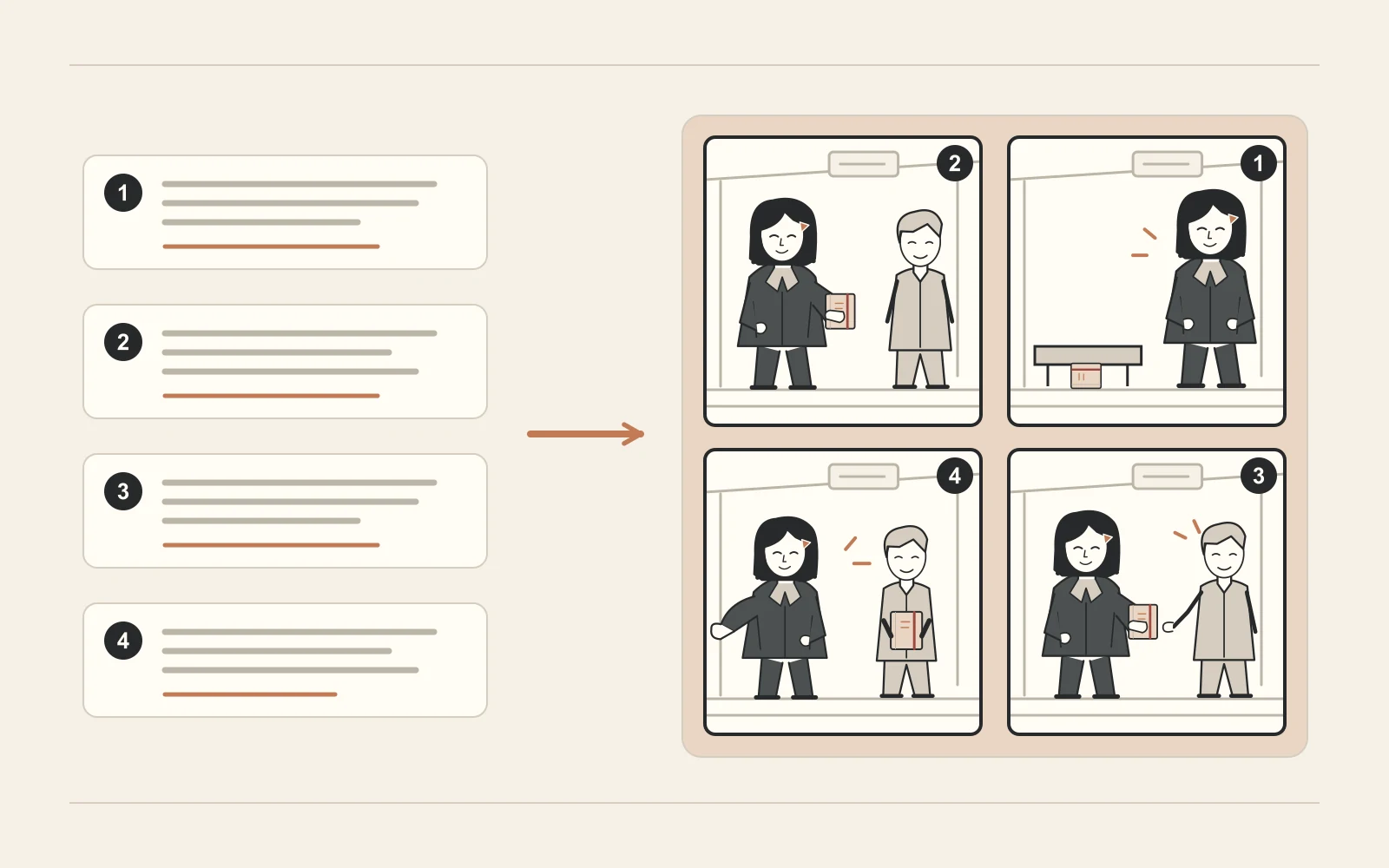
AI-assisted editorial guide with original teaching examples. The diagrams illustrate a workflow; they are not screenshots, measured product results, or customer testimonials.
Before keeping the draft
- Four panels follow the declared reading order.
- Mira's hair, left-side triangle clip, and dark jacket stay consistent.
- The notebook keeps its red band and changes hands once.
- Each bubble points to the correct speaker.
- Dialogue is correct and legible at reading size.
- The final panel resolves the return without explanation.
Questions
How much script belongs in one panel?
Start with one visible action or reaction. Split finding, lifting, opening, and returning into separate moments, or simplify the scene.
Must a manga page have four panels?
No. Four panels keep this exercise manageable. Add space when an action, pause, or exchange needs it.
Are the four-panel diagram and the 12-page case the same test?
No. Mira's four-panel lesson is an authored diagram and prompt, not a generated result. The separate published 12-page case is a first-party controlled script-to-comic delivery with original files, first-review failures, revisions and limitations. Neither is an independent Higgsfield comparison.
Sources & scope
Sources support the specific points described below. A source link does not imply an endorsement of LlamaGen.
- LlamaGen AI Manga Generator
Official workflow: story brief, cast notes, drafting, and dialogue review. First-party documentation, not independent evaluation.
- LlamaGen Manga Editor
Official overview of page composition, artwork, and dialogue editing. Check the product for current capabilities.
- LlamaGen story-to-comic controlled delivery (August 11, 2026)
First-party source with the original 2,150-word input, 12-page/48-panel final files, 33/48 first review, redraw history, and disclosed output limitations. This case is comics, not a separate manga-format benchmark.