

The short answer
If the pose works but the hand anatomy fails, try a narrow Partial Modification mask first. If the whole arm gesture or camera angle is wrong, redraw that panel instead.
A concrete example
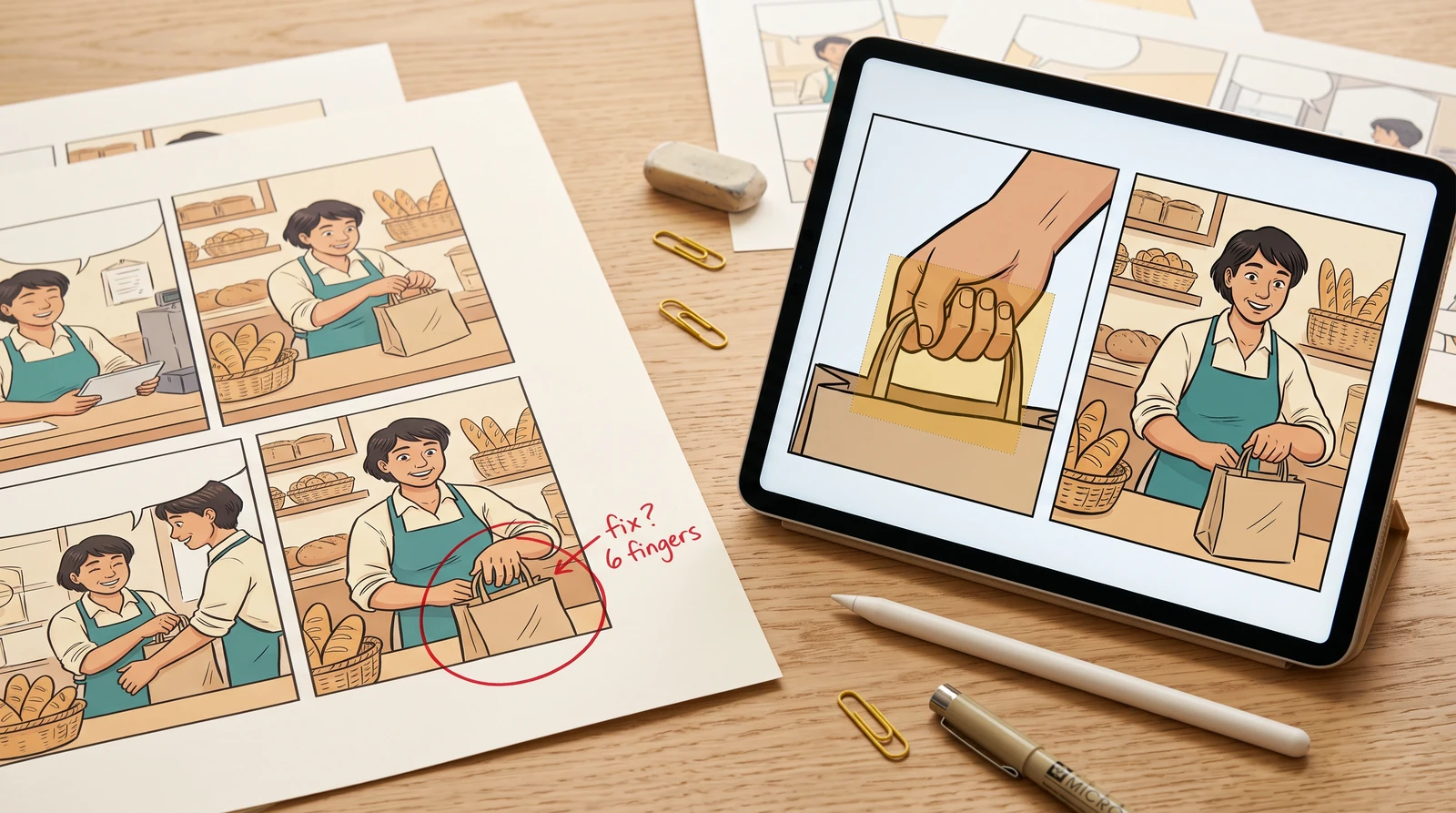
An illustrated baker carries a paper bag beside the counter; one hand accidentally has an extra finger. The goal is to restore a clear bag grip without replacing the baker, outfit or background.
How to make the edit
- 01
Identify whether the failure is a small finger shape, an incorrect prop grip or a fully impossible pose. These need different-sized edits.
- 02
For a small anatomy flaw, mask the fingers and wrist with a slight overlap onto the bag handle. Ask for a natural five-finger grip and preserve the original perspective and line thickness.
- 03
Compare the edited fingers with the other visible hand, adjacent panels and the original. If arm direction or silhouette still fails, try a targeted panel redraw.
Review the result
- Finger count and finger separation read clearly at normal comic viewing size.
- Hand, wrist and bag handle connect without floating or intersecting edges.
- The baker's face, apron, counter and lighting remain recognizable.
What this does not guarantee
Generative tools can introduce new artifacts even in a small mask. No fixed prompt guarantees anatomically correct hands; keep a recoverable original and review manually.
Illustrated repair workflows
These scenes illustrate repair tasks. Genuine source-and-result captures from the actual tools are still awaiting review.
Common questions
Should I redraw the whole comic because of one hand?
Usually not. Repair the smallest failing panel or region when the remaining composition is approved.
What if the whole pose is wrong?
Use panel redraw, specify the intended gesture and retain the character reference; do not rely on a tiny mask to solve a structural pose problem.