

Story adaptation
Turn a short story into eight readable comic panels
Eight panels are a useful planning constraint: enough room for a small problem, an attempt and a consequence. Build an action sequence first, then choose a layout that lets a reader follow it.
Open Story to ComicAI creation happens in the linked product. Check sign-in, the available controls, plan requirements and the displayed credit cost before generating. This guide does not promise a free or exact result. Plans and credits
LlamaGen Editorial TeamReviewed
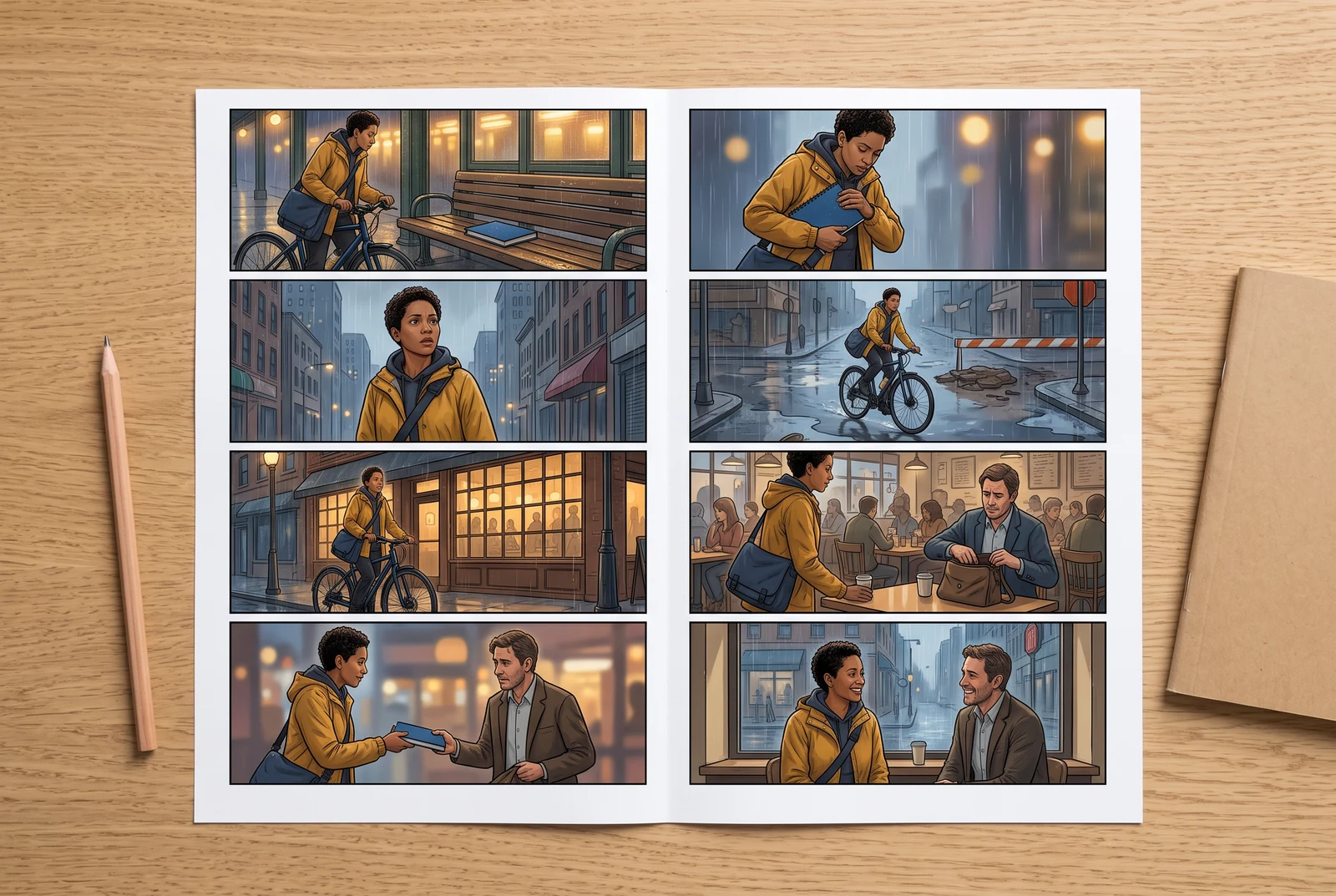
Start with this decision
Give each panel one visible action and a reason to lead into the next. Keep the setup, obstacle, choice and payoff, cut repeated explanation, and number the reading order before requesting art. Eight is the plan’s target, not a guaranteed model output count.
Inspect an existing work example
A longer source shows why adaptation needs revision
The existing Last Light of Meridian Station record contains a 2,150-word original screenplay and a twelve-page, forty-eight-panel delivered comic. Page one below is a four-panel landscape page. It is a longer controlled example, not proof of the new eight-panel exercise.
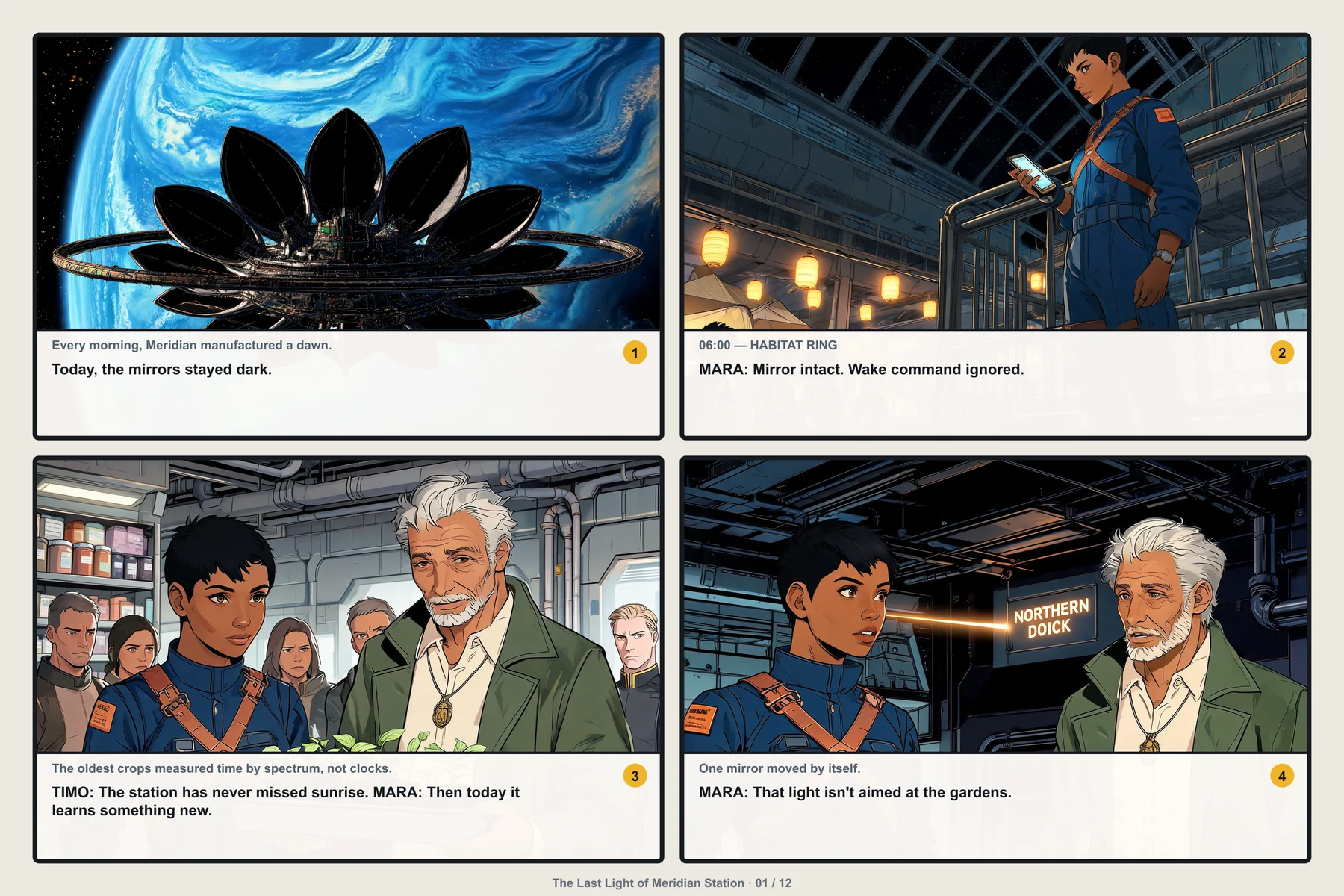
- Compare the published source with the page and downloadable PDF to see which information was turned into visible action.
- The recorded delivery required targeted redraws; retaining the first generated version was not enough for the complete project.
- Small model-rendered signs include distorted lettering, and captions sit in text bands rather than conventional balloons. Review both the art and the authored text.
Previously published first-party controlled work, separate from the new planning exercise and the AI lifestyle scenes. No new paid product generation was run for this guide. Visible lettering in the original example is English.
Local planning exercise
Edit a complete eight-panel beat board
A courier finds a wet sketchbook and returns it to an artist. Change the actions and switch the reading layout. This is a local text storyboard, not a generator or an art export.
Selected option: Left-to-right page
Read each row from the left, then move down. Numbers keep the same eight story beats.
Edit each action, then check its place in the reading sequence. Changing direction repositions the cards without changing their numbered story order.
A note for the next draft
One action in each panel
Treat the eight numbered cards as a page plan with two columns and four rows.
- Check that the subject and action are visible in every beat.
- Read each row from left to right before moving down.
- Keep a quiet payoff if it completes the story.
This planning exercise runs only on this page. It does not upload, generate, save between visits or send your choices to the product.
An authored planning exercise. Its notes and cards are not generated comic art, a fidelity score, an identity lock or a reconstruction of a historical person.
Prepare, create and review
Choose a story small enough for the page
A short comic cannot carry every event and backstory detail. Decide whose problem the page follows and what changes by the final panel.
- Write the beginning situation and ending change in one sentence each.
- Keep the actions needed to connect those two states.
- Remove explanations that repeat what the image already shows.
Translate prose into visible beats
An action such as lifting a wet sketchbook can be drawn. A sentence about regretting the past needs an expression, object, gesture or caption choice to become readable.
- Give each numbered panel one main visible action.
- Use a close view only when its detail carries information.
- Keep dialogue short enough to coexist with the art.
Check order before and after generation
A clear text plan does not guarantee a model will draw the correct count or reading flow. Compare the generated page with the numbered brief.
- Choose left-to-right, right-to-left or a vertical sequence deliberately.
- Check missing, merged or repeated actions.
- Revise layout or lettering in an appropriate editor when precise control is needed.
Problems worth catching early
- Eight paragraphs are pasted into eight panels.
- Rewrite the prose as visible actions and remove repeated exposition. A panel is not a paragraph container.
- The requested eight panels become seven, nine or a confusing layout.
- Count and trace the actual result. Simplify or split the brief and use editing where exact structure is required; the guide does not promise exact generation counts.
Before you keep the result
- Every panel has one useful action and leads into the next.
- The chosen direction matches the visual and dialogue order.
- The actual generated count, legibility and ending have been reviewed.
Picture the finished project in use
A page should also make sense away from the editor: held as a booklet, read on a phone, or reviewed as a coordinated set. These presentation concepts are separate from the recorded work examples above.
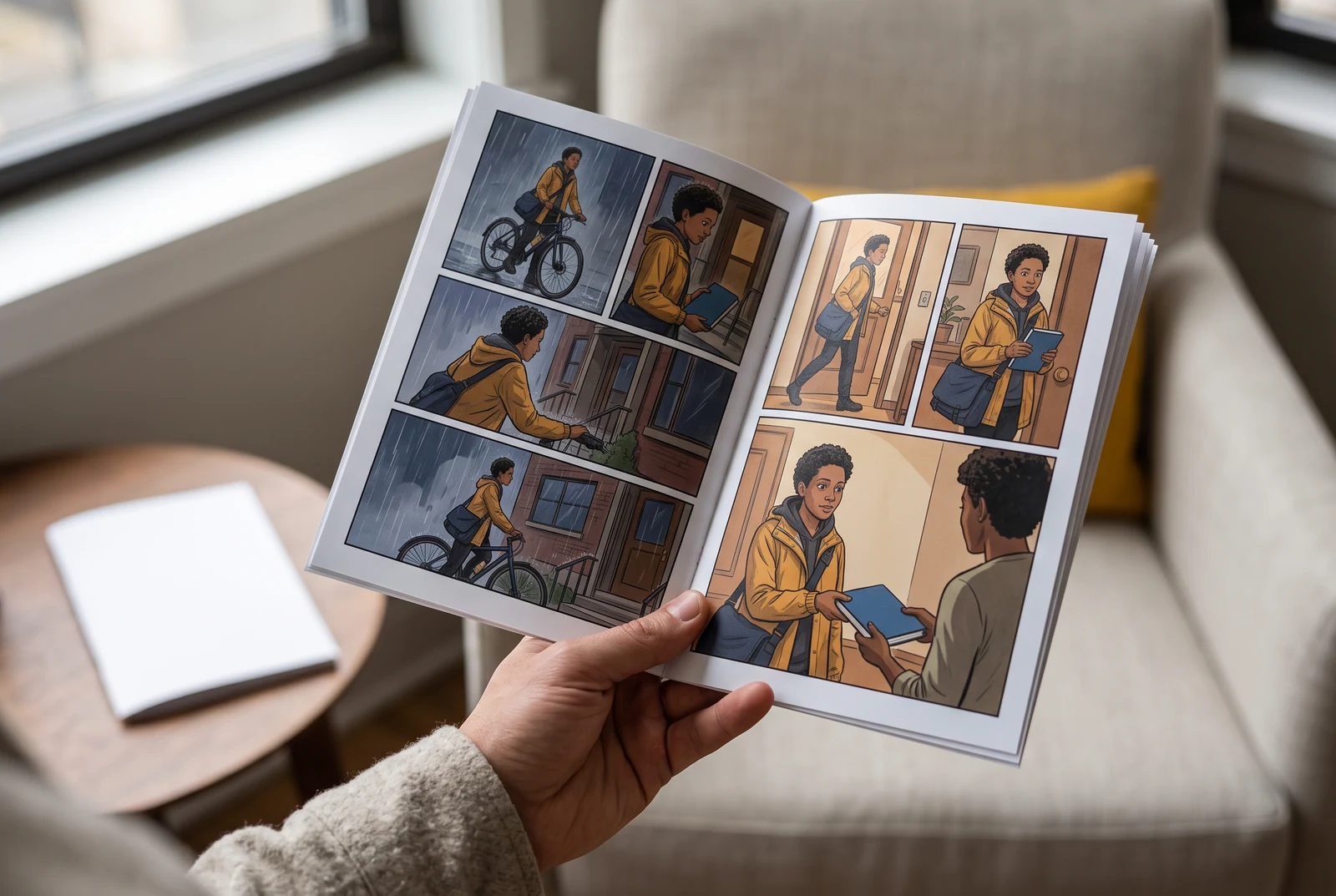
A comic story in hand
Paper edges, a real reading distance and the whole page make the intended presentation clear. This is a fictional AI scene, not a delivered physical item.
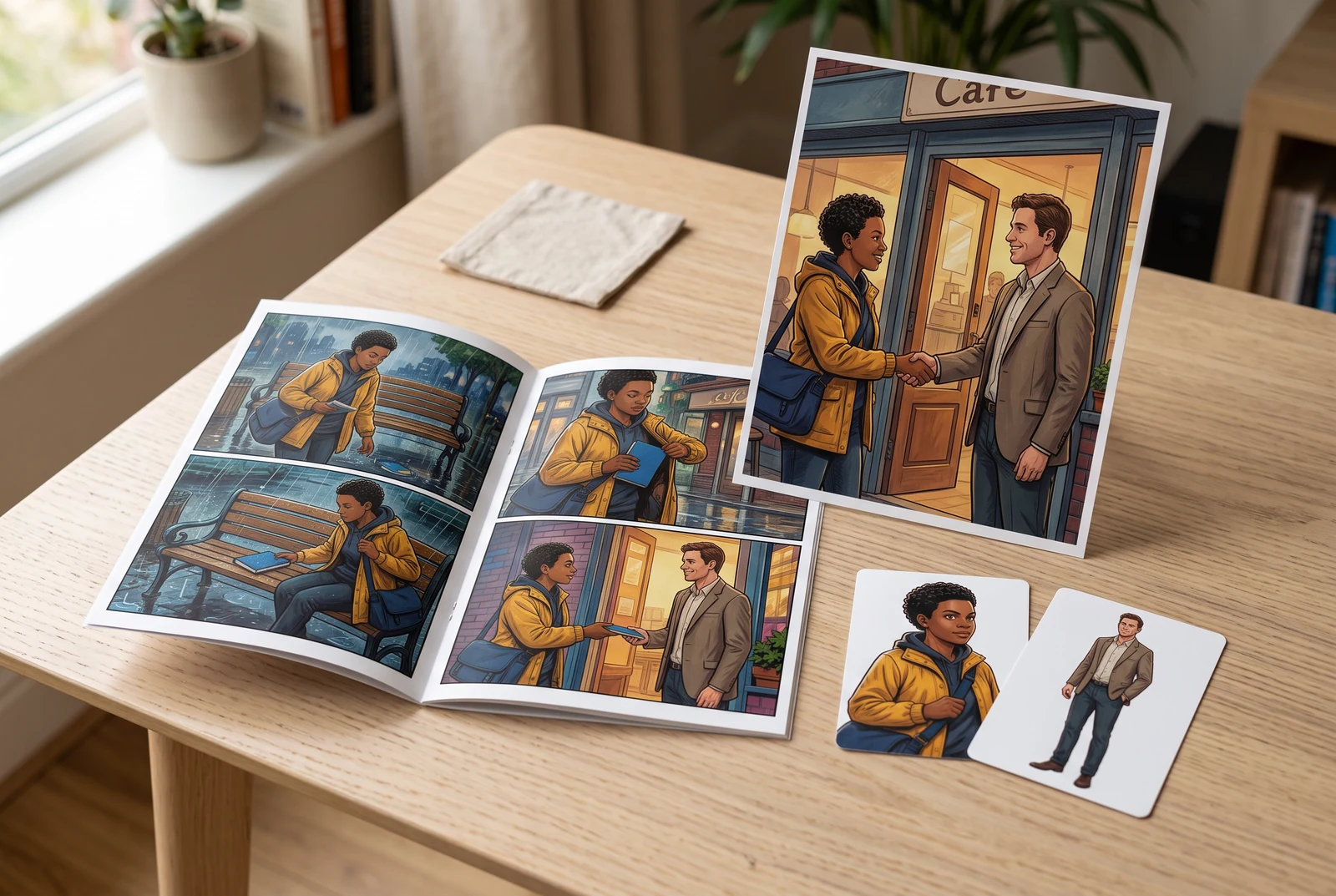
One project, several useful views
Review a finished page beside its reading view and character notes. A coordinated display can communicate the project; it does not prove automatic continuity.
AI-generated fictional presentation scenes, not customer photographs, historical documents, product screenshots, verified print offers or proof of model accuracy.
Frequently asked questions
Will Story to Comic always generate exactly eight panels?
No exact count guarantee is established here. The board is an eight-beat planning template. Count the actual result, look for merged actions and use revision or an editor when the exact structure is required.
Can I edit this template without signing in?
Yes. The text beat board and reading-direction controls run locally on this page without an AI request. The separate creation product may require sign-in, a plan and credits.
Which reading order should I choose?
Choose the convention your readers expect, then apply it consistently to panel placement, action and dialogue. The board repositions numbered text cards; it does not automatically mirror finished art or fix lettering.
Does the twelve-page example prove the eight-panel template works automatically?
No. It is an existing controlled story-adaptation example with a different source, length and layout. Use it to inspect an actual delivered work and its limitations, not as a measured test of this new template.
Continue the workflow
Linked guides and tools have their own language coverage. An English-edition label identifies a fallback where a localized destination is unavailable.