A Bible comic should not be approved just because the art looks polished. It should be approved only when your team can answer four questions clearly:
Use this gate:
source packet -> panel traceability -> context review -> art review
-> audience review -> theological signoff -> final export
The LlamaGen.AI Bible Comic Maker can speed up visual drafting, but generation is not approval. Keep the source record and review notes beside the artwork throughout production.
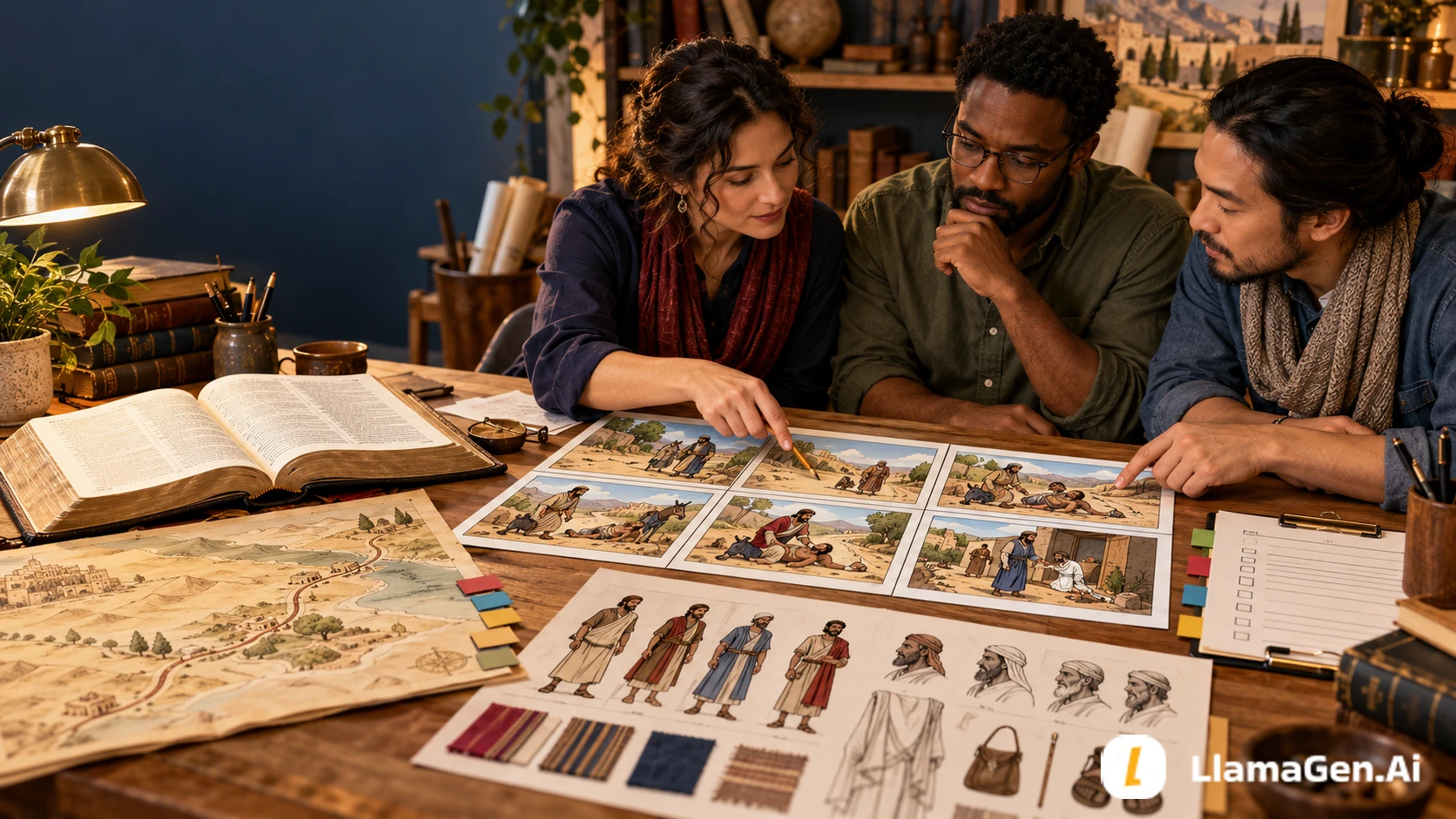
This workflow is for churches, schools, publishers, nonprofits, ministries, and curriculum teams that need more than an attractive image. It helps a team document why a scene is included, what was compressed, who reviewed it, and what still needs correction.
It is not a substitute for your organization's theological standards or for a qualified reviewer. Different traditions may make different decisions about depiction, terminology, translation, symbolism, and age suitability. The checklist makes those decisions visible instead of letting an image model make them silently.
The running example is a six-panel adaptation of the Good Samaritan in Luke 10:25-37. The same method also works for longer comics, posters, storybooks, and visual devotionals.
Do not send an artist or generator only a story title. Prepare one source packet with these fields:
| Field | What to record | Why it matters |
|---|
| Passage boundary | Book, chapter, verses, and what immediately precedes or follows | Prevents scenes from losing their narrative frame |
| Approved translation | Translation name, edition if relevant, and quotation policy | Separates exact Scripture from paraphrase |
| Teaching objective | One sentence describing what learners should understand or do | Prevents unrelated visual spectacle |
| Audience | Age range, cultural context, classroom or public use | Sets safety, vocabulary, and visual complexity |
| Required facts | Events, people, objects, locations, and sequence that must remain | Defines non-negotiable story content |
| Open interpretation | Details not specified by the passage | Stops plausible art choices from becoming claimed facts |
| Prohibited additions | Invented divine speech, motives, miracles, villains, or symbols | Reduces theological drift |
| Rights record | Text permissions, reference-image rights, and intended distribution | Prevents a finished page from becoming unusable |
For exact Bible quotations, follow the permission and acknowledgment requirements of the selected translation. Biblica's permissions page shows why translation, amount quoted, product format, and use of AI-powered applications can affect permission requirements.
A rundown of the latest LlamaGen feature releases, product enhancements, design updates and important bug fixes.
PROJECT
Good Samaritan six-panel classroom comic

PASSAGE BOUNDARY
Luke 10:25-37; retain the question-and-response frame in the lesson notes,
even though the six visual panels focus on the parable's action.

APPROVED TEXT
[organization records its selected translation and permission status]

TEACHING OBJECTIVE
Learners identify mercy as practical action toward a person in need.

REQUIRED FACTS
traveler needs help; two people pass; Samaritan stops; direct care;
transport; continued care at an inn

OPEN INTERPRETATION
exact faces, colors, weather, road geometry, inn layout

PROHIBITED ADDITIONS
invented quotations presented as Scripture; invented motives for passing by;
racial or costume caricature; graphic violence; modern objects

AUDIENCE
ages 7-11, Sunday school handout and classroom projection
Every narrative panel needs an evidence line. This does not mean every visual detail appears explicitly in the passage. It means the team distinguishes source facts from production choices.
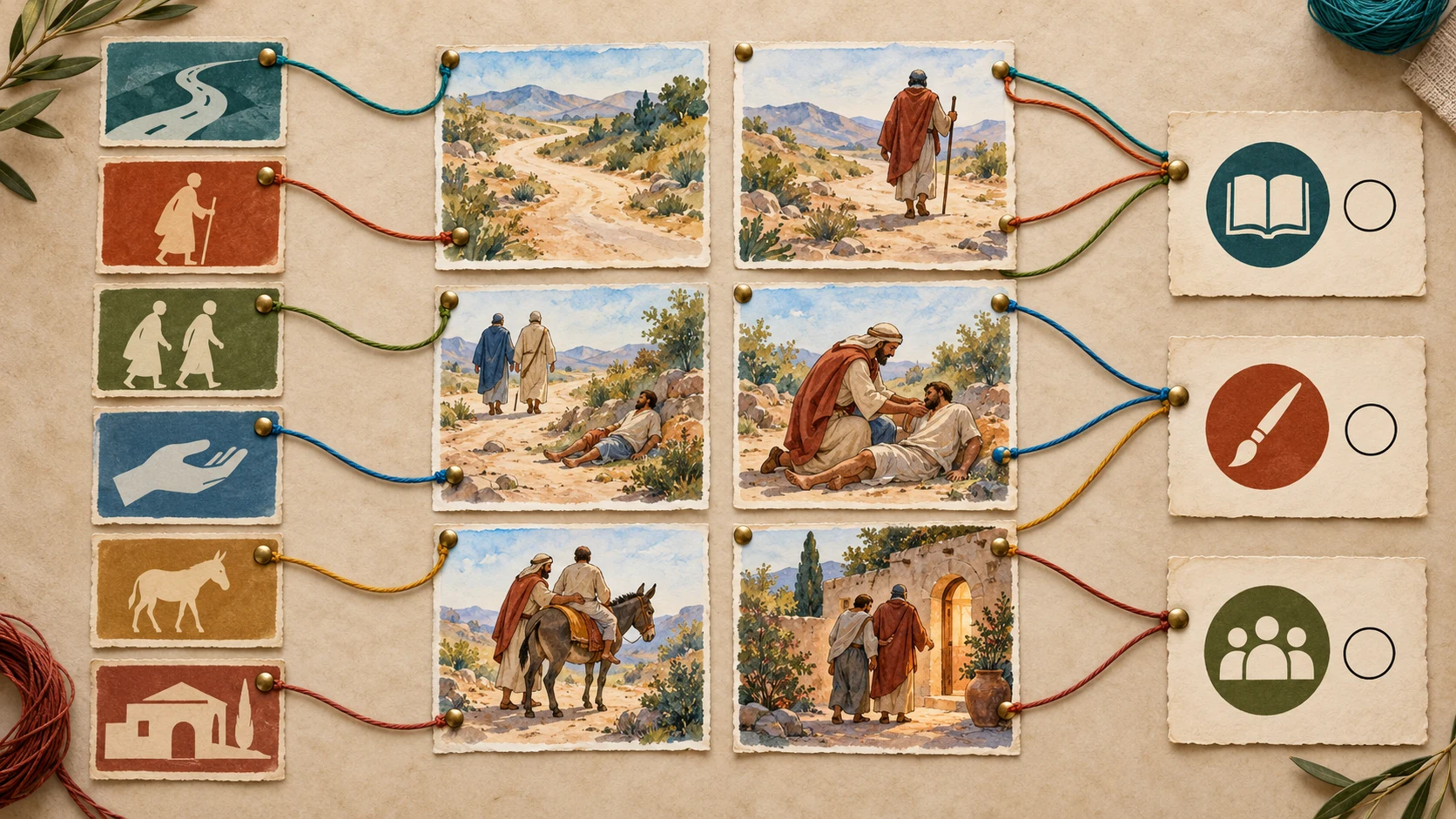
Use four evidence classes:
Here is a completed example:
| Panel | Source moment | Visible claim | Evidence class | Risk to review | Status |
|---|---|---|---|---|---|
| 1 | Traveler goes down the road | One traveler on a difficult road | S plus A | Do not imply a precise route reconstruction | Approved |
| 2 | Traveler is left needing help | Non-graphic injury and isolation | S plus A | Avoid sensational violence | Approved |
| 3 | Two people see and pass | Both notice and continue | S | Do not invent fear, contempt, or excuses | Approved |
| 4 | Samaritan has compassion and approaches | Helper kneels and offers care | S plus A | Do not encode identity through stereotype |
If a panel cannot be assigned a source moment or clearly labeled application, remove it or send it back for review.
Context review asks whether the adaptation changes the lesson even when individual objects look plausible.
In the Good Samaritan lesson, the parable responds to a question. A six-panel comic may focus on the action, but the teacher notes should retain that frame. Otherwise learners may see only a general rescue story and miss the challenge to define neighbor through action.
Combining repeated or transitional moments can be reasonable. Reordering cause and effect is riskier.
Acceptable compression:
care on the road + preparation for travel -> one panel
arrival + arrangement for continued care -> one final panel
Risky compression:
helper notices traveler -> traveler is already safe at the inn
The risky version removes the costly middle actions that carry much of the teaching meaning.
When Scripture does not provide a person's motive, the comic should not present one as fact. Neutral body language is often more accurate than an exaggerated sneer, cowardly posture, or caption explaining why someone acted.
You do not need museum-grade reconstruction for every classroom comic. You do need to remove details that distract from or contradict the setting: asphalt roads, plastic bottles, modern signage, fantasy armor, contemporary furniture, or architecture from the wrong era.
Historical references should support the lesson rather than create false certainty. Record uncertain details as art choices.
Art can introduce an unsupported claim through color, framing, expression, scale, or omission.
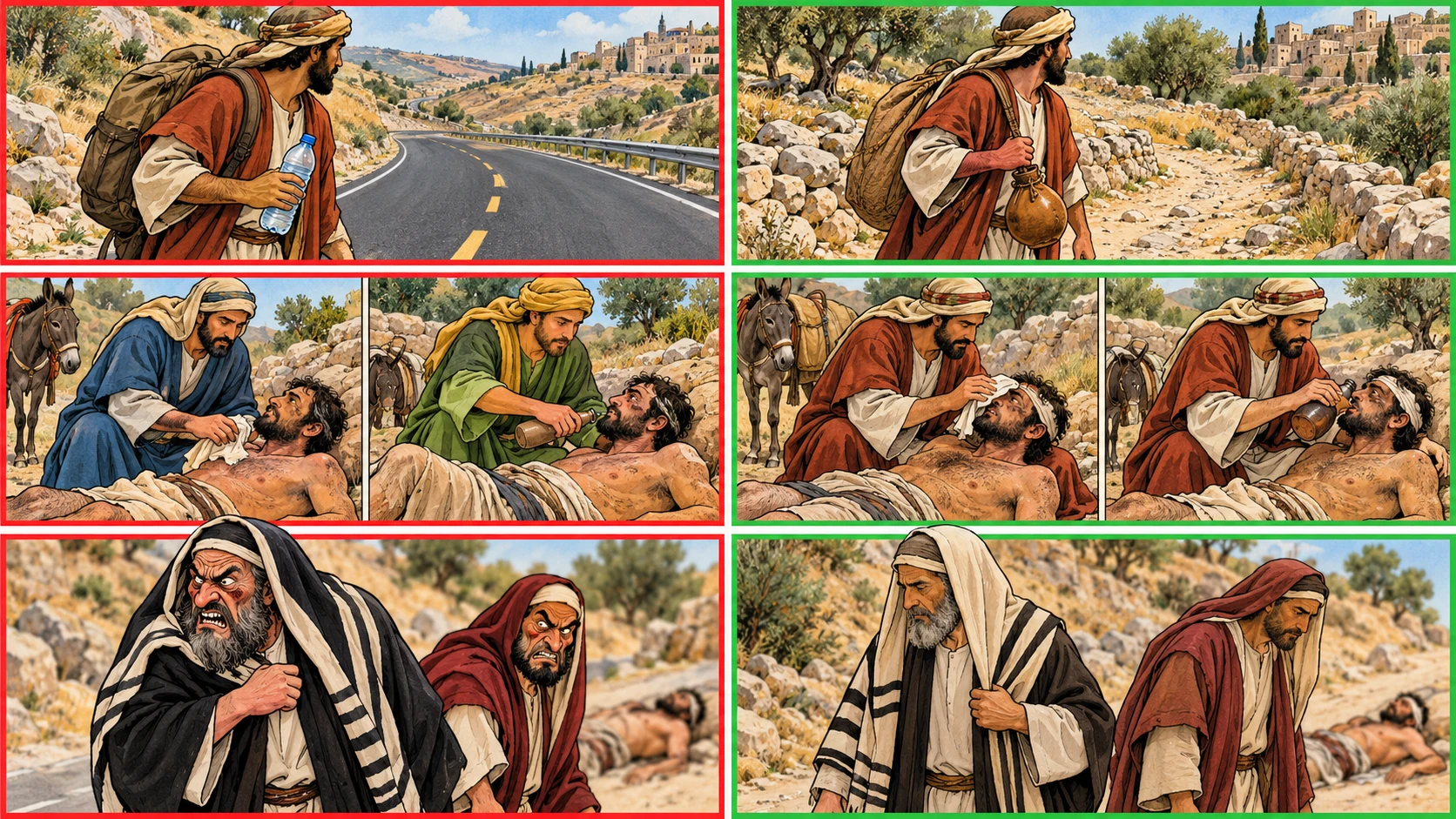
Problem: A paved highway, metal guardrail, and plastic bottle appear in an ancient road scene.
Correction: Use a plausible rocky road, cloth travel bag, pottery or leather water container, and simple local architecture. Do not claim the corrected version is an exact reconstruction; it is a less distracting art choice.
Problem: The helper's face, robe color, and head covering change between stopping, caring, and transporting.
Correction: Lock a small set of recognition anchors before generating: outer robe color, head wrap, travel bag, age range, and facial hair. Continuity is not merely cosmetic. If the learner thinks the helper changed, the causal sequence becomes harder to follow.
Problem: The passersby are given cruel, exaggerated faces while the helper is idealized through skin tone, beauty, or supernatural glow.
Correction: Use ordinary human expressions and let observable actions carry the contrast. Do not teach children to recognize moral worth through ethnic, racial, class, or costume stereotypes.
Problem: The comic gives a full panel to the passersby but crops the act of care into a tiny background detail.
Correction: Give the turning point enough visual space. The panel budget should reflect the teaching objective.
Problem: A speech bubble contains an invented or misspelled verse that visually resembles Scripture.
Correction: Generate art without embedded quotations. Add reviewed text afterward, using a recorded translation and the required attribution.
A creator's intention does not guarantee a viewer's interpretation. The Avoiding Visual Miscommunication paper recommends testing visuals with members of the intended audience rather than validating only the written translation.
For classroom material, ask three to five people who did not build the page:
For children, do not ask leading questions such as, "Can you see that the Samaritan was kind?" Ask what they notice first. Record recurring misunderstandings and revise the image, not the child.
UNESCO's guidance for generative AI in education emphasizes a human-centered approach, age appropriateness, privacy, and human oversight. Those principles are especially relevant when generated visuals are used with minors.
One person can hold more than one role in a small team, but the questions should remain separate.
| Role | Primary responsibility | Required signoff question |
|---|---|---|
| Scripture or theological reviewer | Passage boundary, claims, quotation, interpretation | Does the final page preserve the intended teaching without unsupported claims? |
| Art or production reviewer | Continuity, historical distractions, readability, export | Is the visual sequence clear, consistent, and technically ready? |
| Audience or safeguarding reviewer | Age fit, cultural reading, privacy, emotional safety | Is this appropriate and understandable for the intended learners? |
Use a record like this:
PROJECT ID:
TITLE:
PASSAGE:
TRANSLATION AND PERMISSION STATUS:
AUDIENCE AND DISTRIBUTION:
FINAL FILE URL OR HASH:

SCRIPTURE REVIEW
Reviewer:
Date:
Open issues resolved:
Decision: approve / revise / reject

ART REVIEW
Reviewer:
Date:
Open issues resolved:
Decision: approve / revise / reject

AUDIENCE AND SAFEGUARDING REVIEW
Reviewer:
Date:
Open issues resolved:
Decision: approve / revise / reject

FINAL RELEASE OWNER:
DATE PUBLISHED:
Approval should attach to a specific final file or version. If a panel is regenerated after signoff, the affected checks must reopen. A signature on version 3 should not silently authorize version 4.
The LlamaGen.AI Bible Comic Maker supports familiar story cards and custom Bible story input, including short comic formats such as six-panel pages. Use it after the source packet and panel table are ready.
Do not present the model as a theological reviewer. Its role here is visual production. Human reviewers remain responsible for source, interpretation, child safety, and release.
Open the LlamaGen.AI Bible Comic Maker after your source packet and traceability table are ready. Generate the page, then review each panel as a claim: where did it come from, what did the artist add, and who approved it?
For a teacher-level walkthrough with a ready lesson plan, six story beats, and classroom questions, see How to Turn a Bible Lesson into a 6-Panel Sunday School Comic.
No. Art requires choices about faces, clothing colors, weather, composition, and objects. Accuracy means those choices are not presented as textual facts, do not contradict the passage, and do not distort the intended lesson.
Use the person or body your organization already trusts for curriculum and doctrinal review. The checklist does not define who is qualified for your tradition.
In a small team, yes, but complete the Scripture, art, and audience questions separately. For public, paid, multilingual, or high-reach material, independent review is safer.
Usually not. Too much text can hide the visual sequence and increase quotation-rights risk. Read the passage directly, use minimal captions, and add exact quotations only when they materially help and have been verified.
Reopen the text and layout checks. The art may remain valid, but bubble size, emphasis, attribution, and even scene interpretation can change across languages.
Not necessarily. One reviewer may verify Scripture but miss a continuity error, cultural stereotype, age-safety issue, or rights problem. Use the review roles that match your distribution risk.
Written by Jay and editorially reviewed by Monica on October 16, 2026. This checklist is an editorial workflow, not theological, legal, or licensing advice. The example images are original instructional visuals based on a paraphrased Good Samaritan sequence and should not be treated as definitive historical reconstructions. The public LlamaGen.AI Bible Comic Maker workflow was checked on the review date; product controls and plan limits may change.
Popular creator tools
Go from comics and storyboards to stylized photos with LlamaGen.
| Revise costume |
| 5 | Helper transports the traveler | Traveler supported on a donkey | S | Keep both identities consistent | Approved |
| 6 | Care continues at an inn | Helper speaks to innkeeper; traveler rests | S plus A | Do not invent quoted dialogue | Approved |
Visualize every scene before production starts.
© 2026 LlamaGen.Ai All rights reserved
Leading the Future of AI Comic Generation