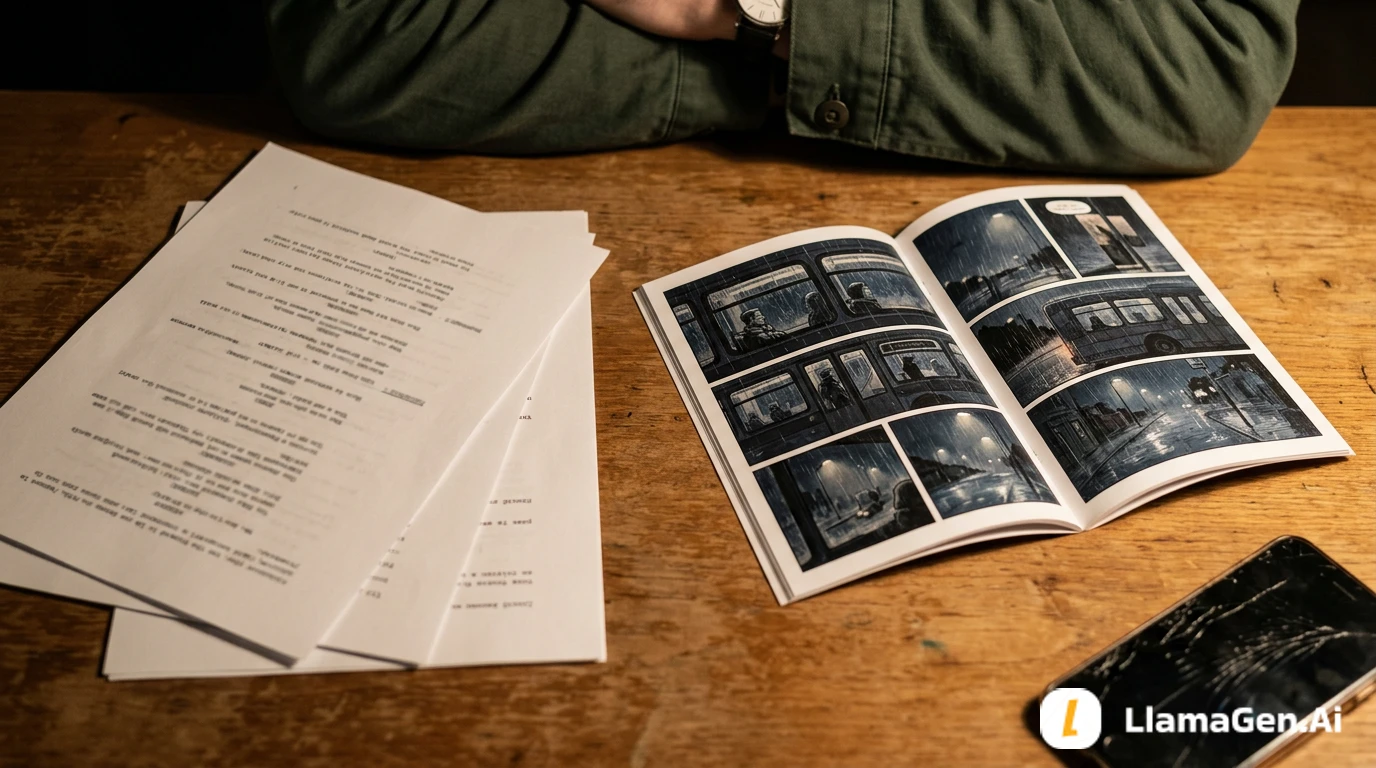
Use AI for the decisions it handles well: finding the story turn, compressing prose into visible beats, formatting a panel script, and checking continuity. Do not ask one prompt to write, direct, draw, letter, and publish the entire book.
If you skip the planning stages, the result usually looks like a folder of unrelated images. If every stage preserves the same story facts, you have a comic a reader can actually finish.
If your source already exists as a document, start by uploading the script to LlamaGen.AI Comic Copilot. For a short idea or panel-ready script, use LlamaGen.AI Comic Strips. In both cases, keep the same cast, page count, and export target fixed until the mini book reads clearly from page 1 to page 8.
Why Prompt-Only Comics Fail as Books
A single prompt can create a striking panel. A book needs the same people, the same world, and a reason to turn the page.
Prompt-only habit
What the reader sees
Book repair
"Make a comic about a night bus"
Random faces each panel
Lock two named characters first
One image per vibe
No page rhythm
Plan all eight pages before generating
Zoznam zmien
Podnecujte sny mladých Kde ožívajú milióny príbehov
Prehľad najnovších vydaní funkcií LlamaGen, vylepšení produktu, aktualizácií dizajnu a dôležitých opráv chýb.
✦
✧
✦
✧
Nové médium pre Rozprávanie príbehov
Vytvárajte bez obmedzení príbehy, komiksy, animácie, hry a ďalší obsah—za pár sekúnd, ktorý osloví moderné publikum
New costume every prompt
The cast feels recast
Write a one-line visual lock
All talk in captions
Pages read like illustrated prose
Budget dialogue and silence
Export as a ZIP of PNGs
Not a book
Export in reading order, then make a PDF or print file
The test in this article used the same original script twice: once as a single prompt, and once as a book pipeline.
Test Setup
Test item
Setup
Date reviewed
October 21, 2026
Source
Original 8-page mini-comic script, The Last Night Bus
This is a workflow test, not a pricing benchmark. Free-maker limits can change.
The test question was:
Can one short script become an 8-page comic book a stranger can read without asking who is who?
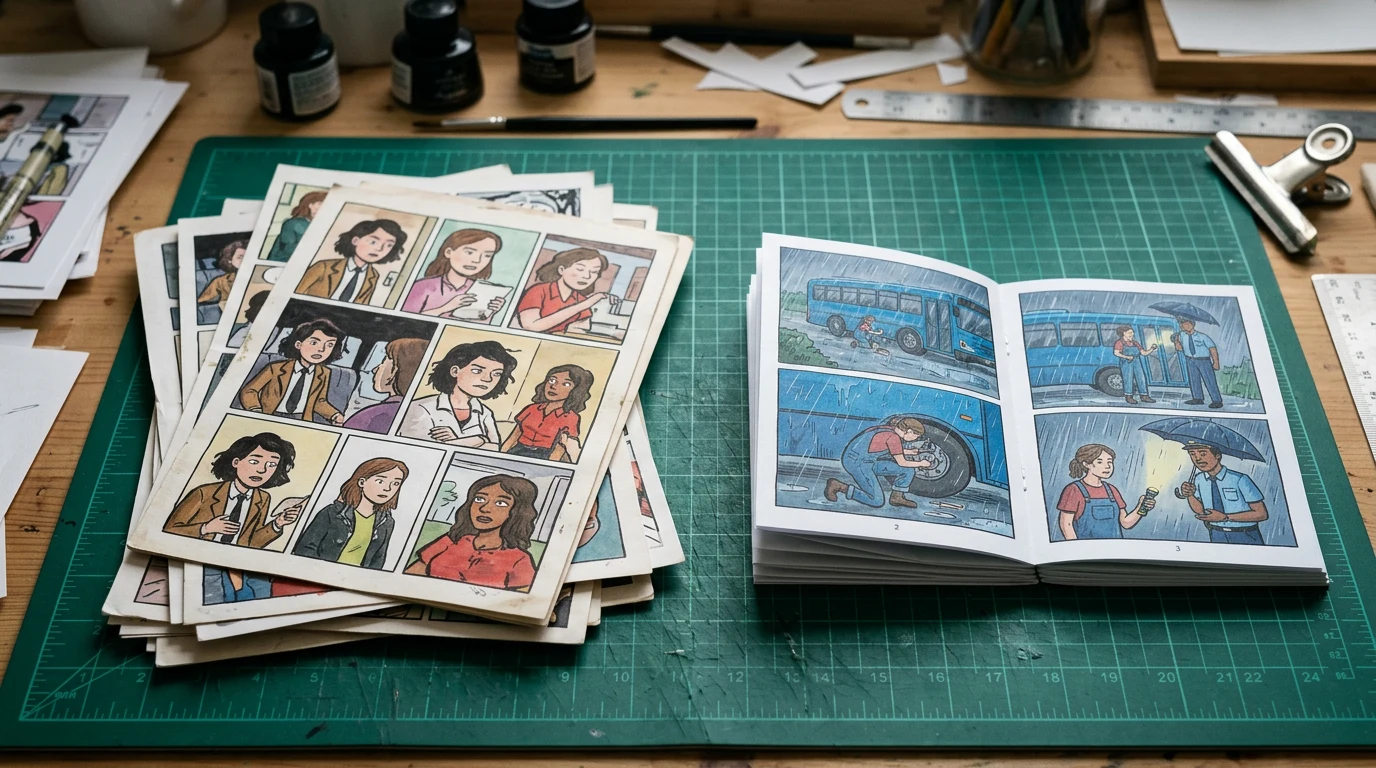
Control result: no. The one-prompt version recast the driver twice, lost the cracked phone, and ended on a pretty rain shot with no ticket reveal.
Book-path result: yes, after one repair pass on page 5.
Source Script: The Last Night Bus
Use this original 8-page script. Do not paste a copyrighted comic.
Cast:
- Ren, 28, night-shift mechanic. Cropped black hair, green work jacket, cracked phone.
- Mira, 44, bus driver. Braided hair, navy uniform, silver ring, laminated route card.

Page 1. Rain. The depot is almost empty. Ren runs. The destination board shows LAST BUS.
Page 2. Mira closes the folding doors. Her tablet says OUT OF SERVICE after this loop.
Page 3. Ren slaps the glass. Mira almost drives on. She sees the cracked phone, not his face.
Page 4. Inside. Two seats between them. The bus is otherwise empty.
Page 5. Flash: two kids on the same route years ago. A lost laminated card.
Page 6. Present. Mira's ring taps the wheel. Ren cannot find the right sentence.
Page 7. The ticket machine prints. The date is tomorrow.
Page 8. Mira opens the doors at a stop that is not on the tablet. Rain. They do not explain it.
This script is short on purpose. Comics usually fail from overloaded prose, not from a small plot.
Step 1: Ask AI for a Production Script, Not a Finished Comic
Start with a premise and require a production-shaped answer. This prompt works in a capable writing assistant because it separates story decisions from visual instructions:
You are adapting an original short story into an eight-page comic.

Return, in this order:
1. One-sentence premise.
2. A compact story bible containing cast, recurring props, locations,
   visual rules, and facts that must not change.
3. Eight page beats. Every page must change what the reader knows.
4. A panel-by-panel script with action, framing, dialogue, and continuity notes.
5. A continuity audit listing any contradiction you found.

Do not generate prose narration for actions the art can show.
Do not invent a new character, costume, prop, or location after page 1
unless the script explicitly introduces it.
Wait for approval before expanding the dialogue.
Review the answer before sending it to an image workflow. AI may produce a neat table while quietly changing a name, moving a prop, or resolving the mystery too early. The human approval pass decides which story facts become the source of truth.
Step 2: Make a One-Page Book Lock
A book script names people, objects that repeat, and the final-page image.
Keep a one-page lock file:
Book: The Last Night Bus
Pages: 8
Format: print comic page, left-to-right
Must repeat: green jacket, cracked phone, navy uniform, silver ring, rain, ticket
Must not reset: hair, age, bus interior, night lighting
Final image: doors opening at an unlisted stop
Upload or paste that lock file with the approved script into LlamaGen.AI Comic Copilot before generating page 1.
If you already have a chapter instead of a comic script, adapt it first with Novel to Comic Adaptation, then come back to this book pipeline.
Step 3: Lock the Cast Before Any Pretty Panel
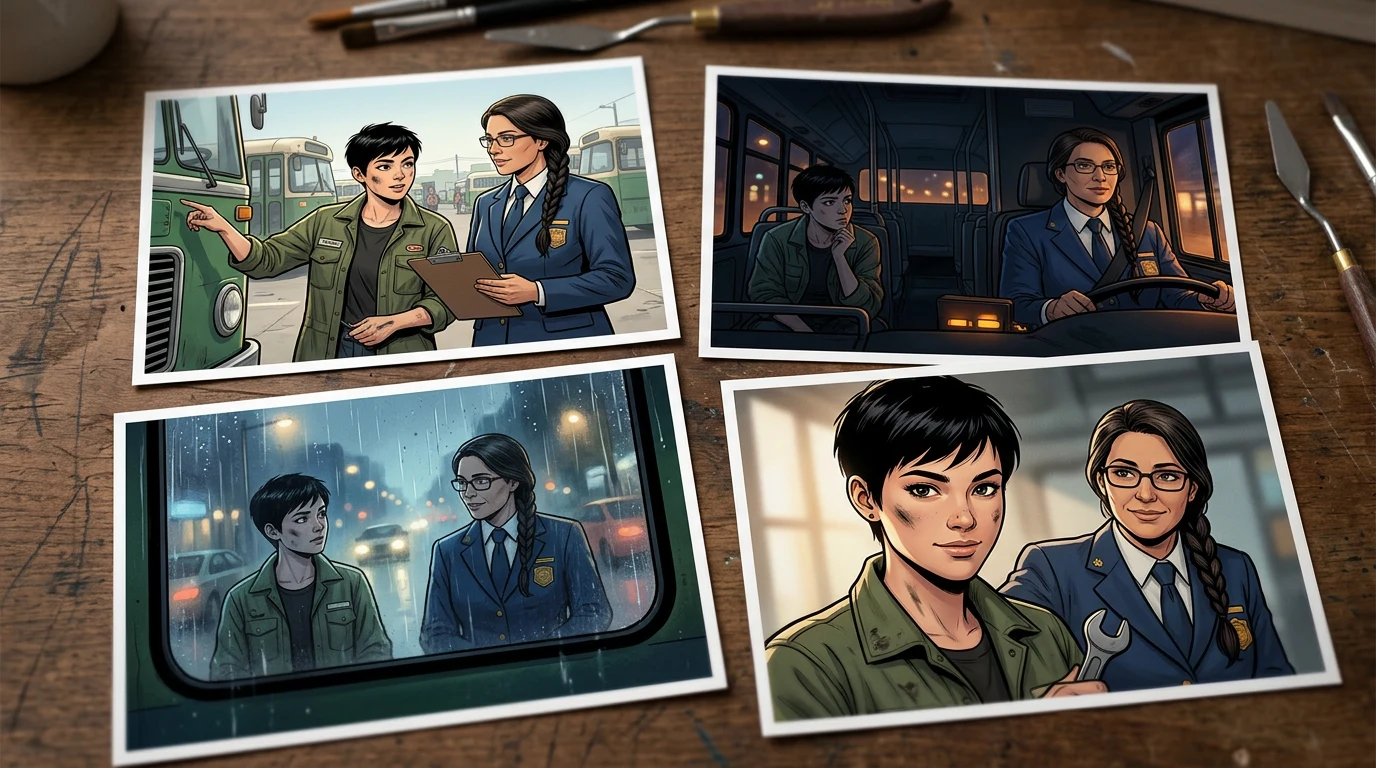
Do not generate page 1 until both characters exist as reusable references.
Lock item
Ren
Mira
Shape
Short, square jaw, work-jacket bulk
Taller in the seat, braided silhouette
Color
Green jacket, dark jeans
Navy uniform, silver ring catch-light
Prop
Cracked phone
Laminated route card
Face rule
Tired, not teenage
Mid-40s, not recast younger
Fail if
Jacket becomes a hoodie
Hair becomes loose every page
Generate a four-up reference set: daylight memory, night bus, rain glass, close-up. If any frame recasts them, repair the lock before continuing.
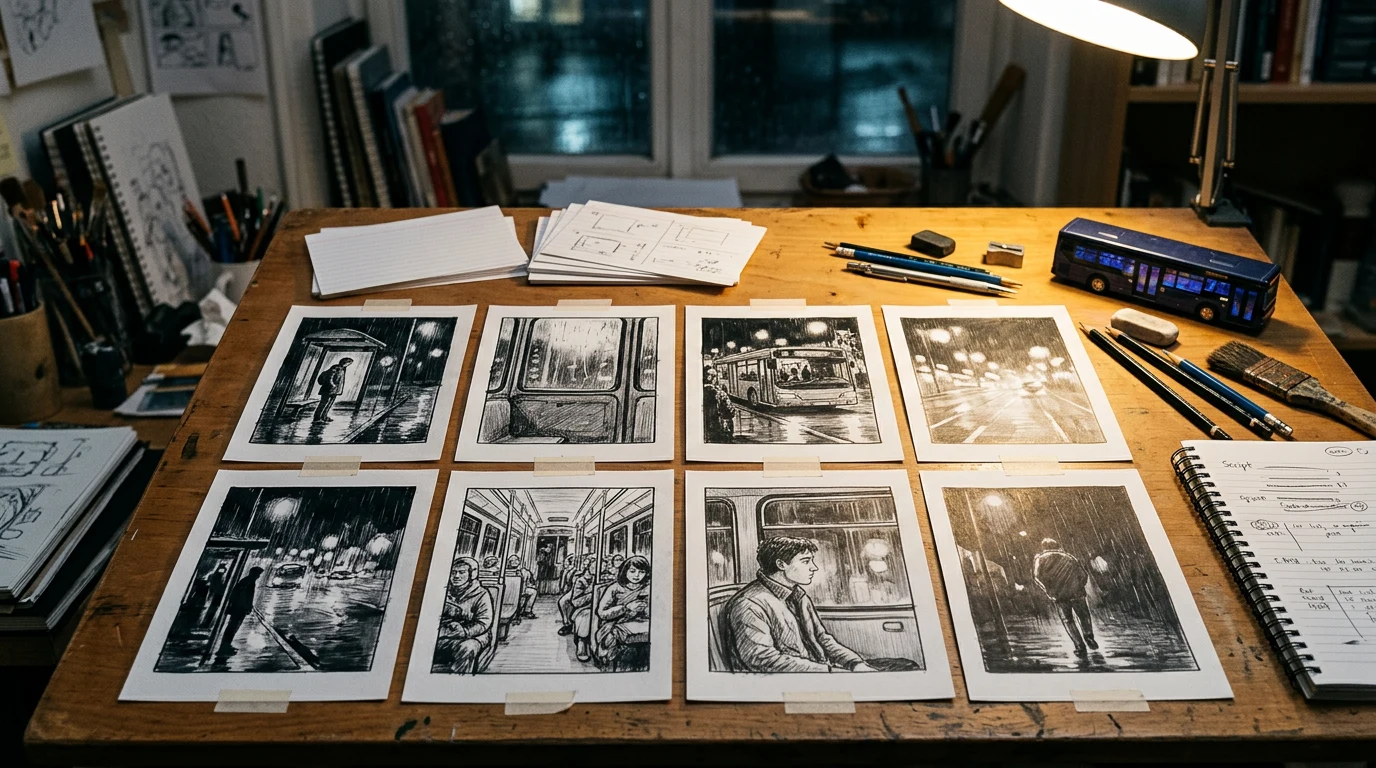
Step 4: Plan Eight Pages Before You Draw Eight Images
A comic book is a reading machine. Each page should change what the reader knows.
Page
Job
Visual must
Do not
1
Hook
LAST BUS board, running Ren
Explain his backstory
2
Clock
Mira vs OUT OF SERVICE
Fill the bus with extras
3
Contact
Cracked phone on glass
Swap to a random passenger
4
Pressure
Empty seats between them
Start a new subplot
5
Memory
Two kids, one laminated card
Make it a five-page flashback
6
Silence
Ring on the wheel
Caption the emotion twice
7
Turn
Ticket dated tomorrow
End on a rain texture shot
8
Payoff
Unlisted stop, open doors
Add speech explaining the theme
If a page does not change the reader's information, cut it before you generate it.
For panel density inside each page, keep Comic Production Pipeline nearby: script, storyboard, panels, lettering, export is still the right order at book scale.
Step 5: Generate Panels from the Page Plan, Not from Vibes
Keep Ren and Mira from the cast lock.
Page 3 of 8.
Night bus, rain on glass.
Ren slaps the door. Mira almost leaves.
Show the cracked phone, not a new face.
No new characters. No costume change.
Leave room for two short balloons.
Then inspect three things before moving on to page 4:
Is the jacket still green?
Is Mira still Mira?
Can a new reader identify the story object?
If any answer is no, regenerate that page. Do not try to fix continuity later. Drift compounds.
Step 6: Letter After the Pictures Can Carry the Beat
Lettering is not the story. It controls timing.
Page
Balloon budget
Why
1-2
0-1
The board and tablet already carry information
3
1
Contact needs one human sound
4-6
1-2
Pressure lives in seats and hands
7
0
The ticket date is the line
8
0-1
Doors are the ending
In the failed control pass, page 1 used four captions. In the book pass, page 1 stayed almost silent. The reader still understood LAST BUS.
Step 7: Export a Book, Not a Gallery
A finished AI comic book needs a reading order.
01-cover-or-page-1
02
...
08
then: PDF or print spread in that order
Check the export against this list:
Check
Pass
A stranger can name both characters by page 3
Yes
The cracked phone appears at least three times
Yes
Page 7 still contains tomorrow's date
Yes
Files are named in reading order
Yes
You can send one PDF, not twelve prompts
Yes
If you only have loose images, you have a generator session, not yet a book. Bind them into one readable file before calling it finished.
Failure Case: The One-Prompt Control
The control prompt was:
Make an 8-page comic about the last night bus.
Symptom
What happened
Book-path repair
Recast
Mira looked 22 on page 4
Cast lock with age and braid
Lost prop
Cracked phone vanished after page 1
Prop listed in every page brief
No turn
Page 8 was rain beauty, no doors
Page job table forced the unlisted stop
Unreadable
Four captions on page 1
Balloon budget
That contrast is the point of the article. AI can draw the bus. A comic book still needs a script that survives export.
Recommended Workflow
Stage
Action
Output
1
Use AI to turn the premise into an auditable eight-page script
Production script
2
Approve a one-page story and continuity lock
Source of truth
3
Lock recurring characters and props
Cast sheet
4
Assign a story job to each page
Page plan
5
Upload the script or generate one page at a time
Draft panels
6
Repair failed panels without discarding accepted pages
Approved art
7
Letter and export in reading order
Finished mini comic
FAQ
Can I make an AI comic book for free?
Yes, as a starting point. LlamaGen.AI Comic Strips can draft pages from a script, while Comic Copilot is the stronger starting point for an existing document. Access, limits, and credit costs can change, so check the live interface before estimating a full book. Free access does not solve continuity by itself.
How long should the first book be?
Eight pages is enough to prove continuity. Do not start with 80.
Do I need to draw?
No. You do need to decide cast, page jobs, and export order. That is editorial work, not illustration skill.
When a new reader can finish it in order without asking which image comes next.
Final Takeaway
Do not ask an AI writing model and an AI comic generator to improvise eight pages independently.
Use the writing model to create an auditable script. Use LlamaGen.AI to keep that approved script, cast, and page plan alive through visual production.
Open LlamaGen.AI Comic Copilot, upload your approved script and lock file, and do not export until the cast, recurring props, dialogue, and final-page turn are still there.
Product controls, plan eligibility, and generation costs were checked on October 21, 2026. Use the live product as the final reference because interface options can change.
Related hot tags
AI Comic
Comic Book
Tutorial
Script to Panels
Popular creator tools
Turn inspiration into your next story
Create comics, storyboards and stylized photos with LlamaGen.