Book Report Comic Strip: Show What the Story Supports
A spare piece of cardboard becomes evidence of a changed mind.
Turn a completed reading into a six-panel report that identifies setting, characters, conflict, significant events and resolution, while supporting an interpretation with specific text evidence.
An original teaching example. Read the complete panel script, checks and references below the book.
03
Reading · text evidence · LlamaGen
01 · Source materials
Read the whole original story before making the report.
A Crossing for Two is an original short story written for this page, not an adaptation of a published book or a customer’s manuscript. Read all six paragraphs below. The worked report distinguishes events that the text states from a reader’s interpretation of Nia’s changing attitude. A real book report begins with a book or story the student has read; this short model demonstrates the method without claiming to summarize an entire novel automatically.
04
Reading · text evidence · LlamaGen
02 · The challenge
Can a reader see where the report ends and an unsupported invention would begin?
Read first
Does the report use all six source paragraphs rather than only the title or an image?
Significant events
Do the chosen scenes show the refusal, the bridge problem, Oren’s help and Nia’s changed action in order?
Evidence
Can each quoted phrase be found exactly in the original text, with its paragraph identified?
Interpretation
Is the idea that Nia becomes more willing to share presented as an inference supported by actions, not a fact about thoughts the narrator never states?
05
Reading · text evidence · LlamaGen
03 · Planning the page
A story takes shape.
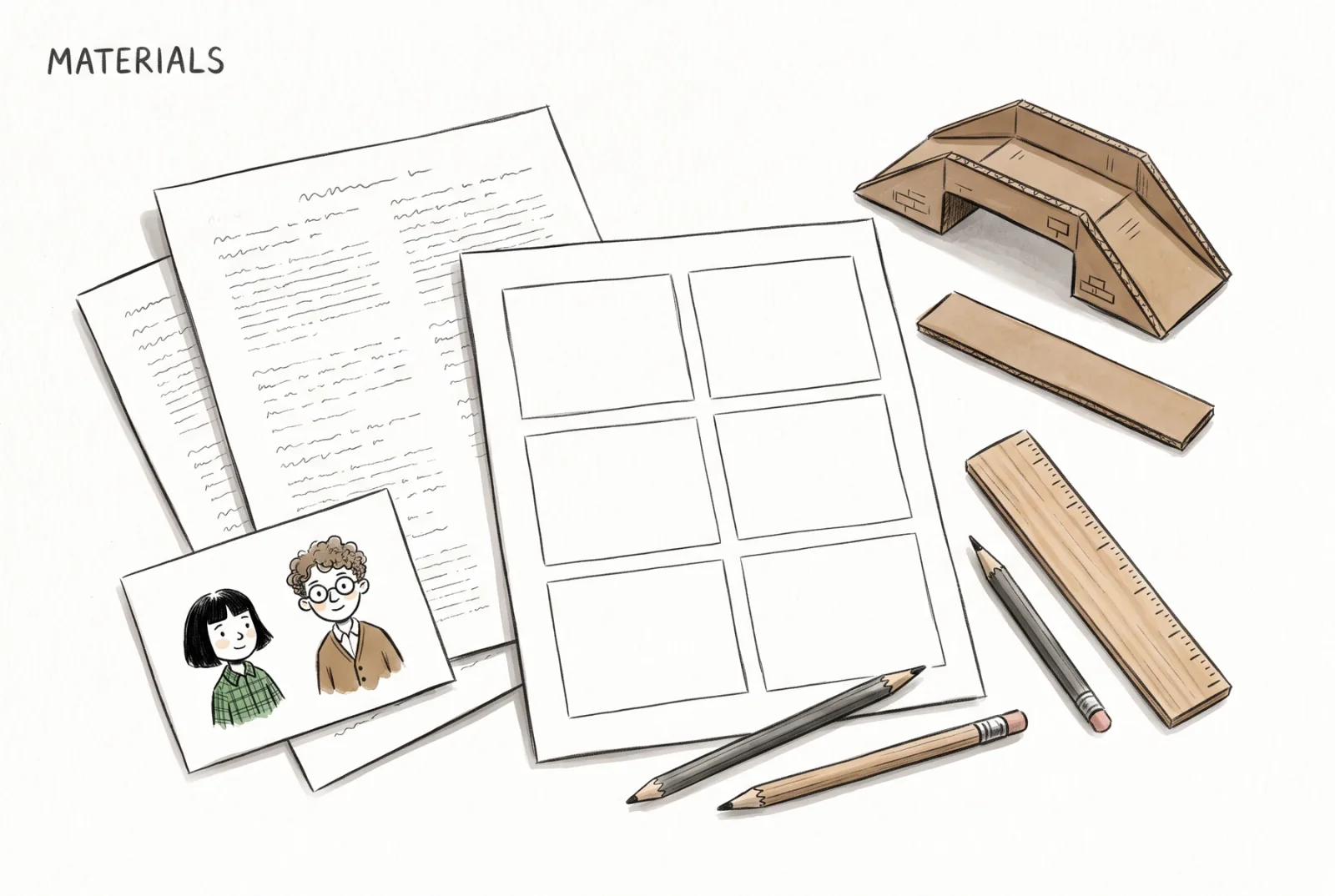
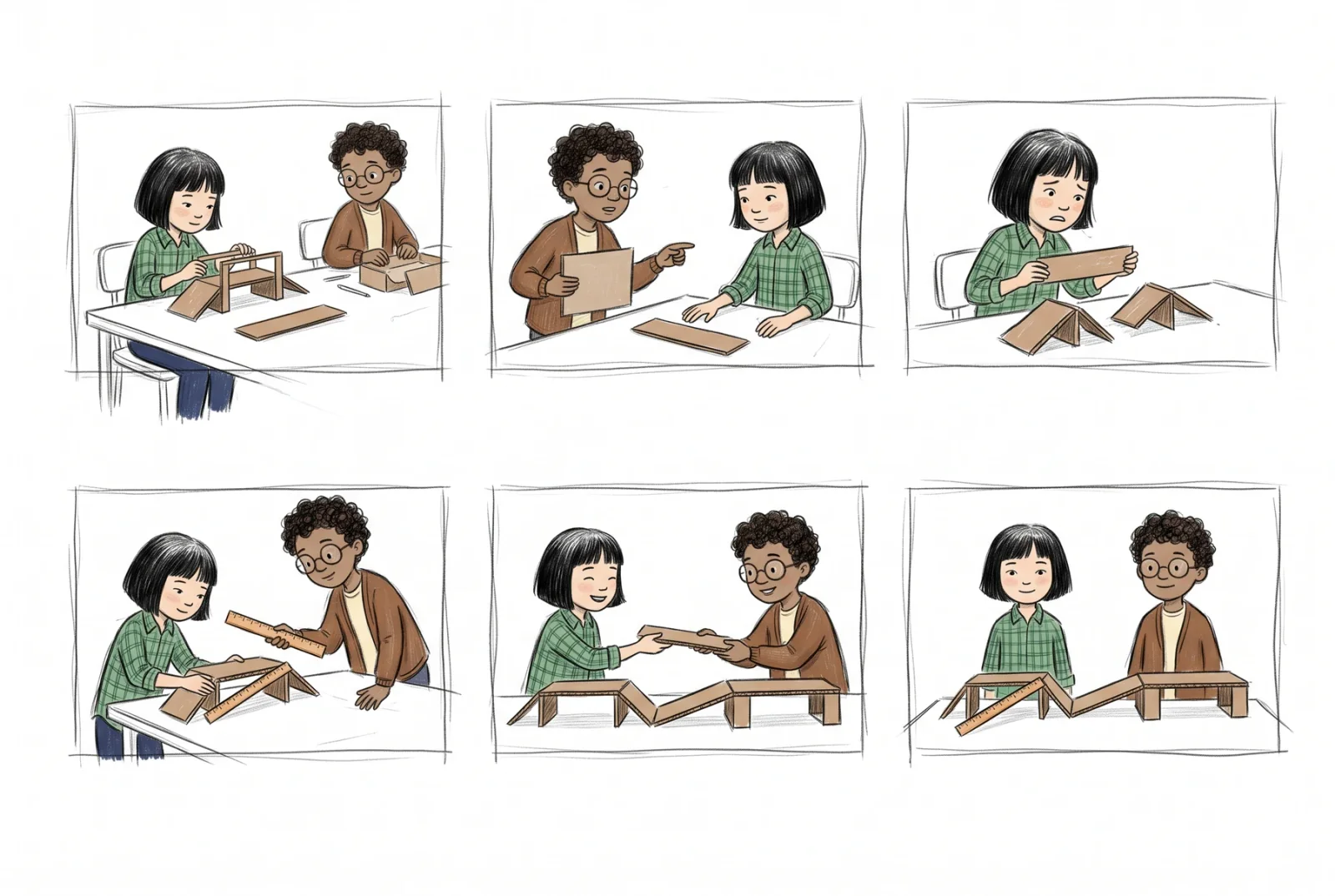
Plan six panels for this task: Turn a completed reading into a six-panel report that identifies setting, characters, conflict, significant events and resolution, while supporting an interpretation with specific text evidence. Keep visual symbols consistent, leave caption space, and use the complete reviewed script below.
Illustrated planning concept, not an editor screenshot or recorded session.
06
Reading · text evidence · LlamaGen
04 · The creative process
Make a draft. Make it yours.
Read
Mark the setting, characters, problem and outcome in the original text before drafting any picture.
Select
Choose six events that make the conflict and resolution understandable without adding a new subplot.
Support
Match the report’s claims to paragraph numbers and short exact quotations or clearly marked paraphrases.
Explain
Add a brief interpretation, then ask a partner which evidence supports it and which other reading could fit.
07
Reading · text evidence · LlamaGen
05 · Comic concept
Six panels, ready to read and question.
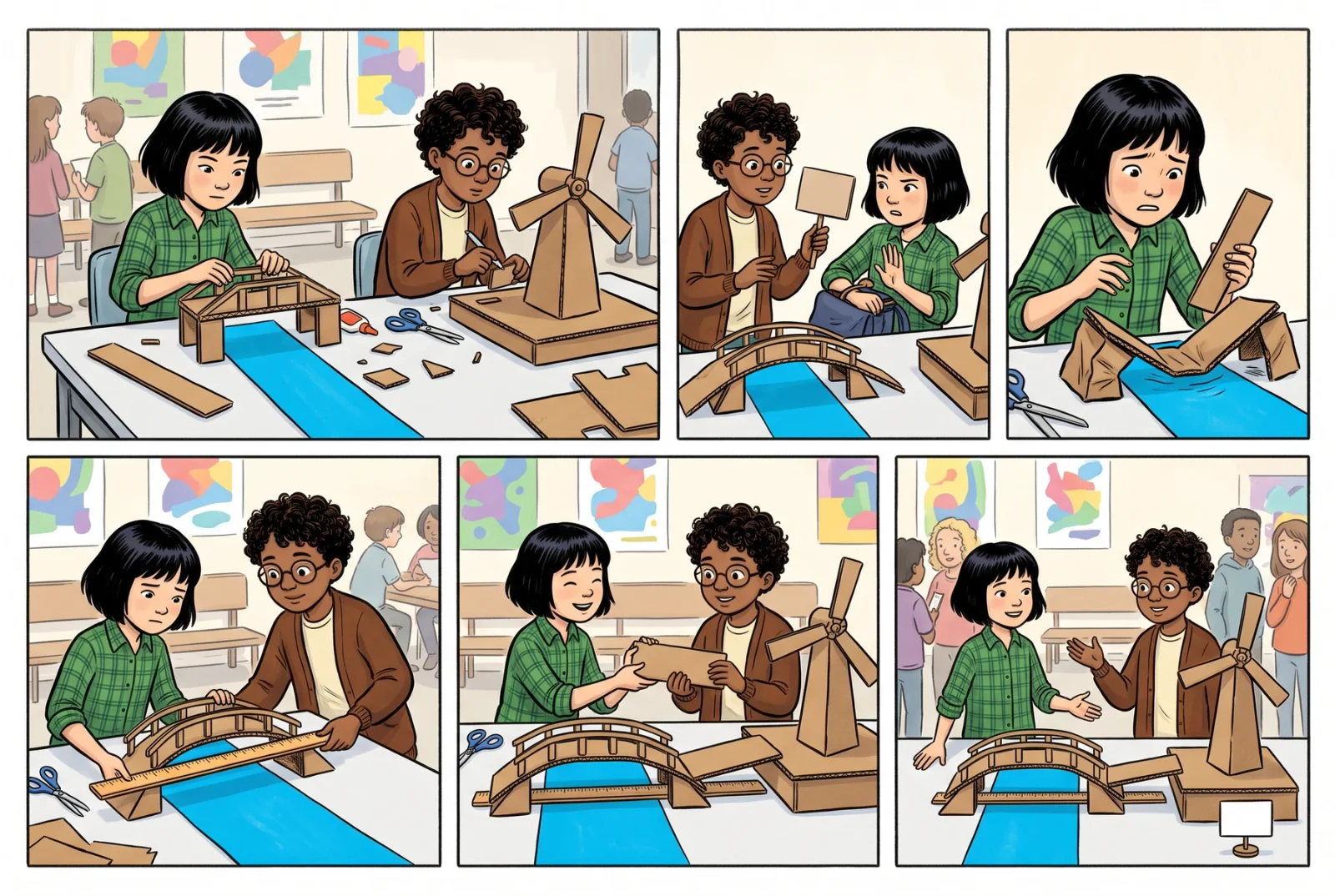
AI-generated six-panel illustration of the original school-fair story: Nia’s refusal, the damaged bridge, Oren’s ruler and the shared ramp to his windmill. Read the original paragraphs and evidence captions for the report’s interpretation.
08
Reading · text evidence · LlamaGen
The next page is yours
Make your own version. Check every caption.
Start with one short scene. Review the words, the characters and the details before making the next page.
Sign-in and generation credits may apply. Features and export options depend on your workspace and plan.
09
By LlamaGen · Original classroom example · Edition
The complete classroom example
Turn a completed reading into a six-panel report that identifies setting, characters, conflict, significant events and resolution, while supporting an interpretation with specific text evidence.
Suggested audience: Upper-elementary readers and language learners; use the original short text below as a small worked example before choosing another reading.
AI-generated six-panel illustration of the original school-fair story: Nia’s refusal, the damaged bridge, Oren’s ruler and the shared ramp to his windmill. Read the original paragraphs and evidence captions for the report’s interpretation.
Read the original source story
This short story was written for this classroom example. Use its events and exact wording to check the book-report panels.
A Crossing for Two — an original classroom short story
Paragraph 1. After school, Nia arranged her cardboard bridge over a strip of blue paper in the hall. The school fair would open in twenty minutes. Beside her, Oren was setting up a cardboard windmill. Nia tucked a spare board under her table.
Paragraph 2. Oren held up a blank sign. “Could I have a little cardboard for a stand?” he asked. Nia covered the spare board with her bag. “I need every piece,” she said. Oren put his sign flat on the table.
Paragraph 3. When Nia moved her bridge, one support bent. The bridge sagged into the paper stream. She pulled out the spare board, but it was too short to span the gap. She stared at the crooked crossing.
Paragraph 4. Oren brought over his long ruler. “Try it as a brace,” he said. Together they slid it under the bridge. The ruler held the crossing steady. Oren had offered help without asking again for the cardboard.
Paragraph 5. Nia cut the spare board in half. She gave one piece to Oren for his sign stand. They used the other piece as a ramp from her bridge to the windmill platform, then moved their projects closer together.
Paragraph 6. When the first visitors arrived, Nia stepped aside so Oren could explain the windmill beside her. “Leave room for two,” she said. The ruler stayed under the bridge, and the shared ramp stayed between their projects.
Read the six-panel script
The illustrations are concepts. These editable captions carry the explanation; read and check them even when images or animation are unavailable.
1. Setting and characters
In the school hall, Nia with a short dark bob and green checked shirt works on a cardboard bridge; curly-haired Oren with round glasses and a brown cardigan sets up a windmill beside her.
Paragraph 1 places Nia and Oren at the school fair before it opens. The bridge and windmill are separate projects.
2. A choice creates conflict
Oren holds his sign while Nia covers the spare cardboard with her bag. The report leaves room beside the image for its short quotation.
Evidence, paragraph 2: “I need every piece”. Nia refuses the material Oren needs for his sign stand.
3. The problem becomes visible
Nia’s bridge sags toward the blue paper stream. She compares the gap with the spare board, which is too short to span it.
Paragraph 3 states that a support bends and the spare board is too short. The problem is structural, not caused by Oren.
4. Help changes the situation
Oren and Nia slide the long ruler under the bridge as a brace; the same ruler remains visible in the repaired model.
Evidence, paragraph 4: “Try it as a brace”. Oren helps before receiving any cardboard.
5. A different action
Nia divides the spare board. One piece becomes Oren’s sign stand; the other becomes a ramp connecting the bridge and windmill platform.
Paragraph 5 supports a change in Nia’s behavior: she shares the material and helps join the two projects.
6. Resolution and an inference
Visitors see the two projects side by side. Both children have room to explain them, with the ruler and shared ramp still present.
Evidence, paragraph 6: “Leave room for two”. Read with paragraphs 2 and 5, this supports an interpretation that Nia has become more willing to cooperate.
Use the script in your own comic
Continue with the complete prompt and six-panel script below, or copy them into the comic workspace. The link prepares a draft; generation only starts when you submit in the workspace. Prepare the images first, add captions using supported editing controls, then check the draft. This page does not promise automatic factual accuracy or a one-click finished worksheet.
Sign-in and generation credits may apply. Do not upload student names or photographs without the appropriate permission. Printing and shipping are not included.
Check the subject before sharing
The character-change interpretation is a supported reading, not the only possible response. A student might emphasize trust or practical cooperation, provided the explanation points to the text. Do not invent a prize, a punishment, a secret motive or a magical bridge repair. Quotes in the report are short excerpts from the original story above; paraphrases should not be placed inside quotation marks.
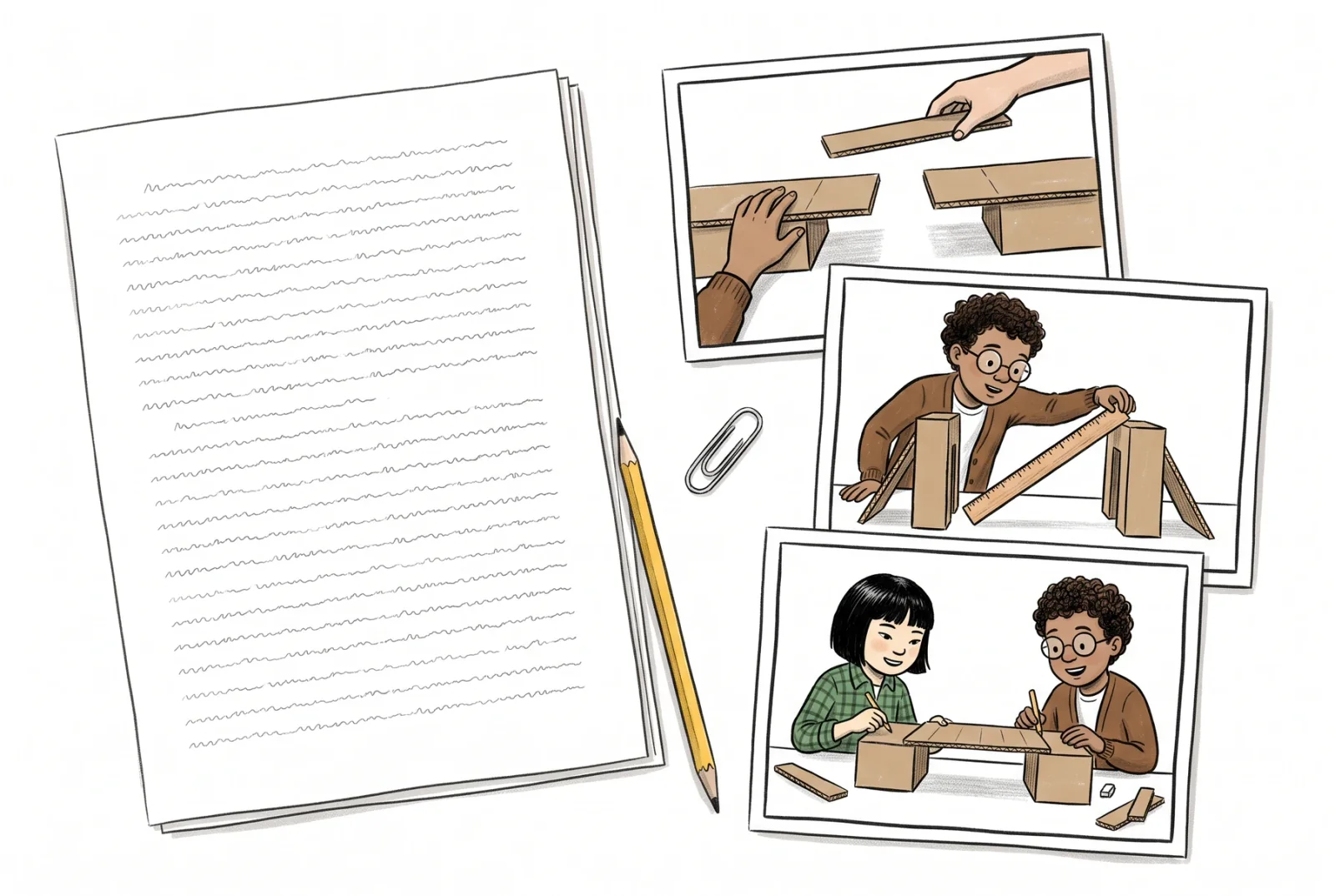
AI-generated source-and-scene review composition for checking the original story’s evidence, ruler brace and shared ramp; the exact quotations are supplied in the HTML.
Put the source beside the report.
Compare each panel with the original paragraphs, then inspect the report’s explanation. A visually consistent comic can still invent evidence, change the cause of a problem or present an interpretation as a stated fact.
Quotation match: Find “I need every piece”, “Try it as a brace” and “Leave room for two” in paragraphs 2, 4 and 6.
Cause and sequence: The support bends; Oren does not sabotage the bridge. His help comes before Nia shares the board.
Visible continuity: Keep the ruler under the bridge and the shared ramp between the projects after the repair.
Explain the inference: Connect the refusal, the shared material and the final invitation before claiming that Nia’s attitude changes.
Try a different version
Make a claim–evidence–explanation table with three rows. Use the refusal in paragraph 2, the shared material in paragraph 5 and the final invitation in paragraph 6. Then test the alternative claim “Nia cooperates only because her bridge breaks.” Which details support it, and which complicate it? Finish with one sentence about what the comic leaves out and whether that omission changes the reading.
Questions about this example
What should a six-panel book report comic include?
Start with the reading assignment’s requirements. This worked example uses setting and characters, a consequential choice, the main problem, a turning point, a changed action and an evidence-based interpretation of the resolution. Its panels are a report structure, not a rule that every story has exactly six events.
Do students need to draw every event in the book?
No. Select significant events that make the conflict and resolution understandable. Explain important omissions and keep the sequence faithful to the text. A short report is not a substitute for reading the assigned book.
Can I use my own book or a classroom novel?
Use a text you have read and are permitted to use for the assignment. Record the author, title and relevant page or chapter references, follow the teacher’s quotation and rights guidance, and avoid uploading or reproducing a complete copyrighted book without permission. The freely readable example here is our original short story.
Does the tool automatically know whether a quotation is real?
No such verification is promised here. Check each quotation against your source and keep a paragraph, page or chapter reference. The student’s evidence choices and explanation remain part of the reading work.
Sources and how this page was made
Artwork generation: Google Vertex AI · gemini-nano-banana-2.1.
LlamaGen authored this teaching example using the references below. The script and activity are original; the source scene, storyboard sheet, wordless comic and review illustration were generated separately with Google Vertex AI. They do not demonstrate automatic source-to-comic conversion. No teacher endorsement, measured learning benefit or independent expert review is claimed.
Checked against these linked sources for this edition on November 16, 2026. Teachers should adapt vocabulary and verify the final draft against their curriculum.
Your story, one scene at a time
Make your own version. Check every caption.
Make a book report comic strip from an original short story with six evidence-linked panels, a character-change example and a classroom review checklist.
What should a six-panel book report comic include?+
Start with the reading assignment’s requirements. This worked example uses setting and characters, a consequential choice, the main problem, a turning point, a changed action and an evidence-based interpretation of the resolution. Its panels are a report structure, not a rule that every story has exactly six events.
How was this classroom example made?+
An original LlamaGen classroom example with AI-generated editorial illustrations. Not a customer project, scientific observation or verified product output. Check the supplied captions and sources before classroom use. No customer quotation, endorsement or measured outcome is claimed.
More ways to tell a story
Another page. Another possibility.
An original LlamaGen classroom example with AI-generated editorial illustrations. Not a customer project, scientific observation or verified product output. Check the supplied captions and sources before classroom use. Images were created with Google Vertex AI. The illustrated planning and comic stages do not demonstrate an automatic transformation of the source illustration.
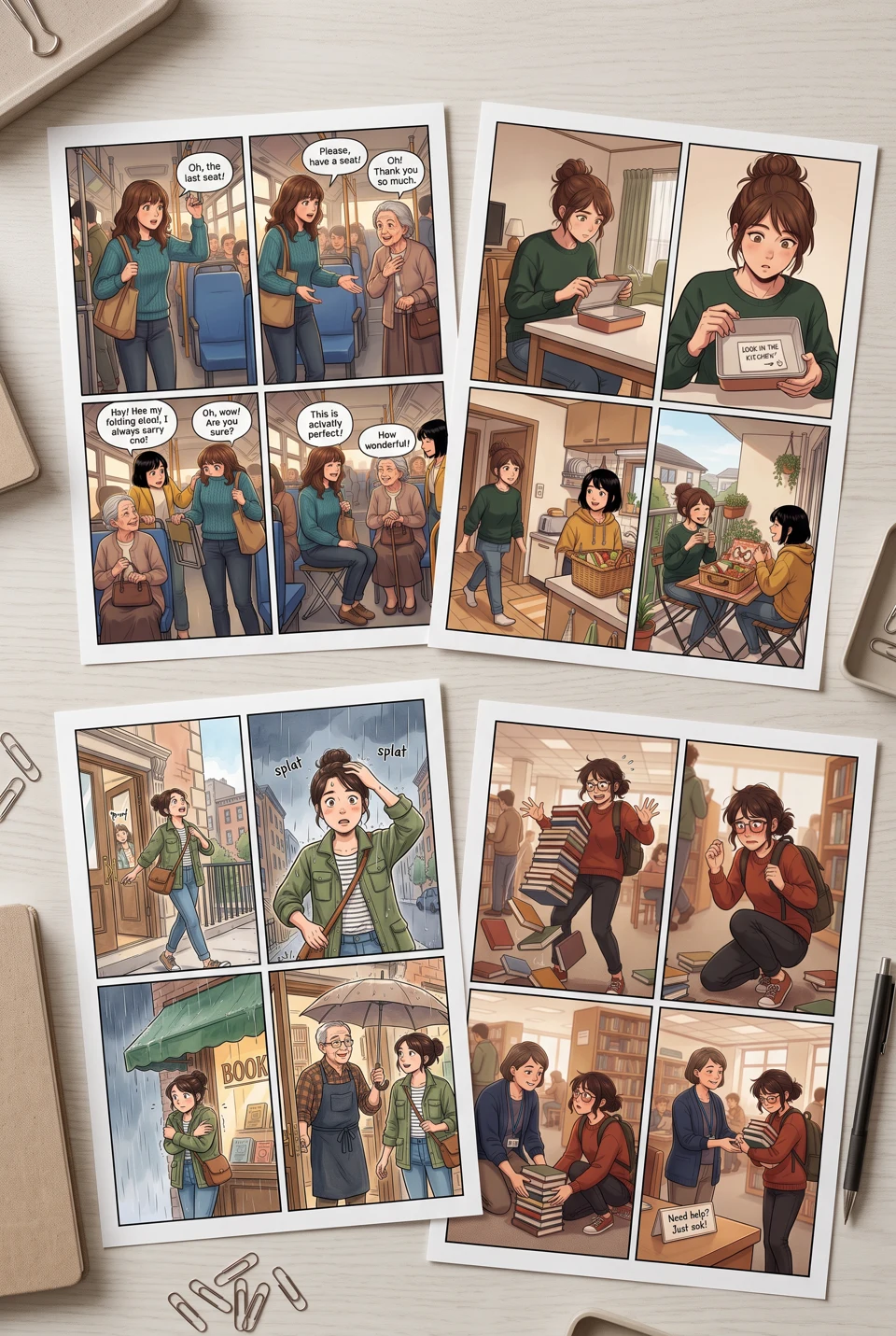
Read, review and print an original four-panel story
These original English-language illustrations were created directly with Vertex AI. They are editorial examples, not customer projects or proof of the website’s upload, credit deductions or generation flow. Interface and notes are translated; lettering in artwork remains English.
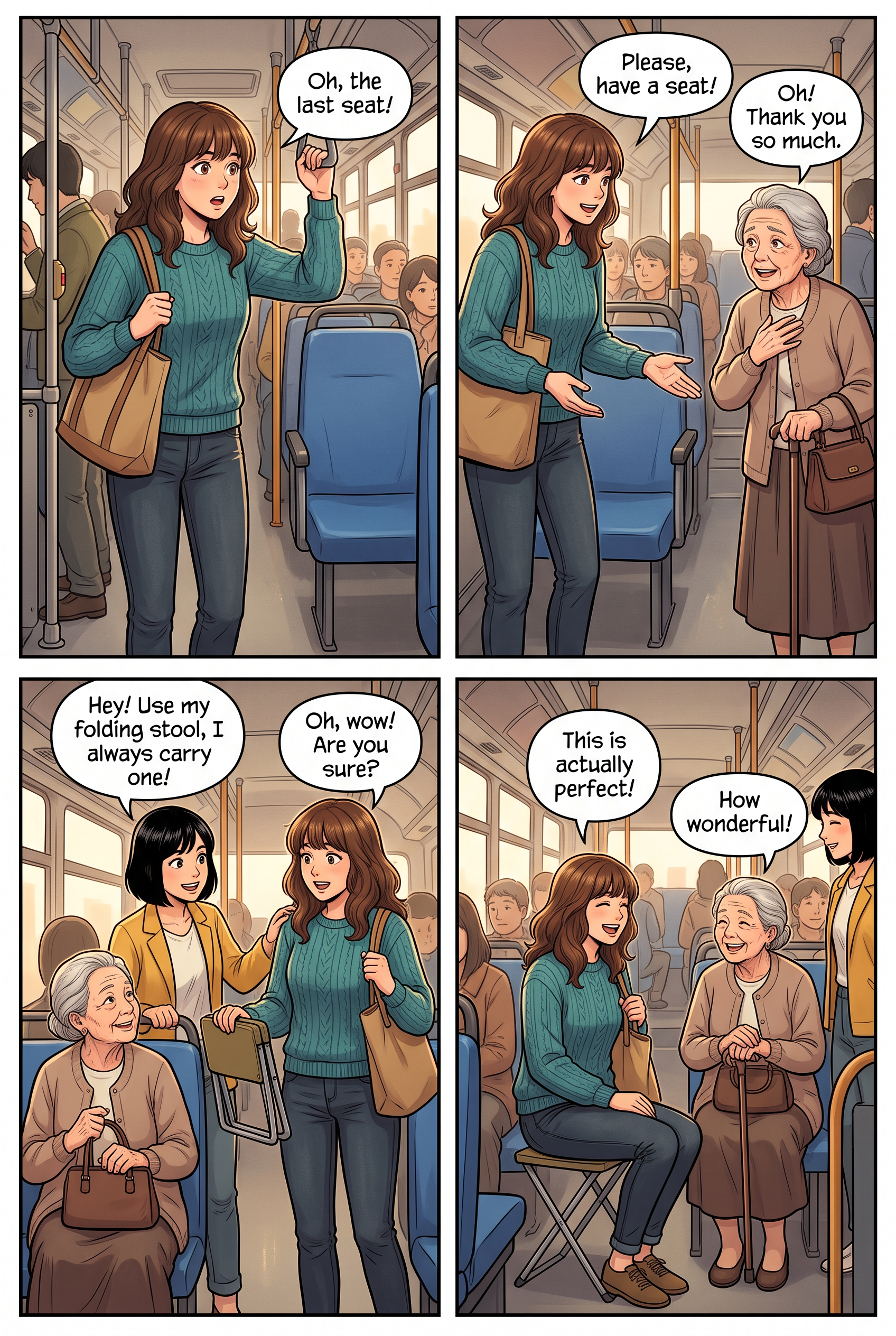
The Last Seat
A commuter notices the last bus seat. She offers it to an older passenger. A friend offers her a folding stool. She laughs beside the seated passenger.
Original English generation brief
Create an ORIGINAL finished four-panel comic page in portrait 2:3, exactly two rows and two columns with four clear equal panels and white gutters. Warm professional color manga, adult female lead, fully clothed casual contemporary clothing. Maintain identical face, hair, clothing and props through the four panels. English story, mostly visual storytelling, no extra captions, no title printed on image, no watermark, no borrowed franchise characters. Clear left-to-right top-to-bottom sequence. Four beats: A commuter notices the last bus seat. She offers it to an older passenger. A friend offers her a folding stool. She laughs beside the seated passenger. Natural hands and readable staging. This is original editorial artwork, not a photograph or a customer testimonial.
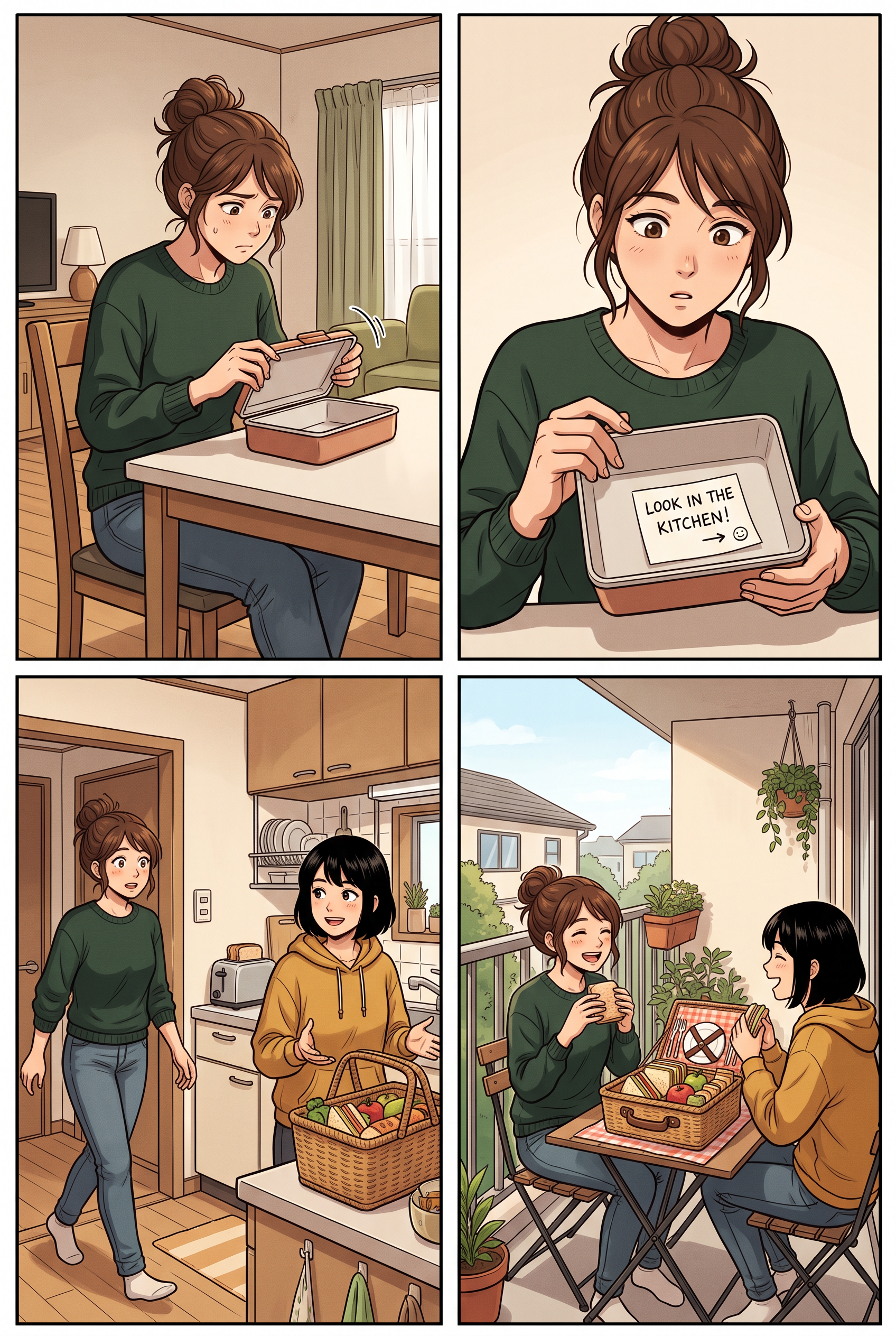
A woman opens an empty lunch box. She finds a note pointing to the kitchen. Her roommate reveals a picnic basket. They eat together on the balcony.
Original English generation brief
Create an ORIGINAL finished four-panel comic page in portrait 2:3, exactly two rows and two columns with four clear equal panels and white gutters. Warm professional color manga, adult female lead, fully clothed casual contemporary clothing. Maintain identical face, hair, clothing and props through the four panels. English story, mostly visual storytelling, no extra captions, no title printed on image, no watermark, no borrowed franchise characters. Clear left-to-right top-to-bottom sequence. Four beats: A woman opens an empty lunch box. She finds a note pointing to the kitchen. Her roommate reveals a picnic basket. They eat together on the balcony. Natural hands and readable staging. This is original editorial artwork, not a photograph or a customer testimonial.
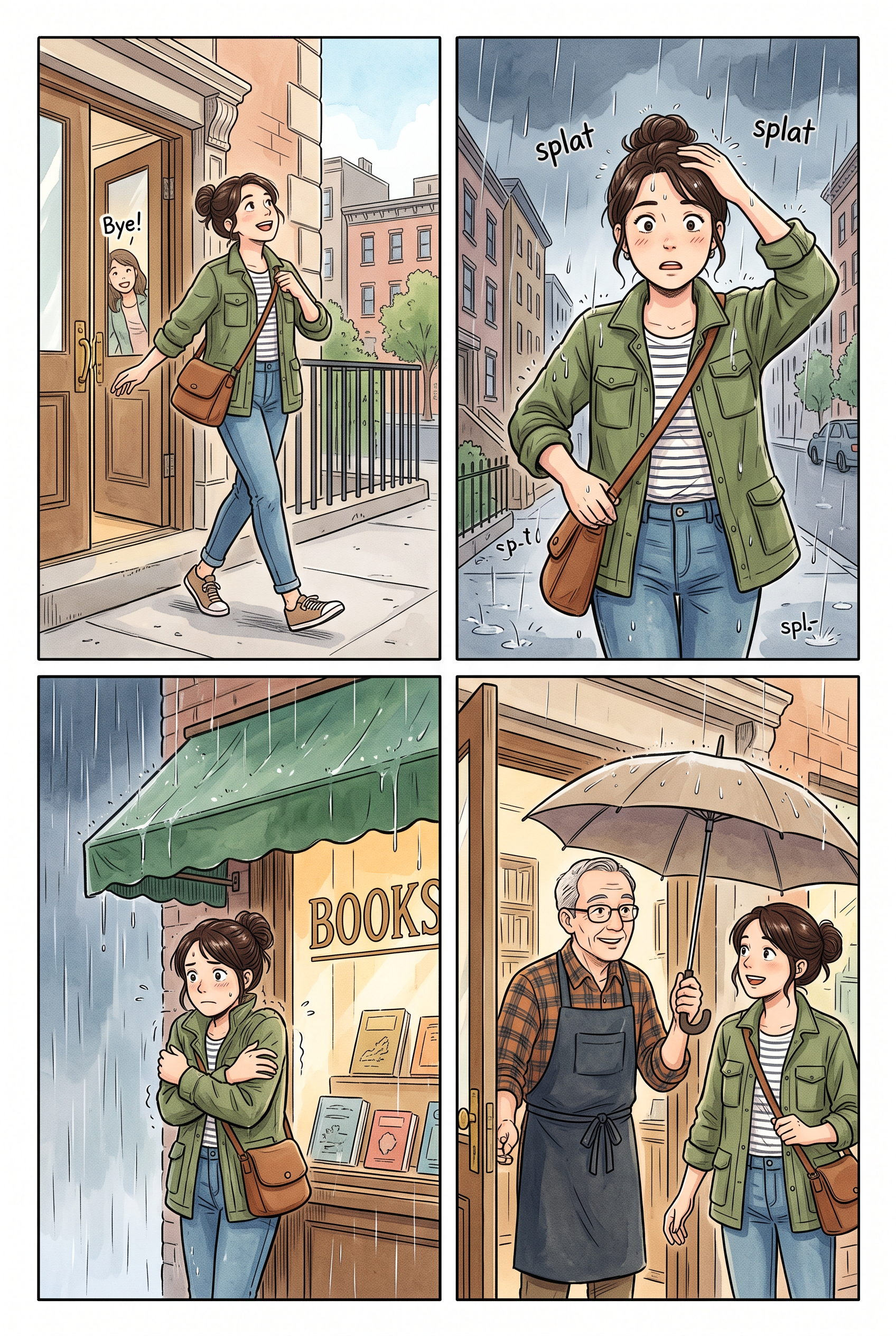
A woman leaves home without an umbrella. Rain begins. She shelters under a bookshop awning. The bookseller shares an umbrella and they smile.
Original English generation brief
Create an ORIGINAL finished four-panel comic page in portrait 2:3, exactly two rows and two columns with four clear equal panels and white gutters. Warm professional color manga, adult female lead, fully clothed casual contemporary clothing. Maintain identical face, hair, clothing and props through the four panels. English story, mostly visual storytelling, no extra captions, no title printed on image, no watermark, no borrowed franchise characters. Clear left-to-right top-to-bottom sequence. Four beats: A woman leaves home without an umbrella. Rain begins. She shelters under a bookshop awning. The bookseller shares an umbrella and they smile. Natural hands and readable staging. This is original editorial artwork, not a photograph or a customer testimonial.
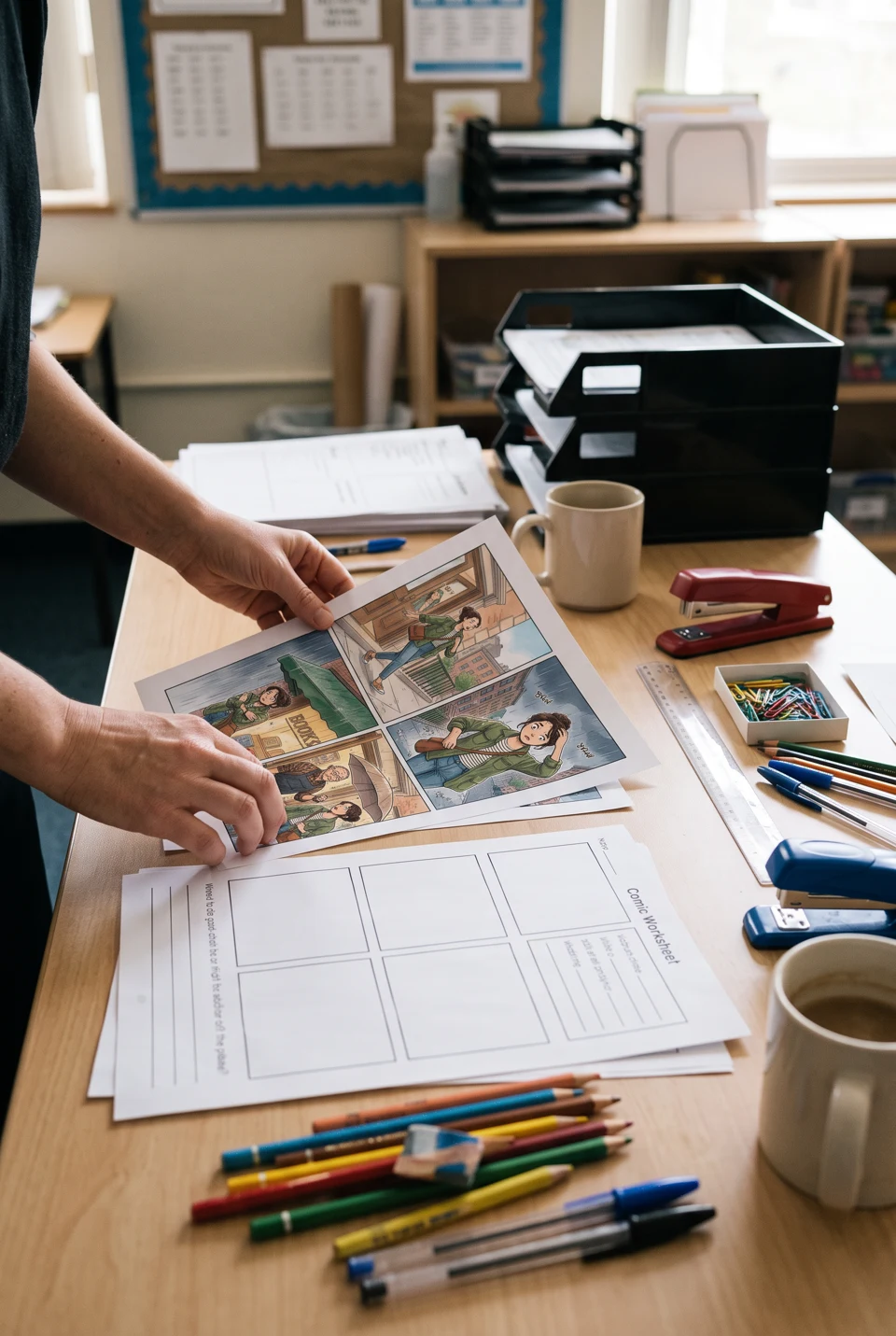
AI-generated illustrative use scene featuring our original comic artwork. Not a customer photograph or a physical print test.AI-generated illustrative use scene featuring our original comic artwork. Not a customer photograph or a physical print test.
Review before sharing
Read left to right, then top to bottom. Check four distinct story beats.
Compare face, hair, clothing, hands and recurring objects across panels.
Check every caption and speech bubble. Verify classroom facts against the linked source.
Open the downloaded PDF and check order, margins and readable text at actual size.
Downloads and generation have different requirements
The sample images, blank templates and PDFs can be downloaded without an account. AI generation uses the existing sign-in, plan and credit rules. Check the displayed cost before submitting. A4 and Letter files fit the whole image inside a half-inch margin; physical printer output has not been tested.
Book Report Comic Strip: Show What the Story Supports | LlamaGen