Two pairs of chromosomes. One round of copying. Four cells to check.
Explain how one round of DNA replication followed by meiosis I and II reduces chromosome sets, while distinguishing homologous chromosomes from sister chromatids.
An original teaching example. Read the complete panel script, checks and references below the book.
03
Biology · inheritance · LlamaGen
01 · Source materials
Build a chromosome key before drawing a cell.
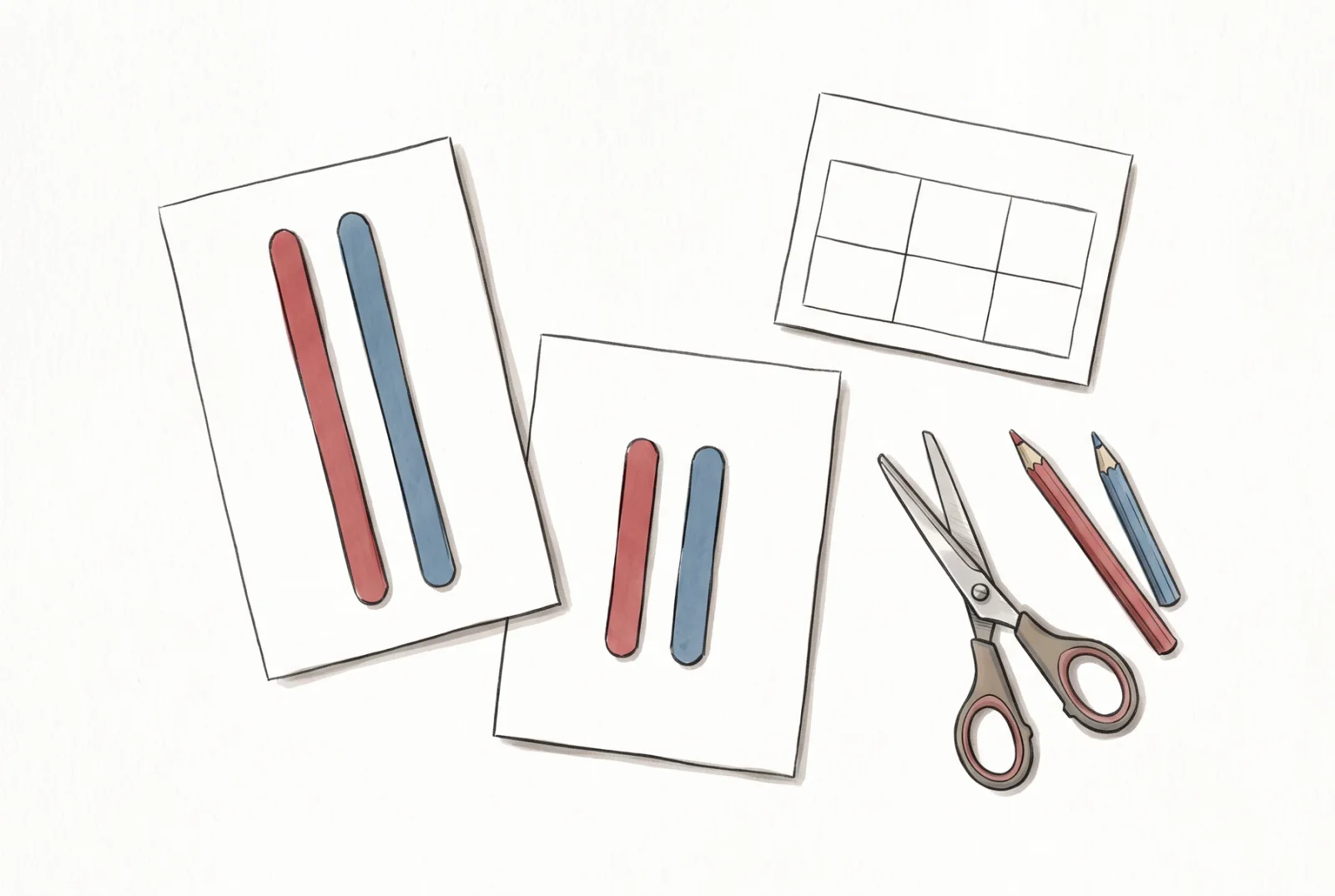
Use an original paper model with two homologous pairs: one long pair and one short pair. Two colors distinguish the two parental sets, and small matching segment marks let readers follow a crossover. The starting diploid model has four chromosomes, written 2n = 4; this is a drawing convention, not the human chromosome count. Keep one consistent key beside the six-panel plan. Use the references below to check what separates in each division instead of treating meiosis as two identical rounds of mitosis.
04
Biology · inheritance · LlamaGen
02 · The challenge
Can the reader tell which partners separate first, and why no second round of DNA copying belongs between the divisions?
One replication
Does DNA copy once before meiosis I, with no new replication between meiosis I and II?
Two kinds of partners
Are homologous chromosomes distinguished from the two sister chromatids of one replicated chromosome?
First division
Do homologs separate in meiosis I while sister chromatids remain joined?
Final sets
After the second division and cytokinesis, does each model cell have one long and one short chromosome, rather than both homologs of either pair?
05
Biology · inheritance · LlamaGen
03 · Planning the page
A story takes shape.
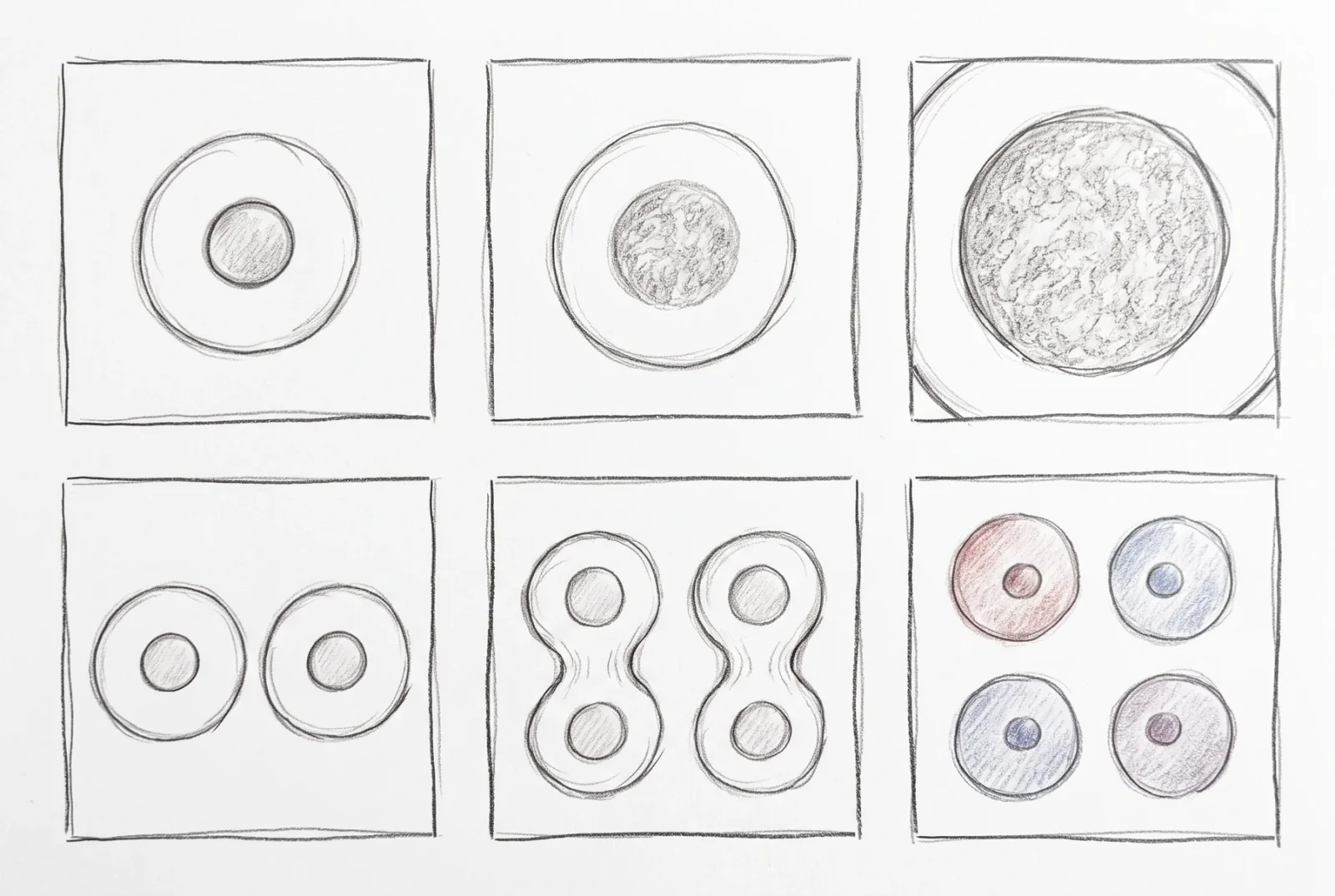
Plan six panels for this task: Explain how one round of DNA replication followed by meiosis I and II reduces chromosome sets, while distinguishing homologous chromosomes from sister chromatids. Keep visual symbols consistent, leave caption space, and use the complete reviewed script below.
Illustrated planning concept, not an editor screenshot or recorded session.
06
Biology · inheritance · LlamaGen
04 · The creative process
Make a draft. Make it yours.
Model
Make the two size-matched homologous pairs and record the meaning of each color and segment mark.
Track
Plan the single DNA-copying step, a crossover between nonsister chromatids, and the two different separations.
Caption
Give each scene one explanation of chromosome behavior; place the full counting key beside the artwork.
Audit
Count the chromosomes and chromatids after each completed division, then compare the outcome with the mitosis lesson.
07
Biology · inheritance · LlamaGen
05 · Comic concept
Six panels, ready to read and question.
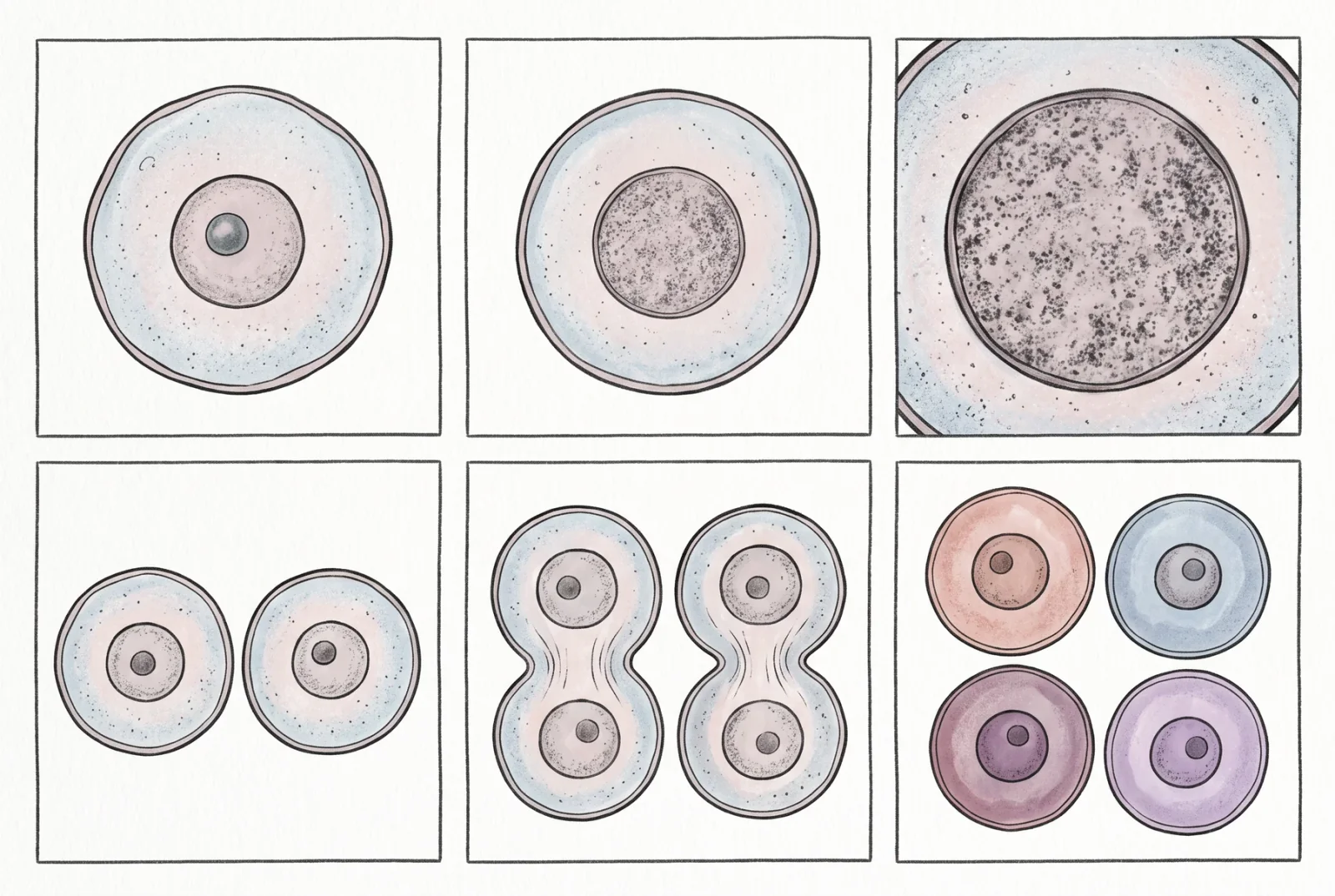
AI-generated six-frame cell-division concept with chromosome details omitted. Use the written 2n = 4 model to count chromosomes and distinguish the two separations.
08
Biology · inheritance · LlamaGen
The next page is yours
Make your own version. Check every caption.
Start with one short scene. Review the words, the characters and the details before making the next page.
Sign-in and generation credits may apply. Features and export options depend on your workspace and plan.
09
By LlamaGen · Original classroom example · Edition
The complete classroom example
Explain how one round of DNA replication followed by meiosis I and II reduces chromosome sets, while distinguishing homologous chromosomes from sister chromatids.
Suggested audience: Secondary-school biology learners who already know basic cell structure and DNA replication; adjust terminology with the teacher.
AI-generated six-frame cell-division concept with chromosome details omitted. Use the written 2n = 4 model to count chromosomes and distinguish the two separations.
Read the six-panel script
The illustrations are concepts. These editable captions carry the explanation; read and check them even when images or animation are unavailable.
1. Start with two homologous pairs
A simplified animal cell contains four single chromosome models: two long and two short, with one of each length from each parental set.
Our starting model is diploid: two sets, four chromosomes in total (2n = 4).
2. Copy the DNA once
The same four chromosome models are now duplicated; each is represented by two sister chromatids joined at a centromere.
Before meiosis begins, DNA replicates. There are still four chromosomes, now made of eight chromatids.
3. Pair, recombine, align
The long homologs pair with each other, and the short homologs pair with each other. A matching segment exchange between nonsister chromatids is shown before the pairs align for the first division.
Homologous chromosomes pair in meiosis I. Crossing over can create new combinations of inherited DNA.
4. Meiosis I separates homologs
The first division finishes with two cells. Each contains one duplicated long chromosome and one duplicated short chromosome; sister chromatids are still joined.
The first division separates homologous chromosomes. Each cell now has one set, although its chromosomes are still duplicated.
5. Meiosis II separates sisters
Without an intervening DNA-copying scene, the sister chromatids move apart inside each of the two cells.
In the second division, sister chromatids separate. DNA has not been copied again.
6. Check four haploid products
Four completed model cells are displayed. Each has one long and one short single chromosome, with segment marks retained where crossing over occurred.
Each final cell has one chromosome set (n = 2 in this model). Compare the DNA combinations, not just the cell count.
Use the script in your own comic
Continue with the complete prompt and six-panel script below, or copy them into the comic workspace. The link prepares a draft; generation only starts when you submit in the workspace. Prepare the images first, add captions using supported editing controls, then check the draft. This page does not promise automatic factual accuracy or a one-click finished worksheet.
Sign-in and generation credits may apply. Do not upload student names or photographs without the appropriate permission. Printing and shipping are not included.
Check the subject before sharing
This six-panel script compresses several named stages into a simplified, symmetric animal-cell model. It is not an account of human egg formation: oogenesis has unequal divisions and does not produce four equivalent mature eggs. Count chromosomes by centromeres at the stated checkpoints; the X-like drawing represents one replicated chromosome, not a pair of homologs. Scientific labels and counts must be checked independently of the AI-generated illustration. The accompanying illustrations omit the exact chromosome structures and counts; the written script and counting activity supply those details.
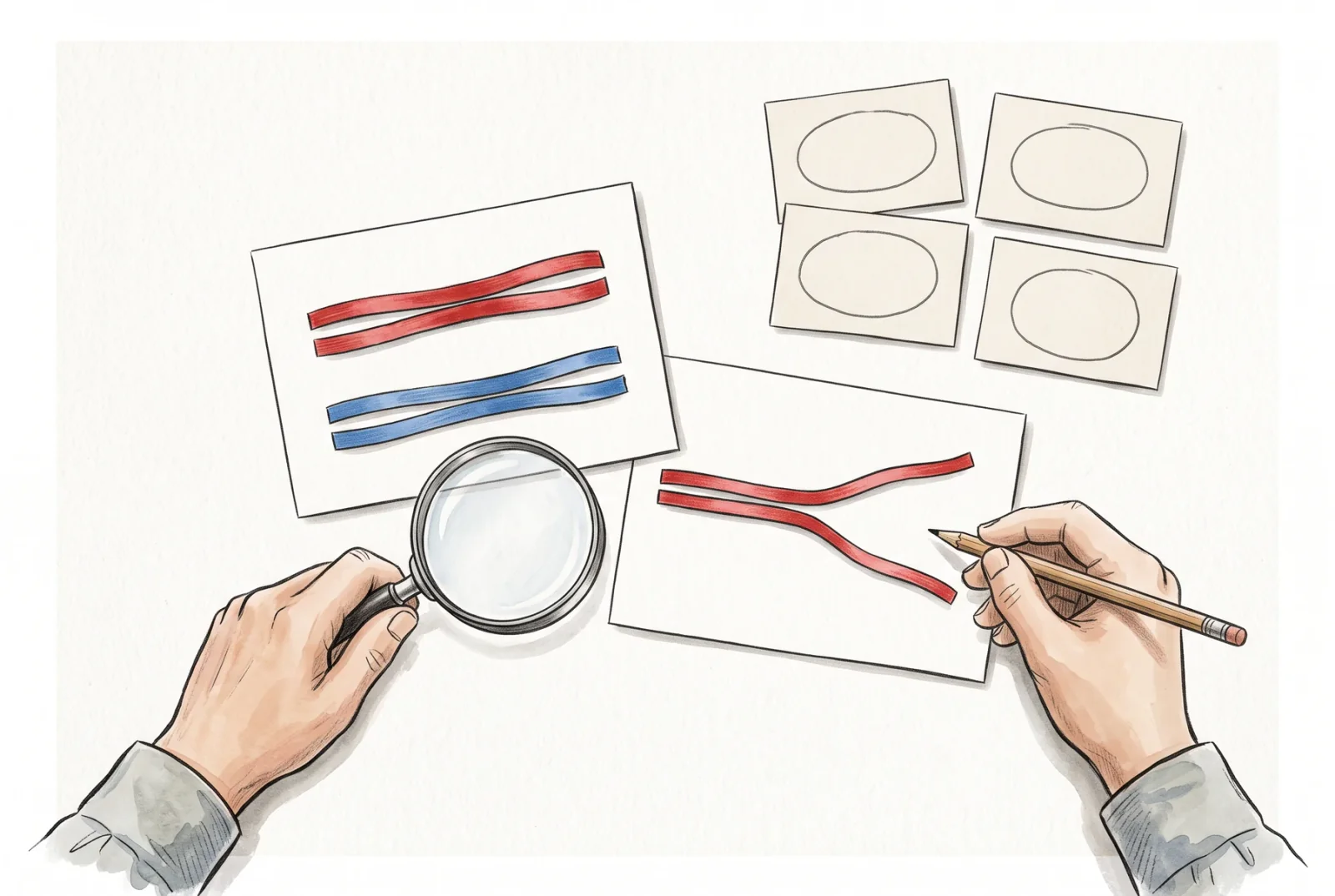
AI-generated paper-model review composition. Chromosome structures and counts are omitted; compare homolog separation and sister-chromatid separation using the written checkpoints.
Check the separation, not the prettiness of the cells.
The generated paper-model illustrations deliberately omit chromosome structures and precise counts. Their cell outlines suggest the order of divisions, not evidence that the 2n = 4 model has been drawn correctly. Compare the two kinds of separation and use the written checkpoints as the teaching reference.
After meiosis I: The model should show two cells, each with two duplicated chromosomes: one long and one short.
After meiosis II: The model should show four cells, each with two single chromosomes: one long and one short.
Crossover continuity: Exchanged segments stay attached to the chromosome models as they move; whole chromosomes do not change length or appear from nowhere.
Try a different version
Make a four-row table: before DNA replication, after replication, after completed meiosis I, and after completed meiosis II. Record chromosomes/chromatids per cell as 4/4, 4/8, 2/4 and 2/2 for this model. Then change the orientation of one homologous pair before the first separation and compare the resulting combinations. Explain why changing that orientation does not add another DNA-copying step.
Questions about this example
How is a meiosis comic different from a mitosis comic?
It needs a reduction in chromosome sets and two distinct separations: homologs first, sister chromatids second. A mitosis strip cannot become a meiosis strip merely by adding two more cells to its ending.
Does an X-shaped chromosome count as two chromosomes?
At the checkpoints used here, an X-like model is one replicated chromosome with two sister chromatids joined at a centromere. After the sisters separate, each is a chromosome in its own right. State the checkpoint before counting.
Should I draw four sperm or four eggs at the end?
Use four generic haploid model cells for this lesson. The later development of gametes differs across organisms and between sperm and egg formation; four identical egg icons would misrepresent human oogenesis.
Sources and how this page was made
Artwork generation: Google Vertex AI · gemini-nano-banana-2.1.
LlamaGen authored this teaching example using the references below. The script and activity are original; the source scene, storyboard sheet, wordless comic and review illustration were generated separately with Google Vertex AI. They do not demonstrate automatic source-to-comic conversion. No teacher endorsement, measured learning benefit or independent expert review is claimed.
NHGRI: meiosis — Reference for reduction from diploid to haploid sets and the two meiotic divisions.
NHGRI: crossing over — Reference for exchange between paired homologous chromosomes and new inherited combinations.
Checked against these linked sources for this edition on November 16, 2026. Teachers should adapt vocabulary and verify the final draft against their curriculum.
Your story, one scene at a time
Make your own version. Check every caption.
Plan a meiosis comic strip with a six-panel chromosome story, a meiosis I versus II comparison, a counting activity and checks for common diagram errors.
How is a meiosis comic different from a mitosis comic?+
It needs a reduction in chromosome sets and two distinct separations: homologs first, sister chromatids second. A mitosis strip cannot become a meiosis strip merely by adding two more cells to its ending.
How was this classroom example made?+
An original LlamaGen classroom example with AI-generated editorial illustrations. Not a customer project, scientific observation or verified product output. Check the supplied captions and sources before classroom use. No customer quotation, endorsement or measured outcome is claimed.
More ways to tell a story
Another page. Another possibility.
An original LlamaGen classroom example with AI-generated editorial illustrations. Not a customer project, scientific observation or verified product output. Check the supplied captions and sources before classroom use. Images were created with Google Vertex AI. The illustrated planning and comic stages do not demonstrate an automatic transformation of the source illustration.
Read, review and print an original four-panel story
These original English-language illustrations were created directly with Vertex AI. They are editorial examples, not customer projects or proof of the website’s upload, credit deductions or generation flow. Interface and notes are translated; lettering in artwork remains English.
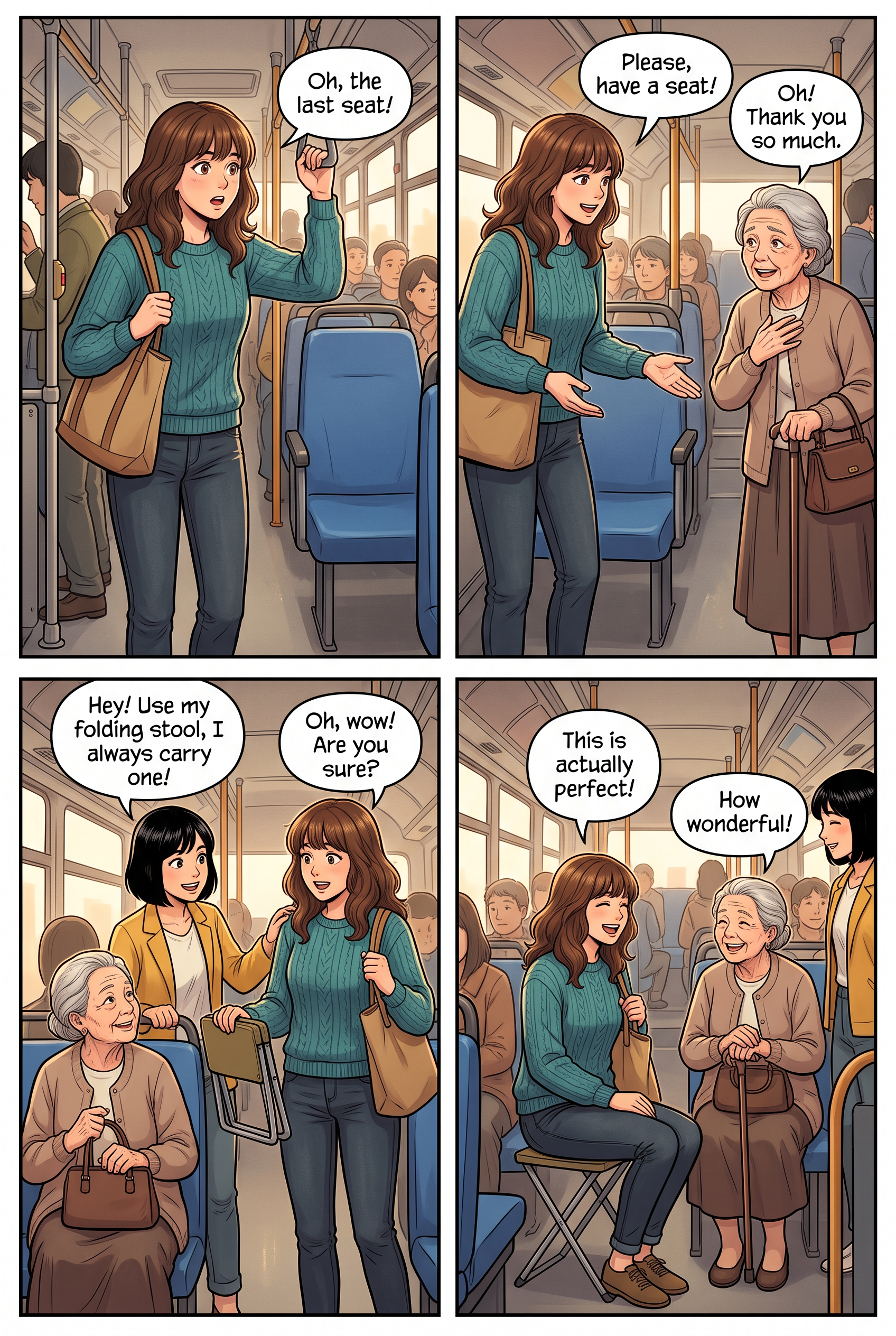
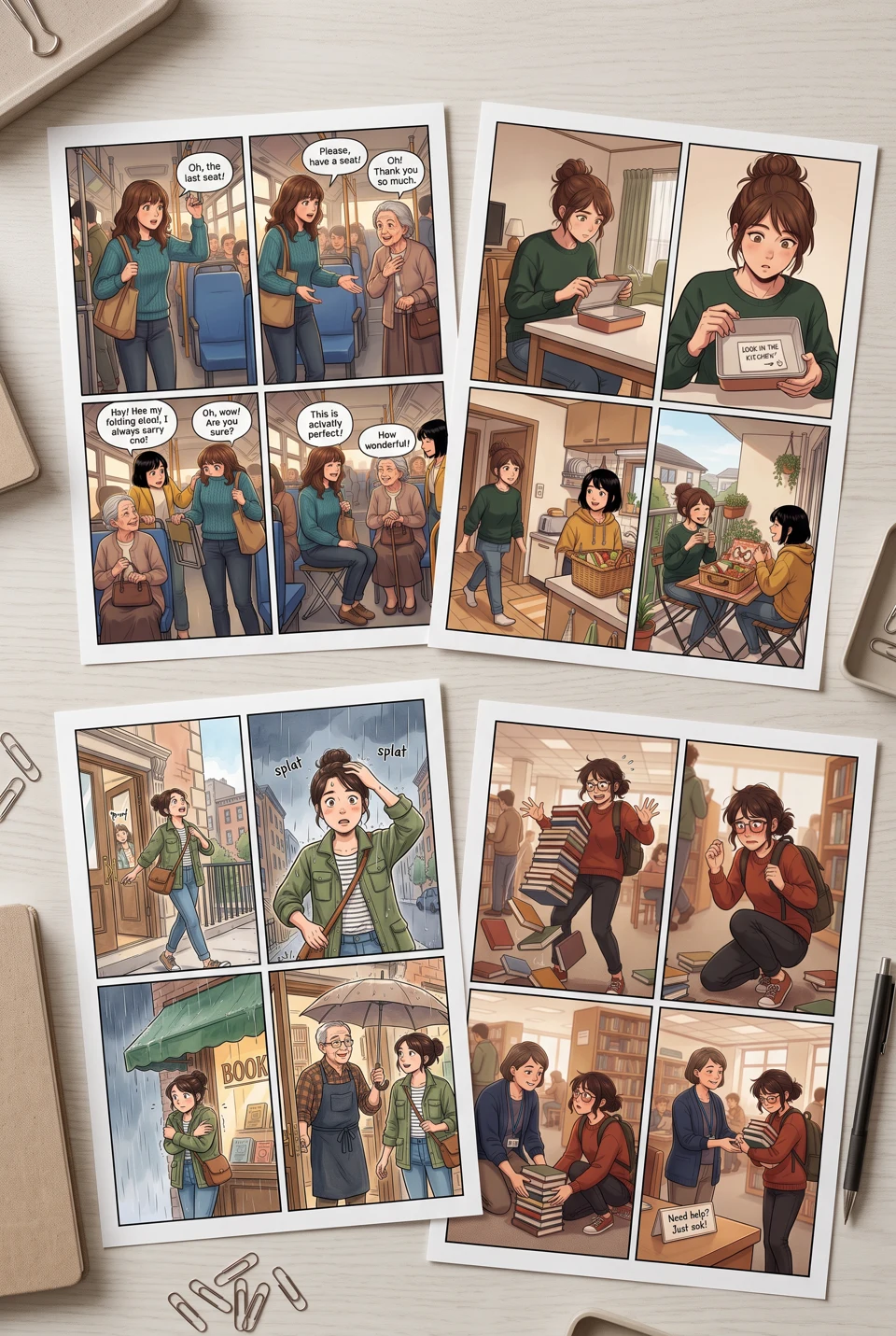
The Last Seat
A commuter notices the last bus seat. She offers it to an older passenger. A friend offers her a folding stool. She laughs beside the seated passenger.
Original English generation brief
Create an ORIGINAL finished four-panel comic page in portrait 2:3, exactly two rows and two columns with four clear equal panels and white gutters. Warm professional color manga, adult female lead, fully clothed casual contemporary clothing. Maintain identical face, hair, clothing and props through the four panels. English story, mostly visual storytelling, no extra captions, no title printed on image, no watermark, no borrowed franchise characters. Clear left-to-right top-to-bottom sequence. Four beats: A commuter notices the last bus seat. She offers it to an older passenger. A friend offers her a folding stool. She laughs beside the seated passenger. Natural hands and readable staging. This is original editorial artwork, not a photograph or a customer testimonial.
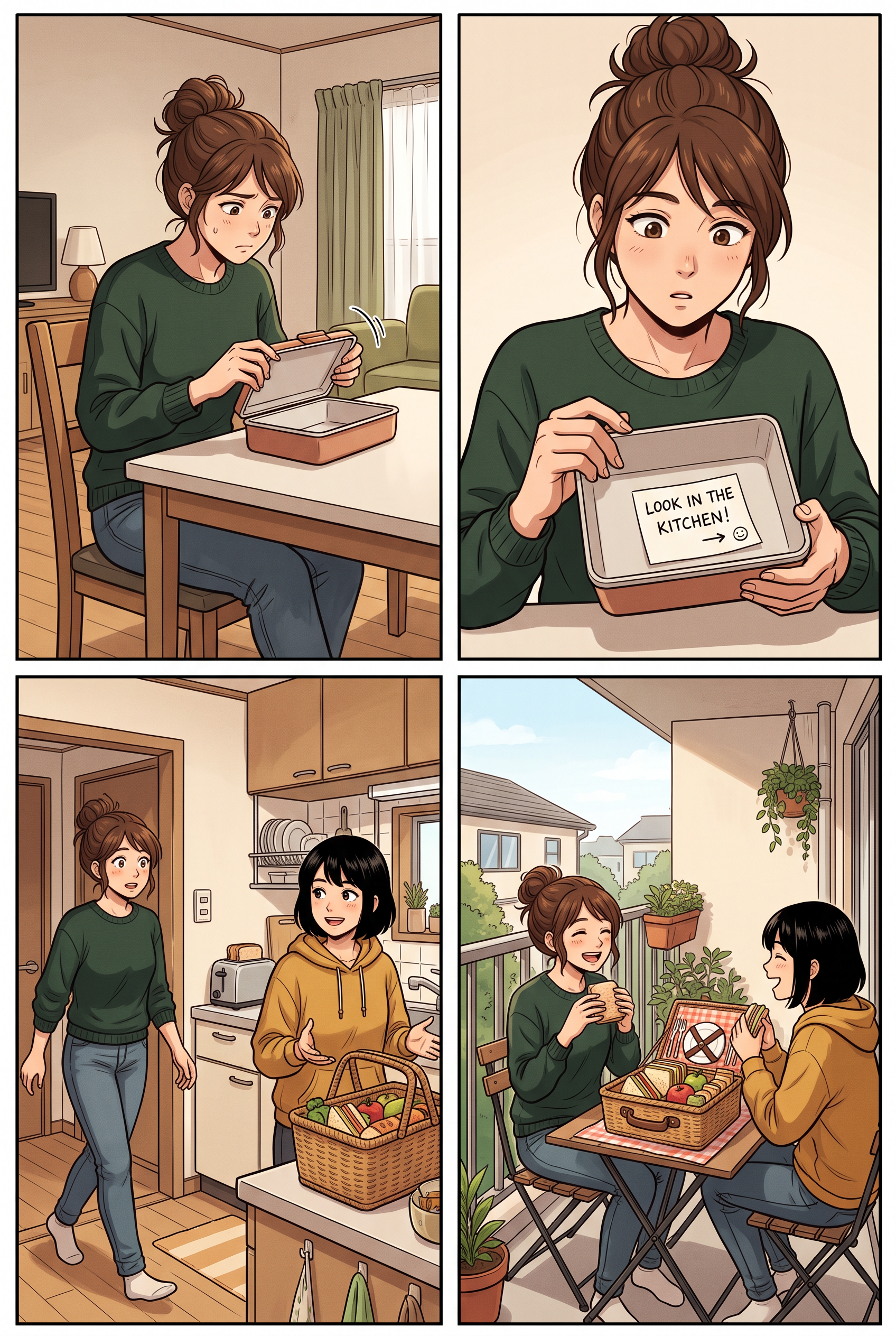
A woman opens an empty lunch box. She finds a note pointing to the kitchen. Her roommate reveals a picnic basket. They eat together on the balcony.
Original English generation brief
Create an ORIGINAL finished four-panel comic page in portrait 2:3, exactly two rows and two columns with four clear equal panels and white gutters. Warm professional color manga, adult female lead, fully clothed casual contemporary clothing. Maintain identical face, hair, clothing and props through the four panels. English story, mostly visual storytelling, no extra captions, no title printed on image, no watermark, no borrowed franchise characters. Clear left-to-right top-to-bottom sequence. Four beats: A woman opens an empty lunch box. She finds a note pointing to the kitchen. Her roommate reveals a picnic basket. They eat together on the balcony. Natural hands and readable staging. This is original editorial artwork, not a photograph or a customer testimonial.
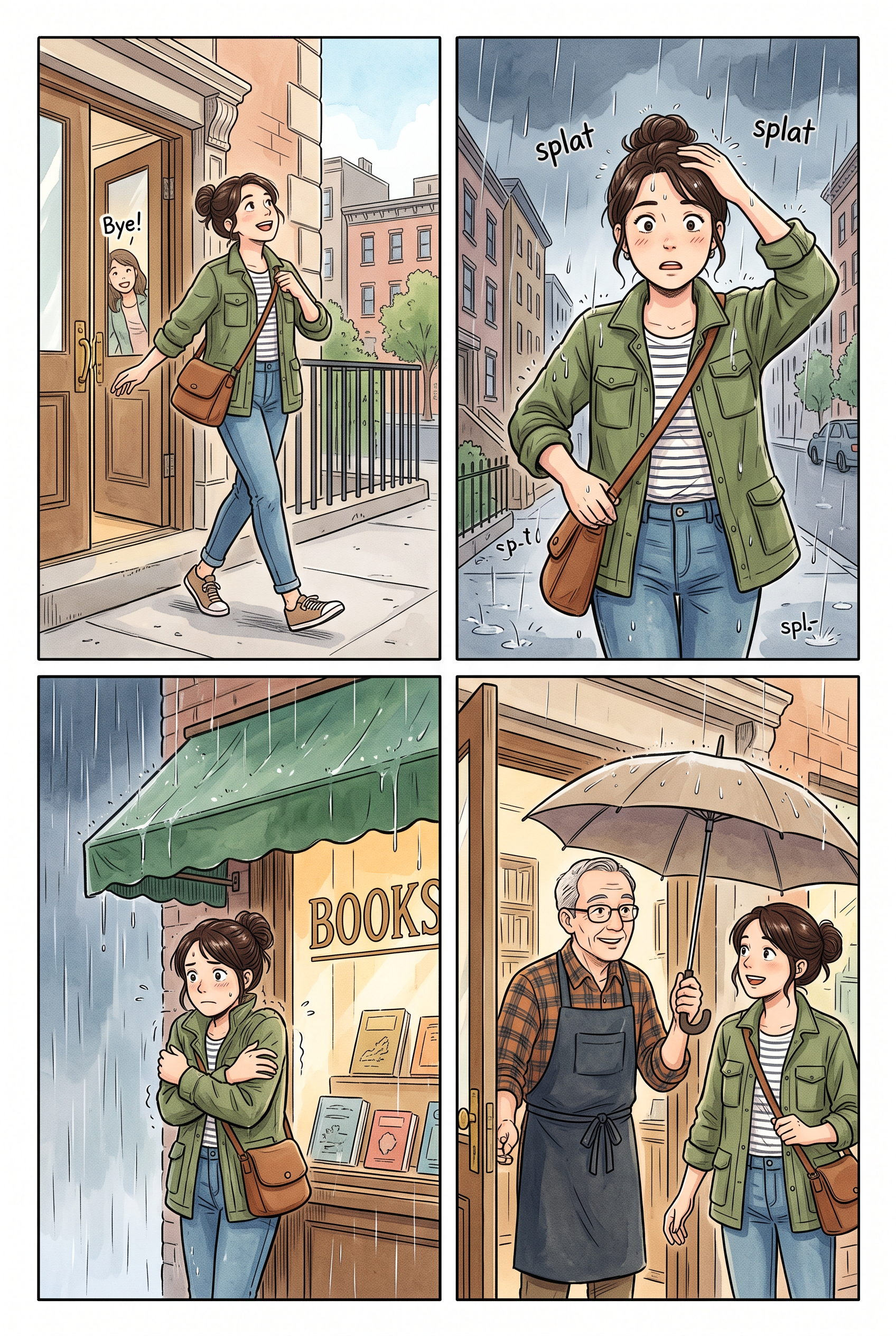
A woman leaves home without an umbrella. Rain begins. She shelters under a bookshop awning. The bookseller shares an umbrella and they smile.
Original English generation brief
Create an ORIGINAL finished four-panel comic page in portrait 2:3, exactly two rows and two columns with four clear equal panels and white gutters. Warm professional color manga, adult female lead, fully clothed casual contemporary clothing. Maintain identical face, hair, clothing and props through the four panels. English story, mostly visual storytelling, no extra captions, no title printed on image, no watermark, no borrowed franchise characters. Clear left-to-right top-to-bottom sequence. Four beats: A woman leaves home without an umbrella. Rain begins. She shelters under a bookshop awning. The bookseller shares an umbrella and they smile. Natural hands and readable staging. This is original editorial artwork, not a photograph or a customer testimonial.
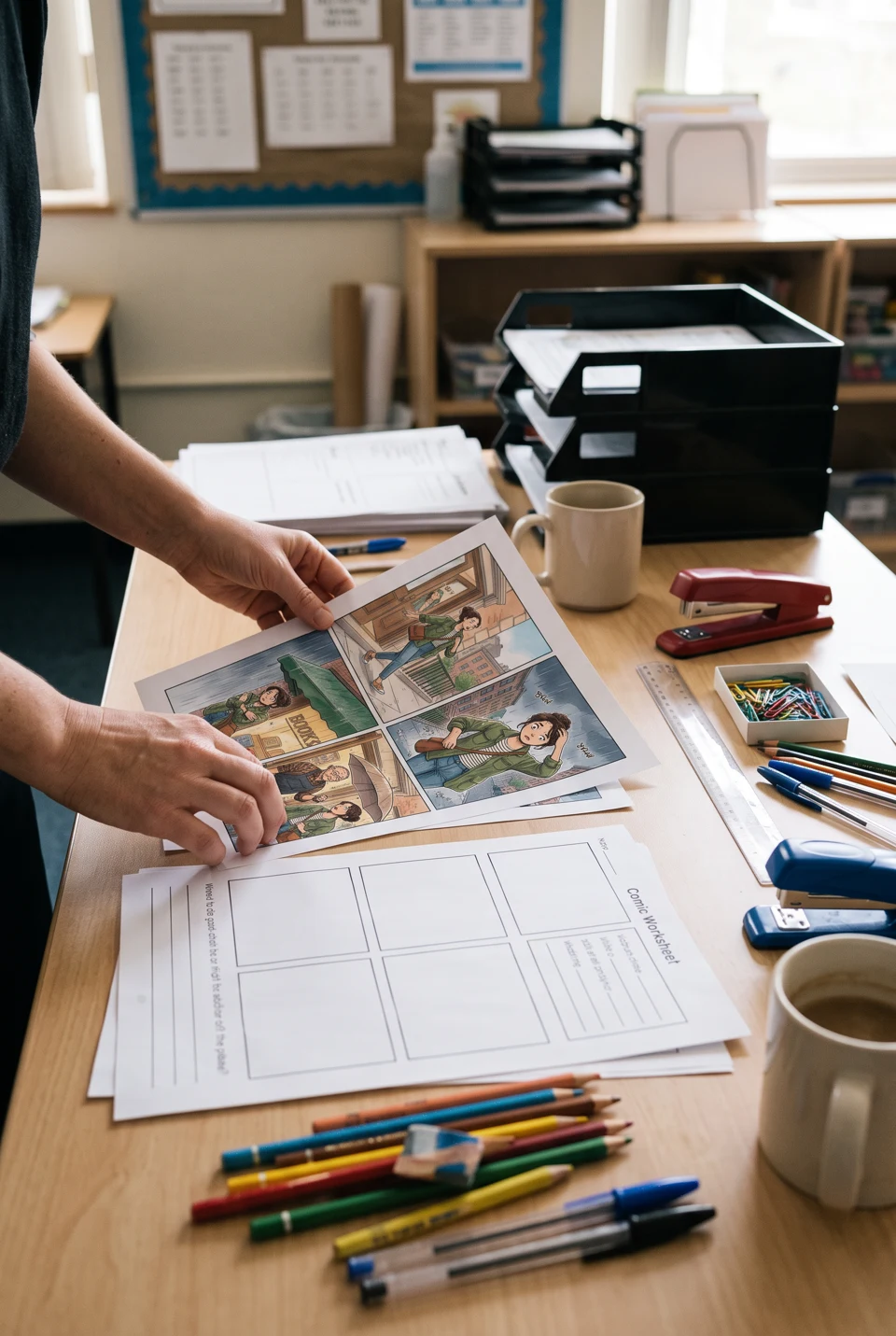
AI-generated illustrative use scene featuring our original comic artwork. Not a customer photograph or a physical print test.AI-generated illustrative use scene featuring our original comic artwork. Not a customer photograph or a physical print test.
Review before sharing
Read left to right, then top to bottom. Check four distinct story beats.
Compare face, hair, clothing, hands and recurring objects across panels.
Check every caption and speech bubble. Verify classroom facts against the linked source.
Open the downloaded PDF and check order, margins and readable text at actual size.
Downloads and generation have different requirements
The sample images, blank templates and PDFs can be downloaded without an account. AI generation uses the existing sign-in, plan and credit rules. Check the displayed cost before submitting. A4 and Letter files fit the whole image inside a half-inch margin; physical printer output has not been tested.
Meiosis Comic Strip: One Copy, Two Divisions | LlamaGen