Logo LlamaGenJenama LlamaGen
  1. Laman Utama
Storyboard-to-Video Handoff Checklist: Shots, Timing, Audio, and Continuity
All posts

Storyboard-to-Video Handoff Checklist: Shots, Timing, Audio, and Continuity

Jay
Jay
November 1st, 2026
Salin pautan
  • What changes between a storyboard and a video brief?
  • Step 1: Freeze a reviewable sequence
  • Step 2: Specify the timebase and duration
  • Step 3: Describe what moves and what stays fixed
  • Step 4: Include references and audio decisions
  • Step 5: Check continuity at the cuts
  • Step 6: Send a package another person can open
  • Step 7: Approve a short motion test before scaling
  • Final handoff checklist
  • FAQ
  • Is an animatic the final video?
  • Should every storyboard frame become one video clip?
  • What should I do if a generated shot changes the character?
elevate-your-comics.png
Elevate your Comics with LlamaGen

A storyboard is ready for video when the next person can identify the approved shots, understand timing and motion, find the correct assets, and see which decisions still need approval.

Build the handoff around shot IDs, frame files, a timing sheet, motion notes, audio cues, and a revision log. You can start with LlamaGen.AI Storyboard to plan the sequence, then prepare a production package that can be reviewed independently of the creation tool.

What changes between a storyboard and a video brief?

A storyboard frame captures a moment. A video brief also needs duration, transitions, opening and closing states, and instructions for what moves.

A filmmaking discussion about prep methods shows how boards and animatics can help test staging and pacing. Different projects need different levels of detail. A quiet interview and an animated chase should not use the same handoff template without adjustment.

The Storyboard overview describes a workflow from story and scene breakdown through shots, revisions, and animatic export. Use the options available in your workspace. A planning export does not automatically guarantee compatibility with every video editor or generation model.
The public LlamaGen.AI storyboard feature page captured during preparation

Public product page captured November 2, 2026. The following production illustrations are conceptual examples, not screenshots of a completed video job.

Step 1: Freeze a reviewable sequence

Read the storyboard in order before preparing individual video requests. Check what the viewer knows at each point, where the scene changes, and whether each reaction has enough context.

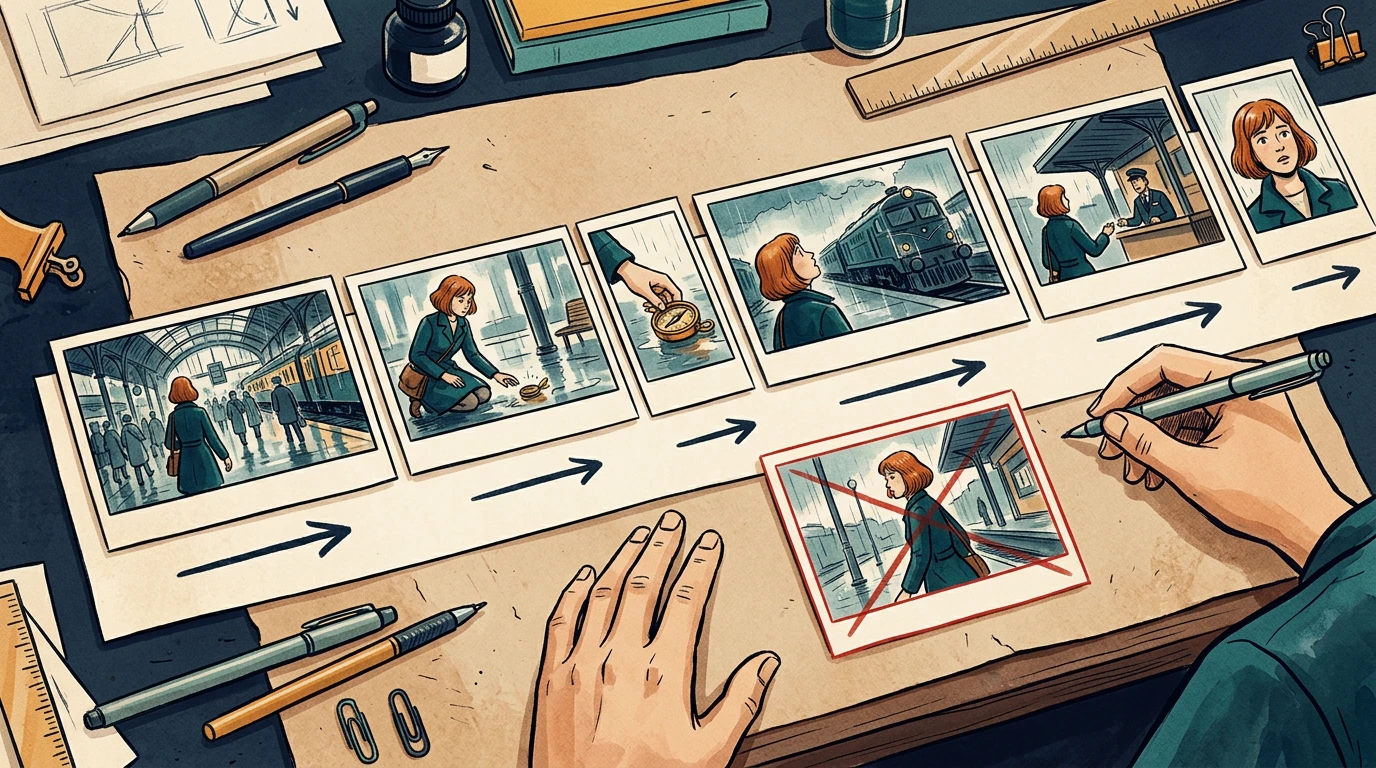
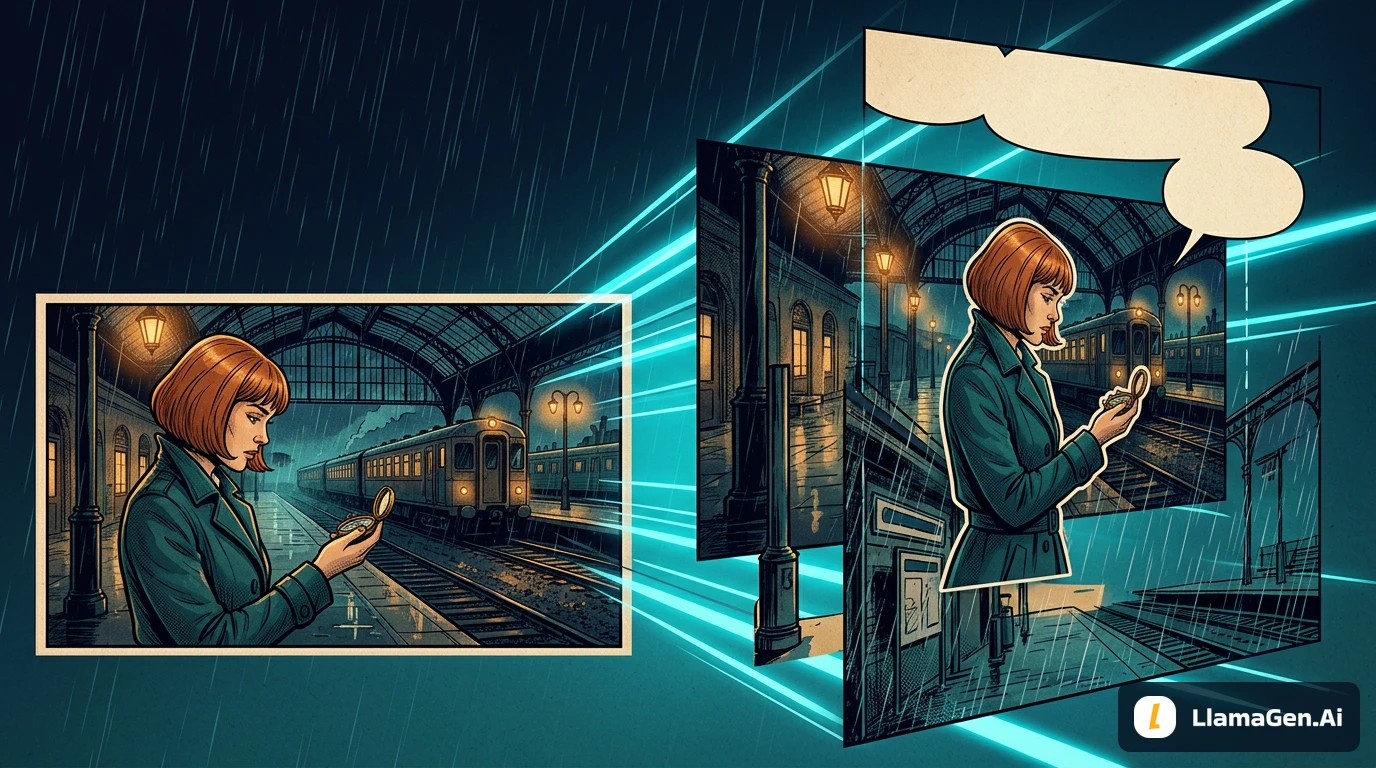
The running example is a 24-second station sequence. Mira enters, sees a compass, picks it up, notices a train, approaches an attendant, and reacts to a new clue. Her copper bob, teal coat, and brass compass remain consistent throughout.

Assign stable shot IDs such as ST01-S010. Keep those IDs when inserting or revising shots. Do not rename every later shot just because one image was added.

Step 2: Specify the timebase and duration

Confirm the delivery aspect ratio, frame dimensions, and frame rate with the editor before production starts. The example below uses 24 fps and six shots totaling 24 seconds. It is a planning example, not a claim about any model's supported clip length.

Related hot tags

Storyboard

Penghasilan Video

Production Checklist

Alat pencipta popular

Tukar inspirasi menjadi cerita seterusnya

Cipta komik, papan cerita dan foto bergaya dengan LlamaGen.

01

Penjana Komik AI

Tukar idea menjadi jalur komik yang kemas dalam beberapa minit.

Cipta komik
02

Penjana Manga AI

Cipta seni manga yang ekspresif dan cerita berpanel berbilang.

Cipta manga
03

Penjana Papan Cerita AI

Bayangkan setiap babak sebelum produksi bermula.

Cipta papan cerita
04

Tukar Gambar kepada Komik

Tukar mana-mana foto menjadi ilustrasi gaya komik.

Cipta komik daripada gambar
05

Pembuat Strip Komik AI

Bina jalur komik yang boleh dikongsi dengan watak yang konsisten.

Cipta jalur komik

LlamaGen community

checkmark

Get hands-on help with your comics

checkmark

Showcase your comics to fellow LlamaGen creators

checkmark

Participate in special events to win gifts

Log perubahan

Cetuskankan impian untuk yang muda
Tempat berjuta-juta cerita menjadi hidup

Ringkasan keluaran ciri terbaru LlamaGen, penambahbaikan produk, kemas kini reka bentuk dan pembaikan pepijat penting.

✦
✧
✦
✧

Medium baharu untuk Penceritaan

Cipta cerita, komik, animasi, permainan dan banyak lagi tanpa had—dalam beberapa saat yang sesuai dengan audiens moden

Log Masuk
Langgan Sekarang
Diskaun 20%
ShotStory beatSecondsFrames at 24 fps
S010Mira enters the station372
S020She notices the compass496
S030She picks it up372
S040A train catches her attention5120
S050She approaches the attendant496
S060She recognizes a clue5120
TotalComplete sequence

Use one explicit convention in the timing sheet. For example, start frames can be inclusive and end frames exclusive: S010 occupies frames 0 through 71, with an end boundary of 72.

Do not mix that convention with an editor's inclusive In/Out interpretation without converting the numbers first. Adobe's timecode documentation is a useful reference when aligning frame counts and display choices with the receiving editor.

A conceptual six-shot sequence with varied timeline widths and continuity directions

The card widths illustrate pacing. Use the timing sheet, not visual card width, as the numeric source of truth.

Step 3: Describe what moves and what stays fixed

Separate subject motion from camera motion. Phrases like "make it cinematic" leave too many decisions unresolved.

For each shot, write:

Shot: ST01-S030
Start: Mira crouches; compass rests on the wet floor.
Action: her right hand lifts the compass toward her face.
Camera: low medium shot, restrained push-in.
End: compass is held still at chest height.
Preserve: face, copper bob, teal coat, compass shape, station lighting.
Avoid: added people, extra hands, changing train direction.

A clear start and end state helps the next shot connect. If your selected video tool cannot deliver the requested camera behavior, simplify the shot or replace it with an editorial move instead of repeatedly regenerating without a clear diagnosis.

Step 4: Include references and audio decisions

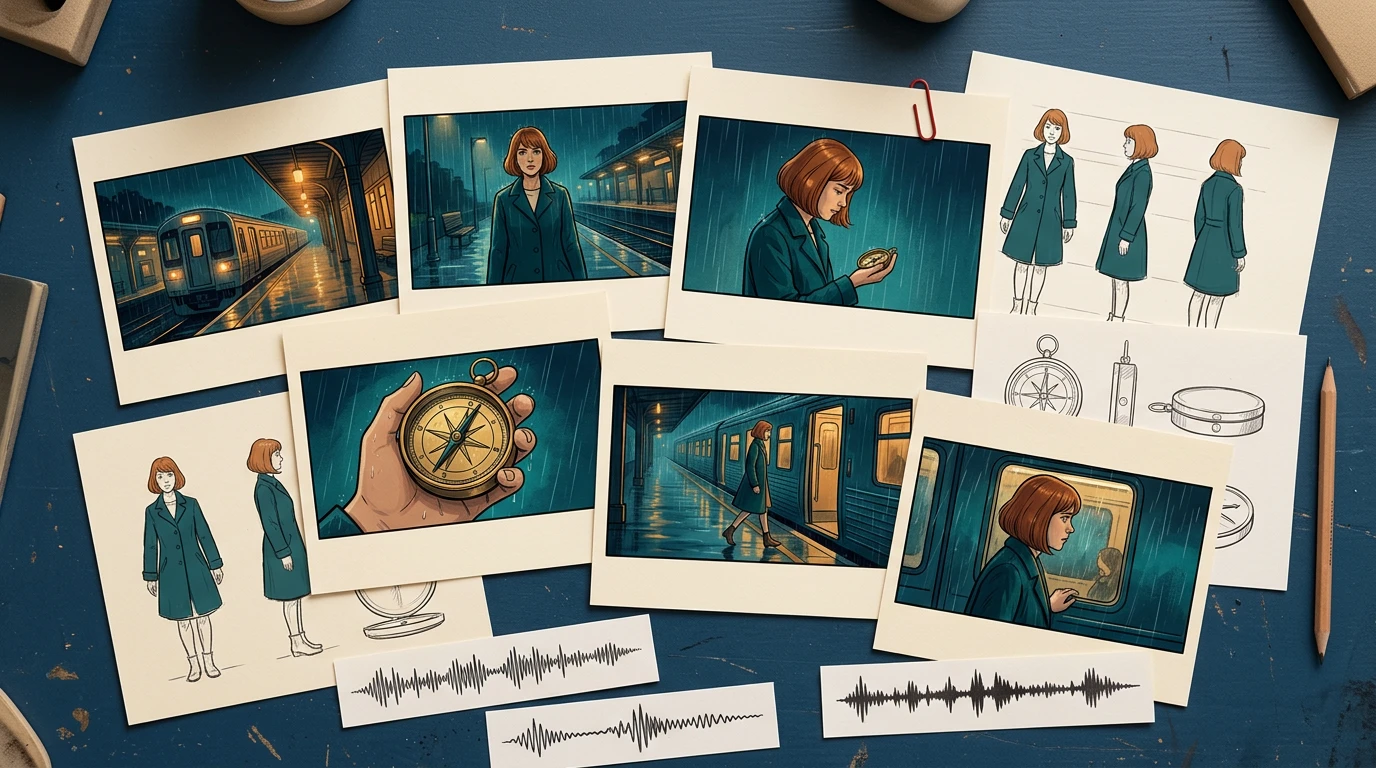
Provide the approved character reference, recurring prop reference, and location reference alongside the frames. Include only the versions the recipient should use.

For audio, distinguish final dialogue, temporary voice, sound effects, ambience, and music. Record cue positions and whether an audio file is approved for publication. Do not let a temporary track become the final soundtrack just because it was attached to the animatic.

A conceptual handoff kit with storyboard cards, character and prop references, and audio cue strips

The package should explain the scene even if the recipient has not watched earlier iterations.

Step 5: Check continuity at the cuts

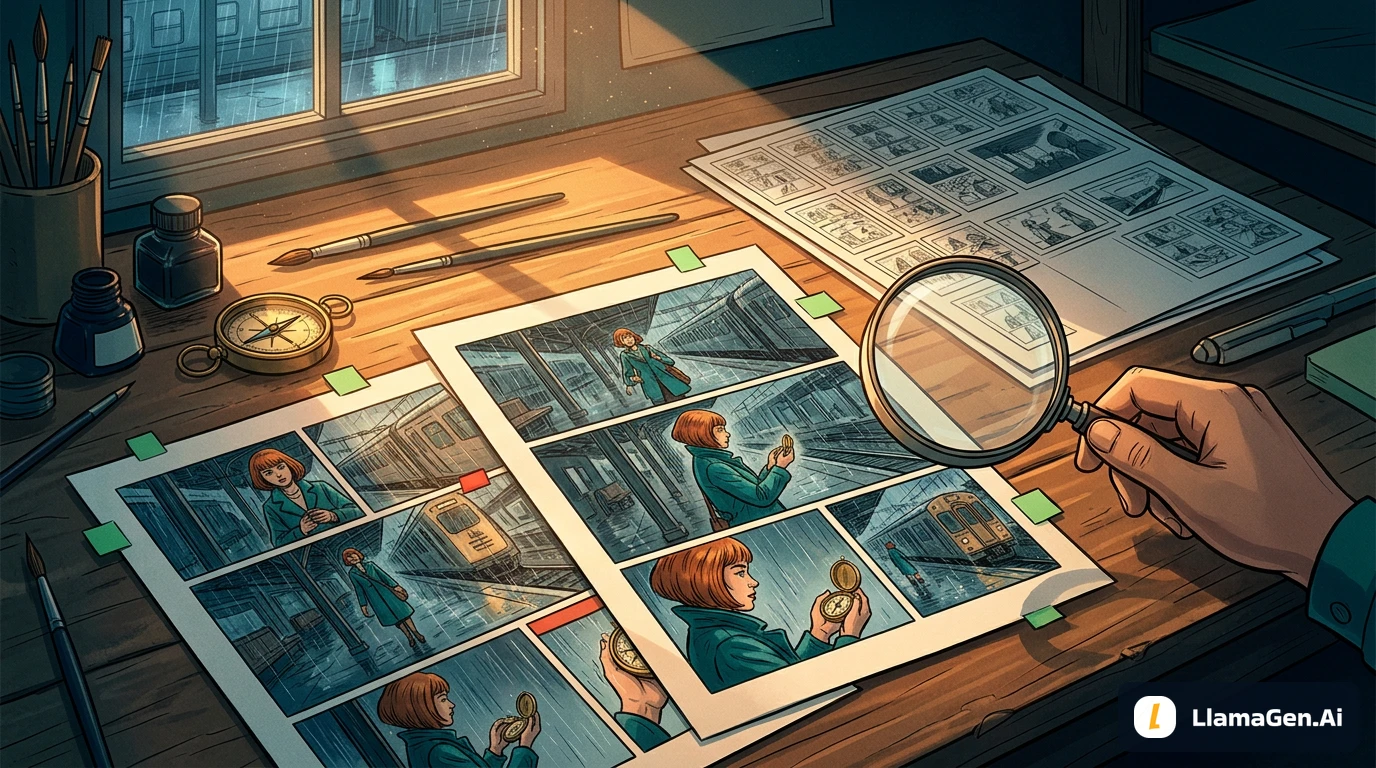
Review the last useful frame of each shot beside the first useful frame of the next. Watch for changes in hand position, prop scale, screen direction, eyeline, lighting, and background geography.

In the local timing-sheet exercise, an intentionally missing S040 entry creates a 120-frame gap. The corrected sheet restores the six-shot sequence to 576 continuous frames. That validates the schedule structure; it does not validate motion quality or editorial pacing.

For visual continuity, run a separate review. A repaired timing row cannot fix a character suddenly holding the compass in the other hand.

Step 6: Send a package another person can open

A simple handoff structure is easier to inspect than a folder full of filenames containing "final."

station-sequence/
  brief-and-delivery-spec.txt
  shot-list.csv
  frames/
    ST01-S010-v03.png
    ST01-S020-v02.png
  references/
    mira-approved-v02.png
    compass-approved-v01.png
  audio/
  animatic-review-v04.mp4
  revision-log.csv

List every expected file in a manifest, including version and approval state. Use relative paths inside the package when practical. Open it from a clean folder or a second machine to catch missing references.

When exporting XML or another interchange format, test it in the receiving application before promising a seamless transfer. For a small production, a frame sequence plus CSV may be a more predictable fallback.

Step 7: Approve a short motion test before scaling

Choose one difficult representative shot: a face, a hand interacting with the compass, or a camera move across overlapping layers. Review that test before converting every frame into video.

Track preparation time, generation wait, review, revision, and assembly separately. Record the actual credits or cost reported by the selected tool. Static storyboard generation time does not predict a finished video's production budget.

Use a specific rejection reason: hand changed, compass melted, direction reversed, timing too short, or dialogue obscured. Repair the affected shot and recheck its cuts while keeping the other approved material available.

Final handoff checklist

  • Shot IDs and intended order are unambiguous.
  • Every shot points to an approved frame and reference version.
  • Duration, frame rate, aspect ratio, and frame-count convention agree.
  • Subject motion, camera motion, and start/end states are separate.
  • Screen direction, eyelines, hands, and props match across cuts.
  • Dialogue and audio cues are versioned and cleared for their intended use.
  • The animatic and manifest match the same revision.
  • Another person can open the package without missing assets.
  • Outstanding decisions have an owner and approval deadline.

Prepare your next sequence in Storyboard, then use this checklist before motion production. If the sequence still changes substantially during review, return to the storyboard-first workflow before committing more shots.

FAQ

Is an animatic the final video?

No. An animatic mainly tests sequence and timing. The final video may still require motion generation, editing, sound work, and additional quality review.

Should every storyboard frame become one video clip?

No. Match clips to the intended shots and your tool's capabilities. Several storyboard drawings can describe one shot, and one drawing may still need added start and end planning.

What should I do if a generated shot changes the character?

Compare it with the approved references, simplify conflicting motion instructions, and retest that shot. Then recheck its neighboring cuts before accepting the replacement.

Product workflow reviewed November 2, 2026. The timing exercise is a local planning check; this article does not claim that the illustrative sequence was generated as a finished video.

Logo LlamaGen
  • United States
  • Español
  • Français (France)
  • 日本語
  • 한국어
  • Deutsch
  • 繁體中文 (台灣)
  • 繁體中文 (香港)
  • 简体中文
  • Português
  • Italiano
  • Español (México)
  • العربية
  • Русский
  • Português (Brasil)
  • Tiếng Việt
  • Bahasa Melayu

Muat turun LlamaGen secara percuma

iOSKomputer

Produk

  • Laman Utama
  • Artikel
  • Blog
  • Cipta

Blog terdahulu

Storyboard-to-Video Handoff Checklist: Shots, Timing, Audio, and Continuity

Storyboard-to-Video Handoff Checklist: Shots, Timing, Audio, and Continuity

Turn approved storyboard frames into a clear video handoff with stable shot IDs, timing, motion note

Jay
Jay
November 1st, 2026
How to Localize a Comic Without Redrawing the Artwork

How to Localize a Comic Without Redrawing the Artwork

Preserve approved comic art while translating dialogue, rebuilding editable lettering, checking read

Jay
Jay
October 31st, 2026
Batch Comic Production Workflow: Draft, Approve, Repair, and Export 40 Pages

Batch Comic Production Workflow: Draft, Approve, Repair, and Export 40 Pages

Plan a 40-page AI comic with a pilot, reviewable batches, a page ledger, selective repairs, and expo

Jay
Jay
October 30th, 2026
From a Flat AI Image to an Editable Comic Page

From a Flat AI Image to an Editable Comic Page

Turn a finished comic image into an editable comic page by reviewing an asset sheet, extracting tran

Jay
Jay
October 28th, 2026
Lihat semua blog
24
576
Pelancaran terkini
  • Ciri-ciri
  • Pembuat jalur komik
  • Studio MangaBaru
  • Tukar Gambar Menjadi Komik
  • Komik ke Video
  • Kilang Komik AI
  • Agen Komik
  • iOS & Android
  • Mac & Windows
  • Muat Turun
  • Comic ZapBaru
  • Penjana Komik AI
  • Penjana Kartun AI
  • Penjana Webtoon AI
  • Pembuat Jalur Komik
  • Tukar Gambar Menjadi Komik
  • Penjana Manga AI
  • Penterjemah Manga
  • Foto ke Anime
  • Anime ke Dunia Sebenar
  • Pewarna Manga
  • Penjana Watak Anime
  • Alat aset permainan piksel
  • penjana sprite sheet AI
  • Alat permainan piksel terbaik 2026
  • Pembuat Komik Foto
  • Alternatif Comic Life
  • Produk berkaitan

    • Keluarga LlamaGen
    • CineoBoardBaru
    • Comics API
    • Comic Zap
    • Velika

    Pelan

    • Penetapan Harga
    • Permulaan
    • Profesional
    • Untuk perusahaan
    • Pendidikan
    • API Komik
    • Hubungi Jualan
    • Pelan Pendidikan
    • Guru
    • Pelajar
    • Guru dan Pelajar
    • Startup
    • Diskaun Pendidikan

    Syarikat

    • Bercakap dengan Pengasas Kami
    • Tentang
    • Peta Jalan Produk

    Bantuan

    • Pusat Bantuan
    • Kepercayaan
    • AI Selamat

    Komuniti

    • Pencipta
    • Rakan Kongsi
    • Rakan Kongsi
    • Testimoni
    • Dinding Cinta
    • LlamaGen MCPBaru
    • Pembangun LlamaGen

    Sumber

    • Log perubahan
    • Blog
    • Panduan

    Alat

    • Penjana Logo AI
    • Penjana Watak Gaya Grokbot
    • PNG ke Komik

    AI Models

    • Grok Imagine Image 2.0
    • Wan 3.0
    • Wan 3.0 Prime
    • Seedance 2.5
    • MiniMax H3
    • Nano Banana 2.1
    • Nano Banana 2 Lite
    • Seedream 5.0 Flash
    • Seedream 5.0 Pro
    • Seedance 2.0 Mini
    • Kling 3.0 Turbo
    • Nano Banana 2
    • GPT Image 2
    • Gemini Omni Flash
    • All AI Models

    Alat AI

    • Pengekstrak Pakaian AI
    • Penukar Gaya Rambut AI
    • Penukar Gaya Rambut Manga AI
    LinkedInX (Twitter)InstagramYouTubeKumpulan FacebookRedditDiscordSokongan e-mel
    PrivasiTermaPeta laman
    Muat Turun Aset Jenama
    © 2026 LlamaGen.Ai Hak cipta terpeliharaSemua perkhidmatan adalah dalam talian
  • Penetapan Harga
  • API
  • Affiliate ProgramNEW
  • Menerajui Masa Depan Penjanaan Komik AI

    • sokongan 24/7
    • Kemas kini mingguan
    • Selamat dan Patuhi
    • Masa aktif 99.9%

    Tanya AI tentang LlamaGen

    Storyboard-to-Video Handoff Checklist: Shots, Timing, Audio, and Continuity - LlamaGen.AI Blog
    Kerjaya
  • E-mel kami
  • Dunia Maskot Kami
  • Kit Media
  • Perkongsian KOL
  • Kandungan
  • Perkhidmatan Profesional
  • Soalan Lazim
  • Keselamatan
  • Kebolehcapaian
  • Tutorial Video
  • Hubungi kami
  • Peta laman
  • Komik Peribadi
  • Ciri-ciri
  • Alternatif
  • Apl AI Terbaik
  • Panduan Pewarnaan Manga GPT-6
  • Kemahiran Buku Komik Claude
  • Panduan Komik AI Gemini
  • Komik Itu
  • Diskaun Pendidikan
  • Diskaun pelajar
  • Teks ke Komik
  • PDF ke Komik
  • Skrip ke Komik
  • Buku ke Komik
  • Tukar Gambar Menjadi Komik
  • Penjana Seni Piksel AI
  • Komik Pendidikan
  • Penjana Video AI
  • Penjana Video AI Gemini
  • Penjana Video AI Tanpa Wajah Percuma
  • Komik ke Video
  • Perisian Papan Cerita
  • Penjana Papan Cerita AI
  • Perisian Penulisan Skrip
  • Penyunting Skrip
  • Cerita AI
  • Penjana Cerita AI
  • Penjana Storybook
  • Penjana Imej AI
  • Pemecah Lapisan AI
  • Kawalan Sudut Kamera AI
  • Penjana Seni Piksel AI
  • Alat aset permainan piksel
  • penjana sprite sheet AI
  • Pemotong sprite sheet
  • Alat permainan piksel terbaik 2026
  • API Animasi
  • Pemalam ChatGPT/Codex
  • Panduan Pemasangan ChatGPT
  • Pemalam Claude Code
  • Panduan Pemasangan Claude Code
  • Penjana Kesan Angin AI
  • Penjana Peta Kedalaman AI
  • Latar Belakang Putih AI
  • Pembuang Objek AI
  • Cuba Pakaian Maya AI
  • Nyahkabur Imej AI
  • Nyahhingar AI
  • Pemulihan Foto AI
  • Bayang Produk AI
  • Penjana Latar Belakang AI
  • Penjana Headshot AI
  • Pembuat Emoji AI
  • Penukar Latar Belakang AI
  • Buka Mata AI
  • Kecantikan AI
  • Fotografi Produk AI